Kirjojen hintavertailu. Mukana 11 244 527 kirjaa ja 12 kauppaa.

Kirjahaku

Etsi kirjoja tekijän nimen, kirjan nimen tai ISBN:n perusteella.

1000 tulosta hakusanalla Sarah E. Igo

The Averaged American

The Averaged American

Sarah E. Igo

Harvard University Press
2008
nidottu
Americans today “know” that a majority of the population supports the death penalty, that half of all marriages end in divorce, and that four out of five prefer a particular brand of toothpaste. Through statistics like these, we feel that we understand our fellow citizens. But remarkably, such data—now woven into our social fabric—became common currency only in the last century. Sarah Igo tells the story, for the first time, of how opinion polls, man-in-the-street interviews, sex surveys, community studies, and consumer research transformed the United States public.Igo argues that modern surveys, from the Middletown studies to the Gallup Poll and the Kinsey Reports, projected new visions of the nation: authoritative accounts of majorities and minorities, the mainstream and the marginal. They also infiltrated the lives of those who opened their doors to pollsters, or measured their habits and beliefs against statistics culled from strangers. Survey data underwrote categories as abstract as “the average American” and as intimate as the sexual self. With a bold and sophisticated analysis, Igo demonstrates the power of scientific surveys to shape Americans’ sense of themselves as individuals, members of communities, and citizens of a nation. Tracing how ordinary people argued about and adapted to a public awash in aggregate data, she reveals how survey techniques and findings became the vocabulary of mass society—and essential to understanding who we, as modern Americans, think we are.

The Known Citizen

The Known Citizen

Sarah E. Igo

Harvard University Press
2020
nidottu
A Washington Post Book of the YearWinner of the Merle Curti AwardWinner of the Jacques Barzun PrizeWinner of the Ralph Waldo Emerson Award“A masterful study of privacy.”—Sue Halpern, New York Review of Books“Masterful (and timely)…[A] marathon trek from Victorian propriety to social media exhibitionism…Utterly original.”—Washington PostEvery day, we make decisions about what to share and when, how much to expose and to whom. Securing the boundary between one’s private affairs and public identity has become an urgent task of modern life. How did privacy come to loom so large in public consciousness? Sarah Igo tracks the quest for privacy from the invention of the telegraph onward, revealing enduring debates over how Americans would—and should—be known. The Known Citizen is a penetrating historical investigation with powerful lessons for our own times, when corporations, government agencies, and data miners are tracking our every move.“A mighty effort to tell the story of modern America as a story of anxieties about privacy…Shows us that although we may feel that the threat to privacy today is unprecedented, every generation has felt that way since the introduction of the postcard.”—Louis Menand, New Yorker“Engaging and wide-ranging…Igo’s analysis of state surveillance from the New Deal through Watergate is remarkably thorough and insightful.”—The Nation
Populist Assault Sarah E Van D

Populist Assault Sarah E Van D

Bowling Green University Popular Press,US
1992
sidottu
Sarah E. Van De Vort Emery, a Michigan woman transplanted from the Finger Lakes region of New York, was for many years a voice for Populism in the late 19th century. Emery was a woman who believed and acted on her beliefs that freedom and the flowering of the human potential should not five way to the demands of the "money power."
Populist Assault Sarah E Van D

Populist Assault Sarah E Van D

Adams & Thornton

Bowling Green University Popular Press,US
1982
nidottu
Sarah E. Van De Vort Emery, a Michigan woman transplanted from the Finger Lakes region of New York, was for many years a voice for Populism in the late 19th century. Emery was a woman who believed and acted on her beliefs that freedom and the flowering of the human potential should not five way to the demands of the -money power.-
I Am the River: Sarah E. Ray and the Bob-Lo Boat

I Am the River: Sarah E. Ray and the Bob-Lo Boat

Patricia Lee Gauch; Leah Henderson

Levine Querido
2026
sidottu
I am the river. Blue and green, fast and flowing, sweeping river grasses aside . . . moving between Lake Erie and Detroit. The Detroit River has long had a story to tell. It has seen a time before people. And it has seen many faces cross its waters, from Indigenous people guiding canoes to settlers on its banks and freedom seekers riding the underground railroad north toward liberty, with Bob-Lo Island at the river's end, so close to Canada. At one time, a giant steamboat carried hundreds of excited children and adults to the amusement park that was built on Bob-Lo. But Sarah E. Ray discovered in 1945 that not all people were invited on this boat, to this island, once a symbol of the journey to freedom. It depended, she discovered, on the color of your skin. This is the dramatic story of how one young woman's courage could create a dramatic turning point that would stand out proudly, and forevermore, in the history of a river older than the country called America.
Spectacular Men

Spectacular Men

Sarah E. Chinn

Oxford University Press Inc
2017
sidottu
In Spectacular Men, Sarah E. Chinn investigates how working class white men looked to the early American theatre for examples of ideal manhood. Theatre-going was the primary source of entertainment for working people of the early Republic and the Jacksonian period, and plays implicitly and explicitly addressed the risks and rewards of citizenship. Ranging from representations of the heroes of the American Revolution to images of doomed Indians to plays about ancient Rome, Chinn unearths dozens of plays rarely read by critics. Spectacular Men places the theatre at the center of the self-creation of working white men, as voters, as workers, and as Americans.
Drones

Drones

Sarah E. Kreps; James Patton Rogers

OXFORD UNIVERSITY PRESS INC
2025
sidottu
The second edition of Drones: What Everyone Needs to Know® provides a comprehensive and updated look at the rapidly evolving world of drones, otherwise known as unmanned or uncrewed aerial vehicles (UAVs). Covering the past, present, and future of military and civilian applications, this book explores how drones have transformed--and are transforming--industries and warfare. It delves into the ethical, legal, and safety concerns raised by their widespread use, examining issues from privacy violations to international security. While the US has historically been a dominant force in drone development, this fully updated volume addresses the global proliferation of drones. They quickly became one of the most effective weapons in the Russia-Ukraine War, and states like China, Iran, and Turkey are now supplying drones to states and violent non-state actors around the world. This book discusses the dramatic rise of commercial drones, from deliveries to emergency response, while analyzing the challenges of regulation and public perception. Drones also expands beyond the air to cover ground and maritime drones, and projects the future of drone technology across multiple domains with a focus on autonomous vehicles and lethal autonomous weapons. A must-read for anyone seeking a well-rounded understanding of this pivotal technology, Drones: What Everyone Needs to Know® provides crucial insights into how UAVs are reshaping modern warfare, domestic security, and civilian life.
Drones

Drones

Sarah E. Kreps; James Patton Rogers

OXFORD UNIVERSITY PRESS INC
2026
nidottu
The second edition of Drones: What Everyone Needs to Know® provides a comprehensive and updated look at the rapidly evolving world of drones, otherwise known as unmanned or uncrewed aerial vehicles (UAVs). Covering the past, present, and future of military and civilian applications, this book explores how drones have transformed--and are transforming--industries and warfare. It delves into the ethical, legal, and safety concerns raised by their widespread use, examining issues from privacy violations to international security. While the US has historically been a dominant force in drone development, this fully updated volume addresses the global proliferation of drones. They quickly became one of the most effective weapons in the Russia-Ukraine War, and states like China, Iran, and Turkey are now supplying drones to states and violent non-state actors around the world. This book discusses the dramatic rise of commercial drones, from deliveries to emergency response, while analyzing the challenges of regulation and public perception. Drones also expands beyond the air to cover ground and maritime drones, and projects the future of drone technology across multiple domains with a focus on autonomous vehicles and lethal autonomous weapons. A must-read for anyone seeking a well-rounded understanding of this pivotal technology, Drones: What Everyone Needs to Know® provides crucial insights into how UAVs are reshaping modern warfare, domestic security, and civilian life.
Harnessing Disruption

Harnessing Disruption

Sarah E. Kreps

OXFORD UNIVERSITY PRESS INC
2026
sidottu
A timely and thought-provoking exploration of technological disruption, drawing on history's most transformative innovations—from nuclear power to AI—to offer a vital roadmap for navigating the future of technology. In Harnessing Disruption, Sarah E. Kreps—a national security expert and military veteran—offers a fresh, clear-eyed framework for understanding the social and political dynamics that shape technological change. From nuclear weapons to AI, cryptocurrency, and social media, breakthrough innovations rarely arrive without backlash. Disruption is not collapse. History shows it is part of a recurring pattern. With unmatched insight and authority, Kreps traces a five-stage cycle that technologies follow: emergence, early warnings, crisis, agenda-setting, and institutional response. Drawing on decades of research and real-world policy experience, she argues that disruption is neither inherently dangerous nor inherently self-correcting. Rather, it's a process we can steer, if we learn to see the signs and act decisively. Harnessing Disruption challenges fatalistic narratives that cast AI and other technologies as uncontrollable forces. It makes the case for cautious optimism: that institutions can adapt, societies can recalibrate, and technologies can be governed in ways that protect both innovation and the public good. Timely, incisive, and grounded in both historical precedent and contemporary case studies, this book provides the tools for anyone, including policymakers, entrepreneurs, and citizens, to understand where we are in the cycle of disruption and how to shape what comes next.
Environmental Guilt and Shame

Environmental Guilt and Shame

Sarah E. Fredericks

Oxford University Press
2021
sidottu
Bloggers confessing that they waste food, non-governmental organizations naming corporations selling unsustainably harvested seafood, and veterans apologizing to Native Americans at the Standing Rock Sioux Reservation for environmental and social devastation caused by the United States government all signal the existence of action-oriented guilt and identity-oriented shame about participation in environmental degradation. Environmental Guilt and Shame demonstrates that these moral emotions are common among environmentally friendly segments of the United States but have received little attention from environmental ethicists though they can catalyze or hinder environmental action. Concern about environmental guilt and shame among “everyday environmentalists” reveals the practical, emotional, ethical, and existential issues raised by environmental guilt and shame and ethical insights about guilt, shame, responsibility, agency, and identity. A typology of guilt and shame enables the development and evaluation of these ethical insights. Environmental Guilt and Shame makes three major claims: first, individuals and collectives, including the diffuse collectives that cause climate change, can have identity, agency, and responsibility and thus guilt and shame. Second, some agents, including collectives, should feel guilt and/or shame for environmental degradation if they hold environmental values and think that their actions shape and reveal their identity. Third, a number of conditions are required to conceptually, existentially, and practically deal with guilt and shame's effects on agents. These conditions can be developed and maintained through rituals. Existing rituals need more development to fully deal with individual and collective guilt and shame as well as the anthropogenic environmental degradation that may spark them.
Handbook of Frontal Lobe Assessment

Handbook of Frontal Lobe Assessment

Sarah E. MacPherson; Sergio Della Sala; Simon R. Cox; Alessandra Girardi; Matthew H. Iveson

Oxford University Press
2015
nidottu
There are several tests used in clinical practice and research worldwide that have been devised to assess the functions subsumed by the frontal lobes of the brain. Anatomical localisation has revealed that the frontal lobes can be divided into sub-regions with different functional domains. As a result, a number of authors working in the frontal lobe literature have made a case for patients with frontal lobe damage to be considered in their distinct subgroups, rather than considered together in one unitary group. As a result, it is important for clinicians and researchers to be made aware of the functions assessed by individual frontal tests and understand which frontal regions might be impaired in their patient groups, as patients with damage to one of these regions will perform poorly on tasks tapping that region yet may perform well on tasks tapping the unaffected regions within the frontal lobes. The 'Handbook of Frontal Lobe Assessment' provides a critical review and appraisal of both the neuropsychological and experimental tests that have been devised to assess frontal lobe functions. It includes many tests that have not been included in previously published neuropsychological compendia. Throughout, the book discusses the available frontal tests in relation to patient and lesion data, neuroimaging data and aging data in order to offer clinicians and researchers the opportunity to choose the best assessment instrument for their purpose.
The Semantics of Evidentials

The Semantics of Evidentials

Sarah E. Murray

Oxford University Press
2017
sidottu
This book provides a compositional, truth-conditional, crosslinguistic semantics for evidentiality, the linguistic encoding of the source of information on which a statement is based. Central to the proposed theory is the distinction between what propositional content is at-issue and what content is not-at-issue. Evidentials contribute not-at-issue content, and can affect the level of commitment a sentence makes to the main proposition, contributed by sentential mood. In this volume, Sarah Murray builds on recent work in the formal semantics of evidentials and related phenomena, and proposes a semantics that does not appeal to separate dimensions of illocutionary meaning. Instead, she argues that all sentences make three contributions: at-issue content, not-at-issue content, and an illocutionary relation. At-issue content is presented and made available for subsequent anaphora, but is not directly added to the common ground; not-at-issue content directly updates the common ground; and the illocutionary relation uses the at-issue content to impose structure on the common ground, which, depending on the clause type, can trigger further updates. The analysis is supported by extensive empirical data from Cheyenne, drawn from the author's own fieldwork, as well as from English and a variety of other languages.
The Semantics of Evidentials

The Semantics of Evidentials

Sarah E. Murray

Oxford University Press
2017
nidottu
This book provides argues for a compositional, truth-conditional, crosslinguistic semantics for evidentiality, the linguistic encoding of the source of information on which a statement is based. Central to the proposed theory is the distinction between what propositional content is at-issue and what content is not-at-issue. Evidentials contribute not-at-issue content, and can affect the level of commitment a sentence makes to the main proposition, which is contributed by sentential mood. In this volume, Sarah Murray builds on recent work in the formal semantics of evidentials and related phenomena, and proposes a semantics that does not appeal to separate dimensions of illocutionary meaning. Instead, she argues that all sentences make three semantic contributions: at-issue content, not-at-issue content, and an illocutionary relation. At-issue content is presented and made available for subsequent anaphora, but is not directly added to the common ground; not-at-issue content directly updates the common ground; and the illocutionary relation uses a proposition to impose structure on the common ground, which, depending on the clause type, can trigger further updates. The analysis is supported by extensive empirical data from Cheyenne, drawn from the authors own fieldwork, as well as from English and a variety of other languages.
Coalitions of Convenience

Coalitions of Convenience

Sarah E. Kreps

Oxford University Press Inc
2011
sidottu
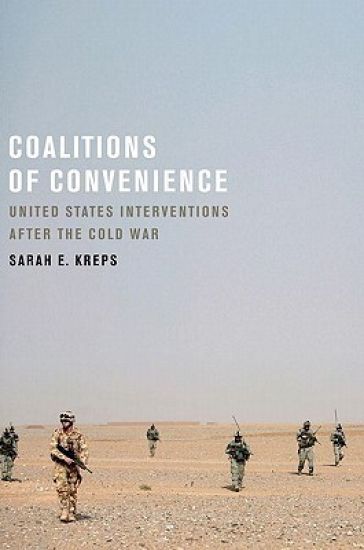
When the Clinton Administration sent the United States military into Haiti in 1994, it first sought United Nations authorization and assembled a large coalition of allies. With a defense budget 20 times the entire GDP of Haiti, why did the US seek multilateral support when its military could quickly and easily have overpowered the 7,600-soldier Haitian army? The US has enjoyed unrivaled military power after the Cold War and yet in eight out of ten post-Cold War military interventions, it has chosen to use force multilaterally rather than going alone. Why does the US seek allies when, as the case of Haiti so starkly illustrates, it does not appear to need their help? Why in other instances such as the 2003 Iraq War does it largely sidestep international institutions and allies and intervene unilaterally? In Coalitions of Convenience, Sarah E. Kreps answers these questions through a study of US interventions after the post-Cold War. She shows that even powerful states have incentives to intervene multilaterally. Coalitions and international organization blessing confer legitimacy and provide ways to share what are often costly burdens of war. But those benefits come at some cost, since multilateralism is less expedient than unilateralism. With long time horizons--in which threats are distant--states will welcome the material assistance and legitimacy benefits of multilateralism. Short time horizons, however, will make immediate payoffs of unilateralism more attractive, even if it means foregoing the longer-term benefits of multilateralism. Coalitions of Convenience ultimately shows that power may create more opportunities for states such as the US to act alone, but that the incentives are stacked against doing so. The implications of the argument go beyond questions of how the US uses force. They speak to questions about how the world works when power is concentrated in the hands of one state, how international institutions function, and what the rise of China and resurgence of Russia may mean for international cooperation and conflict.
Coalitions of Convenience

Coalitions of Convenience

Sarah E. Kreps

Oxford University Press Inc
2011
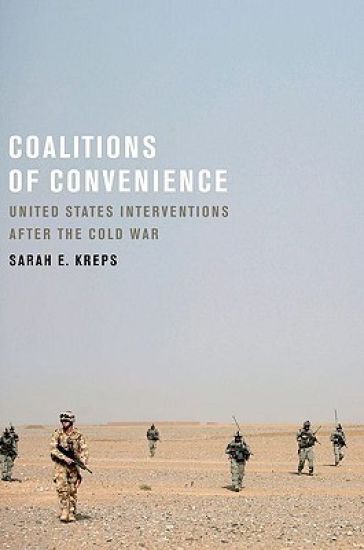
nidottu
When the Clinton Administration sent the United States military into Haiti in 1994, it first sought United Nations authorization and assembled a large coalition of allies. With a defense budget 20 times the entire GDP of Haiti, why did the US seek multilateral support when its military could quickly and easily have overpowered the 7,600-soldier Haitian army? The US has enjoyed unrivaled military power after the Cold War and yet in eight out of ten post-Cold War military interventions, it has chosen to use force multilaterally rather than going alone. Why does the US seek allies when, as the case of Haiti so starkly illustrates, it does not appear to need their help? Why in other instances such as the 2003 Iraq War does it largely sidestep international institutions and allies and intervene unilaterally? In Coalitions of Convenience, Sarah E. Kreps answers these questions through a study of US interventions after the post-Cold War. She shows that even powerful states have incentives to intervene multilaterally. Coalitions and international organization blessing confer legitimacy and provide ways to share what are often costly burdens of war. But those benefits come at some cost, since multilateralism is less expedient than unilateralism. With long time horizons--in which threats are distant--states will welcome the material assistance and legitimacy benefits of multilateralism. Short time horizons, however, will make immediate payoffs of unilateralism more attractive, even if it means foregoing the longer-term benefits of multilateralism. Coalitions of Convenience ultimately shows that power may create more opportunities for states such as the US to act alone, but that the incentives are stacked against doing so. The implications of the argument go beyond questions of how the US uses force. They speak to questions about how the world works when power is concentrated in the hands of one state, how international institutions function, and what the rise of China and resurgence of Russia may mean for international cooperation and conflict.