
Kirjahaku
Etsi kirjoja tekijän nimen, kirjan nimen tai ISBN:n perusteella.
1000 tulosta hakusanalla Scott L Mingus
William “Extra Billy” Smith, the oldest and one of the most controversial Confederate generals on the field at Gettysburg, was also one of the most colorful and charismatic characters of the Civil War and the antebellum Old South. Despite a life full of drama, politics, and adventure, very few books have been written on Smith since a biased loosely written compilation in the late 19th century by his brother-in-law. Scott L. Mingus Sr. has ably filled this historical void with Confederate General William “Extra Billy” Smith: From Virginia’s Statehouse to Gettysburg Scapegoat, now in paperback.Known nationally as “Extra Billy” because of his prewar penchant for finding loopholes in government postal contracts to gain extra money for his stagecoach lines, Smith served as Virginia’s governor during both the War with Mexico and the Civil War, served five terms in the U.S. Congress, and was one of Virginia’s leading spokesmen for slavery and States’ Rights. Extra Billy’s extra-long speeches and wry sense of humor were legendary among his peers. A lawyer during the heady Gold Rush days, Smith made a fortune in California and, like his income earned from stagecoaches, quickly lost it.Despite his advanced age Smith took the field and fought well at First Manassas, was wounded at Seven Pines and again at Sharpsburg, and marched with Lee’s Army of Northern Virginia into Pennsylvania. There, on the first day at Gettysburg, Smith’s frantic messages about a possible Union flanking attack remain a matter of controversy to this day. Did his aging eyes see distant fence-lines that he interpreted as approaching enemy soldiers—mere phantoms of his imagination?—or did his prompt action stave off a looming Confederate disaster? What we do know is that his calls for support diverted limited Confederate manpower away from attacks against Cemetery Hill and Culp’s Hill that might have turned the tide of Southern fortunes in Pennsylvania.Mingus’s biography draws upon a wide array of newspapers, diaries, letters, and other firsthand accounts to paint a broad, deep, and colorful portrait of one of the South’s most interesting leaders and devoted sons. Complete with original maps and photos, Extra Billy Smith will satisfy anyone who loves politics, war, and a great story well told.
The Civil War was the first conflict in which railroads played a major role. Although much has been written about the role of railroads in general, little has been written about specific lines. The Cumberland Valley Railroad, for example, played an important strategic role by connecting Hagerstown, Maryland, to Harrisburg, Pennsylvania. Its location enhanced its importance during some of the Civil War's most critical campaigns. Despite the line's significance to the Union war effort, its remarkable story remains little known. Now available in paperback, the publication of Targeted Tracks: The Cumberland Valley Railroad in the Civil War, 1861-1865, by Scott L. Mingus Sr. and Cooper H. Wingert, rectifies that oversight. Because of its proximity to major cities in the Eastern Theater, the Cumberland Valley Railroad was an enticing Confederate target. As invading armies jostled for position, the CVRR's valuable rolling stock was never far from the minds of Rebel leaders. Northern military and railway officials knew the line was a prized target and coordinated - and just as often butted heads - in a series of efforts to ensure the railroad's prized resources remained out of enemy hands. When they failed to protect the line, as they sometimes did, Southern horsemen wrought havoc on the Northern war effort by tearing up its tracks, seizing or torching Union supplies, and laying waste to warehouses, engine houses, and passenger depots. In October 1859, Abolitionist John Brown used the CVRR in his fateful Harpers Ferry raid. The line was under direct threat by invading Confederates during the Antietam Campaign, and the following summer suffered serious damage (and played a major logistical role) during the Gettysburg Campaign. In 1864, Rebel raiders burned much of its headquarters town at Chambersburg, including the homes of many CVRR employees. The railroad was as vital to residents of the bustling and fertile Cumberland Valley as it was to the Union war effort. Targeted Tracks is grounded on the railway's voluminous reports, letters and diaries of local residents and Union and Confederate soldiers, official reports, and newspaper accounts. The primary sources, combined with the expertise of the authors, bring this largely untold and engaging story to life.

Although it was the Civil War’s second-largest battle, few books have been written about Chickamauga, and nothing like the thousands penned about the war’s largest and bloodiest battle at Gettysburg. You can count on two hands the number of authors who have tackled Chickamauga in any depth, and most of their works cover the entire battle. Left unmined and mostly forgotten are the experiences of specific brigades or regiments or state-affiliated troops. Scott Mingus’s and Joe Owen’s Unceasing Fury: Texans at the Battle of Chickamauga, September 18-20, 1863, is the first full-length book to examine in detail the role of troops from the Lone Star State.Texas troops fought in almost every major sector of the sprawling Chickamauga battlefield - from the first attacks on September 18 on the bridges spanning the creek to the final attack on Snodgrass Hill on September 20, the third day of fighting. In between, Texas regiments launched attack after attack against Union lines at the Viniard farm, Poe Field, Kelly Field, and North Dyer Field. More than 4,400 Texans participated on foot and on horseback; one out of four fell there. Fortunately, many of the survivors left vivid descriptions of battle action, the anguish of losing friends, the pain and loneliness of being so far away from home, and their often-colorful opinions of their generals.The authors of this richly detailed study base their work on scores of personal accounts, memoirs, postwar newspaper articles, diaries, and other primary sources. Their meticulous work, which includes original maps, photos, and other illustrations, provides the first full exploration of the critical role Texas enlisted men and officers played in the three days of fighting near West Chickamauga Creek in September 1863. Unceasing Fury provides the Lone Star State soldiers with the recognition they have so long deserved.
So much has been written about Gettysburg, goes the well-worn cliché, that there is nothing new left to write. Now in paperback, The Second Day at Gettysburg: The Attack and Defense of Cemetery Ridge, July 2, 1863, by David L. Shultz and Scott L. Mingus Sr. aptly demonstrates that there is indeed still much to learn about the war’s largest and bloodiest battle. Based upon a faulty early-morning reconnaissance, General Robert E. Lee decided to attack up the Emmitsburg Road in an effort to collapse the left flank of General George Meade’s Army of the Potomac and decisively defeat it. The effort got underway when General James Longstreet’s First Corps troops crushed General Sickles’ Peach Orchard salient and turned north and east to drive deeply into the Union rear. A third Confederate division under Richard Anderson, part of A. P. Hill’s Third Corps, joined in the attack, slamming one brigade after another into the overstretched Union line stitched northward along the Emmitsburg Road. The bloody fighting stair-stepped its way up Cemetery Ridge, tearing open a large gap in the center of the Federal line that threatened to split the Union army in two. The fate of the Battle of Gettysburg hung in the balance. Despite the importance of the position, surprisingly few Union troops were available to defend the yawning gap on the ridge. Major General Winfield S. Hancock’s Second Corps had been reduced to less than one division when his other two were sucked southward to reinforce the collapsing Third Corps front. Reprising Horatio at the Bridge, the gallant commander cobbled together a wide variety of infantry and artillery commands and threw them into the action, refusing to yield even one acre of ground. The long and intense fighting included hand-to-hand combat and the personal heroics of which legends are made. Veteran Gettysburg authors Shultz and Mingus merge their subject matter expertise and keen understanding of the complex undulating terrain and physical features to produce the most detailed study of this action ever written. In addition to demonstrating how the fighting on the far Union left directly affected the combat to come in the center of General Meade’s line, the authors also address some of the most commonly overlooked aspects of the fighting: what routes did some of the key units take to reach the front? What could the commanders actually see, and when could they see it? How did the fences, roads, farms, trees, ravines, creeks, and others obstacles directly affect tactical decisions, and ultimately the battle itself? Based upon extensive research and graced with dozens of photographs and detailed original maps, The Second Day at Gettysburg offers a balanced, compelling, and ultimately satisfying account of one of the most overlooked and yet important aspects of the defining battle of the American Civil War.
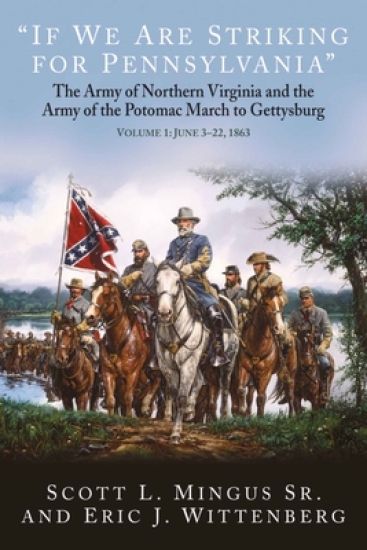
Scott L. Mingus Sr. and Eric J. Wittenberg, the authors of more than forty Civil War books, have once again teamed up to present a history of the opening moves of the Gettysburg Campaign in the two-volume study "If We Are Striking for Pennsylvania": The Army of Northern Virginia's and Army of the Potomac's March to Gettysburg. This compelling study is one of the first to integrate the military, media, political, social, economic, and civilian perspectives with rank-and-file accounts from the soldiers of both armies as they inexorably march toward their destiny at Gettysburg. This first installment covers June 3-22, 1863, while the second, spanning June 22-30, completes the march and carries the armies to the eve of the fighting.Gen. Robert E. Lee began moving his victorious Army of Northern Virginia from the Old Dominion into Pennsylvania on June 3, 1863. Lee believed his army needed to win a major victory on Northern soil if the South was to have a chance to win the war. Transferring the fighting out of war-torn Virginia would allow the state time to heal while he supplied his army from untapped farms and stores in Maryland and the Keystone State. Lee had also convinced Pres. Jefferson Davis that his offensive would interfere with the Union effort to take Vicksburg in Mississippi. The bold movement would trigger extensive cavalry fighting and a major battle at Winchester before culminating in the bloody three-day battle at Gettysburg.As the Virginia army moved north, the Army of the Potomac responded by protecting the vital roads to Washington, D.C., in case Lee turned to threaten the capital. Opposing presidents Abraham Lincoln and Jefferson Davis, meanwhile, kept a close watch on the latest and often conflicting military intelligence gathered in the field. Throughout northern Virginia, central Maryland, and south-central Pennsylvania, meanwhile, civilians and soldiers alike struggled with the reality of a mobile campaign and the massive logistical needs of the armies. Thousands left written accounts of the passage of the long martial columns.Mingus and Wittenberg mined hundreds of primary accounts, newspapers, and other sources to produce this powerful and gripping account. As readers will quickly learn, much of it is glossed over in other studies of the campaign, a campaign which cannot be fully understood without a firm appreciation of what the armies did on their way to the small crossroads town in Pennsylvania.

June 1863. The Gettysburg Campaign is underway. Robert E. Lee's Army of Northern Virginia pushes west into the Shenandoah Valley and then north toward the Potomac River. Only one significant force stands in its way: Maj. Gen. Robert H. Milroy's Union division of the Eighth Army Corps in the vicinity of Winchester and Berryville, Virginia. What happens next is the subject of this provocative new book. Milroy, a veteran Indiana politician-turned-soldier, was convinced the approaching enemy consisted of nothing more than cavalry or was merely a feint, and so defied repeated instructions to withdraw. In fact, the enemy consisted of General Lee's veteran Second Corps under Lt. Gen. Richard S. Ewell. Milroy's controversial decision committed his outnumbered and largely inexperienced men against some of Lee's finest veterans. The complex and fascinating maneuvering and fighting on June 13-15 cost Milroy hundreds of killed and wounded and about 4,000 captured (roughly one-half of his command), with the remainder routed from the battlefield. The combat cleared the northern end of the Shenandoah Valley of Federal troops, demonstrated Lee could obtain supplies on the march, justified the elevation of General Ewell to replace the recently deceased Stonewall Jackson, and sent shockwaves through the Northern states. Today, the Second Battle of Winchester is largely forgotten. But in June 1863, the politically charged front-page news caught President Lincoln and the War Department by surprise and forever tarnished Milroy's career. The beleaguered Federal soldiers who fought there spent a lifetime seeking redemption, arguing their three-day "forlorn hope" delayed the Rebels long enough to allow the Army of the Potomac to arrive and defeat Lee at Gettysburg. For the Confederates, the decisive leadership on display outside Winchester masked significant command issues buried within the upper echelons of Jackson's former corps that would become painfully evident during the early days of July on a different battlefield in Pennsylvania. Award-winning authors Eric J. Wittenberg and Scott L. Mingus Sr. combined their researching and writing talents to produce the most in-depth and comprehensive study of Second Winchester ever written, and now in paperback. Their balanced effort, based upon scores of archival and previously unpublished diaries, newspaper accounts, and letter collections, coupled with familiarity with the terrain around Winchester and across the lower Shenandoah Valley, explores the battle from every perspective. The Second Battle of Winchester is comprehensive, highly readable, deeply researched, and immensely interesting. Now, finally, the pivotal battle in the Shenandoah Valley that opened the door to Gettysburg has the book it has so long deserved.

The Louisiana Tigers in the Gettysburg Campaign, June-July 1863
Scott L. Mingus Sr.; Brent Nosworthy
Louisiana State University Press
2009
sidottu
Previous works on Confederate brigadier general Harry T. Hays's First Louisiana Brigade -- better known as the ""Louisiana Tigers"" -- have tended to focus on just one day of the Tigers' service -- their role in attacking East Cemetery Hill at Gettysburg on July 2, 1863 -- and have touched only lightly on the brigade's role at the Second Battle of Winchester, an important prelude to Gettysburg. In this commanding study, Scott L. Mingus, Sr., offers the first significant detailed exploration of the Louisiana Tigers during the entirety of the 1863 Gettysburg Campaign. Mingus begins by providing a sweeping history of the Louisiana Tigers; their predecessors, Wheat's Tigers; the organizational structure and leadership of the brigade in 1863; and the personnel that made up its ranks. Covering the Tigers' movements and battle actions in depth, he then turns to the brigade's march into the Shenandoah Valley and the Tigers' key role in defeating the Federal army at the Second Battle of Winchester. Combining soldiers' reminiscences with contemporary civilian accounts, Mingus breaks new ground by detailing the Tigers' march into Pennsylvania, their first trip to Gettysburg in the week before the battle, their two-day occupation of York, Pennsylvania -- the largest northern town to fall to the Confederate army -- and their march back to Gettysburg. He offers the first full-scale discussion of the Tigers' interaction with the local population during their invasion of Pennsylvania and includes detailed accounts of the citizens' reactions to the Tigers -- many not published since appearing in local newspapers over a century ago.Mingus explores the Tigers' actions on the first two days of the Battle of Gettysburg and meticulously recounts their famed assault on East Cemetery Hill, one of the pivotal moments of the battle. He closes with the Tigers' withdrawal from Gettysburg and their retreat into Virginia. Appendices include an order of battle for East Cemetery Hill, a recap of the weather during the entire Gettysburg Campaign, a day-by-day chronology of the Tigers' movements and campsites, and the text of the official reports from General Hays for Second Winchester and Gettysburg. Comprehensive and engaging, Mingus's exhaustive work constitutes the definitive account of General Hays's remarkable brigade during the critical summer of 1863.

The Louisiana Tigers in the Gettysburg Campaign, June-July 1863
Scott L. Mingus Sr.; Brent Nosworthy
Louisiana State University Press
2014
nidottu
Previous works on Confederate brigadier general Harry T. Hays's First Louisiana Brigade -- better known as the ""Louisiana Tigers"" -- have tended to focus on just one day of the Tigers' service -- their role in attacking East Cemetery Hill at Gettysburg on July 2, 1863 -- and have touched only lightly on the brigade's role at the Second Battle of Winchester, an important prelude to Gettysburg. In this commanding study, Scott L. Mingus, Sr., offers the first significant detailed exploration of the Louisiana Tigers during the entirety of the 1863 Gettysburg Campaign. Mingus begins by providing a sweeping history of the Louisiana Tigers; their predecessors, Wheat's Tigers; the organizational structure and leadership of the brigade in 1863; and the personnel that made up its ranks. Covering the Tigers' movements and battle actions in depth, he then turns to the brigade's march into the Shenandoah Valley and the Tigers' key role in defeating the Federal army at the Second Battle of Winchester. Combining soldiers' reminiscences with contemporary civilian accounts, Mingus breaks new ground by detailing the Tigers' march into Pennsylvania, their first trip to Gettysburg in the week before the battle, their two-day occupation of York, Pennsylvania -- the largest northern town to fall to the Confederate army -- and their march back to Gettysburg. He offers the first full-scale discussion of the Tigers' interaction with the local population during their invasion of Pennsylvania and includes detailed accounts of the citizens' reactions to the Tigers -- many not published since appearing in local newspapers over a century ago.Mingus explores the Tigers' actions on the first two days of the Battle of Gettysburg and meticulously recounts their famed assault on East Cemetery Hill, one of the pivotal moments of the battle. He closes with the Tigers' withdrawal from Gettysburg and their retreat into Virginia. Appendices include an order of battle for East Cemetery Hill, a recap of the weather during the entire Gettysburg Campaign, a day-by-day chronology of the Tigers' movements and campsites, and the text of the official reports from General Hays for Second Winchester and Gettysburg. Comprehensive and engaging, Mingus's exhaustive work constitutes the definitive account of General Hays's remarkable brigade during the critical summer of 1863.

Confederate Calamity: J.E.B. Stuart's Cavalry Ride Through York County, Pa.
Scott L. Mingus
Createspace Independent Publishing Platform
2015
nidottu
Gettysburg Glimpses: True Stories from the Battlefield
Scott L. Mingus
Createspace Independent Publishing Platform
2017
nidottu
Antietam: Human Interest Stories
Scott L. Mingus
Createspace Independent Publishing Platform
2018
nidottu
Scott Mingus presents another insightful, rich collection of human interest stories, this one surrounding the Maryland campaign of September 1862. Although each mini-story stands by itself as a fascinating anecdote, the author places them in context, chronologically, to give the reader a deeper understanding of what went on during this historic event. It's as if we are placed in the event and able to look around and see what is happening from the perspective and experiences of soldiers and civilians alike. This work, in four chapters, covers the actions leading up to the battle of Antietam and follows through to the aftermath of America's bloodiest day. Sources for each story are included to allow the reader/researcher to explore this subject even further. It also offers an "easy read" for those who might not otherwise be interested studying the details characteristic of historic narratives.
"This Trying Hour": The Philadelphia, Wilmington & Baltimore Railroad in the Civil War
Robert L. Williams; Scott L. Mingus
Createspace Independent Publishing Platform
2017
nidottu
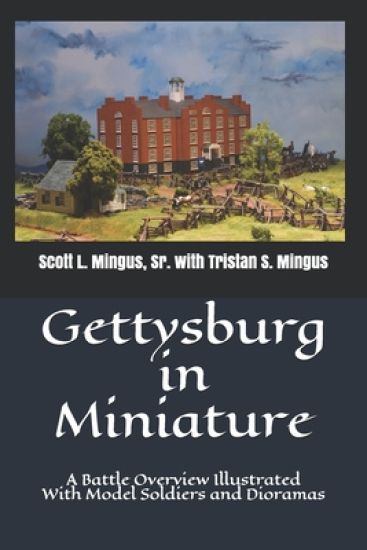
Gettysburg in Miniature: A Battle Overview Illustrated With Model Soldiers and Dioramas
Tristan S. Mingus; Scott L. Mingus
Independently Published
2019
nidottu
The battle of Gettysburg remains one of the most-studied battles in American history. However, few authors have ever used military miniatures, wargames, dioramas, and scale model soldiers and battle scenes as the means of fully illustrating a sweeping overview of the battle, campaign, key personalities, and the aftermath, including Abraham Lincoln's Gettysburg Address. A team of gamers and dioramists from across North America and Europe have joined multiple-award-winning wargamer and author Scott Mingus to present more than 200 black-and-white photos of their finest works related to Gettysburg. This is aimed at teenagers but should satisfy most Gettysburg buffs of all ages, as well as gamers and modelers.
Human Interest Stories of the Civil War
Thomas M. Mingus; Scott L. Mingus Jr
Createspace Independent Publishing Platform
2017
nidottu

An Equal Place is a monumental study of the role of lawyers in the movement to challenge economic inequality in one of America's most unequal cities: Los Angeles. Breaking with the traditional focus on national civil rights history, the book turns to the stories of contemporary lawyers, on the front lines and behind the scenes, who use law to reshape the meaning of low-wage work in the local economy. Covering a transformative period of L.A. history, from the 1992 riots to the 2008 recession, Scott Cummings presents an unflinching account of five pivotal campaigns in which lawyers ally with local movements to challenge the abuses of garment sweatshops, the criminalization of day labor, the gentrification of downtown retail, the incursion of Wal-Mart groceries, and the misclassification of port truck drivers. Through these campaigns, lawyers and activists define the city as a space for redefining work in vital industries transformed by deindustrialization, outsourcing, and immigration. Organizing arises outside of traditional labor law, powered by community-labor and racial justice groups using levers of local government to ultimately change the nature of labor law itself. Cummings shows that sophisticated legal strategy — engaging yet extending beyond courts, in which lawyers are equal partners in social movements — is an indispensable part of the effort to make L.A. a more equal place. Challenging accounts of lawyers' negative impact on movements, Cummings argues that the L.A. campaigns have achieved meaningful reform, while strengthening the position of workers in local politics, through legal innovation. Dissecting the reasons for failure alongside the conditions for success, this groundbreaking book illuminates the crucial role of lawyers in forging a new model of city-building for the twenty-first century.

An innovative approach for understanding how law matters in contemporary social movements that rise to meet the twin challenges of American democracy: promoting liberal values of equality and inclusion, while fortifying the rule of law itself. Fifty years after the Civil Rights Movement, America confronts a new democratic reckoning. What role do-and should-lawyers play in strengthening collective action at this pivotal moment? In Lawyers and Movements, Scott L. Cummings offers an innovative answer to this age-old question, breaking from the legacy of legal liberalism to reveal the essential, yet underappreciated, work of lawyers in social struggle-redefining legal mobilization in transformative times. Building from a sweeping analysis of progressive legal theory and practice, Cummings challenges foundational critiques of lawyers as inaccurate and ill-suited to the current context. In response, he advances a new theory of legal mobilization in which control over law is at the heart of movements rising to meet the twin challenges of contemporary liberalism: promoting inclusion and equity, while fortifying democratic institutions. A call to radically rethink how lawyers contribute to progressive change, Lawyers and Movements asserts a timely challenge to democracy in crisis.

The Chicago Guide to Communicating Science
Scott L. Montgomery
University of Chicago Press
2017
nidottu
For more than a decade, The Chicago Guide to Communicating Science has been the go-to reference for anyone who needs to write or speak about their research. Whether a student writing a thesis, a faculty member composing a grant proposal, or a public information officer crafting a press release, Scott Montgomery's advice is perfectly adaptable to any scientific writer's needs. This new edition has been thoroughly revised to address crucial issues in the changing landscape of scientific communication, with an increased focus on those writers working in corporate settings, government, and nonprofit organizations as well as academia. Half a dozen new chapters tackle the evolving needs and paths of scientific writers. These sections address plagiarism and fraud, writing graduate theses, translating scientific material, communicating science to the public, and the increasing globalization of research.The Chicago Guide to Communicating Science recognizes that writers come to the table with different needs and audiences. Through solid examples and concrete advice, Montgomery sets out to help scientists develop their own voice and become stronger communicators. He also teaches readers to think about their work in the larger context of communication about science, addressing the roles of media and the public in scientific attitudes as well as offering advice for those whose research concerns controversial issues such as climate change or emerging viruses. More than ever, communicators need to be able to move seamlessly among platforms and styles. The Chicago Guide to Communicating Science's comprehensive coverage means that scientists and researchers will be able to expertly connect with their audiences, no matter the medium.

Throughout recorded history, the exchange of scientific knowledge across cultures has been crucial in shaping human civilization. For instance, without the Greek and Roman works that were translated into Arabic and later reintroduced into Europe, the Renaissance as we know it would not have occured. Yet, until now, the enormous importance of translation to the history of science has remained largely unexamined. In this innovative work, Scott L. Montgomery explores the diverse roles that translation has played in the development of Western science from antiquity to the present. Beginning with an in-depth consideration of astronomy, he presents case histories of science in translation from a variety of disciplines and cultural contexts, both Western and non-Western (such as the origin and evolution of modern science in Japan). Montgomery highlights key historical and philosophical issues, including the instability of the scientific text, what is lost and gained in the process of translating science, and the impossibility of a truly universal technical language.