Kirjojen hintavertailu. Mukana 11 244 527 kirjaa ja 12 kauppaa.

Kirjahaku

Etsi kirjoja tekijän nimen, kirjan nimen tai ISBN:n perusteella.

258 tulosta hakusanalla Sextius Michel

Aurores Et Couchants: Poésies Intimes, Études Antiques
Aurores et couchants: poesies intimes, etudes antiques / Sextius-MichelDate de l'edition originale: 1893Ce livre est la reproduction fidele d'une oeuvre publiee avant 1920 et fait partie d'une collection de livres reimprimes a la demande editee par Hachette Livre, dans le cadre d'un partenariat avec la Bibliotheque nationale de France, offrant l'opportunite d'acceder a des ouvrages anciens et souvent rares issus des fonds patrimoniaux de la BnF.Les oeuvres faisant partie de cette collection ont ete numerisees par la BnF et sont presentes sur Gallica, sa bibliotheque numerique.En entreprenant de redonner vie a ces ouvrages au travers d'une collection de livres reimprimes a la demande, nous leur donnons la possibilite de rencontrer un public elargi et participons a la transmission de connaissances et de savoirs parfois difficilement accessibles.Nous avons cherche a concilier la reproduction fidele d'un livre ancien a partir de sa version numerisee avec le souci d'un confort de lecture optimal. Nous esperons que les ouvrages de cette nouvelle collection vous apporteront entiere satisfaction.Pour plus d'informations, rendez-vous sur www.hachettebnf.fr

Oraison Funèbre de Mgr Louis-Sextius de Jarente de la Bruyère, Évêque d'Orléans
Oraison funebre de Mgr Louis-Sextius de Jarente de La Bruyere, eveque d'Orleans, ... prononcee dans l'eglise royale de S.-Aignan d'Orleans, le 28 mai 1789... par Mre Francois-Benoist Rozier, ...Date de l'edition originale: 1789Ce livre est la reproduction fidele d'une oeuvre publiee avant 1920 et fait partie d'une collection de livres reimprimes a la demande editee par Hachette Livre, dans le cadre d'un partenariat avec la Bibliotheque nationale de France, offrant l'opportunite d'acceder a des ouvrages anciens et souvent rares issus des fonds patrimoniaux de la BnF.Les oeuvres faisant partie de cette collection ont ete numerisees par la BnF et sont presentes sur Gallica, sa bibliotheque numerique.En entreprenant de redonner vie a ces ouvrages au travers d'une collection de livres reimprimes a la demande, nous leur donnons la possibilite de rencontrer un public elargi et participons a la transmission de connaissances et de savoirs parfois difficilement accessibles.Nous avons cherche a concilier la reproduction fidele d'un livre ancien a partir de sa version numerisee avec le souci d'un confort de lecture optimal. Nous esperons que les ouvrages de cette nouvelle collection vous apporteront entiere satisfaction.Pour plus d'informations, rendez-vous sur www.hachettebnf.fr
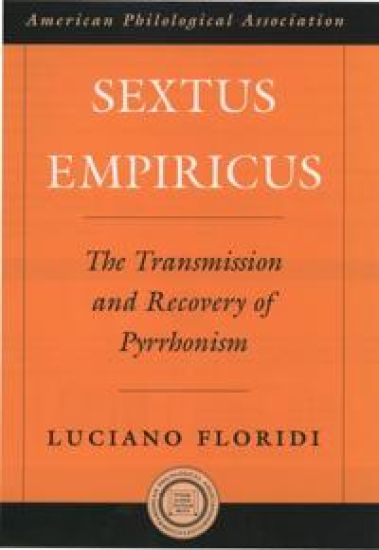
Sextus Empiricus

Sextus Empiricus

Luciano Floridi

Oxford University Press Inc
2002
sidottu
The subject is Sextus Empiricus, one the chief sources of information on ancient philosophy and one of the most influential authors in the history of skepticism. Sextus' works have had an extraordinary influence on western philosophy, and this book provides the first exhaustive and detailed study of their recovery, transmission, and intellectual influence through Late Antiquity, the Middle Ages, and the Renaissance. This study deals with Sextus' biography, as well as the history of the availability and reception of his works. It also contains an extensive bibliographical section, including editions, translations, and commentaries.
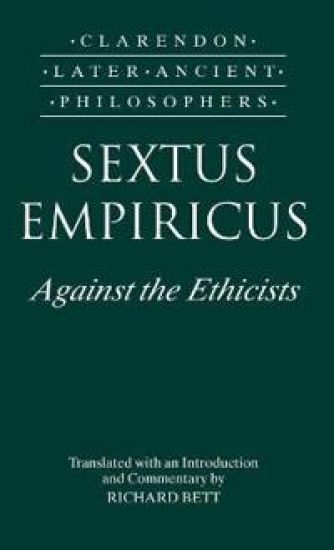
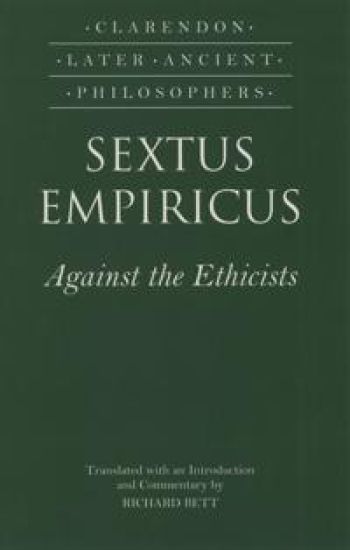
Sextus Empiricus: Against the Ethicists

Sextus Empiricus: Against the Ethicists

Sextus Empiricus

Clarendon Press
1996
sidottu
About Sextus Sextus Empiricus is one of the most important ancient philosophical writers after Plato and Aristotle. His writings are our main source for the doctrines and arguments of Scepticism. He probably lived in the second century AD. Eleven books of his writings have survived, covering logic, physics, ethics, and numerous more specialized fields. About Against the Ethicists In this unjustly neglected and misunderstood work Sextus sets out a distinctive Sceptic position in ethics. He discusses the concepts good and bad, and puts forward the sceptical argument that nothing is either good or bad by nature or intrinsically or invariably, but only relatively to persons and/or to circumstances. He then argues that the sceptic is better off than the non-sceptic. In the latter part of the book, Sextus attacks the Stoic view that there is such a thing as a `skill for life'. About this edition This volume contains a translation of Against the Ethicists in clear modern English, together with an introduction and a detailed commentary. Those who have discussed this work in the past have tended to underestimate it, often regarding its main position as essentially the same as that of Sextus' better-known Outlines of Pyrrhonism. Richard Bett shows that Against the Ethicists represents quite a distinct and coherent philosophical outlook, associated with a phase of Scepticism earlier than Sextus himself, an outlook of which little other evidence survives.
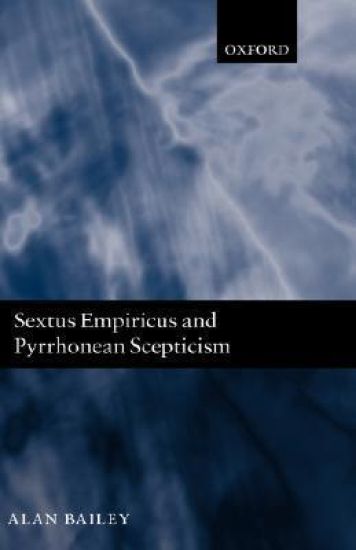
Sextus Empiricus and Pyrrhonean Scepticism
Alan Bailey offers a clear and vigorous exposition and defence of the philosophy of Sextus Empiricus, one of the most influential of ancient thinkers, the father of philosophical scepticism. The subsequent sceptical tradition in philosophy has not done justice to Sextus: his views stand up today as remarkably insightful, offering a fruitful way to approach issues of knowledge, understanding, belief, and rationality. It is widely supposed that any form of scepticism that arrives at a global denial of the availability of rationally justified beliefs is self-refuting and unliveable. Bailey shows that the former objection can be disarmed by distinguishing between the mature Pyrrhonean sceptic's assessment of his negative epistemological arguments and the assessment forced upon his philosophical opponents by their own rationalistic code. The latter objection overlooks the role Sextus allocates to beliefs that are necessitated by the Pyrrhonist's psychological and biological constitution. Alan Bailey's refreshing presentation of Sextus to a modern philosophical readership rescues scepticism from the sceptics.
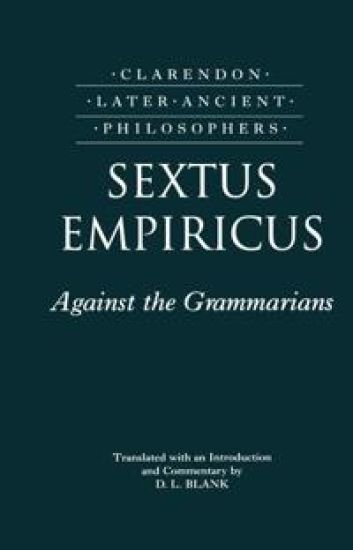
Sextus Empiricus: Against the Grammarians (Adversus Mathematicos I)
Sextus Empiricus is one of the most important ancient philosophical writers after Plato and Aristotle. His writings are our main source for the doctrines and methods of Scepticism. He probably lived in the second century AD. Eleven books of his writings have survived, covering logic, physics, ethics, and many other fields. Against the Grammarians is the first book of Sextus' Adversus Mathematicos, his broad-ranging polemic against the various liberal studies of classical learning. It is prefaced by a short general attack on the arts (included in this volume); then Sextus focuses on the grammatical writers of the classical era, categorizing, analysing, and criticizing their doctrines. The result is not only an invaluable source for ancient ideas about grammar, language, and literary technique, but an excellent example of sustained Sceptical reasoning. David Blank presents a new translation into clear modern English of this important treatise, together with the first ever commentary on the work. In an extended introduction he discusses Against the Grammarians in the broad context of Sextus' work as a whole, Scepticism in general, and the history of ancient writings in this field.
Sextus Empiricus: Against the Ethicists

Sextus Empiricus: Against the Ethicists

Sextus Empiricus

Clarendon Press
2000
nidottu
About Sextus: Sextus Empiricus is one of the most important ancient philosophical writers after Plato and Aristotle. His writings are our main source for the doctrines and arguments of Scepticism. He probably lived in the second century AD. Eleven books of his writings have survived, covering logic, physics, ethics, and numerous more specialized fields. About Against the Ethicists: In this unjustly neglected and misunderstood work Sextus sets out a distinctive Sceptic position in ethics. He discusses the concepts good and bad, and puts forward the sceptical argument that nothing is either good or bad by nature or intrinsically or invariably, but only relatively to persons and/or to circumstances. He then argues that the sceptic is better off than the non-sceptic. In the latter part of the book, Sextus attacks the Stoic view that there is such a thing as a 'skill for life'. About this edition: This volume contains a translation of Against the Ethicists into clear modern English, together with an introduction and a detailed commentary. Those who have discussed this work in the past have tended to underestimate it, often regarding its main position as essentially the same as that of Sextus' better-known Outlines of Pyrrhonism. Richard Bett shows that Against the Ethicists represents a quite distinct and coherent philosophical outlook, associated with a phase of Scepticism earlier than Sextus himself, an outlook of which little other evidence survives.