
Kirjahaku
Etsi kirjoja tekijän nimen, kirjan nimen tai ISBN:n perusteella.
477 tulosta hakusanalla Shamsuddin Prof Tamboli


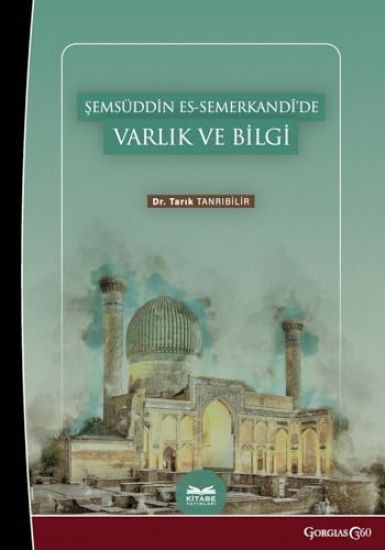
Samarkandi, one of the scholars of Islamic theology, produced ideas on many subjects. His views on existence and knowledge are discussed in this book under detailed subheadings.



Impact of Aristotelian logic on Arab-Islamic Sciences and Arts
Shamsuddin Salahuddin
LAP Lambert Academic Publishing
2013
pokkari
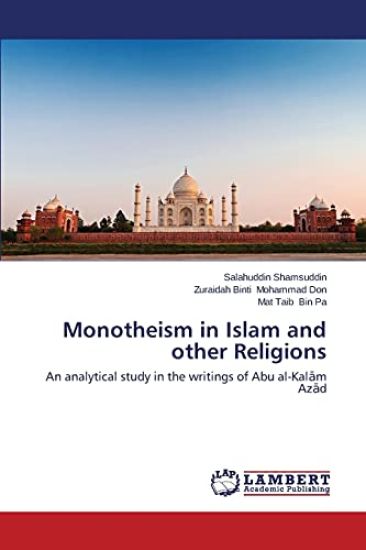
Monotheism in Islam and Other Religions
Shamsuddin Salahuddin
LAP Lambert Academic Publishing
2014
pokkari
Climate Change and Its Impacts on Irrigation and Groundwater Resources
Shamsuddin Shahid; Moshiur Rahman; M Mamnunul Keramat
LAP Lambert Academic Publishing
2012
pokkari

Khâja Shamsuddin Mohammad Hâfez (1327-1390 C.E.) was born in Shiraz, a city in Southwest Iran where he lived his entire life. The elegance, beauty, and delicacy of his poetry have made him the most beloved poet of the Persian-speaking world. Hâfez composed the bulk of his poetry in the form of ghazal, a lyrical poem similar to an English sonnet whose length ranges from seven to thirteen couplets. Ghazals often deal with love and beauty and may occasionally be interspersed with philosophical, ethical, didactic, or critical lines about life and the universe. Reza Saberi has produced a new English translation of the complete Divan of Hâfez, using Dr. Parviz N. Khânlari's Edition. The text of The Divan of Hâfez is an authentic translation of all of the poems of Hâfez complete with their Persian originals.




Every flower its beauty bestows, Your lips the dearest gems dispose, May your lips nurture our souls, With the wine that every spirit knows. From the Rubaiyat of Hafiz Better known by his nom de plume, Hafiz, Khwaja Shamsuddin Mohammad (1319-1389) is the most popular of the Persian poets; he acquired his surname from memorizing the Koran at an early age. A teacher of the Koran who associated with mystics, his lyrical Among his works are the first-known examples of literary styles the long rhyming poem, the couplet, and the rubaiyat, or the epic poem told in quatrains that survive to this day. Contemporary Muslim critics translate his passionat Hafiz influenced and was translated by, among others, Goethe and Emerson; literary scholars believe that Goethe's Westvstlicher Diwan (1819) was inspired by Hafiz. The poet is buried in a splendid tomb near Shiraz, Iran.

Google Web Toolkit 2 Application Development Cookbook
Ahammad Shamsuddin
Packt Publishing Limited
2010
nidottu
The recipes in this book are in a straightforward and easy to follow format.The range of topics covered in this book will bring out the forward-thinking Java developer in you. If you want to build AJAX web applications with GWT then this book is for you. Developers with prior programming experience of Java development and object-oriented programming will find this book very useful.
Physical Chemistry of Metallurgical Processes, Second Edition
Mohammad Shamsuddin
Springer Nature Switzerland AG
2021
sidottu
This updated, second edition retains its classroom-tested treatment of physical chemistry of metallurgical topics, such as roasting of sulfide minerals, matte smelting, converting, structure, properties and theories of slag, reduction of oxides and reduction smelting, interfacial phenomena, steelmaking, secondary steelmaking, role of halides in extraction of metals, refining, hydrometallurgy and electrometallurgy, and adds new data in worked-out examples as well as up-to-date references to the literature. The book further explains the physical chemistry of various metallurgical topics, steps involved in extraction of metals, such as roasting, matte smelting/converting, reduction smelting, steelmaking reactions, deoxidation, stainless steelmaking, vacuum degassing, refining, leaching, chemical precipitation, ion exchange, solvent extraction, cementation, gaseous reduction and electrowinning. Each topic is illustrated with appropriate examples of applications of the technique in extraction of some common, reactive, rare, or refractory metal together with worked out problems explaining the principle of the operation. The problems require imagination and critical analyses and also encourage readers for creative application of thermodynamic data in metal extraction.Updates and condenses text throughout the book by sequential arrangement of paragraphs in different chapters;Maximizes readers’ understanding of the physicochemical principles involved in extraction/production of common and rare/reactive metals by pyro- as well as hydrometallurgical routes;Reinforces concepts presented with worked examples in each chapter explaining the process steps;Explains the physical chemistry of various metallurgical steps, such as roasting, matte smelting/converting, and reduction smelting, steelmaking, aqueous processing etc. in extraction of metals;Collects and uniformly presents scattered information on physicochemical principles of metal production from various books and journals.
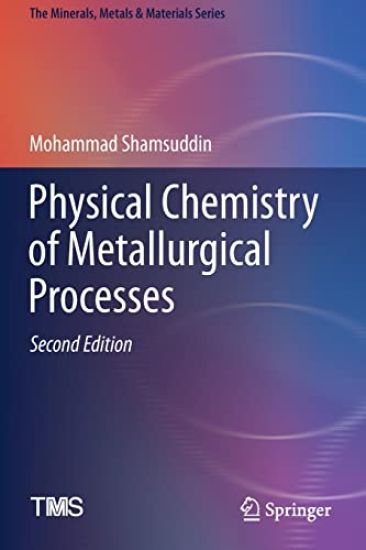
Physical Chemistry of Metallurgical Processes, Second Edition
Mohammad Shamsuddin
Springer Nature Switzerland AG
2022
nidottu
This updated, second edition retains its classroom-tested treatment of physical chemistry of metallurgical topics, such as roasting of sulfide minerals, matte smelting, converting, structure, properties and theories of slag, reduction of oxides and reduction smelting, interfacial phenomena, steelmaking, secondary steelmaking, role of halides in extraction of metals, refining, hydrometallurgy and electrometallurgy, and adds new data in worked-out examples as well as up-to-date references to the literature. The book further explains the physical chemistry of various metallurgical topics, steps involved in extraction of metals, such as roasting, matte smelting/converting, reduction smelting, steelmaking reactions, deoxidation, stainless steelmaking, vacuum degassing, refining, leaching, chemical precipitation, ion exchange, solvent extraction, cementation, gaseous reduction and electrowinning. Each topic is illustrated with appropriate examples of applications of the technique in extraction of some common, reactive, rare, or refractory metal together with worked out problems explaining the principle of the operation. The problems require imagination and critical analyses and also encourage readers for creative application of thermodynamic data in metal extraction.Updates and condenses text throughout the book by sequential arrangement of paragraphs in different chapters;Maximizes readers’ understanding of the physicochemical principles involved in extraction/production of common and rare/reactive metals by pyro- as well as hydrometallurgical routes;Reinforces concepts presented with worked examples in each chapter explaining the process steps;Explains the physical chemistry of various metallurgical steps, such as roasting, matte smelting/converting, and reduction smelting, steelmaking, aqueous processing etc. in extraction of metals;Collects and uniformly presents scattered information on physicochemical principles of metal production from various books and journals.