Kirjojen hintavertailu. Mukana 11 244 527 kirjaa ja 12 kauppaa.

Kirjahaku

Etsi kirjoja tekijän nimen, kirjan nimen tai ISBN:n perusteella.

1000 tulosta hakusanalla Shaun Nichols

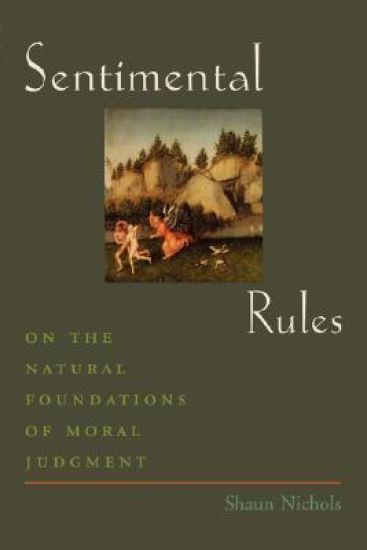
Sentimental Rules

Sentimental Rules

Shaun Nichols

Oxford University Press Inc
2007
nidottu
Sentimental Rules is an ambitious and highly interdisciplinary work, which proposes and defends a new theory about the nature and evolution of moral judgment. In it, philosopher Shaun Nichols develops the theory that emotions play a critical role in both the psychological and the cultural underpinnings of basic moral judgment. Nichols argues that our norms prohibiting the harming of others are fundamentally associated with our emotional responses to those harms, and that such "sentimental rules" enjoy an advantage in cultural evolution, which partly explains the success of certain moral norms. This has sweeping and exciting implications for philosophical ethics. Nichols builds on an explosion of recent intriguing experimental work in psychology on our capacity for moral judgment and shows how this empirical work has broad import for enduring philosophical problems. The result is an account that illuminates fundamental questions about the character of moral emotions and the role of sentiment and reason in how we make our moral judgments. This work should appeal widely across philosophy and the other disciplines that comprise cognitive science.
Bound

Bound

Shaun Nichols

Oxford University Press
2017
nidottu
The problem of free will arises from ordinary, commonsense reflection. Shaun Nichols examines these ordinary attitudes from a naturalistic perspective. He offers a psychological account of the origins of the problem of free will. According to his account the problem arises because of two naturally emerging ways of thinking about ourselves and the world, one of which makes determinism plausible while the other makes determinism implausible. Although contemporary cognitive science does not settle whether choices are determined, Nichols argues that our belief in indeterminist choice is grounded in faulty inference and should be regarded as unjustified. However, even if our belief in indeterminist choice is false, it's a further substantive question whether that means that free will doesn't exist. Nichols argues that, because of the flexibility of reference, there is no single answer to whether free will exists. In some contexts, it will be true to say 'free will exists'; in other contexts, it will be false to say that. With this substantive background in place, Bound promotes a pragmatic approach to prescriptive issues. In some contexts, the prevailing practical considerations suggest that we should deny the existence of free will and moral responsibility; in other contexts the practical considerations suggest that we should affirm free will and moral responsibility. This allows for the possibility that in some contexts, it is morally apt to exact retributive punishment; in other contexts, it can be apt to take up the exonerating attitude of hard incompatibilism.
Rational Rules

Rational Rules

Shaun Nichols

Oxford University Press
2021
sidottu
Moral systems, like normative systems more broadly, involve complex mental representations. Rational Rules proposes that moral learning can be understood in terms of general-purpose rational learning procedures. Nichols argues that statistical learning can help answer a wide range of questions about moral thought: Why do people think that rules apply to actions rather than consequences? Why do people expect new rules to be focused on actions rather than consequences? How do people come to believe a principle of liberty, according to which whatever is not expressly prohibited is permitted? How do people decide that some normative claims hold universally while others hold only relative to some group? The resulting account has both empiricist and rationalist features: since the learning procedures are domain-general, the result is an empiricist theory of a key part of moral development, and since the learning procedures are forms of rational inference, the account entails that crucial parts of our moral system enjoy rational credentials. Moral rules can also be rational in the sense that they can be effective for achieving our ends, given our ecological settings. Rational Rules argues that at least some central components of our moral systems are indeed ecologically rational: they are good at helping us attain common goals. Nichols argues that the account might be extended to capture moral motivation as a special case of a much more general phenomenon of normative motivation. On this view, a basic form of rule representation brings motivation along automatically, and so part of the explanation for why we follow moral rules is that we are built to follow rules quite generally.
Bound

Bound

Shaun Nichols

Oxford University Press
2015
sidottu
The problem of free will arises from ordinary, commonsense reflection. Shaun Nichols examines these ordinary attitudes from a naturalistic perspective. He offers a psychological account of the origins of the problem of free will. According to his account the problem arises because of two naturally emerging ways of thinking about ourselves and the world, one of which makes determinism plausible while the other makes determinism implausible. Although contemporary cognitive science does not settle whether choices are determined, Nichols argues that our belief in indeterminist choice is grounded in faulty inference and should be regarded as unjustified. However, even if our belief in indeterminist choice is false, it's a further substantive question whether that means that free will doesn't exist. Nichols argues that, because of the flexibility of reference, there is no single answer to whether free will exists. In some contexts, it will be true to say 'free will exists'; in other contexts, it will be false to say that. With this substantive background in place, Bound promotes a pragmatic approach to prescriptive issues. In some contexts, the prevailing practical considerations suggest that we should deny the existence of free will and moral responsibility; in other contexts the practical considerations suggest that we should affirm free will and moral responsibility. This allows for the possibility that in some contexts, it is morally apt to exact retributive punishment; in other contexts, it can be apt to take up the exonerating attitude of hard incompatibilism.
Mindreading

Mindreading

Shaun Nichols; Stephen P. Stich

Clarendon Press
2003
sidottu
The everyday capacity to understand the mind, or "mindreading", plays an enormous role in our ordinary lives. Shaun Nichols and Stephen Stich provide a detailed and integrated account of the intricate web of mental components underlying this fascinating and multifarious skill. The imagination, they argue, is essential to understanding others, and there are special cognitive mechanisms for understanding oneself. The account that emerges has broad implications for longstanding philosophical debates over the status of folk psychology.
Mindreading

Mindreading

Shaun Nichols; Stephen P. Stich

Clarendon Press
2003
nidottu
The everyday capacity to understand the mind, fancifully dubbed 'mindreading', plays an enormous role in our lives. In the latter half of the 20th century mindreading became the object of sustained scientific and theoretical research, capturing the attention of a wide range of disciplines, including philosophy, developmental psychology, behavioral ecology, anthropology, and cognitive psychopathology. What has been missing is a detailed and integrated account of the mental components that underlie this remarkable capacity. Nichols and Stich develop and defend a new account of the psychological mechanisms underlying mindreading. They maintain that it is, as common sense would suggest, vital to distinguish between reading others' minds and reading one's own. In reading other minds, the imagination plays a central role. As a result, the authors begin with an explicit and systematic account of pretence and imagination which proposes that pretence representations are contained in a separate mental workspace, the 'Possible World Box', which is part of the basic architecture of the human mind. The mechanisms underlying pretence get recruited when people attempt to understand others and predict their behaviour. In some cases, we use our own mental mechanisms to simulate the mental processes of another, as suggested by the 'simulation theory' of mindreading. However, mindreading also implicates very different kinds of mechanisms that rely on rich bodies of information, as suggested by information-based accounts of mindreading. In addition, the authors argue, reading other minds involves important processes that don't fit into either category. None of these mechanisms, though, explain how we read our own minds, which, according to the authors, requires invoking an entirely independent set of mechanisms. What we find, then, is an intricate web of mental components to explain our fascinating and multifarious knack of understanding minds. This account provides a valuable framework for future work on mindreading and has broad implications for philosophical debates that have surrounded the issue for the last quarter century.
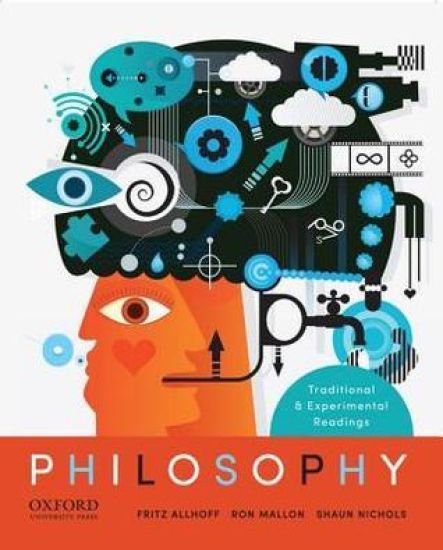
Philosophy

Philosophy

Ron Mallon; Shaun Nichols

Oxford University Press Inc
2012
nidottu
Recently, the fields of empirical and experimental philosophy have generated tremendous excitement, due to unexpected results that have challenged philosophical dogma. Responding to this trend, Philosophy: Traditional and Experimental Readings is the first introductory philosophy reader to integrate cutting-edge work in empirical and experimental philosophy with traditional philosophy. Featuring coverage that is equal parts historical, contemporary, and empirical/experimental, this topically organized reader provides students with a unique introduction to both the core and the vanguard of philosophy. The text is enhanced by pedagogical tools including commentary on each reading and chapter, study questions, suggested further readings, and a glossary. An Instructor's Manual and Companion Website at www.oup.com/us/allhoff provide additional resources.
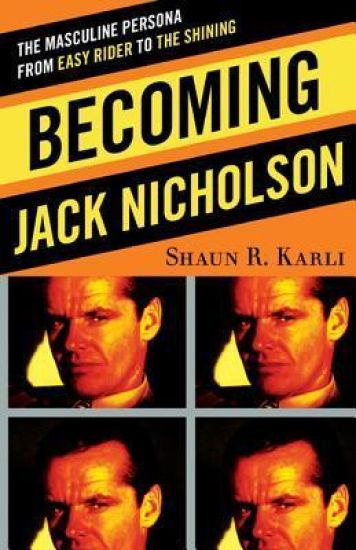
Becoming Jack Nicholson

Becoming Jack Nicholson

Shaun R. Karli

Scarecrow Press
2012
sidottu
One of the most celebrated figures in the world of cinema, Jack Nicholson has appeared in more than fifty films, stamping each with his larger-than-life presence. Because Nicholson brought a set of traits and attitudes with him to his roles that the actor and filmmakers variously inflected, audiences associated certain characteristics with his screen identity. At times his rebelliousness was celebrated as an act of self-expression against an oppressive system (Five Easy Pieces, The Passenger, One Flew Over the Cuckoo’s Nest), and at others it was revealed as an absurd masculine fantasy (The Last Detail, Chinatown, and The Shining). In each, the actor embodies an inherent tension between a desire to make authentic choices and a pressure to conform to societal expectations of manly behavior. In Becoming Jack Nicholson: The Masculine Persona from Easy Rider to The Shining, Shaun Karli looks at the actor’s on-screen presence in eight key films between 1969 and 1980. Karli explores how in each of these films, the actor and the filmmakers played upon audience expectations of “Jack Nicholson” to challenge prevailing attitudes about masculinity and power. Focusing on the actor's image in a string of counterculture films that spanned the 1970s, Karli argues that audiences created a composite "understanding" of the Nicholson persona in these movies. Examining both the actor and the on-screen version of the Nicholson character, this book offers a fascinating look at one of the major screen figures of the past forty years. Becoming Jack Nicholson will appeal to scholars of cinema, but also to those interested in gender studies, American studies, and sociology.
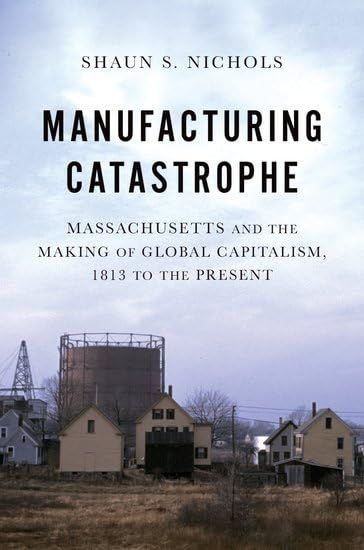
Manufacturing Catastrophe

Manufacturing Catastrophe

Shaun S. Nichols

OXFORD UNIVERSITY PRESS INC
2024
sidottu
American economic history has traditionally been told as a narrative of industrialization and affluence collapsing into globalization and industrial decay. Offering a reappraisal of this pattern, Manufacturing Catastrophe traces the successive rise and fall of the whaling, textile, garment, electronics, and high-tech industries in Massachusetts over the past two hundred years. It shows how business, labor, and political leaders repeatedly mobilized the lure of crisis—cheap labor, low taxes, and generous manufacturing subsidies—to pull and push both capital and workers across the continents, repeatedly remaking the pioneering industrial cities of Fall River and New Bedford. Workers—ranging from migrating Azorean seamen to British weavers to Quebecois farmers—and capitalists—including mobile manufacturers, globetrotting whalers, and multinational conglomerators—participated in the creation of regional growth and, with it, American industrial ascendance. Exploring the paradoxical and recurring coexistence of high unemployment and labor shortages in these cities, this book explains why recovery and growth have not necessarily translated into long-term prosperity. In doing so, it illuminates how economic catastrophe was, ironically, a critical ingredient in the making of America's industrial hegemony.
Manufacturing Catastrophe

Manufacturing Catastrophe

Shaun S. Nichols

OXFORD UNIVERSITY PRESS INC
2024
nidottu
American economic history has traditionally been told as a narrative of industrialization and affluence collapsing into globalization and industrial decay. Offering a reappraisal of this pattern, Manufacturing Catastrophe traces the successive rise and fall of the whaling, textile, garment, electronics, and high-tech industries in Massachusetts over the past two hundred years. It shows how business, labor, and political leaders repeatedly mobilized the lure of crisis—cheap labor, low taxes, and generous manufacturing subsidies—to pull and push both capital and workers across the continents, repeatedly remaking the pioneering industrial cities of Fall River and New Bedford. Workers—ranging from migrating Azorean seamen to British weavers to Quebecois farmers—and capitalists—including mobile manufacturers, globetrotting whalers, and multinational conglomerators—participated in the creation of regional growth and, with it, American industrial ascendance. Exploring the paradoxical and recurring coexistence of high unemployment and labor shortages in these cities, this book explains why recovery and growth have not necessarily translated into long-term prosperity. In doing so, it illuminates how economic catastrophe was, ironically, a critical ingredient in the making of America's industrial hegemony.
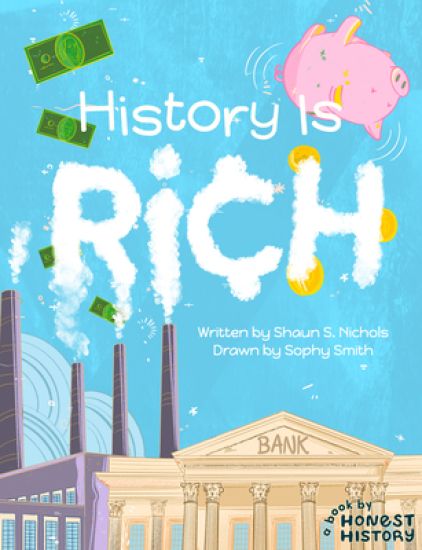
History is Rich

History is Rich

Shaun S. Nichols; Sophy Smith

GIBBS M. SMITH INC
2022
sidottu
Journey through the rich history of money, capitalism, and the American economy in History Is Rich, a children's book by Honest History.Journey through the rich history of money, capitalism, and the American economy in History Is Rich, a children's book by Honest History. From the history of early capitalism through modern technology, explore and learn about the ways money is made and used in America. What do railroads and Amazon have in common? What was life like before capitalism? Discover the beginnings of Big Business, stocks, corporations and other American financial institutions. Each page is beautifully-illustrated and each complex topic is broken down so kids can easily understand and use the information to create a better future for themselves and the world.History for kids has never contained more adventure than in the new series by Honest History, History Is ________. Each book in the series presents a topic in a fun, engaging way that inspires kids to make a positive impact on history themselves.
The Magic Egg Book

The Magic Egg Book

Shauna Nicholson-Kelly

Dancing Moon Press
2021
sidottu
On sunny day on Woodpecker Farm, the eggs hatched and the baby chicks tumbled out into the world. But not all of the mama hens had babies of their own. Sometimes it takes kindness and a little bit of magic to make a family.How do you explain to a child that their family may have been created differently than other families but is still just as beautiful? A new children's picture book was created by a mom who asked herself that very question. The Magic Egg Book, by Shauna Nicholson-Kelly, tells the story of a mama hen and a baby chick who find one another other in a special way.
The Magic Egg Book

The Magic Egg Book

Shauna Nicholson-Kelly

Dancing Moon Press
2021
pokkari
On sunny day on Woodpecker Farm, the eggs hatched and the baby chicks tumbled out into the world. But not all of the mama hens had babies of their own. Sometimes it takes kindness and a little bit of magic to make a family.How do you explain to a child that their family may have been created differently than other families but is still just as beautiful? A new children's picture book was created by a mom who asked herself that very question. The Magic Egg Book, by Shauna Nicholson-Kelly, tells the story of a mama hen and a baby chick who find one another other in a special way.
Magi: Book of Forsaken Futures

Magi: Book of Forsaken Futures

Shawn Allen Nichols

Createspace Independent Publishing Platform
2013
nidottu
Magi: Book of Forsaken Futures(2013) by Shawn Allen Nichols Junior, (Not be confused with other works by other authors as unrelated) is a choose your own adventure written entirely in first person present. The flow of the story, as well as available characters and their alliance changes dependant on their choices and those of other characters. This cast of over fifty characters, over thirty the reader receives control of, ranges from Hale the light magic type to Rywho the apprentice of Death. The story opens to a man of quickly fading life and mind. Upon his death the torch passes to Hale Skyne and his other personality Newbie amidst a war between vampires and the Auk Mentar(werewolves) taking place in a deserted town. After filling the reader in on their world and situation, the torch passes again to Rywho Yu as his path to redemption tangles him in a new role as Death's apprentice. From there, their choices and interactions set them on one of many tracks, leading to one of 95 different endings. So, what will you choose and what will be your forsaken future?Look up our Facebook page for daily samples and like the page for exclusive offers at https: //m.facebook.com/Magiboff
Do You See What I'm Saying?

Do You See What I'm Saying?

Shawn M Nicholson

L3 Publishing House
2023
pokkari
Do You See What I'm Saying; Walking by Faith. Our goal is for the reader to take away this spiritual and biblical fact, Faith Must be Released in WORDS. For years faith has been taught in the church. People have been encouraged to believe. But we have not heard many teachings about WORDS or saying what you believe. Faith Equals the Word of God Hebrews 11:1 reads, "Now faith is the substance of things...." Therefore, all things were made by faith. In other words, "everything that you see around you was made by faith." Do You See What I'm Saying? I wrote this book, Do You See What I'm Saying? To help reduce barriers, that may prevent you from reaching your purpose. To encourage all people who are struggling emotionally, physically, spiritually, or even mentally and are looking for helpful information and resources to assist with their spiritual journey towards purpose. Child of God, you can overcome every negative circumstance in life by getting the Word in your spirit and speaking the promises of God. You see, faith is more than just believing. To have the God kind of faith you must believe, trust, and rely on His Word. In God's Word, you'll find the wisdom necessary to accomplish the Lord's will for your life.
Pass-I-On

Pass-I-On

Shawn M Nicholson

L3 Publishing House
2021
pokkari
Thank you for purchasing my book. It is my extreme honor to be apart of your library, I want to welcome you to take a look into my journey and as I reveil the 7 Building Blocks to Sustainability and Success. So from me to you, live your life in abundance. Go after your dreams. Fulfill your destiny. "Don't settle for mediocrity. Take a chance. Take a risk. Find that passion. Know what you're really worth." Remember this, "Passion is the ability to PASS-I-ON "
Witch's Brew

Witch's Brew

Shawn Engel; Steven Nichols

Sterling
2021
sidottu
Drink deliciously and magickally with this exquisite compendium of potent mystical beverages, with witchy wisdom from author Shawn Engel and expertly crafted cocktails from mixologist Steven Nichols. For thousands of years, witches young and old have concocted mysterious potions to heal, to divine the future, to get in touch with the energies of the planet-and just to have fun. In this enchanting compendium of 40 drink recipes, mystical maven Shawn Engel shares her thoughts on what to imbibe for power, energy, and amusement. Written in tandem with the award-winning cocktail writer and developer Steven Nichols, this collection presents a broad range of drinks for every purpose. Whether it's a trio of beverages celebrating the energies of the maiden, mother, and crone (with notes of pomegranate, fig, and smoke respectively), or an eminently sippable mint-based money magick brew for prosperity, this book is a party with a purpose. Not only are these drinks fun and shareable, they also contain ingredients with ancient magickal significance. For example, the 'Keep it Hexy' is not only a delicious vodka-based cocktail perfect for kick-starting a memorable evening, it also contains black pepper to return a hex to sender, sage to cleanse an evil eye, and blackberries for protection. All recipes include energetic properties and plenty of information about magickal ingredients and why they've been used to address certain ills for millennia; some even come with invocations and rituals to amplify their power.
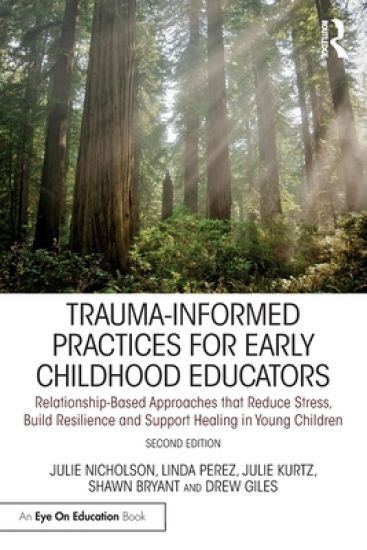
Trauma-Informed Practices for Early Childhood Educators

Trauma-Informed Practices for Early Childhood Educators

Julie Nicholson; Linda Perez; Julie Kurtz; Shawn Bryant; ew Giles

TAYLOR FRANCIS LTD
2023
nidottu
This second edition of Trauma-Informed Practices for Early Childhood Educators continues to guide childcare providers and early educators working with infants, toddlers, preschoolers and early elementary-aged children to understand trauma as well as its impact on young children’s brains, behavior, learning and development. The book covers a range of trauma-responsive teaching strategies that readers can use to create strength-based environments that support children’s health, healing and resiliency. Updates include a greater emphasis on resilience and collaborating with mental health specialists, new chapters on developing children’s body awareness/sensory literacy and pathways to regulation that reduce stress through breathing techniques and mindful movement, as well as new vignettes and case studies to use in workshops or professional development. Supervisors and coaches will learn a range of powerful trauma-responsive practices that they can use to support workforce development and enhance their quality improvement initiatives.