Kirjojen hintavertailu. Mukana 11 342 296 kirjaa ja 12 kauppaa.

Kirjahaku

Etsi kirjoja tekijän nimen, kirjan nimen tai ISBN:n perusteella.

1000 tulosta hakusanalla Shelley D. Lane

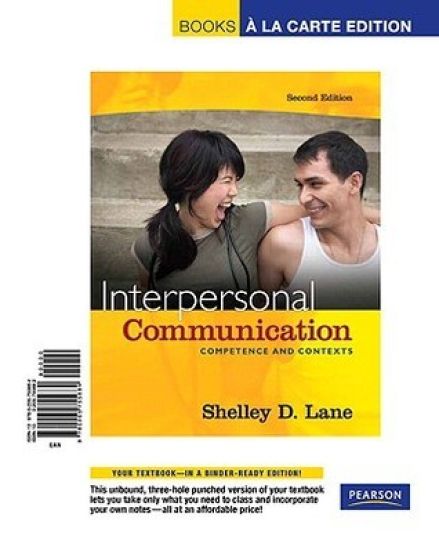
Interpersonal Communication

Interpersonal Communication

Shelley D. Lane

Routledge Member of the Taylor and Francis Group
2009
irtolehti
Interpersonal Communication: Competence and Contexts prepares students to communicate successfully in today's fast-paced and complex society through the implementation of a unique competence-building model. This highly readable text provides the theories, concepts, and applications in a pedagogically sound format based on a model of communication competence made up of three elements: motivation, knowledge, and skill. Studying interpersonal communication through this distinct framework will provide a foundation for students' motivation to communicate competently, increase their knowledge about communication, and enhance their acquisition and performance of communication skills. Covering a broad range of interpersonal communication themes, including strategic alternatives and solutions to communication challenges and information about friendship, family, romantic, and workplace relationships, this Second Edition presents theories, concepts, and activities with engaging examples and an attention-getting design.
Understanding Everyday Incivility

Understanding Everyday Incivility

Shelley D. Lane

Rowman Littlefield
2017
sidottu
Understanding Everyday Incivility delves into the day-to-day annoying behaviors that color our interactions with other people, such as the use of crude language in public, family members who claim that they’re “just teasing” and we’re “too sensitive,” coworkers who constantly interrupt us, and inflammatory remarks posted on social media sites. Shelley D. Lane explores what is considered uncivil behavior, why we label some acts as crude or selfish while others are deemed polite and proper, and how these labels often change from one context to the next. She highlights the power dynamics at play in our interactions and explains how “rude” behavior can sometimes be beneficial—and “polite” behavior can be detrimental. Rather than a simplistic manual of manners, Lane provides the tools to understand everyday incivility and strategies for responding effectively and appropriately.
Understanding Everyday Incivility

Understanding Everyday Incivility

Shelley D. Lane

Rowman Littlefield
2020
nidottu
Understanding Everyday Incivility delves into the day-to-day annoying behaviors that color our interactions with other people, such as the use of crude language in public, family members who claim that they’re “just teasing” and we’re “too sensitive,” coworkers who constantly interrupt us, and inflammatory remarks posted on social media sites. Shelley D. Lane explores what is considered uncivil behavior, why we label some acts as crude or selfish while others are deemed polite and proper, and how these labels often change from one context to the next. She highlights the power dynamics at play in our interactions and explains how “rude” behavior can sometimes be beneficial—and “polite” behavior can be detrimental. Rather than a simplistic manual of manners, Lane provides the tools to understand everyday incivility and strategies for responding effectively and appropriately.
Communication in a Civil Society

Communication in a Civil Society

Shelley D. Lane; Ruth Anna Abigail; John Casey Gooch

TAYLOR FRANCIS LTD
2024
nidottu
Using the concept of “civility” as the major theme, this fully updated second edition offers a unique and alternative way to teach and learn about communication.The book brings together discrete areas that explore the fundamentals of communication and intrapersonal communication, interpersonal communication, small group communication, and public speaking. Every chapter includes theories, concepts, and examples that allow students to use civil and ethical communication skills in their personal relationships, in collaboration with colleagues, and in giving public speeches and professional presentations. This new edition highlights advances in and concepts related to mediated and technology-based communication, such as chatbots, technostress, and dating apps, and shows how students can engage in civil face-to-face and mediated interaction. Additionally, each chapter includes a real-world incident that students are asked to analyze in terms of specific chapter information and skills related to civility.Communication in a Civil Society is an ideal textbook for Introduction to Communication, Interpersonal Communication, and Public Speaking courses.Materials for instructors including PowerPoint slides, a test bank, and an instructor’s manual, are available at www.routledge.com/9781032513263.
Communication in a Civil Society

Communication in a Civil Society

Shelley D. Lane; Ruth Anna Abigail; John Casey Gooch

TAYLOR FRANCIS LTD
2024
sidottu
Using the concept of “civility” as the major theme, this fully updated second edition offers a unique and alternative way to teach and learn about communication.The book brings together discrete areas that explore the fundamentals of communication and intrapersonal communication, interpersonal communication, small group communication, and public speaking. Every chapter includes theories, concepts, and examples that allow students to use civil and ethical communication skills in their personal relationships, in collaboration with colleagues, and in giving public speeches and professional presentations. This new edition highlights advances in and concepts related to mediated and technology-based communication, such as chatbots, technostress, and dating apps, and shows how students can engage in civil face-to-face and mediated interaction. Additionally, each chapter includes a real-world incident that students are asked to analyze in terms of specific chapter information and skills related to civility.Communication in a Civil Society is an ideal textbook for Introduction to Communication, Interpersonal Communication, and Public Speaking courses.Materials for instructors including PowerPoint slides, a test bank, and an instructor’s manual, are available at www.routledge.com/9781032513263.
Interpersonal Communication

Interpersonal Communication

Lane Shelley D.

Routledge Member of the Taylor and Francis Group
2009
nidottu
Interpersonal Communication: Competence and Contexts prepares students to communicate successfully in today's fast-paced and complex society through the implementation of a unique competence-building model. This highly readable text provides the theories, concepts, and applications in a pedagogically sound format based on a model of communication competence made up of three elements: motivation, knowledge, and skill. Studying interpersonal communication through this distinct framework will provide a foundation for students' motivation to communicate competently, increase their knowledge about communication, and enhance their acquisition and performance of communication skills. Covering a broad range of interpersonal communication themes, including strategic alternatives and solutions to communication challenges and information about friendship, family, romantic, and workplace relationships, this Second Edition presents theories, concepts, and activities with engaging examples and an attention-getting design.
Mind Science: The Science of Health, Wealth, Happiness and Success

Mind Science: The Science of Health, Wealth, Happiness and Success

Shelley D. Chuchmuch

Createspace Independent Publishing Platform
2016
nidottu
The Mind Science program assists people with identifying and realizing their goals, dreams, and aspirations by making them more self-aware by developing their hidden talents and potential through the theory of the Multiple Intelligence's, The Law of Attraction, Positive Psychology, Emotional Intelligence, Mindfulness, Theology, Psychology, Neuroscience, Metaphysics / Spirituality, and applied Economics. Mind Science is based on scientifically proven methods, evidence-based research and principles and success strategies used by 21st-century leadership and leaders of past. Timeless success strategies and principles of purposeful life experience creation. This program is suitable for all people in all fields. Teachers, Coaches, Students, Business Owners, Leaders and the like This program includes 365 Daily reflections, activities, business success tips, self-success strategies, organizational skills, affirmations, mindfulness processes and more. Read one page per day engaging in systematic problem solving and creative meditation journal writing for 20 minutes. Learn hundreds of processes, strategies and tips for living your best optimal life experience. Positive thought, positive emotion = positive life
E=me2: A Unified Theory

E=me2: A Unified Theory

Shelley D. Chuchmuch

ABC-IQ
2017
nidottu
Great teachers force us to question. Great teachers force us to think, to seek understanding, to seek truth. Jesus, Mohamed, Buddha, Confucius, Abraham, Krishna and many others have taught us that there is something beyond all of us, but what is that energy, what is that truth? Where does it come from? Was that energy that was something that was beyond me, or could I access this energy all the time? When we have the death experience are we finished or are we infinite? Theology teaches us that "I AM" created in the likeness of God, there is no death and that life is eternal. What does that really mean? Have you ever really thought about it? What I learned is that nothing JUST happens. Like the domino effect, everything is inter-connected One thing impacts another and everything impacts you What is truth? What is culture? Why do I have emotions? What is energy? How is energy created? How is life experience created? What is your intuition? Why do I have tears? Albert Einstein once said, "Everyone is a genius but if you judge a fish on its ability to climb a tree, it will live its whole life believing it is stupid". I AM a product of an education model that did not work for my style of learning. I spent many years fighting off a feeling of "not being good enough" because of my inability to read and write to the standard of other kids when I was young. I questioned a lot of things, and some things, I just accepted because I didn't have the life experience to compare my thought to anything different. Words did not teach me, applying words to my life experience did. I did not learn until I could apply the topic to my own life experience. Everything I learned in school prepared me for my profession but it did not prepare me for the trials and tribulations of everyday life. In 2006, my entire life collapsed all around me. How did that happen? How could all of my worst night mares have come true? Was God out to get me? How could these experiences have entered into my reality? My physical, mental, spiritual and emotional faculties were challenged in a way that I had never been challenged before. My entire body system was crying out for me to listen but I ignored the signs, life became something that I had to survive. I cried an awful lot, and for a very long time. What was the point of the buckets of tears I had cried and the stabbing pain that I had felt in my heart so often? Who created that for me? I had to intellectualize and understand my emotional pain. I set out to heal myself, I set out to find my truth. My journey of seeking understanding truth has taken me from the physical, to the non-physical, to metaphysics, theoretical physics, spirituality, quantum physics, theology, philosophy, psychology, neuroscience, medical science, sociology, to history, to economics, to political science. It has taken me from grief and despair to absolute joy, it has taken me from heaven to hell, to the America's, to Europe, to the United Kingdom, to The Middle East, to Africa and Asia, and it has taken me right back home where I started.
Electrochemical Systems

Electrochemical Systems

Alanah Fitch; Ingrid Fritsch; Carol Korzeniewski; Johna Leddy; Shelley D. Minteer

John Wiley Sons Ltd
2024
sidottu
Introducing the topic of electrochemistry for non-electrochemists, Electrochemical Systems provides an overview of the fundamentals of electrochemical theory and techniques along with an appreciation for its wide range of applications. Covering both common topics (batteries, corrosion, and fuel cells) along with new topics (membranes and proteins), introductory chapters provide students and practitioners with the skills to be able to "read" cyclic voltammograms, linear sweep voltammetry, and other various fundamental terms. Chapters are arranged in order of ascending complexity of the system.
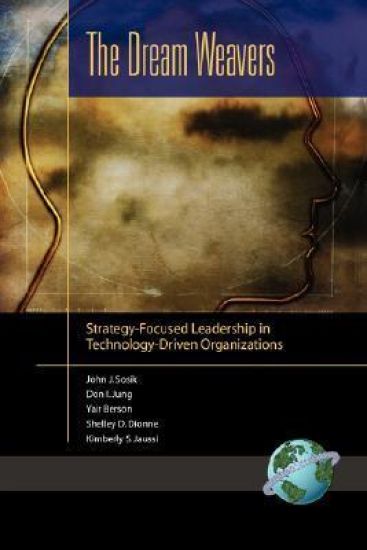
The Dream Weavers

The Dream Weavers

John J. Sosik; Don I. Jung; Yair Berson; Shelley D. Dionne; Kimberly S. Jaussi

Information Age Publishing
2004
nidottu
The main question that guided the thinking behind this book can be stated as follows: "What kind of leadership behavior must executives of technology-driven organizations display to spur performance excellence?" To address this question the authors conducted videotaped interviews of executives from 65 organizations– including General Electric, Qualcomm, The Vanguard Group, and Barclays Global Investors – to identify common behaviors and traits that lead to organizational success. In addition to the interviews, they surveyed the executives’ followers to evaluate the leadership and organizational culture to examine successful executive leadership from multiple reference points. The authors found that displaying outstanding executive leadership doesn't necessarily require a commanding presence, a genius-level IQ, expertise, or even a strong command and control system. At the heart of outstanding strategic leadership was an ability to envision a strategy for taking the raw inputs provided by their environments (e.g., people, technology, ideas, opportunities) and then to weave them into an integrated pattern or system of social, technical and intellectual resources that ultimately produce dramatically higher levels of organizational success factors. The book includes dozens of stories and narratives from the executive leaders to offer readers an in-depth look at what constitutes effective strategy-focused leadership in technology-driven organizations.
The Dream Weavers

The Dream Weavers

John J. Sosik; Don I. Jung; Yair Berson; Shelley D. Dionne; Kimberly S. Jaussi

Information Age Publishing
2004
sidottu
The main question that guided the thinking behind this book can be stated as follows: "What kind of leadership behavior must executives of technology-driven organizations display to spur performance excellence?" To address this question the authors conducted videotaped interviews of executives from 65 organizations– including General Electric, Qualcomm, The Vanguard Group, and Barclays Global Investors – to identify common behaviors and traits that lead to organizational success. In addition to the interviews, they surveyed the executives’ followers to evaluate the leadership and organizational culture to examine successful executive leadership from multiple reference points. The authors found that displaying outstanding executive leadership doesn't necessarily require a commanding presence, a genius-level IQ, expertise, or even a strong command and control system. At the heart of outstanding strategic leadership was an ability to envision a strategy for taking the raw inputs provided by their environments (e.g., people, technology, ideas, opportunities) and then to weave them into an integrated pattern or system of social, technical and intellectual resources that ultimately produce dramatically higher levels of organizational success factors. The book includes dozens of stories and narratives from the executive leaders to offer readers an in-depth look at what constitutes effective strategy-focused leadership in technology-driven organizations.
Nehemiah on Leadership

Nehemiah on Leadership

Ph D Shelley M Fisher

Christian Faith Publishing, Inc
2018
pokkari
In a time when leadership seems to be in the throes of despair, Nehemiah's leadership journey is refreshing. At the onset of the book that bears his name he is serving, exemplary leaders serve. The book depicts the ethical dimensions of leadership, as Nehemiah shows compassion for the plight of his people because the walls were down, putting them in imminent danger. We learn that effective leaders do not compromise their values, and they confront improprieties both within and outside of the organization.Nehemiah displayed many attributes of an effective leader--risk-taker, for example. The law of the land forbade a person from going before the king with a sad countenance; however, Nehemiah, the risk-taker, prayed and received favor from the king despite his sad countenance. In surmounting the challenge of rebuilding the walls, he demonstrates the role of the administrator by: Praying; Planning; Goal-setting and strategizing; Using excellent communication skills; Team building; and Mediating conflict. Nehemiah demonstrates how to deal with conflict. Since conflict is inevitable, it is important for leaders to know how to resolve it. I Can't Come Down displays Nehemiah's focus and perseverance on the task. He shows how to structure tasks with diverse groups--mayors, priests, people of all backgrounds, including women--worked collectively to accomplish the completion of the walls in fifty-two days. The ageless principles of leadership comingle with contemporary organizational theory. Albert Bandura highlights agency, self-efficacy, collective and leadership efficacy as key factors in motivation. Organizational theorists view leaders today through the five lenses of motivation, communication, politics, structure, and design. Finally, the reader is challenged to become proactive in his own community by participation, persuasion, and prayer. The concept of positive deviance is suggested as viable for solving problems in neighborhoods. It is a misnomer to think in terms of sacred and secular, for God is Creator of everything.
Nehemiah on Leadership

Nehemiah on Leadership

Ph D Shelley M Fisher

Christian Faith Publishing, Inc
2018
sidottu
In a time when leadership seems to be in the throes of despair, Nehemiah's leadership journey is refreshing. At the onset of the book that bears his name he is serving, exemplary leaders serve. The book depicts the ethical dimensions of leadership, as Nehemiah shows compassion for the plight of his people because the walls were down, putting them in imminent danger. We learn that effective leaders do not compromise their values, and they confront improprieties both within and outside of the organization.Nehemiah displayed many attributes of an effective leader--risk-taker, for example. The law of the land forbade a person from going before the king with a sad countenance; however, Nehemiah, the risk-taker, prayed and received favor from the king despite his sad countenance. In surmounting the challenge of rebuilding the walls, he demonstrates the role of the administrator by: Praying; Planning; Goal-setting and strategizing; Using excellent communication skills; Team building; and Mediating conflict. Nehemiah demonstrates how to deal with conflict. Since conflict is inevitable, it is important for leaders to know how to resolve it. I Can't Come Down displays Nehemiah's focus and perseverance on the task. He shows how to structure tasks with diverse groups--mayors, priests, people of all backgrounds, including women--worked collectively to accomplish the completion of the walls in fifty-two days. The ageless principles of leadership comingle with contemporary organizational theory. Albert Bandura highlights agency, self-efficacy, collective and leadership efficacy as key factors in motivation. Organizational theorists view leaders today through the five lenses of motivation, communication, politics, structure, and design. Finally, the reader is challenged to become proactive in his own community by participation, persuasion, and prayer. The concept of positive deviance is suggested as viable for solving problems in neighborhoods. It is a misnomer to think in terms of sacred and secular, for God is Creator of everything.
A Principal's Tale

A Principal's Tale

Ed D Shelley McIntosh

J Merrill Publishing, Inc.
2021
pokkari
Self Determination TheoryAutonomyCompetenceRelatedness"A Principal's Tale: A Self Determined Leader by Shelley McIntosh, Ed.D., is an engaging book that will help readers comprehend urban school administration and self-determination theory of urban school principals... A Principal's Tale is informative and educational and will help future and current urban school principals and administrators, and all those who are keen to learn how principals do their job."Mamta Madhaven Readers' Favorite
Memoir of a Black Christian Nationalist

Memoir of a Black Christian Nationalist

Ed D Shelley McIntosh

J Merrill Publishing, Inc.
2021
pokkari
These days are filled with social unrest. Lack of compassion from elected officials, police brutality, unjust laws that create poverty through minimal wages but soaring profits for capitalists, benign neglect of blighted neighborhoods, and crime within the cities and in governments create a landscape of oppression that directly diminishes the quality of life, especially for African Americans. What is the role of the Black church and Black Christians in light of these realities? Just to save souls is not enough Memoir of a Black Christian Nationalist: Seeds of Liberation is a poignant personal story of the author's thirty-year experience of being a Black Christian Nationalist. The theological framework, program, and organization re-establishing the Black church's relevancy to the liberation struggle are eloquently and informatively interwoven in . . .The DNA Research about the Race of JesusThe Powerful Leadership of Reverend Albert B. Cleage Jr., Founder of the Shrines of the Black MadonnaThe Transformation of Black People The Seeds of Liberation-Answers for the Black ChurchPractices That Create Freedom, Power, and a More Humane World