Kirjojen hintavertailu. Mukana 11 244 527 kirjaa ja 12 kauppaa.

Kirjahaku

Etsi kirjoja tekijän nimen, kirjan nimen tai ISBN:n perusteella.

490 tulosta hakusanalla Shri Bhuvendra Tyagi

Asha

Asha

Shri Bhuvendra Tyagi

Prabhat Prakashan
2022
nidottu
जब हर तरफ दहशत हो, मायूसी हो, लाचारी हो, तो नाउम्मीदी के अँधेरे चारों ओर उग ही आते हैं। तब जरूरत होती है नई आशा की, जो इन अँधेरों को दूर करके मनोबल बढ़ाए और हालात से जूझने का जज्बा दिलाए। 'आशा' संग्रह की कविताएँ इसी रोशनी और संबल के प्रसार के लिए हैं। अंग्रेजी के 46 कवियों की 51 कविताओं के अनुवाद का यह कविता संग्रह कोरोना-काल ही नहीं, तमाम विषम परिस्थितियों में एक सच्चे दोस्त और शुभचिंतक की तरह हौसला बनाए रखने की ताकत देनेवाला है। माया एंजेलो की कालजयी कविता 'फिर भी उठूँगी मैं', रुडयार्ड किपलिंग की 'अगर', कैटी ए. ब्राउन की 'खुद से हार कभी मत मानो', जॉयस अलकांतारा की 'देखोगे नहीं मुझे कभी हारते', हेनरी वर्ड्सवर्थ लॉन्गफेलो की 'जीवन-मंत्र', लैंग्स्टन ह्यूजेस की 'अब भी जंग में डटा हुआ हूँ', थॉमस हार्डी की 'आशा का गीत', मैक्स एरमन की बहुचर्चित कविता 'मनोकामनाएँ' (डेसिडराटा) और बर्टन ब्रैली की 'चाह जीत की' जैसी ओजस्वी कविताएँ किसी के भी मन से निराशा दूर करके आशा जगाने और किसी भी निरुत्साही को उत्साह और उमंग से भरकर जीवन को सुंदर बनाने में सक्षम हैं। ये आशा जाग्रत् करने के लिए सहज, सरल, शाश्वत, सार्वभौमिक और सर्वकालीन कविताएँ हैं।
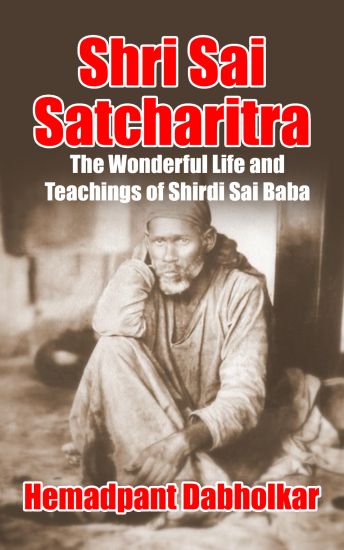
Shri Sai Satcharitra: The Wonderful Life and Teachings of Shirdi Sai Baba
Who was Shirdi Sai Baba? Baba lived all his adult life in Shirdi, a small village in India. To the unknowing, He seemed a simple beggar, dressed in torn clothes, having no need for any material item. Claiming neither the Hindu nor Muslim religion, nor any religion. He lived in an abandoned Mosque with no roof and every day took his food from a few people, making his rounds with his begging bowl, door to door.What really was happening; He was burning the karmas of everyone who came to Him, in the dhuni (Divine Fire) Baba kept burning at all times. Healing and giving guidance on every level. Hundreds of thousands of miracles are attributed to Him in His life and they have multiplied now after His Mahasamadhi. Baba left His physical form in 1918, but his Divine Energy and Intention and Power is always available and at work in the world.The Shri Sai Satcharitra is a discourse based on experiences Baba's devotees had with Him during His life on earth. It is said that Shirdi Sai Baba caused it to be written through Shri Anna Saheb Dabholkar - Hemadpant - by giving inner motivation to him. Baba had clearly told him: "I Myself write my own life. Hearing My stories and teachings will create faith in devotees' hearts and they will easily get self-realization and bliss...." Every chapter is a mixture of philosophy, anecdotes, and teachings. His book is akin to the Vedas for Sai's devotees." To many people, The Divine Truth imparted by this book is even greater than the knowledge contained in the Vedas and the Gita, because all the characters and events in it are real and authentic and have been recorded in detail by many devotees.We have attempted to remain true to N.V. Gunaji's original English translation. While some of the sentence structure and references may be slightly obscure for the Western reader, what is clear is that since the original English translation by N.V. Gunaji was published, that it has in its unaltered state, been a core component of the spread of knowledge and devotion to Shirdi Sai Baba in the English-speaking world. To help the reader with some of the obscure Hindi words and references in the Satcharitra, we have added an extensive Glossary.
Shri Guru Gita

Shri Guru Gita

Fourth State Productions, Inc.
2008
sidottu
Mark Griffin, the founder of the Hard Light Center of Awakening, has selected 108 of the 352 sutras from the ancient Indian text known as the Guru Gita. These verses focus on the universal nature of the Guru, and have been chosen as a tool for serious seekers - those who are sincerely interested in spiritual training and the attainment of Realization. The recitation of the Guru Gita is one of the practices of the Hard Light Center for one simple reason... as Mark Griffin says: "I am teaching you this about the Guru because I believe it's your best chance for Awakening in this lifetime". The word Guru is known to be more than an individual person. Rather, it is a universal principle, a catalyst for enlightenment like no other. This fresh, original English translation from the Sanskrit is specifically designed for the contemporary seeker. Sanskrit and transliteration are also included, as well as an in-depth glossary.
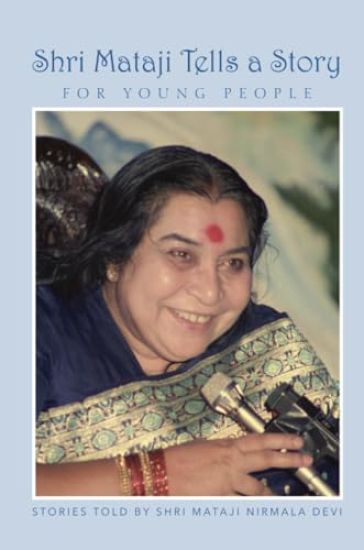
Shri Mataji Tells a Story for Young People

Shri Mataji Tells a Story for Young People

Shri Mataji Nirmala Devi

Lulu.com
2025
pokkari
Twenty-nine stories, as told by Shri Mataji Nirmala Devi, specially selected for young readers. The book includes: Shri Ganesha and His Mother, Shri Krishna and the Butter, The Guru and the Dog, Shri Rama and the Moon, Shivaji and the Mango, The Temple and the Elephants, The Thief and the Gramophone, The Actress and the Poet, The Schoolmaster and the Eggs, Shri Shiva and the Rakshasa, Shri Durga and Shri Jagadamba, Shri Rama and the Fight, Shri Hanuman and the Sneeze, My Father and his Friends, The Schoolmaster and the Eggs and more. This book has twenty-three illustrations.
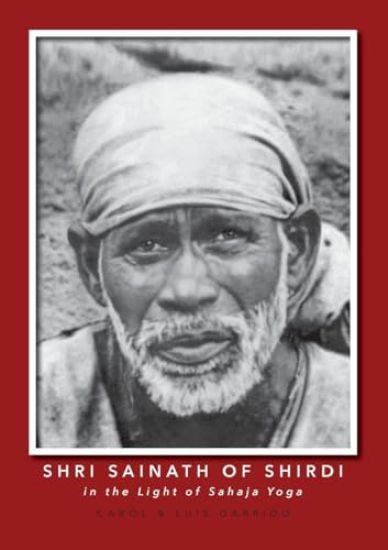
Shri Sainath of Shirdi in the Light of Sahaja Yoga

Shri Sainath of Shirdi in the Light of Sahaja Yoga

Carol Garrido; Luis Garrido

Lulu.com
2024
pokkari
He was a sadhu, a teacher and a saint, so closely identified with one small village that it is easy to forget that Sainath of Shirdi was also an Adi Guru. He is a Primordial Master whose life is not shrouded in an ancient world, but was one that reached forward to almost touch our own in the first years of the twentieth century. In photographs and stories he is remembered. With this book, we look at those images and we hear about his deeds. We will see how his teachings speak to us today. In love, forgiveness and respect for all life, he pointed to a better way. Despite his demure appearance and great humility, he was both a king and a prophet. He should be revered. He should be honoured. With this book, we can begin.
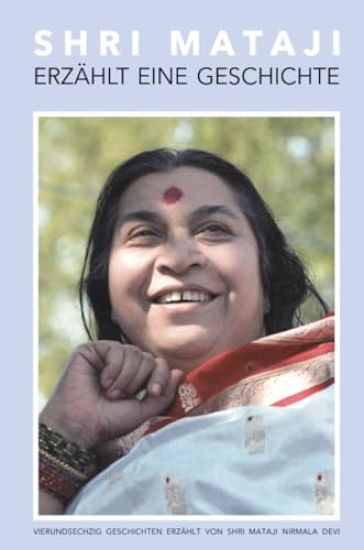
Shri Mataji Erzählt eine Geschichte

Shri Mataji Erzählt eine Geschichte

Shri Mataji Nirmala Devi

Lulu.com
2024
pokkari
Diese Sammlung von vierundsechzig Geschichten, die uns alle von Shri Mataji Nirmala Devi erz hlt wurden, umfasst "Die Erschaffung von Shri Ganesha", "Der Sanyasi und der Regen" und "Padmini und die S nfte". Es sind Geschichten voller Inspiration, Beratung und Humor."Diese Geschichten sind schon bekannt", sagte sie, "aber als Sahaja Yogis m sst ihr das Subtile hinter diesen Geschichten entdecken."
Shri Manache Shloka: English Translation of Smarath Swami Ramdas Shri Manache Shlok from Marathi

Shri Manache Shloka: English Translation of Smarath Swami Ramdas Shri Manache Shlok from Marathi

Geeta Sureshkumar Bhatt

Createspace Independent Publishing Platform
2014
nidottu
The most popular book 'Manache Shlok or Manobodh' includes 205 shloka with 4 lines each. Since the 17th century, 'Manache Schlok are being recited by common people in Maharashtra. Many have learnt them by heart, since the style of schlokas is unique, easy, beautiful and simple, though artistic and meaningful. Manache Shlok teaches your mind to change yourself gradually. The great saint Samartha Ramdas teaches us to have dialogue with our own mind. Your own mind is your friend, your enemy and your own mind can be also your Guru. Find out the reasons of your anger, jealousy, greed, sorrow, depression, fear, because these are the negative emotions, which you have to face constantly in your life. Convince your mind with Ramdas's words as he says, "O you, my coward mind, why are you afraid of worldly sorrows? Get rid of fear and hold courage".
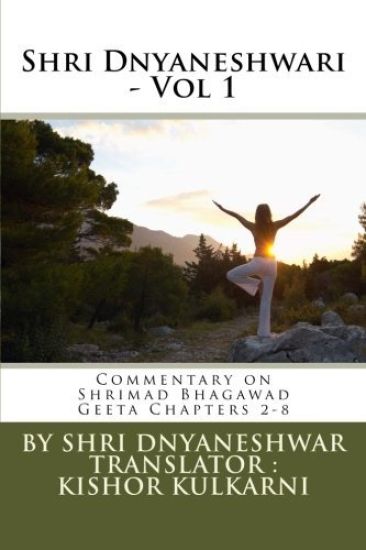
Shri Dnyaneshwari - Vol 1: Commentary by Sant Shri Dnyaneshwar on Shrimad Bhagawad Geeta Chapters 2-8
Shrimad Bhagawad Geeta (also referred to simply as Geeta) is the most revered of Indian scriptures that comprehensively presents the highest spiritual philosophy in the Indian tradition. It is believed to be told by Lord Shri Krishna to Arjuna on the Mahabharat battle field of Kurukshetra. Just before the epic war between Pandavas and Kauravas was to begin, Arjuna was suddenly overcome by confusion about whether it was right for him to fight his own cousins and other relatives as also his revered teachers (gurus) and other elders who were standing opposite him as his enemies. As a result, he dropped his weapons and sat down in his chariot in a completely distraught mood. It was then that Shri Krishna who had taken upon himself the job of being Arjuna's charioteer, preached the complete spiritual philosophy by way of Shrimad Bhagawad Geeta. It helped Arjuna understand clearly what this creation is and what the purpose of human life in it is. He could then proceed with fighting the Mahabharat war as a duty in a detached manner.Shrimad Bhagawad Geeta consists of 18 chapters and is originally in Sanskrit. There have been many explanatory commentaries on it by different philosophers and thinkers. The greatest of some of the most revered saints who lived during the 13th century in Maharashtra, Sant Shri Dnyaneshwar Maharaj, wrote an incomparable commentary on the Geeta titled Bhavarth Deepika, more popularly known as Shri Dnyaneshwari, in Marathi verse form. It is believed that Lord Shri Krishna Himself reincarnated as Sant Dnyaneshwar primarily to take the Geeta philosophy down to the less educated seekers who were unable to understand the original Geeta in Sanskrit language. Shri Dnyaneshwari is the result of that. Sant Shri Dnyaneshwar maharaj took samadhi at a tender age of 21 years soon after completing Dnyaneshwari, which confirms the belief that the primary purpose of his incarnation was delivering Geeta philosophy to the masses of ordinary people.The original Dnyaneshwari is organised exactly on the lines of Geeta in 18 chapters. Each of the shlokas (verses) of Geeta has many owis (Marathi verses) explaining the meaning of the particular shloka. Sant Shri Dnyaneshwar excels in putting across the underlying philosophy by way of many different metaphors and examples from the day-to-day life making it easy for a sincere reader to understand and digest it.The Dnyaneshwari owis are in old Marathi of the 13th century. This series of three books is an attempt by the author to take the Dnyaneshwari to non-Marathi seekers. It is a literal translation of the original "owis" rendered as modern English prose. It is presented in the following format - the original Sanskrit shloka of Geeta followed by its literal meaning in English and then the English translation of the related owis. At some places, more than one shloka are presented together if the meaning can be better understood that way. The reader is expected to have a reasonable degree of familiarity with Indian spiritual philosophy and the commonly used Sanskrit terms in respect of the various fundamental spiritual concepts.Chapter 1 and the first ten shlokas of Geeta describe the formation of armies on both the sides with the names and qualities of the various warriors gathered on the battle field. There is also a description of the distraught state of Arjuna's mind in this initial part. The actual philosophical preaching by Lord Shri Krishna starts from Chapter 2, shloka 11 and hence this book also starts from that point onwards. This translation of the complete Dnyaneshwari is presented in three volumes. The first volume covers chapters 2 to 8, second covers chapters 9-13 and the third covers chapters 14-18.