Kirjojen hintavertailu. Mukana 11 213 693 kirjaa ja 12 kauppaa.

Kirjahaku

Etsi kirjoja tekijän nimen, kirjan nimen tai ISBN:n perusteella.

1000 tulosta hakusanalla Stephen D. Carpenter

General Stephen D. Lee

General Stephen D. Lee

Herman Hattaway

University Press of Mississippi
1988
nidottu
This biographical portrait by a well known Civil War historian brings much deserved attention to an exceptional Confederate military figure who became one of the New South's most progressive leaders.Herman Hattaway's clear, swift narrative depicts Lee in brilliant performance at Second Manassas, Chickasaw Bayou, Nashville, and after the war as a leader who used his military skills and discipline to work in bringing prosperity and education into the defeated South.After the war Lee established a home in Mississippi and found fulfillment in his calling to be the first president of Mississippi A & M College (today Mississippi State University), where he preached the message of applying brain power to farming. His admirers bestowed upon him the title ""Father of Industrial Education in the South.""Though the significance of Stephen D. Lee was long overlooked in historical perspectives of the Civil War and the development of the New South, Hattaway's appreciative study has remedied a case of unintended neglect by previous historians.
Sabbath-on-Swathe: the author-ized biography of Stephen D. Geller

Sabbath-on-Swathe: the author-ized biography of Stephen D. Geller

Kae Geller; Stephen D. Geller

Createspace Independent Publishing Platform
2018
nidottu
Sabbath-on-Swathe is the dreamland of Stephen Geller, an international known and lauded screenwriter, novelist and playwright. In this heightened landscape, artists, entertainers, composers and performers travel to Geller's bookshop, theater and music salon for tea, martinis, toast, and scrambled eggs with lox, cream cheese and onions. As well as huddles, confabs and cuddles. You never know who or what will turn up, in S-o-S
The Basics of IT Audit

The Basics of IT Audit

Stephen D. Gantz

Syngress Media,U.S.
2013
nidottu
The Basics of IT Audit: Purposes, Processes, and Practical Information provides you with a thorough, yet concise overview of IT auditing. Packed with specific examples, this book gives insight into the auditing process and explains regulations and standards such as the ISO-27000, series program, CoBIT, ITIL, Sarbanes-Oxley, and HIPPA. IT auditing occurs in some form in virtually every organization, private or public, large or small. The large number and wide variety of laws, regulations, policies, and industry standards that call for IT auditing make it hard for organizations to consistently and effectively prepare for, conduct, and respond to the results of audits, or to comply with audit requirements. This guide provides you with all the necessary information if you're preparing for an IT audit, participating in an IT audit or responding to an IT audit.
Synaptic Transmission

Synaptic Transmission

Stephen D. Meriney; Erika Fanselow

Academic Press Inc
2019
nidottu
Synaptic Transmission is a comprehensive guide to the topic of neurotransmission that provides an in-depth discussion on many aspects of synapse structure and function—a fundamental part of the neuroscience discipline. Chapters include boxes that describe renowned/award-winning researchers and their contributions to the field of synaptic transmission, diseases relevant to the material presented, details of experimental approaches used to study synaptic transmission, and interesting asides that expand on topics covered. This book will inspire students to appreciate how the basic cellular and molecular biology of the synapse can lead to a better understanding of nervous system function and neurological disorders.
Arguing the Apocalypse

Arguing the Apocalypse

Stephen D. O'Leary

Oxford University Press Inc
1998
nidottu
Apocalyptic expectations of Armageddon and a New Age have been a fixture of the American cultural landscape for centuries. With the approach of the year 2000, such millennial visions seem once again to be increasing in popularity. Stephen O'Leary sheds new light on the age-old phenomenon of the End of the Age by proposing a rhetorical explanation for the appeal of millennialism. Using examples of apocalyptic argument from ancient to modern times, O'Leary identifies the recurring patterns in apocalyptic texts and movements and shows how and why the Christian Apocalypse has been used to support a variety of political stances and programs. The book concludes with a critical review of the recent appearances of doomsday scenarios in our politics and culture, and a meditation on the significance of the Apocalypse in the nuclear age. Arguing the Apocalypse is the most thorough examination of its subject to date: a study of a neglected chapter of our religious and cultural history, a guide to the politics of Armageddon, and a map of millennial consciousness.
Multinational Corporations and Foreign Direct Investment

Multinational Corporations and Foreign Direct Investment

Stephen D. Cohen

Oxford University Press Inc
2007
nidottu
The integrating thesis of this study is the inevitability of heterogeneity in FDI and MNCs and, accordingly, the imperative of disaggregation. Nuance is too pervasive to permit many valid generalizations. This leads to a hardly earth-shattering, but surprisingly infrequently-offered conclusion that FDI, i.e. that any individual foreign-owned subsidiaries can, on balance, have a positive, negative, neutral (and/or irrelevant), or indeterminate effect. Foreign-owned subsidiaries are seldom if ever identical and need to be considered on a case by case basis according to circumstances. Hence, the phrase "it depends" is the mantra of this study. Disaggregation is an essential diagnostic tool to identify and measure the different levels of quality of MNCs subsidiaries. Most policy advocates and researchers, whatever their ideological persuasion, have failed to acknowledge the seemingly obvious: different kinds of businesses engage in different kinds of corporate activity and diverse results. The result of different input is different output. A nearly limitless number of characteristics are associated with three main variables: the nature and the effects of tens of thousands of individual foreign subsidiaries plus conditions in countries where they are located. MNCs are better described as the middlemen of change since they themselves are largely the effect of even larger phenomena, namely technological changes that restructure the international economic order. An opening exists for an even-handed, "no attitude" analysis that incorporates a methodology and viewpoint different from the thousands of books, articles, book chapters, and speeches written about MNCs and FDI. A large majority have failed to explicitly recognize how important perceptions, value judgments, ideology, and, sometimes, self-interest are in shaping discussions by both advocates and critics. People tend to view the FDI/MNC phenomena through differently configured lenses that have been individually molded by the unique mix of values and experiences that shapes our thinking. Evaluations of FDI and MNCs are prime examples of relatively oversimplified perceptions defining "truth". This book argues that a different route to understanding is needed and overdue: acknowledge the diversity and heterogeneity of phenomena that are lumped under very broad rubrics. MNCs are different by nature and therefore different in their respective mix of costs and benefits.
The Diary of Antera Duke, an Eighteenth-Century African Slave Trader

The Diary of Antera Duke, an Eighteenth-Century African Slave Trader

Stephen D. Behrendt; A.J.H. Latham; David Northrup

Oxford University Press Inc
2010
sidottu
The diary of Antera Duke is one of the earliest and most extensive surviving documents written by an African residing in coastal West Africa predating the arrival of British missionaries and officials in the mid-19th century. Antera Duke (ca.1735-ca.1809) was a leader and merchant in late eighteenth-century Old Calabar, a cluster of Efik-speaking communities in the Cross River region. He resided in Duke Town, forty miles from the Atlantic Ocean in modern-day southeast Nigeria. His diary, written in trade English from 18 January 1785 to 31 January 1788, is a candid account of daily life in an African community during a period of great historical interest. Written by a major African merchant at the height of Calabar's overseas commerce, it provides valuable information on Old Calabar's economic activity both with other African businessmen and with European ship captains who arrived to trade for slaves, produce and provisions. It is also unique in chronicling the day-to-day social and cultural life of a vibrant African community. Antera Duke's diary is much more than a historical curiosity; it is the voice of a leading African-Atlantic merchant who lived during an age of expanding cross-cultural trade. The book reproduces the original diary of Antera Duke, as transcribed by a Scottish missionary, Arthur W. Wilkie, ca. 1907 and published by OUP in 1956. A new rendering of the diary into standard English appears on facing pages, and the editors have advanced the annotation completed by anthropologist Donald Simmons in 1954 by editing 71 and adding 158 footnotes. The updated reference information incorporates new primary and secondary source material on Old Calabar, and notes where their editorial decisions differ from those made by Wilkie and Simmons. Chapters 1 and 2 detail the eighteenth-century Calabar slave and produce trades, emphasizing how personal relationships between British and Efik merchants formed the nexus of trade at Old Calabar. To build a picture of Old Calabar's regional trading networks, Chapter 3 draws upon information contained in Antera Duke's diary, other contemporary sources, and shipping records from the 1820s. Chapter 4 places information in Antera Duke's diary in the context of eighteenth-century Old Calabar political, social and religious history, charting how Duke Town eclipsed Old Town and Creek Town through military power, lineage strength and commercial acumen.
The Bible After Deleuze

The Bible After Deleuze

Stephen D. Moore

OXFORD UNIVERSITY PRESS INC
2022
sidottu
The impact of Gilles Deleuze on critical thought in the opening decades of the twenty-first century rivals that of Jacques Derrida or Michel Foucault on critical thought in the closing decades of the twentieth. The "Deleuze and..." industry is in overdrive in the humanities, the social sciences, and beyond, busily connecting Deleuzian philosophy to everything from literature to architecture, metaphysics to mathematics, ethics to physics, sexuality to technology, and ecology to theology. What of Deleuze and the Bible? What does the Bible become when it is plugged into the Deleuzian corpus? An immense affective assemblage, among other things. And what does biblical criticism become in the process? A practice of close reading that is other than interpretation and renounces the concept of representation. Not just for those already familiar with the work of Deleuze, the book begins with an extended introduction to Deleuzian thought. It then proceeds to unexegetical explorations of five successive themes: Text (how to make yourself a Bible without Organs, and why); Body (why there are no bodies in the Bible, and how to read them anyway); Sex (a thousand tiny sexes, a trillion tiny Jesuses); Race (Jesus and the white faciality machine); and Politics (democracy, despots, pandemics, ancient prophets). Cumulatively, these explorations limn the fluid contours of a Bible after Deleuze.
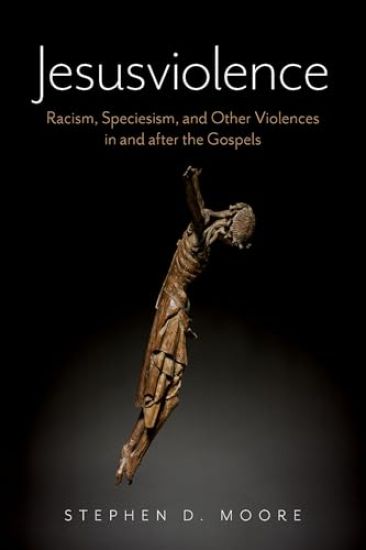
Jesusviolence

Jesusviolence

Stephen D. Moore

OXFORD UNIVERSITY PRESS INC
2026
sidottu
What does Jesus say and do within the narrative worlds of the New Testament gospels that, through the ages, enabled innumerable gory horrors and immense systemic violences to be perpetrated with his presumed permission? That is the question driving this book. Its compound title, Jesusviolence, simultaneously denotes: first, the violences inflicted on the gospel Jesuses in their narrative worlds; second, the violences enacted by the gospel Jesuses in their narrative worlds; and third, certain of the violences enacted in Jesus's name in our histories and worlds. The book's investigation of Jesusviolence extends over a spectrum ranging from the spectacularly visible--most notably, the ultraviolent spectacle that was Roman crucifixion--to the systemically invisible, which is to say structural, sanctioned, or sanctified violence, encapsulated in such gospel sayings as "The poor you always have with you" and "Are you [humans] not of more value than [nonhuman animals]?" Entangled with class- and species-related stratgems of systemic violence in and after the gospels are sex/gender-related stratagems, and race/ethnicity-related stratagems, the latter epitomized by the whitening of the gospel Jesus(es). A religio-cultural by-product of European colonialism, this white Jesus still towers over much of the globe. The book also conducts an iconoclastic interrogation of representation, the foundational concept for all previous scholarship on biblical violence, arguing that it is a distantiating concept inadequate for engaging with the visceral nature and immediacy of violence. Inspired by affect theory, non-representational theory, and other related currents of thought, this book is more interested in what gospel texts do than what they mean--not least when what they do, or cause to be done, is violent.
Statistical Evidence in Medical Trials

Statistical Evidence in Medical Trials

Stephen D. Simon

Oxford University Press
2006
sidottu
Statistical Evidence in Medical Trials is a lucid, well-written and entertaining text that addresses common pitfalls in evaluating medical research. Including extensive use of publications from the medical literature and a non-technical account of how to appraise the quality of evidence presented in these publications, this book is ideal for health care professionals, students in medical or nursing schools, researchers and students in statistics, and anyone needing to assess the evidence published in medical journals. Stephen D. Simon earned a Ph.D. in statistics from the University of Iowa in 1982. He currently works as a research biostatistician at Children's Mercy Hospitals and Clinics in Kansas City, MO. He has authored or co-authored over 60 publications in a variety of medical and statistical journals, four of which have won awards. He has given a wide range of lectures and classes on statistics, evidence based medicine, research ethics, and quality control.