Kirjojen hintavertailu. Mukana 11 238 394 kirjaa ja 12 kauppaa.

Kirjahaku

Etsi kirjoja tekijän nimen, kirjan nimen tai ISBN:n perusteella.

1000 tulosta hakusanalla Stephen D. Moore

The Bible After Deleuze

The Bible After Deleuze

Stephen D. Moore

OXFORD UNIVERSITY PRESS INC
2022
sidottu
The impact of Gilles Deleuze on critical thought in the opening decades of the twenty-first century rivals that of Jacques Derrida or Michel Foucault on critical thought in the closing decades of the twentieth. The "Deleuze and..." industry is in overdrive in the humanities, the social sciences, and beyond, busily connecting Deleuzian philosophy to everything from literature to architecture, metaphysics to mathematics, ethics to physics, sexuality to technology, and ecology to theology. What of Deleuze and the Bible? What does the Bible become when it is plugged into the Deleuzian corpus? An immense affective assemblage, among other things. And what does biblical criticism become in the process? A practice of close reading that is other than interpretation and renounces the concept of representation. Not just for those already familiar with the work of Deleuze, the book begins with an extended introduction to Deleuzian thought. It then proceeds to unexegetical explorations of five successive themes: Text (how to make yourself a Bible without Organs, and why); Body (why there are no bodies in the Bible, and how to read them anyway); Sex (a thousand tiny sexes, a trillion tiny Jesuses); Race (Jesus and the white faciality machine); and Politics (democracy, despots, pandemics, ancient prophets). Cumulatively, these explorations limn the fluid contours of a Bible after Deleuze.
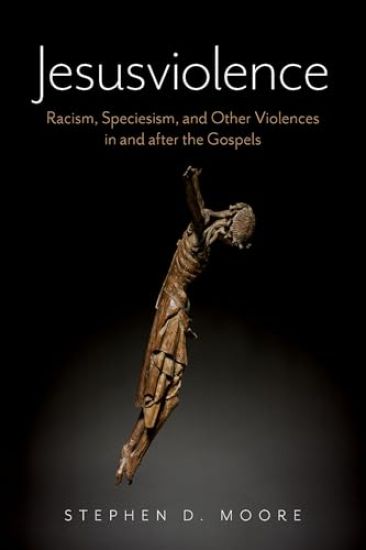
Jesusviolence

Jesusviolence

Stephen D. Moore

OXFORD UNIVERSITY PRESS INC
2026
sidottu
What does Jesus say and do within the narrative worlds of the New Testament gospels that, through the ages, enabled innumerable gory horrors and immense systemic violences to be perpetrated with his presumed permission? That is the question driving this book. Its compound title, Jesusviolence, simultaneously denotes: first, the violences inflicted on the gospel Jesuses in their narrative worlds; second, the violences enacted by the gospel Jesuses in their narrative worlds; and third, certain of the violences enacted in Jesus's name in our histories and worlds. The book's investigation of Jesusviolence extends over a spectrum ranging from the spectacularly visible--most notably, the ultraviolent spectacle that was Roman crucifixion--to the systemically invisible, which is to say structural, sanctioned, or sanctified violence, encapsulated in such gospel sayings as "The poor you always have with you" and "Are you [humans] not of more value than [nonhuman animals]?" Entangled with class- and species-related stratgems of systemic violence in and after the gospels are sex/gender-related stratagems, and race/ethnicity-related stratagems, the latter epitomized by the whitening of the gospel Jesus(es). A religio-cultural by-product of European colonialism, this white Jesus still towers over much of the globe. The book also conducts an iconoclastic interrogation of representation, the foundational concept for all previous scholarship on biblical violence, arguing that it is a distantiating concept inadequate for engaging with the visceral nature and immediacy of violence. Inspired by affect theory, non-representational theory, and other related currents of thought, this book is more interested in what gospel texts do than what they mean--not least when what they do, or cause to be done, is violent.
Mark and Luke in Poststructuralist Perspectives

Mark and Luke in Poststructuralist Perspectives

Stephen D. Moore

Yale University Press
1992
sidottu
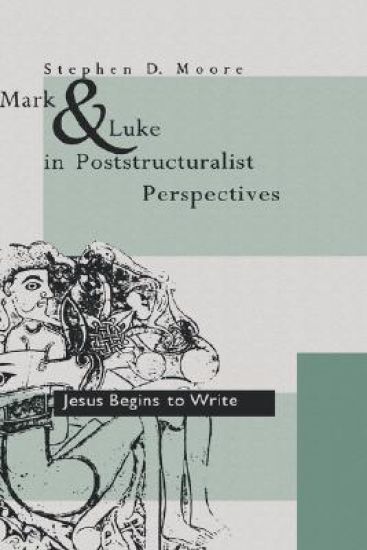
"What is the lesson of that other, newly sprung tree (the cross) in whose bark Mark has carved his Gospel (for this is a book that bleeds)? Is it that Jesus's body, grafted onto the cross, became one with it, and thus became tree, branch, book, and leaf, inscribed with letters of blood, can now at last be read, no longer an indecipherable code but an open codex? And that in its (now) re(a)d(able) ink, lately invisible, the message that was scratched into the fig tree is transcribed: outside the gates, but only just, the summer Son is shining in full strength?"--Stephen D. MooreIn this book Stephen D. Moore offers a dazzling new reading of the Gospels of Mark and Luke, applying the poststructuralist techniques of Derrida, Lacan, and Foucault to illuminate these texts in a way that no one has done before. Written with wit and a sensitivity to words--and wordplay--that is reminiscent of Moore's fellow countryman James Joyce, the book is also deeply learned, impressive in its detailed knowledge of previous scholarship as well as in the challenges it presents to that scholarship.Moore argues that whereas the language of the Gospels is concrete, pictorial, and often startling, the language of modern gospel scholarship tends to be propositional and abstract. Calling himself a New Test-what-is-meant scholar, he approaches the Gospels of Mark and Luke as though they were pictograms or dreamwork to decipher and interpret, writing a response that is no less visceral and immediate than the biblical texts themselves.
Revelation: An Introduction and Study Guide

Revelation: An Introduction and Study Guide

Stephen D. Moore

T. T.Clark Ltd
2021
nidottu
This study guide explores the origins and reception history of the Book of Revelation and its continuing fascination for readers from both religious and secular backgrounds. Stephen D. Moore examines the transcultural impact Revelation has had, both within and beyond Christianity, not only on imaginings of when and how the world will end, but also on imaginings of the risen Jesus, heaven and hell, Satan, the Antichrist, and even Mary the mother of Jesus.Moore traces Revelation’s remarkable reception through the ages, with special emphasis on its twentieth and twenty-first century appropriations, before resituating the book in its original context of production: Who wrote it, where, when, why, and modelled on what? The study guide culminates with a miniature commentary on the entire text of Revelation, weaving together liberationist, postcolonial, feminist, womanist, queer, and ecological approaches to the book in order to discern what it might mean for contemporary readers and communities concerned with issues of social justice.
Revelation: An Introduction and Study Guide

Revelation: An Introduction and Study Guide

Stephen D. Moore

T. T.Clark Ltd
2021
sidottu
This study guide explores the origins and reception history of the Book of Revelation and its continuing fascination for readers from both religious and secular backgrounds. Stephen D. Moore examines the transcultural impact Revelation has had, both within and beyond Christianity, not only on imaginings of when and how the world will end, but also on imaginings of the risen Jesus, heaven and hell, Satan, the Antichrist, and even Mary the mother of Jesus.Moore traces Revelation’s remarkable reception through the ages, with special emphasis on its twentieth and twenty-first century appropriations, before resituating the book in its original context of production: Who wrote it, where, when, why, and modelled on what? The study guide culminates with a miniature commentary on the entire text of Revelation, weaving together liberationist, postcolonial, feminist, womanist, queer, and ecological approaches to the book in order to discern what it might mean for contemporary readers and communities concerned with issues of social justice.
Post Structuralism and the New Testament

Post Structuralism and the New Testament

Stephen D. Moore

Augsburg Fortress
1994
pokkari
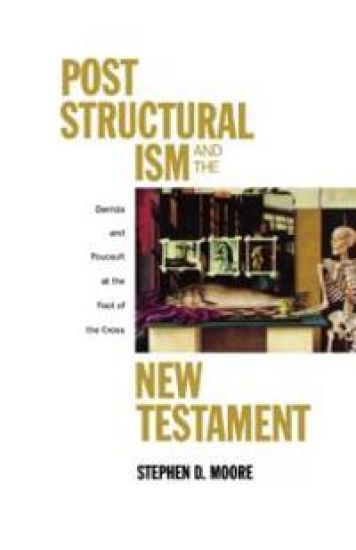
With typical wit and jargon-free clarity: Stephen D. Moore guides us through the maze of concepts and projects that constitute the multidisciplinary phenomenon of post-structuralism. Moore centers on two lengthy exegetical examples - a Derridean reading of John and his interpreters and a Foucauldian reading of Paul and his. The book also deals with deconstruction's relationship to Theology and its relationship to biblical scholarship old and new - historical critical, narrative critical, and feminist. All who want to know what the fuss is about will owe Moore a debt of gratitude for this book.
The Invention of the Biblical Scholar

The Invention of the Biblical Scholar

Stephen D. Moore

Fortress Press,U.S.
2011
pokkari
What is a "biblical scholar"? Stephen D. Moore and Yvonne Sherwood provide a thoroughly defamiliarizing and frequently entertaining re-description of this peculiar academic species and its odd disciplinary habitat. The modern-and -biblical scholar, they argue, is a product of the Enlightenment. Even when a biblical scholar imagines that she is doing something else entirely (something confessional, theoretical, literary, or even postmodern), she is sustaining Enlightened modernity and its effects. This study poses questions for scholars across the humanities concerned with the question of the religious and the secular. It also poses pressing questions for scholars and students of biblical interpretation: What other forms might biblical criticism have taken? What untried forms might biblical criticism yet take? Contents Adobe Acrobat Document Preface Adobe Acrobat Document Chapter 1 Adobe Acrobat Document Samples require Adobe Acrobat Reader Having trouble downloading and viewing PDF samples? "A lively and readable survey of the engagement of literary and biblical studies with Theory, that is, postmodern theories. The authors challenge biblical scholars to engage Theory to understand our own disciplinary history, and thereby widen our horizons and free ourselves to be more broadly intellectually relevant. I encourage biblical scholars and graduate students to take up the challenge." -Joanna Dewey Harvey H. Guthrie, Jr. Professor Emerita of Biblical Studies Episcopal Divinity School, Cambridge, Massachusetts "No one is more conversant in literary Theory than Moore and Sherwood, who have for some time been smuggling it into biblical studies in creative ways. As literary critics become less enamored of the promise of Theory, Moore and Sherwood see new possibilities for biblical scholars to move beyond the modernist obsession with 'the Enlightenment Bible' and engage theorists who are 'getting religion.' Their critique is sometimes caustic, always right-on; their manifesto points beyond traditional historical-critical methods, identity politics, and 'contextualization' for its own sake to a new, genuine universality that may shape the future of our discipline." -Richard Horsley Distinguished Professor of Liberal Arts and the Study of Religion, retired University of Massachusetts, Boston "Tongue-in-cheek and down-to-earth, this manifesto pairs clarity with a personal voice. A breath of fresh air, it makes everyone interested in being a "good" biblical scholar sit on edge. Sit tight! It's worth it." -Mieke Bal Academy Professor Royal Netherlands Academy of Arts and Sciences
God's Beauty Parlor

God's Beauty Parlor

Stephen D. Moore

Stanford University Press
2002
sidottu
God's Beauty Parlor opens the Bible to the contested body of critical commentary on sex and sexuality known as queer theory and to masculinity studies. Through a series of dazzling rereadings staged not only in God's beauty parlor, but also in God's boudoir, locker room, and war room, the author pursues the themes of homoeroticism, masculinity, beauty, and violence through such texts as the Song of Songs, the Gospels, the Letter to the Romans, and the Book of Revelation. He ponders such matters as the curious place of the Song of Songs in the history of sexuality, or how an apparent paean to male-female love became a pretext for literary cross-dressing for legions of male Jewish and Christian commentators; Jesus' face and physique in relation to ideologies of beauty, ranging from the patristic era, when the "earthly" Jesus was regularly represented as ugly, to the contemporary global culture industry, with its trademark equation of looks with worth; the gendered and sexual substratum of Paul's doctrine of salvation embedded in his most influential epistle—not least his gendering of righteousness as masculine and sin as feminine; and the intimate imbrication of masculinity and mass death in Revelation, a book about war making men making war-making men . . . some of whom also happen to be gods. God's Beauty Parlor is an exhilarating attempt to bring some of the most significant currents in contemporary gender studies to bear on a text that, even in the post-Christian West, remains the ultimate cultural icon, cipher, and shibboleth.
Decolonial Theory and Biblical Unreading
Postcolonial theory in the mode of Edward Said, Gayatri Spivak, and, above all, Homi Bhabha has long been a resource for biblical scholars concerned with empire and imperialism, colonialism and neocolonialism. Outside biblical studies, however, postcolonial theory is increasingly eclipsed by decolonial theory with its key concepts of the coloniality of power, decoloniality, and epistemic delinking. Decolonial theory begs a radical reconception of the origins of critical biblical scholarship; invites a delinking of biblical interpretation from the colonial matrix of power; and provides resources for doing so, as this book demonstrates through a decolonial (un)reading of the Gospel of Mark.
Gospel Jesuses and Other Nonhumans

Gospel Jesuses and Other Nonhumans

Stephen D Moore

Society of Biblical Literature
2017
sidottu
This new resource from Stephen D. Moore applies nonhuman critical theory to the biblical texts of Matthew, Mark, Luke, John, and Acts. Nonhuman theory is a confluence of several of the main theoretical streams that have issued forth since the heyday of high poststructuralism, including affect theory, posthuman animality studies, critical plant studies, object-oriented new materialisms, and assemblage theory. Nonhuman theory dismantles and reassembles the Western concept of "the human" that coalesced during the Enlightenment and testifies to other conceptions of the human and of the nonhuman, not least those found in the New Testament gospels and Acts. Exegetical explorations and defamiliarizations of these overly familiar texts open new paths in biblical ecotheology and ecocriticism for scholars and students of the Bible, literary criticism, and cultural studies.
Gospel Jesuses and Other Nonhumans

Gospel Jesuses and Other Nonhumans

Stephen D Moore

Society of Biblical Literature
2017
pokkari
This new resource from Stephen D. Moore applies nonhuman critical theory to the biblical texts of Matthew, Mark, Luke, John, and Acts. Nonhuman theory is a confluence of several of the main theoretical streams that have issued forth since the heyday of high poststructuralism, including affect theory, posthuman animality studies, critical plant studies, object-oriented new materialisms, and assemblage theory. Nonhuman theory dismantles and reassembles the Western concept of "the human" that coalesced during the Enlightenment and testifies to other conceptions of the human and of the nonhuman, not least those found in the New Testament gospels and Acts. Exegetical explorations and defamiliarizations of these overly familiar texts open new paths in biblical ecotheology and ecocriticism for scholars and students of the Bible, literary criticism, and cultural studies.
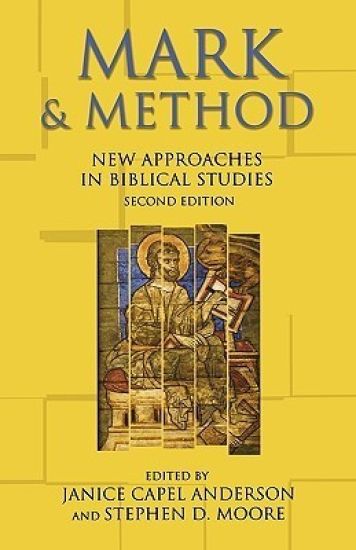
Mark and Method

Mark and Method

Janice Capel Anderson; Stephen D. Moore

Augsburg Fortress
2008
pokkari
Since its publication by Fortress Press in 1992, Mark and Method has been an invaluable resource for the study of Mark, and of the range of methods used in interpreting the New Testament. This second edition offers a new introduction and chapters brought up to date with the latest developments in interpretation, including new chapters on Cultural Studies and Post-Colonial Criticism. The contributors include: Janice Capel Anderson, Stephen D. Moore, Elizabeth Struthers Malbon, Robert M. Fowler, David Rhoads, Tat-Siong Benny Liew, and Abraham Smith.