Kirjojen hintavertailu. Mukana 11 244 527 kirjaa ja 12 kauppaa.

Kirjahaku

Etsi kirjoja tekijän nimen, kirjan nimen tai ISBN:n perusteella.

1000 tulosta hakusanalla Stephen Gaukroger

Civilization and the Culture of Science

Civilization and the Culture of Science

Stephen Gaukroger

Oxford University Press
2022
nidottu
How did science come to have such a central place in Western culture? How did cognitive values—and subsequently moral, political, and social ones—come to be modelled around scientific values? In Civilization and the Culture of Science, Stephen Gaukroger explores how these values were shaped and how they began, in turn, to shape those of society. The core nineteenth- and twentieth-century development is that in which science comes to take centre stage in determining ideas of civilization, displacing Christianity in this role. Christianity had provided a unifying thread in the study of the world, however, and science had to match this, which it did through the project of the unity of the sciences. The standing of science came to rest or fall on this question, which the book sets out to show in detail is essentially ideological, not something that arose from developments within the sciences, which remained pluralistic and modular. A crucial ingredient in this process was a fundamental rethinking of the relations between science and ethics, economics, philosophy, and engineering. In his engaging description of this transition to a scientific modernity, Gaukroger examines five of the issues which underpinned this shift in detail: changes in the understanding of civilization; the push to unify the sciences; the rise of the idea of the limits of scientific understanding; the concepts of 'applied' and 'popular' science; and the way in which the public was shaped in a scientific image.

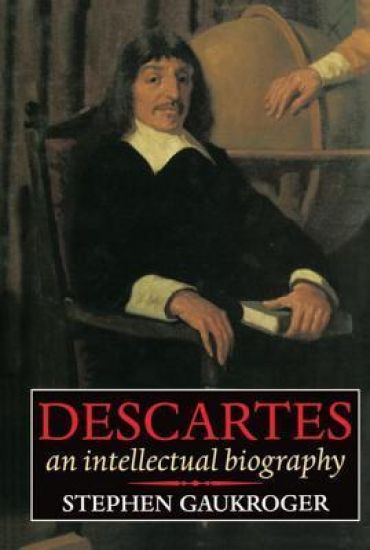
Descartes: An Intellectual Biography

Descartes: An Intellectual Biography

Stephen Gaukroger

Clarendon Press
1997
nidottu
René Descartes (1596-1650) is the father of modern philosophy, and one of the greatest of all thinkers. This is the first intellectual biography of Descartes in English; it offers a fundamental reassessment of all aspects of his life and work. Stephen Gaukroger, a leading authority on Descartes, traces his intellectual development from childhood, showing the connections between his intellectual and personal life and placing these in the cultural context of seventeenth century Europe. Descartes' early work in mathematics and science produced ground breaking theories, methods, and tools still in use today. This book gives the first full account of how this work informed and influenced the later philosophical studies for which, above all, Descartes is renowned. Not only were philosophy and science intertwined in Descartes' life; so were philosophy and religion. The Church of Rome found Galileo guilty of heresy in 1633; two decades earlier, Copernicus' theories about the universe had been denounced as blasphemous. To avoid such accusations, Descartes clothed his views about the relation between God and humanity, and about the nature of the universe, in a philosophical garb acceptable to the Church. His most famous project was the exploration of the foundations of human knowledge, starting from the proof of one's own existence offered in the formula Cogito ergo sum, `I am thinking therefore I exist'. Stephen Gaukroger argues that this was not intended as an exercise in philosophical scepticism, but rather to provide Descartes' scientific theories, influenced as they were by Copernicus and Galileo, with metaphysical legitimation. This book offers for the first time a full understanding of how Descartes developed his revolutionary ideas. It will be welcomed by all readers interested in the origins of modern thought.
Descartes: An Intellectual Biography

Descartes: An Intellectual Biography

Stephen Gaukroger

Oxford University Press
1995
sidottu
Descartes is one of the greatest of all thinkers. Modern philosophy is generally taken to begin with him. His unique contribution to Western thought covers not only philosophy but also science and mathematics; his studies in mechanics and optics have provided modern science with tools still used and work still built on today. This is the first intellectual biography of Descartes in English. Stephen Gaukroger traces his intellectual development from childhood, establishes the connections between his intellectual and personal life, and placing these in the context of the cultural environment of the time, offers a fundamental reassessment of all aspects of his life and work. It is usually assumed that there is a little development in Descartes' thought, but this biography shows evidence of very significant changes of view and a general shift in his concern away from natural philosophy following the condemnation of Galileo by the Church in 1633. Starting with a full account of Descartes' early scientific work, Dr Gaukroger shows how it informed and influenced his later philosophical studies. On this new view, Descartes' philosophical work was meant not a self-contained exercise in epistemology and scepticism, but rather as a defence of his physical doctrines against a hostile Church. This book allows for the first time a full understanding of Descartes' ideas in the context of his life and times. It will be welcomed by all readers interested in the origins of modern thought.
Cartesian Logic

Cartesian Logic

Stephen Gaukroger

Clarendon Press
1989
sidottu
This book deals with a neglected episode in the history of logic and theories of cognition: the way in which conceptions of inference changed during the seventeenth century. The author focuses on the work of Descartes, contrasting his construal of inference as an instantaneous grasp in accord with the natural light of reason, with the Aristotelian view of inference as a discursive process. Gaukroger offers a new interpretation of Descartes`s contribution to the question, revealing it to be a significant advance over humanist and late Scholastic conceptions. He argues that Descartes's account played a pivotal role in the development of our understanding of the nature of inference.
The Natural and the Human

The Natural and the Human

Stephen Gaukroger

Oxford University Press
2016
sidottu
Stephen Gaukroger presents an original account of the development of empirical science and the understanding of human behaviour from the mid-eighteenth century. Since the seventeenth century, science in the west has undergone a unique form of cumulative development in which it has been consolidated through integration into and shaping of a culture. But in the eighteenth century, science was cut loose from the legitimating culture in which it had had a public rationale as a fruitful and worthwhile form of enquiry. What kept it afloat between the middle of the eighteenth and the middle of the nineteenth centuries, when its legitimacy began to hinge on an intimate link with technology? The answer lies in large part in an abrupt but fundamental shift in how the tasks of scientific enquiry were conceived, from the natural realm to the human realm. At the core of this development lies the naturalization of the human, that is, attempts to understand human behaviour and motivations no longer in theological and metaphysical terms, but in empirical terms. One of the most striking feature of this development is the variety of forms it took, and the book explores anthropological medicine, philosophical anthropology, the 'natural history of man', and social arithmetic. Each of these disciplines re-formulated basic questions so that empirical investigation could be drawn upon in answering them, but the empirical dimension was conceived very differently in each case, with the result that the naturalization of the human took the form of competing, and in some respects mutually exclusive, projects.
The Natural and the Human

The Natural and the Human

Stephen Gaukroger

Oxford University Press
2018
nidottu
Stephen Gaukroger presents an original account of the development of empirical science and the understanding of human behaviour from the mid-eighteenth century. Since the seventeenth century, science in the west has undergone a unique form of cumulative development in which it has been consolidated through integration into and shaping of a culture. But in the eighteenth century, science was cut loose from the legitimating culture in which it had had a public rationale as a fruitful
Civilization and the Culture of Science

Civilization and the Culture of Science

Stephen Gaukroger

Oxford University Press
2020
sidottu
How did science come to have such a central place in Western culture? How did cognitive values--and subsequently moral, political, and social ones--come to be modelled around scientific values? In Civilization and the Culture of Science, Stephen Gaukroger explores how these values were shaped and how they began, in turn, to shape those of society. The core nineteenth- and twentieth-century development is that in which science comes to take centre stage in determining ideas of civilization, displacing Christianity in this role. Christianity had provided a unifying thread in the study of the world, however, and science had to match this, which it did through the project of the unity of the sciences. The standing of science came to rest or fall on this question, which the book sets out to show in detail is essentially ideological, not something that arose from developments within the sciences, which remained pluralistic and modular. A crucial ingredient in this process was a fundamental rethinking of the relations between science and ethics, economics, philosophy, and engineering. In his engaging description of this transition to a scientific modernity, Gaukroger examines five of the issues which underpinned this shift in detail: changes in the understanding of civilization; the push to unify the sciences; the rise of the idea of the limits of scientific understanding; the concepts of 'applied' and 'popular' science; and the way in which the public was shaped in a scientific image.
The Emergence of a Scientific Culture

The Emergence of a Scientific Culture

Stephen Gaukroger

Clarendon Press
2006
sidottu
Why did science emerge in the West and how did scientific values come to be regarded as the yardstick for all other forms of knowledge? Stephen Gaukroger shows just how bitterly the cognitive and cultural standing of science was contested in its early development. Rejecting the traditional picture of secularization, he argues that science in the seventeenth century emerged not in opposition to religion but rather was in many respects driven by it. Moreover, science did not present a unified picture of nature but was an unstable field of different, often locally successful but just as often incompatible, programmes. To complicate matters, much depended on attempts to reshape the persona of the natural philosopher, and distinctive new notions of objectivity and impartiality were imported into natural philosophy, changing its character radically by redefining the qualities of its practitioners. The West's sense of itself, its relation to its past, and its sense of its future, have been profoundly altered since the seventeenth century, as cognitive values generally have gradually come to be shaped around scientific ones. Science has not merely brought a new set of such values to the task of understanding the world and our place in it, but rather has completely transformed the task, redefining the goals of enquiry. This distinctive feature of the development of a scientific culture in the West marks it out from other scientifically productive cultures. In The Emergence of a Scientific Culture, Stephen Gaukroger offers a detailed and comprehensive account of the formative stages of this development---and one which challenges the received wisdom that science was seen to be self-evidently the correct path to knowledge and that the benefits of science were immediately obvious to the disinterested observer.
The Emergence of a Scientific Culture

The Emergence of a Scientific Culture

Stephen Gaukroger

Oxford University Press
2008
nidottu
Why did science emerge in the West and how did scientific values come to be regarded as the yardstick for all other forms of knowledge? Stephen Gaukroger shows just how bitterly the cognitive and cultural standing of science was contested in its early development. Rejecting the traditional picture of secularization, he argues that science in the seventeenth century emerged not in opposition to religion but rather was in many respects driven by it. Moreover, science did not present a unified picture of nature but was an unstable field of different, often locally successful but just as often incompatible, programmes. To complicate matters, much depended on attempts to reshape the persona of the natural philosopher, and distinctive new notions of objectivity and impartiality were imported into natural philosophy, changing its character radically by redefining the qualities of its practitioners. The West's sense of itself, its relation to its past, and its sense of its future, have been profoundly altered since the seventeenth century, as cognitive values generally have gradually come to be shaped around scientific ones. Science has not merely brought a new set of such values to the task of understanding the world and our place in it, but rather has completely transformed the task, redefining the goals of enquiry. This distinctive feature of the development of a scientific culture in the West marks it out from other scientifically productive cultures. In The Emergence of a Scientific Culture, Stephen Gaukroger offers a detailed and comprehensive account of the formative stages of this development---and one which challenges the received wisdom that science was seen to be self-evidently the correct path to knowledge and that the benefits of science were immediately obvious to the disinterested observer.
The Collapse of Mechanism and the Rise of Sensibility

The Collapse of Mechanism and the Rise of Sensibility

Stephen Gaukroger

Oxford University Press
2010
sidottu
Understanding the emergence of a scientific culture - one in which cognitive values generally are modelled on, or subordinated to, scientific ones - is one of the foremost historical and philosophical problems with which we are now confronted. The significance of the emergence of such scientific values lies above all in their ability to provide the criteria by which we come to appraise cognitive enquiry, and which shape our understanding of what it can achieve. The period between the 1680s and the middle of the eighteenth century is a very distinctive one in this development. It is then that we witness the emergence of the idea that scientific values form a model for all cognitive claims. It is also at this time that science explicitly goes beyond technical expertise and begins to articulate a world-view designed to displace others, whether humanist or Christian. But what occurred took place in a peculiar and overdetermined fashion, and the outcome in the mid-eighteenth century was not the triumph of 'reason', as has commonly been supposed, but rather a simultaneous elevation of the standing of science and the beginnings of a serious questioning of whether science offers a comprehensive form of understanding. The Collapse of Mechanism and the Rise of Sensibility is the sequel to Stephen Gaukroger's acclaimed 2006 book The Emergence of a Scientific Culture. It offers a rich and fascinating picture of the development of intellectual culture in a period where understandings of the natural realm began to fragment.
Objectivity

Objectivity

Stephen Gaukroger

Oxford University Press
2012
nidottu
- Is objectivity possible? - Can there be objectivity in matters of morals, or tastes? - What would a truly objective account of the world be like? - Is everything subjective, or relative? - Are moral judgments objective or culturally relative? Objectivity is both an essential and elusive philosophical concept. An account is generally considered to be objective if it attempts to capture the nature of the object studied without judgement of a conscious entity or subject. Objectivity stands in contrast to subjectivity: an objective account is impartial, one which could ideally be accepted by any subject, because it does not draw on any assumptions, prejudices, or values of particular subjects. Stephen Gaukroger shows that it is far from clear that we can resolve moral or aesthetic disputes in this way and it has often been argued that such an approach is not always appropriate for disciplines that deal with human, rather than natural, phenomena. Moreover, even in those cases where we seek to be objective, it may be difficult to judge what a truly objective account would look like, and whether it is achievable. This Very Short Introduction demonstrates that there are a number of common misunderstandings about what objectivity is, and explores the theoretical and practical problems of objectivity by assessing the basic questions raised by it. As well as considering the core philosophical issues, Gaukroger also deals with the way in which particular understandings of objectivity impinge on social research, science, and art. ABOUT THE SERIES: The Very Short Introductions series from Oxford University Press contains hundreds of titles in almost every subject area. These pocket-sized books are the perfect way to get ahead in a new subject quickly. Our expert authors combine facts, analysis, perspective, new ideas, and enthusiasm to make interesting and challenging topics highly readable.
The Collapse of Mechanism and the Rise of Sensibility

The Collapse of Mechanism and the Rise of Sensibility

Stephen Gaukroger

Oxford University Press
2012
nidottu
Understanding the emergence of a scientific culture - one in which cognitive values generally are modelled on, or subordinated to, scientific ones - is one of the foremost historical and philosophical problems with which we are now confronted. The significance of the emergence of such scientific values lies above all in their ability to provide the criteria by which we come to appraise cognitive enquiry, and which shape our understanding of what it can achieve. The period between the 1680s and the middle of the eighteenth century is a very distinctive one in this development. It is then that we witness the emergence of the idea that scientific values form a model for all cognitive claims. It is also at this time that science explicitly goes beyond technical expertise and begins to articulate a world-view designed to displace others, whether humanist or Christian. But what occurred took place in a peculiar and overdetermined fashion, and the outcome in the mid-eighteenth century was not the triumph of 'reason', as has commonly been supposed, but rather a simultaneous elevation of the standing of science and the beginnings of a serious questioning of whether science offers a comprehensive form of understanding. The Collapse of Mechanism and the Rise of Sensibility is the sequel to Stephen Gaukroger's acclaimed 2006 book The Emergence of a Scientific Culture. It offers a rich and fascinating picture of the development of intellectual culture in a period where understandings of the natural realm began to fragment.
The Soft Underbelly of Reason

The Soft Underbelly of Reason

Stephen Gaukroger

Routledge
1998
sidottu
This book provides a valuable understanding on the different views of the passions in the Seventeenth Century. The contributors show that fundamental questions about the nature of wisdom, goodness and beauty were understood in terms of the contrast between reason and passions in this era. Those with an interest in philosophy , the history of medicene, and women's studies will find this collection a fascinating read.
The Soft Underbelly of Reason

The Soft Underbelly of Reason

Stephen Gaukroger

Routledge
2011
nidottu
This book provides a valuable understanding on the different views of the passions in the Seventeenth Century. The contributors show that fundamental questions about the nature of wisdom, goodness and beauty were understood in terms of the contrast between reason and passions in this era. Those with an interest in philosophy , the history of medicene, and women's studies will find this collection a fascinating read.
Descartes' System of Natural Philosophy

Descartes' System of Natural Philosophy

Stephen Gaukroger

Cambridge University Press
2002
pokkari
Towards the end of his life, Descartes published the first four parts of a projected six-part work, The Principles of Philosophy. This was intended to be the definitive statement of his complete system of philosophy, dealing with everything from cosmology to the nature of human happiness. Stephen Gaukroger examines the whole system, and reconstructs the last two parts, ‘On Living Things’ and ‘On Man’, from Descartes’ other writings. He relates the work to the tradition of late Scholastic textbooks which it follows, and also to Descartes’ other philosophical writings, and he examines the ways in which Descartes transformed not only the practice of natural philosophy but also our understanding of what it is to be a philosopher. His book is the first comprehensive examination of Descartes’ complete philosophical system.
Francis Bacon and the Transformation of Early-Modern Philosophy

Francis Bacon and the Transformation of Early-Modern Philosophy

Stephen Gaukroger

Cambridge University Press
2001
sidottu
This ambitious and important book, first published in 2001, provides a truly general account of Francis Bacon as a philosopher. It describes how Bacon transformed the values that had underpinned philosophical culture since antiquity by rejecting the traditional idea of a philosopher as someone engaged in contemplation of the cosmos. The book explores in detail how and why Bacon attempted to transform the largely esoteric discipline of natural philosophy into a public practice through a program in which practical science provided a model that inspired many from the seventeenth to the twentieth centuries. Stephen Gaukroger shows that this reform of natural philosophy was dependent on the creation of a new philosophical persona: a natural philosopher shaped through submission to the dictates of Baconian method. This book will be recognized as a major contribution to Baconian scholarship, of special interest to historians of early-modern philosophy, science, and ideas.
Francis Bacon and the Transformation of Early-Modern Philosophy

Francis Bacon and the Transformation of Early-Modern Philosophy

Stephen Gaukroger

Cambridge University Press
2001
pokkari
This ambitious and important book, first published in 2001, provides a truly general account of Francis Bacon as a philosopher. It describes how Bacon transformed the values that had underpinned philosophical culture since antiquity by rejecting the traditional idea of a philosopher as someone engaged in contemplation of the cosmos. The book explores in detail how and why Bacon attempted to transform the largely esoteric discipline of natural philosophy into a public practice through a program in which practical science provided a model that inspired many from the seventeenth to the twentieth centuries. Stephen Gaukroger shows that this reform of natural philosophy was dependent on the creation of a new philosophical persona: a natural philosopher shaped through submission to the dictates of Baconian method. This book will be recognized as a major contribution to Baconian scholarship, of special interest to historians of early-modern philosophy, science, and ideas.
Descartes' System of Natural Philosophy

Descartes' System of Natural Philosophy

Stephen Gaukroger

Cambridge University Press
2002
sidottu
Towards the end of his life, Descartes published the first four parts of a projected six-part work, The Principles of Philosophy. This was intended to be the definitive statement of his complete system of philosophy, dealing with everything from cosmology to the nature of human happiness. In this book, Stephen Gaukroger examines the whole system, and reconstructs the last two parts, 'On Living Things' and 'On Man', from Descartes' other writings. He relates the work to the tradition of late Scholastic textbooks which it follows, and also to Descartes' other philosophical writings, and he examines the ways in which Descartes transformed not only the practice of natural philosophy but also our understanding of what it is to be a philosopher. His book is a comprehensive examination of Descartes' complete philosophical system.
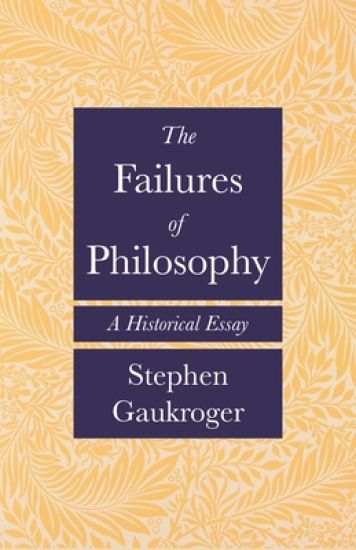
The Failures of Philosophy

The Failures of Philosophy

Stephen Gaukroger

PRINCETON UNIVERSITY PRESS
2020
sidottu
The first book to address the historical failures of philosophy—and what we can learn from themPhilosophers are generally unaware of the failures of philosophy, recognizing only the failures of particular theories, which are then remedied with other theories. But, taking the long view, philosophy has actually collapsed several times, been abandoned, sometimes for centuries, and been replaced by something quite different. When it has been revived it has been with new aims that are often accompanied by implausible attempts to establish continuity with a perennial philosophical tradition. What do these failures tell us?The Failures of Philosophy presents a historical investigation of philosophy in the West, from the perspective of its most significant failures: attempts to provide an account of the good life, to establish philosophy as a discipline that can stand in judgment over other forms of thought, to set up philosophy as a theory of everything, and to construe it as a discipline that rationalizes the empirical and mathematical sciences. Stephen Gaukroger argues that these failures reveal more about philosophical inquiry and its ultimate point than its successes ever could. These failures illustrate how and why philosophical inquiry has been conceived and reconceived, why philosophy has been thought to bring distinctive skills to certain questions, and much more.An important and original account of philosophy’s serial breakdowns, The Failures of Philosophy ultimately shows how these shortcomings paradoxically reveal what matters most about the field.
The Failures of Philosophy

The Failures of Philosophy

Stephen Gaukroger

PRINCETON UNIVERSITY PRESS
2023
pokkari
The first book to address the historical failures of philosophy—and what we can learn from themPhilosophers are generally unaware of the failures of philosophy, recognizing only the failures of particular theories, which are then remedied with other theories. But, taking the long view, philosophy has actually collapsed several times, been abandoned, sometimes for centuries, and been replaced by something quite different. When it has been revived it has been with new aims that are often accompanied by implausible attempts to establish continuity with a perennial philosophical tradition. What do these failures tell us?The Failures of Philosophy presents a historical investigation of philosophy in the West, from the perspective of its most significant failures: attempts to provide an account of the good life, to establish philosophy as a discipline that can stand in judgment over other forms of thought, to set up philosophy as a theory of everything, and to construe it as a discipline that rationalizes the empirical and mathematical sciences. Stephen Gaukroger argues that these failures reveal more about philosophical inquiry and its ultimate point than its successes ever could. These failures illustrate how and why philosophical inquiry has been conceived and reconceived, why philosophy has been thought to bring distinctive skills to certain questions, and much more.An important and original account of philosophy’s serial breakdowns, The Failures of Philosophy ultimately shows how these shortcomings paradoxically reveal what matters most about the field.