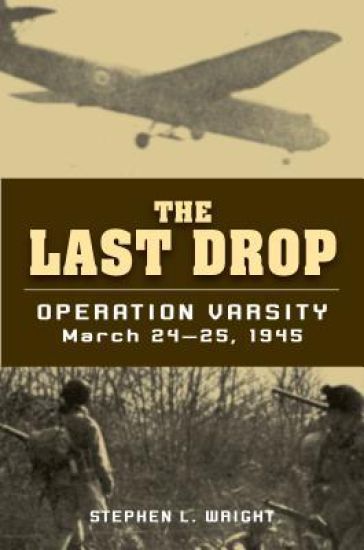
Operation Varsity was the last major airborne offensive of World War II and remains the largest and most successful single-lift drop in history. Conducted by the American 17th and British 6th Airborne Divisions, the goal of the operation was to cross the Rhine River and gain a foothold in Germany. The Last Drop details the horrors of parachuting through flak-filled skies, the dangers of piloting a glider safely to the ground, and the struggles of infantry combat, and shows how thorough training, extensive planning, solid execution, and sheer guts combined to make Operation Varsity a stunning victory.
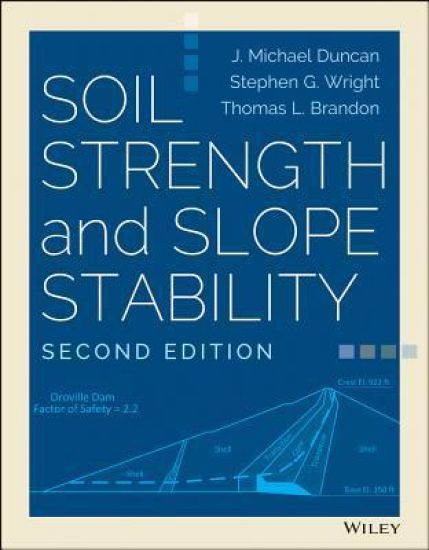
The definitive guide to the critical issue of slope stability and safety Soil Strength and Slope Stability, Second Edition presents the latest thinking and techniques in the assessment of natural and man-made slopes, and the factors that cause them to survive or crumble. Using clear, concise language and practical examples, the book explains the practical aspects of geotechnical engineering as applied to slopes and embankments. The new second edition includes a thorough discussion on the use of analysis software, providing the background to understand what the software is doing, along with several methods of manual analysis that allow readers to verify software results. The book also includes a new case study about Hurricane Katrina failures at 17th Street and London Avenue Canal, plus additional case studies that frame the principles and techniques described. Slope stability is a critical element of geotechnical engineering, involved in virtually every civil engineering project, especially highway development. Soil Strength and Slope Stability fills the gap in industry literature by providing practical information on the subject without including extraneous theory that may distract from the application. This balanced approach provides clear guidance for professionals in the field, while remaining comprehensive enough for use as a graduate-level text. Topics include: Mechanics of soil and limit equilibrium proceduresAnalyzing slope stability, rapid drawdown, and partial consolidationSafety, reliability, and stability analysesReinforced slopes, stabilization, and repair The book also describes examples and causes of slope failure and stability conditions for analysis, and includes an appendix of slope stability charts. Given how vital slope stability is to public safety, a comprehensive resource for analysis and practical action is a valuable tool. Soil Strength and Slope Stability is the definitive guide to the subject, proving useful both in the classroom and in the field.
This textbook provides a self-contained introduction to linear programming using MATLAB(R) software to elucidate the development of algorithms and theory. Early chapters cover linear algebra basics, the simplex method, duality, the solving of large linear problems, sensitivity analysis, and parametric linear programming. In later chapters, the authors discuss quadratic programming, linear complementarity, interior-point methods, and selected applications of linear programming to approximation and classification problems. Exercises are interwoven with the theory presented in each chapter, and two appendices provide additional information on linear algebra, convexity, and nonlinear functions and on available MATLAB commands, respectively. Readers can access MATLAB codes and associated mex files at a Web site maintained by the authors.
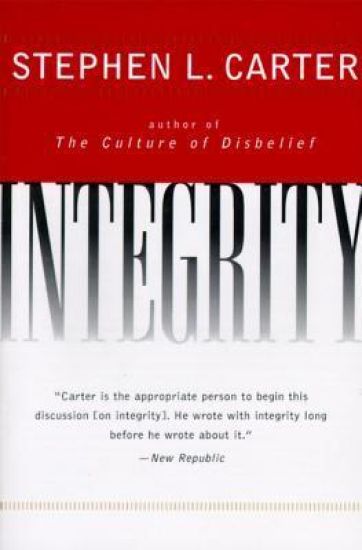
Why do we care more about winning than about playing by the rules? Integrity - all of us are in favor of it, but nobody seems to know how to make sure that we get it. From presidential candidates to crusading journalists to the lords of collegiate sports, everybody promises to deliver integrity, yet all too often, the promises go unfulfilled. Stephen Carter examines why the virtue of integrity holds such sway over the American political imagination. By weaving together insights from philosophy, theology, history and law, along with examples drawn from current events and a dose of personal experience, Carter offers a vision of integrity that has implications for everything from marriage and politics to professional football. He discusses the difficulties involved in trying to legislate integrity as well as the possibilities for teaching it. As the Cleveland Plain Dealer said, "In a measured and sensible voice, Carter attempts to document some of the paradoxes and pathologies that result from pervasive ethical realism... If the modern drift into relativism has left us in a cultural and political morass, Carter suggests that the assumption of personal integrity is the way out."
A leading intellectual and scholar considers the causes and nature of the moral crisis in America today and offers ways in which families, individuals, and politicians can improve the country by adhering to basic principles of civility. Reprint. 35,000 first printing.
When The Emperor of Ocean Park was published, the Observer declared: 'The book is superb, both as a thriller and as a novel of social observation.' Now, with that same astute social observation, narrative drive, and richness of plot and character, Stephen Carter returns us to the New England university town of Elm Harbor, where the murder of a renowned African-American economist opens a door on the racial complications of the town's past, on one family's secrets, and on the most hidden and powerful bastions of African-American political influence. At the centre are Lemaster and Julia Carlyle. He is president of the university, she is a dean at the divinity school - African-Americans living in 'the heart of whiteness'. Lemaster's connections lead to the President of the United States, his old college room-mate. Julia is connected to the dead man, Kellen Zant, her lover before she met Lemaster. The meeting point of these connections - a murder committed and covered up in Elm Harbor thirty years ago, and the shocking plans carried out by a fraternity of the 'darker nation' - forms the core of a mystery that deepens even as Julia, guided by clues left her by Zant, closes in on the politically earth-shattering motive behind his murder. Suspenseful from first to last, galvanising in its exploration of the profound difference between allegiance to ideas and to people, New England White is a resounding confirmation of Stephen Carter's gifts as a writer of fiction.
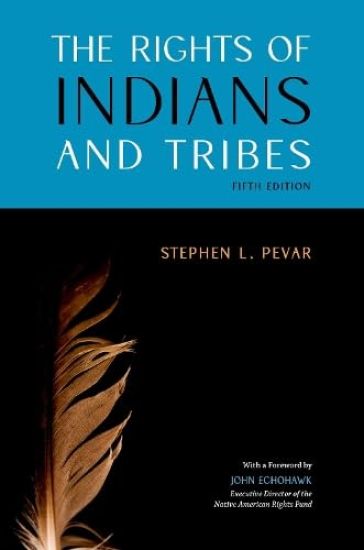
The Rights of Indians and Tribes explains Federal Indian Law in a conversational manner, yet is highly authoritative, containing over 2000 footnotes with citations to relevant court decisions, statutes, and agency regulations. Since its initial publication in 1983 it has sold over 125,000 copies. It is user-friendly and particularly helpful for tribal advocates, students, government officials, lawyers, and members of the general public. The book uses a question-and-answer format and covers every important subject impacting Indians and tribes today and discusses which governments-tribal, state, and federal-have authority on Indian reservations. This fully-updated fifth edition provides a Foreword by John Echohawk, Director of the Native American Rights Fund, and covers the most significant legal issues facing Indians and Indian tribes. This includes the regulation of non-Indians on reservations, definitions of important legal terms, Indian treaties, the Indian Civil Rights Act, the Indian Gaming Regulatory Act, and the Indian Child Welfare Act.
The Rights of Indians and Tribes explains Federal Indian Law in a conversational manner, yet is highly authoritative, containing over 2000 footnotes with citations to relevant court decisions, statutes, and agency regulations. Since its initial publication in 1983 it has sold over 125,000 copies. It is user-friendly and particularly helpful for tribal advocates, students, government officials, lawyers, and members of the general public. The book uses a question-and-answer format and covers every important subject impacting Indians and tribes today and discusses which governments-tribal, state, and federal-have authority on Indian reservations. This fully-updated fifth edition provides a Foreword by John Echohawk, Director of the Native American Rights Fund, and covers the most significant legal issues facing Indians and Indian tribes. This includes the regulation of non-Indians on reservations, definitions of important legal terms, Indian treaties, the Indian Civil Rights Act, the Indian Gaming Regulatory Act, and the Indian Child Welfare Act.
This book presents a new formulation of quantum mechanics using quaternionic, rather than complex, numbers. The author is a highly respected theoretical physicist who has been working on quaternionic quantum mechanics for the last fourteen years. The author clearly explicates the relations between quaternionic, complex and real quantum mechanics, and the book is certain to be a major contribution to theoretical physics. Accessible to readers with a first-year graduate level quantum mechanics course.
Stephen L. Elkin deftly combines the empirical and normative strands of political science to make a powerfully original statement about what cities are, can, and should be. Rejecting the idea that two goals of city politics—equality and efficiency—are opposed to one another, Elkin argues that a commercial republic could achieve both. He then takes the unusual step of addressing how the political institutions of the city can help to form the kind of citizenry such a republic needs. The present workings of American urban political institutions are, Elkin maintains, characterized by a close relationship between politicians and businessmen, a relationship that promotes neither political equality nor effective social problem-solving. Elkin pays particular attention to the issue of land-use in his analysis of these failures of popular control in traditional city politics. Urban political institutions, however, are not just instruments for the dispensing of valued outcomes or devices for social problem-solving—they help to form the citizenry. Our present institutions largely define citizens as interest group adversaries and do little to encourage them to focus on the commercial public interest of the city. Elkin concludes by proposing new institutional arrangements that would be better able to harness the self-interested behavior of individuals for the common good of a commercial republic.
James Madison is the thinker most responsible for laying the groundwork of the American commercial republic. But he did not anticipate that the propertied class on which he relied would become extraordinarily politically powerful at the same time as its interests narrowed. This and other flaws, argues Stephen L. Elkin, have undermined the delicately balanced system he constructed. In Reconstructing the Commercial Republic, Elkin critiques the Madisonian system, revealing which of its aspects have withstood the test of time and which have not. The deficiencies Elkin points out provide the starting point for his own constitutional theory of the republic-a theory that, unlike Madison's, lays out a substantive conception of the public interest that emphasizes the power of institutions to shape our political, economic, and civic lives. Elkin argues that his theory should guide us toward building a commercial republic that is rooted in a politics of the public interest and the self-interest of the middle class. He then recommends specific reforms to create this kind of republic, asserting that Americans today can still have the lives a commercial republic is intended to promote: lives with real opportunities for economic prosperity, republican political self-government, and individual liberty.
If Saint Thomas Aquinas was a great theologian, it is in no small part because he was a great philosopher. And he was a great philosopher because he was a great metaphysician. In the twentieth century, metaphysics was not much in vogue, among either theologians or even philosophers; but now it is making a comeback, and once the contours of Thomas's metaphysical vision are glimpsed, it looks like anything but a museum piece. It only needs some dusting off. Many are studying Thomas now for the answers that he might be able to give to current questions, but he is perhaps even more interesting for the questions that he can raise regarding current answers: about the physical world, about human life and knowledge, and (needless to say) about God. This book is aimed at helping those who are not experts in medieval thought to begin to enter into Thomas's philosophical point of view. Along the way, it brings out some aspects of his thought that are not often emphasised in the current literature, and it offers a reading of his teaching on the divine nature that goes rather against the drift of some prominent recent interpretations.
Drawing upon a wealth of previously untranslated documents, Broken Wings tells how a European nation built an entire air force in secret. Carved up and banned from having a military air service after World War I, Hungary became determined to rearm itself. In the early 1920s, Allied inspectors were evaded and obstructed at every turn; great efforts were made to stockpile equipment from the Great War; and the Hungarian government promoted the development of commercial aviation, partly as a front for military flight operations. The clandestine rearmament program could not depend on manufacturing at home but instead secretly accepted whichever planes Italy and Germany would sell them. During the late 1930s, the Hungarian air force went from operating as a secret branch of the army to an independent modernizing force in its own right. Hungarian air power played a great role in a victorious border skirmish with Slovakia in 1939. The cost of the reemergence of the Hungarian air force, however, was heavy: growing Nazi influence over the country, as Germany increasingly supplied aircraft and training. Inevitably, Hungary entered the Second World War on the side of the Axis in 1941, with its air force soon dwindling in independence and effectively becoming a Luftwaffe auxiliary force. Called back home to defend Hungary from incessant Allied bombings, the Hungarian air force ended the Second World War much as they had the First—salvaging aircraft parts from downed invaders and fighting until they no longer had airfields from which to operate.
In a world where every person is exposed daily through the mass media to images of violence and suffering, as most dramatically exemplified in recent years by the ongoing tragedy in Darfur, the question naturally arises: What responsibilities do we, as bystanders to such social injustice, bear in holding accountable those who have created the conditions for this suffering? And what is our own complicity in the continuance of such violence—indeed, how do we contribute to and benefit from it? How is our responsibility as individuals connected to our collective responsibility as members of a society? Such questions underlie Stephen Esquith’s investigation in this book. For Esquith, being responsible means holding ourselves accountable as a people for the institutions we have built or tolerated and the choices we have made individually and collectively within these institutional constraints. It is thus more than just acknowledgment; it involves settling accounts as well as recognizing our own complicity even as bystanders.
In a world where every person is exposed daily through the mass media to images of violence and suffering, as most dramatically exemplified in recent years by the ongoing tragedy in Darfur, the question naturally arises: What responsibilities do we, as bystanders to such social injustice, bear in holding accountable those who have created the conditions for this suffering? And what is our own complicity in the continuance of such violence—indeed, how do we contribute to and benefit from it? How is our responsibility as individuals connected to our collective responsibility as members of a society? Such questions underlie Stephen Esquith’s investigation in this book. For Esquith, being responsible means holding ourselves accountable as a people for the institutions we have built or tolerated and the choices we have made individually and collectively within these institutional constraints. It is thus more than just acknowledgment; it involves settling accounts as well as recognizing our own complicity even as bystanders.
Winner, T. R. Fehrenbach Book Award, Texas Historical Commission Summerfield G. Roberts Award, Sons of the Republic of Texas Honorable Mention, Certificate of Commendation, American Association for State and Local HistoryHardly were the last shots fired at the Alamo before the Texas Revolution entered the realm of myth and controversy. French visitor Frederic Gaillardet called it a "Texian Iliad" in 1839, while American Theodore Sedgwick pronounced the war and its resulting legends "almost burlesque."In this highly readable history, Stephen L. Hardin discovers more than a little truth in both of those views. Drawing on many original Texan and Mexican sources and on-site inspections of almost every battlefield, he offers the first complete military history of the Revolution. From the war's opening in the "Come and Take It" incident at Gonzales to the capture of General Santa Anna at San Jacinto, Hardin clearly describes the strategy and tactics of each side. His research yields new knowledge of the actions of famous Texan and Mexican leaders, as well as fascinating descriptions of battle and camp life from the ordinary soldier's point of view.This award-winning book belongs on the bookshelf of everyone interested in Texas or military history.