Kirjojen hintavertailu. Mukana 11 582 829 kirjaa ja 12 kauppaa.

Kirjahaku

Etsi kirjoja tekijän nimen, kirjan nimen tai ISBN:n perusteella.

1000 tulosta hakusanalla Stephen M. Younger

Endangered Species: How We Can Avoid Mass Destruction and Build a Lasting Peace
A former nuclear weapons designer, Stephen M. Younger understands, as few others can, humankind's potential for violence. He knows that the proliferation of weapons of mass destruction means that any nation, group, or even individual could cause unimaginable carnage--and the accelerating pace of communications and transportation means that things can happen faster than we can think about them. In Endangered Species, Younger peers into the heart of modern civilization to present a practical plan for ending mass violence, the scourge of our times and a threat to our survival as a species. Looking across our knowledge of psychology, history, politics, and technology, Younger presents a convincing argument that we can escape our spiral into global destruction. But we haven't a moment to lose.
The Bomb: A New History

The Bomb: A New History

Stephen M. Younger

Ecco Press
2010
nidottu
"Younger has provided an insightful guide, especially for the general reader, into today's array of nuclear powers and their capabilities."--James Schlesinger, former Secretary of Defense and Secretary of Energy, former Director of Central IntelligenceIn The Bomb, Stephen Younger, former Los Alamos weapons designer and author of Endangered Species, provides a new history of the making of nuclear policy and the creation of the most terrible weapons humankind has ever possessed. In an era when rogue nations like North Korean and Iran strive to create their own precarious weapons programs, Younger's The Bomb provides much-needed background and insight for students, policy makers, and readers who wish to better understand the important issues involving nuclear weapons and national security.
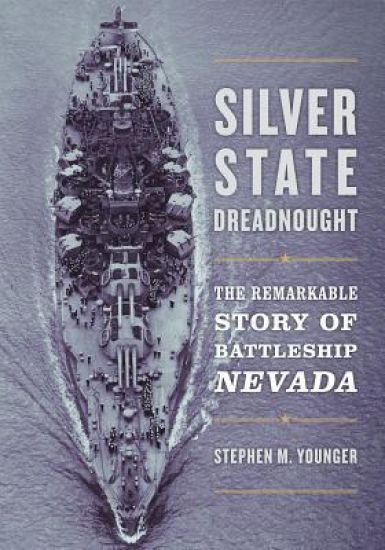
Silver State Dreadnought

Silver State Dreadnought

Stephen M Younger

Naval Institute Press
2018
sidottu
USS Nevada (BB-36) was America's first modern battleship. When her keel was laid in 1912, kings and emperors still ruled much of the world. When she finally slipped beneath the waves in 1948, America was the undisputed global superpower. Nevada was revolutionary for her time: the first ""superdreadnought""; the first U.S. warship to be oil fired; the first to have a triple-gun main turret; and, the first to have all-or-nothing armor. In World War I, she was based in Queenstown, Ireland, to provide protection for American convoys bringing troops to Europe. She survived the naval reduction treaties of the 1920s and was rebuilt in 1928 with the latest technology. The only battleship to get underway at Pearl Harbor, Nevada suffered damage from Japanese bombs and torpedoes and sank in shallow water. Raised and repaired, she did convoy duty in the North Atlantic before joining the invasion fleet for D-Day and the landings in Southern France. Shifting to the Pacific, Nevada provided bombardment support at Iwo Jima and Okinawa. The end of the war saw her outgunned and outmoded, but her contributions were not over. In 1946, she survived not one but two atomic tests, the second of which left the battleship too radioactive for scrapping. On a sunny day in 1948, Nevada was towed off the coast of Oahu and used for target practice. After five days of pounding by everything the Navy could throw her, Nevada was dispatched by a torpedo. She died a warrior's death.Silver State Dreadnought is the story of a remarkable ship, but it is also the story of the remarkable men who sailed in her. Nevada's first captain, William S. Sims, brought his unique style of leadership to America's premiere battleship and set the tone for what became known as the ""Cheer Up Ship."" As Nevada aged, the ship gained the affectionate name ""The Old Maru,"" beloved by all who served in her.
Le Pouvoir de la confiance de Stephen M.R. Covey
Un guide pratique et accessible pour mieux lire et comprendre Le Pouvoir de la confiance de Stephen M.R. Covey et Rebecca Merrill en 50 minutes Avez-vous jamais r alis qu'une confiance bien install e entre les membres d'une quipe leur permettait d' tre plus efficaces dans l'ex cution de leurs t ches ? Que les partenariats entre un fournisseur et son client sont toujours plus prompts se nouer et plus solides lorsqu'existe une confiance mutuelle ? C'est le postulat principal de l'ouvrage de Stephen M.R. Covey et Rebecca Merrill: la confiance est une comp tence cl dans notre conomie globale.Vous trouverez notamment dans ce livre: - Une mise en contexte- Une synth se d taill e de l'ouvrage- Les id es principales d fendues par les auteurs- L'originalit de l'approche- Les r percussions qu'a eues ce livre aupr s des entreprisesLe mot de l' diteur: Avec l'auteure, Charlotte Bouillot, nous avons cherch pr senter aux lecteurs ce livre de r f rence sur le th me de la confiance en milieux conomiques. S'attachant en d crire le contexte de r daction et les principes cl s, nous avons voulu mettre en avant les sp cificit s de l'ouvrage, en insistant sur les notions d' conomie de la confiance, de leadership et de confiance intelligente. Laure Delacroix PROPOS DE LA S RIE 50MINUTES Book ReviewLa s rie Book Review de la collection 50MINUTES propose des documents qui invitent tous les curieux r fl chir sur les grands textes fondateurs de l' conomie ainsi que sur les sommes r cemment parues qui participent la r flexion globale des r alit s conomiques actuelles. Nous avons con u la collection Business & Economics en pensant aux nombreux professionnels oblig s de se former en permanence en conomie, en management, en strat gie ou en marketing. Nos auteurs combinent des l ments de th orie, des pistes de r flexion, et, pour certains sujets, des tudes de cas et de nombre
Wet Mind

Wet Mind

Stephen M. Kosslyn

The Free Press
1995
pokkari
How do our brains allow us to recognize objects and locate them accurately in space, use mental imagery to remember yesterday's breakfast, read, understand speech, learn to dance, and recall a new telephone number? Recent breakthroughs in brain scanning and computing techniques have allowed researchers to plumb the secrets of the healthy brain's operation; simultaneously, much new information has been learned about the nature and causes of neuropsychological deficits in animals and humans following various sorts of brain damage in different locations. In this first comprehensive, integrated, and accessible overview of recent insights into how the brain gives rise to mental activity, the authors explain the fundamental concepts behind and the key discoveries that draw on neural network computer models, brain scans, and behavioral studies. Drawing on this analysis, the authors also present an intriguing theory of consciousness. In addition, this paperback edition contains an epilogue in which the authors discuss the latest research on emotion and cognition and present new information on working memory.
Second Acts: Creating the Life You Really Want, Building the Career You Truly Desire
Second Acts is a guide to reinventing your life. Whether you wish to change careers, move to a more desirable part of the country, start a business, write a novel, or drop everything to pursue a life dream, Stephen Pollan offers a powerful message ofhope and guidance that has benefited his own clients.Through a series of exercises, you will develop a comprehensive "script" for your second act--a step-by-step action plan that will lead you to the life you've always wanted.
Fire Your Boss

Fire Your Boss

Stephen M Pollan; Mark Levine

HarperPerennial
2005
nidottu
Fire Your BossAnd Hire Yourself.Impossible? Not according to nationally bestselling author Stephen M. Pollan. As he says in this new and empowering book, "You don't have to accept your current work situation. You can be in control of your job and your stream of income, so you're never again subject to the whims, prejudices, moods, or circumstances of your so-called boss."In today's difficult work environment, gone are the days of finding satisfaction through your job, gone is the time when your job was secure, and gone are the days when your employer cared about you. This new environment requires new rules, and Pollan has provided surprisingly fresh and intriguing methods for finding "success" on the job.Pollan's bold and unique message begins with the idea that you must "fire your boss." By this he means you can no longer rely on your manager or your company for economic security. Instead, you must put yourself in charge of your working life. In this thought-provoking and counterintuitive career guide, Pollan presents a seven-step program and a series of exercises that give you the confidence, power, and will to achieve the life of your dreams.Once you have changed your mind-set and learned the new rules of the game, you can start the process of moving to a richer, more enriching, and more enjoyable life. And the best part about it? Your boss will love you for it.
Corporate Governance after the Financial Crisis

Corporate Governance after the Financial Crisis

Stephen M. Bainbridge

Oxford University Press Inc
2016
nidottu
The first decade of the new millennium was bookended by two major economic crises. The bursting of the dotcom bubble and the extended bear market of 2000 to 2002 prompted Congress to pass the Sarbanes-Oxley Act, which was directed at core aspects of corporate governance. At the end of the decade came the bursting of the housing bubble, followed by a severe credit crunch, and the worst economic downturn in decades. In response, Congress passed the Dodd-Frank Act, which changed vast swathes of financial regulation. Among these changes were a number of significant corporate governance reforms. Corporate Governance after the Financial Crisis asks two questions about these changes. First, are they a good idea that will improve corporate governance? Second, what do they tell us about the relative merits of the federal government and the states as sources of corporate governance regulation? Traditionally, corporate law was the province of the states. Today, however, the federal government is increasingly engaged in corporate governance regulation. The changes examined in this work provide a series of case studies in which to explore the question of whether federalization will lead to better outcomes. The author analyzes these changes in the context of corporate governance, executive compensation, corporate fraud and disclosure, shareholder activism, corporate democracy, and declining U.S. capital market competitiveness.
Oral History and the Environment

Oral History and the Environment

Stephen M. Sloan; Mark Cave

OXFORD UNIVERSITY PRESS INC
2023
sidottu
As uncontrolled development forces crises in the natural world, deeply ingrained human connections with the earth are changing. Oral history's proven ability to explore issues of race, ethnicity, class, gender, and sexuality make it a uniquely effective methodology for bringing in new perspectives to our understanding of environments. This book brings together interviews with a global range of activists, farmers, water system managers, victims of catastrophe, tribal trustees, wilderness rangers, reindeer herders, and foresters, among others whose life experience gives them special insights into human-environmental interaction and adaption. Commentary by oral historians examines how these stories can be used to better understand our relationship with the natural world. Oral History and the Environment takes what could seem broad and impersonal forces such as climate change and environmentalismLand crystalizes their meaning through personal stories. It overturns narrow historical frameworks bounded artificially by national borders and instead portrays the issues facing our common ecosystems.
Oral History and the Environment

Oral History and the Environment

Stephen M. Sloan; Mark Cave

OXFORD UNIVERSITY PRESS INC
2023
nidottu
As uncontrolled development forces crises in the natural world, deeply ingrained human connections with the earth are changing. Oral history's proven ability to explore issues of race, ethnicity, class, gender, and sexuality make it a uniquely effective methodology for bringing in new perspectives to our understanding of environments. This book brings together interviews with a global range of activists, farmers, water system managers, victims of catastrophe, tribal trustees, wilderness rangers, reindeer herders, and foresters, among others whose life experience gives them special insights into human-environmental interaction and adaption. Commentary by oral historians examines how these stories can be used to better understand our relationship with the natural world. Oral History and the Environment takes what could seem broad and impersonal forces such as climate change and environmentalismDLand crystalizes their meaning through personal stories. It overturns narrow historical frameworks bounded artificially by national borders and instead portrays the issues facing our common ecosystems.
American Legal Thought from Premodernism to Postmodernism

American Legal Thought from Premodernism to Postmodernism

Stephen M. Feldman

Oxford University Press Inc
2000
sidottu
American legal thought has progressed remarkably quickly from premodernism to modernism and into postmodernism in little over two hundred years, running from the nation's founding through today. This book tells the story of this mercurial journey through jurisprudence by showing the development of legal thought through these three intellectual periods. Feldman's narrative revolves around two broad interrelated themes: jurisprudential foundations and the idea of progress. Comprehensive and accessible, the book draws on significant cases from Supreme Court history to provide a handy one-volume overview for law students, practitioners, and legal scholars.
American Legal Thought from Premodernism to Postmodernism

American Legal Thought from Premodernism to Postmodernism

Stephen M. Feldman

Oxford University Press Inc
2000
nidottu
American legal thought has progressed remarkably quickly from premodernism to modernism and into postmodernism in little over two hundred years, running from the nation's founding through today. This book tells the story of this mercurial journey through jurisprudence by showing the development of legal thought through these three intellectual periods. Feldman's narrative revolves around two broad interrelated themes: jurisprudential foundations and the idea of progress. Comprehensive and accessible, the book draws on significant cases from Supreme Court history to provide a handy one-volume overview for law students, practitioners, and legal scholars.