Kirjojen hintavertailu. Mukana 11 342 296 kirjaa ja 12 kauppaa.

Kirjahaku

Etsi kirjoja tekijän nimen, kirjan nimen tai ISBN:n perusteella.

1000 tulosta hakusanalla Sterner St Paul Meek

B. C. 30,000

B. C. 30,000

Sterner St Paul Meek

ALPHA EDITION
2021
pokkari
B. C. 30,000, has been considered important throughout the human history, and so that this work is never forgotten we have made efforts in its preservation by republishing this book in a modern format for present and future generations. This whole book has been reformatted, retyped and designed. These books are not made of scanned copies of their original work and hence the text is clear and readable.
Red, a Trailing Bloodhound

Red, a Trailing Bloodhound

Sterner St Paul 1894-1972 Meek

Hassell Street Press
2021
sidottu
This work has been selected by scholars as being culturally important and is part of the knowledge base of civilization as we know it.This work is in the public domain in the United States of America, and possibly other nations. Within the United States, you may freely copy and distribute this work, as no entity (individual or corporate) has a copyright on the body of the work.Scholars believe, and we concur, that this work is important enough to be preserved, reproduced, and made generally available to the public. To ensure a quality reading experience, this work has been proofread and republished using a format that seamlessly blends the original graphical elements with text in an easy-to-read typeface.We appreciate your support of the preservation process, and thank you for being an important part of keeping this knowledge alive and relevant.
The St Perpetuus Club of Buenos Aires

The St Perpetuus Club of Buenos Aires

Eric Stener Carlson

Independently Published
2018
nidottu
Hidden away in the pages of an old copy of Lives of the Saints is a diary brimming with heresy and claims of supernatural powers. When Miguel Iba ez stumbles across it in the strange bookshop he first believes it to be the ravings of a lunatic. But what if it is true? What if the anonymous author has really learned the secrets of controlling time? Could Miguel learn to do the same and therefore correct all the mistakes in his life?Trapped in a mediocre job at a forgotten Ministry, his marriage falling apart, Miguel desperately searches for more hidden entries. This leads him on a chase through the forbidden bookstores, abandoned buildings and dark subways of Buenos Aires. Miguel's obsession soon brings him to the doors of the Saint Perpetuus Club, a secret society that holds the key to the salamanca, the cave where the Devil grants all wishes . . . for a price. The deeper Miguel goes, the more he wonders whom he can trust. His wife, his friends, his old philosophy professor? Perhaps they are all members of the Club? Miguel is willing to risk his life, and his immortal soul, to uncover the secrets of The Saint Perpetuus Club of Buenos Aires.
The Gospel of St.John and its Relation to the Other Gospels
Beginning at the turn of the century, Rudolf Steiner began to express a passionate interest in Christianity. For him, the event he called the "Mystery of Golgotha" is more than the central event of Christianity; it is, in fact, the turning point in time for all human and earthly evolution. In his Autobiography, Steiner clarified his views on Christianity: Some of what I said and wrote during that period 1890s] seems to contradict the way I described Christianity later on. This is because, when I wrote the word Christianity, I was referring to the teachings of a "world beyond" that was active in all Christian doctrines at the time. The whole meaning of religious experiences pointed to a world of spirit, one that was supposed to be unattainable by human intellect. Whatever religion might have to say and whatever precepts for moral life it might offer arise from what is revealed to human beings from outside. My own direct, inner perception of spirit objected to this; it wanted to experience the worlds of both spirit and the physical in perceptions of the human being and nature. And my ethical individualism objected to this. It rejected the external support of commandments for morality; such support came instead as the result of spiritual soul development within the human being, where divinity lives. That was a trying time for my soul as I looked at Christianity. This period lasted from the time I left the Weimar work until I wrote my book Christianity as Mystical Fact. These kinds of tests are obstacles, placed in one's path by destiny (or karma), and they must be overcome through spiritual development. In these talks, Rudolf Steiner offers his profound insights into the essential truths behind the Christ event, as well as the historic and prehistoric events--on Earth and in the spiritual worlds--leading up to the turning point in time. He shows that the ancient mysteries of the East, the Persians, the Egyptians, the Greeks, and the streams behind those impulses--going back to Atlantis and Lemuria--all lead to the event of Christ's incarnation and the Mystery of Golgotha, through which the Earth became the body of Christ. Further, Steiner talks about what those events mean for the future of humanity and the Earth. The Gospel of St. John and Its Relation to the Other Gospels is an essential document in the literature of Christology and for understanding the central place of esoteric Christianity in Anthroposophy. The essential topics discussed in these lectures: The Christians of St. John; the rebirth of the higher "I" in individuals and in humanity The living spiritual history; the leaders of humanity; the creative Word The transformation of Earth; the prototypes of created types; the servants of the Word The hierarchies of our solar system and the kingdoms of the Earth Human development during the incarnations of our Earth; the kingdom of the luciferic and ahrimanic spirits and the kingdom of the divine spiritual beings The Atlantean oracles; post-Atlantean sanctuaries of initiation; the baptism by John The baptism with water and the baptism with fire and spirit The Mysteries of initiation; rebirth through Jesus Christ The artistic composition of the Gospel of St. John; the climax of power in the signs and miracles Events at the baptism by John; Christ's mastery over the laws of the skeletal structure and the conquest of death The establishment of harmony in the inner forces of human beings through the Christ impulse; the connection between the ancient mysteries and the Gospels The decline of the ancient wisdom and its renewal through the Christ impulse; the significance of the Mystery of Golgotha for human evolution on Earth The cosmic significance of the Mystery of Golgotha; the conquest of death through the expulsion of the luciferic and ahrimanic influence; death as the bringer of life; the Earth becomes a new sun; the effects of the Christ light and its reflection in the Earth's periphery as a spiritual sphere; the Holy Spirit The Earth as the body of Christ and as a new center of light; the Last Supper as a preparation for mystical union with Christ; Paul, the apostle of the spiritually living Christ; the seven stages of Christian initiation; death as the seed of eternal "I" being; spirit knowledge is the fire of life The Gospel of St. John and Its Relation to the Other Gospels is a translation of Das Johannes-Evangelium im Verh ltnis zu den drei anderen Evangelien, besonders zu dem Lukas-Evangelium (GA 112).
The Gospel of St.Mark

The Gospel of St.Mark

Rudolf Steiner

SteinerBooks, Inc
1990
nidottu
Steiner tells us that Mark was especially able to reveal Christ as a cosmic being of his greatness and power, because, after having been a pupil of Peter, he moved to Alexandria during a time when Jewish philosophy and theology was at it's peak. There he absorbed the best aspects and views of pagan gnosis. Mark was able to learn how humankind came arose from the spiritual world and how the luciferic and ahrimanic forces are taken into the human soul. Mark was able to accept everything that was told to him by pagan gnosis concerning our human origin out of the cosmos when our planet came into being. But he could also see, especially from his perspective in Egypt, the strong contrast between our original human destiny and what humankind had become during his time. This lecture cycle, like the Gospel itself, is a work of art in its own right.
The Apocalypse of St John

The Apocalypse of St John

Rudolf Steiner

SteinerBooks, Inc
1985
sidottu
Initiation enables a person to see, understand, and communicate what may be observed with spiritual eyes. St. John's text arises from such an initiation. It addresses the fundamental questions of existence that every human being asks: Where are we? Where have we come from? Where are we going? And because it arises from esoteric Christian vision, it emphasizes the task of the individual: What am I, and what is my purpose now in this era of cosmic and human evolution? These talks by Rudolf Steiner unveil the mysteries of John's vision and show it to be a profound description of Christian initiation. As he says, "The deepest truths of Christianity may be considered quite naturally in connection with this document, for it contains a great part of the mysteries of Christianity--that is, the profoundest part of what may be described as esoteric Christianity."Steiner shows that the messages to the seven churches and the unsealing of the seven seals must be understood as an initiation text. Based on his initiation and on spiritual science, Steiner interprets John's insights into cosmic and human history. In this way, the spiritual images of John's writing--the twenty-four elders, the sea of glass, the woman clothed with the sun, the vials of wrath, the lamb and the dragon, the new heaven and the new earth, and the number of the beast --all take on new meaning. Since the previous painful century has closed, these important words have even greater meaning and significance; readers interested in contributing their moral will to future generations cannot afford to pass them by.Read Bobby Matherne's review of this book
The Gospel of St.John

The Gospel of St.John

Rudolf Steiner

SteinerBooks, Inc
1984
nidottu
During Pentecost 1908--seven years after he had given the world his book Christianity As Mystical Fact and the first intimation of the consequences of his Christ experience--Rudolf Steiner began his great work of renewing humanity's understanding of the Mystery of Golgotha and its meaning for human and earthly evolution. Accordingly, he turned to the deepest, most spiritual of the Gospels--that of the initiate St. John. In this lecture course, readers will find that the incarnation, death, and resurrection of the Divine Word, or Logos, reveals the mission of the Earth: Love. We learn of the mysteries behind Lazarus' resurrection, the "I AM" sayings, and the seven degrees of initiation. We come to understand that the Gospel of St. John is a continuing spiritual presence--to be recalled, meditated, and permeated with one's own life. In doing so, we realized that our purpose--and that of all humankind--is to become the Virgin Sophia, a receptical for the Holy Spirit. All of Steiner's work, as Marie Steiner writes in her introduction, was "to pave the way to Christ." Indeed, at the conclusion of these lectures, Rudolf Steiner said: It will come to be understood that Christianity is only beginning its influence and will fulfill its real mission only when it is understood in its true, spiritual form.... The more these lectures are understood in this sense, the better they will be understood as they were intended. This volume is essential if one is to truly understand Rudolf Steiner's understanding of esoteric Christianity and its place in the world today and in the future. Contents: The Doctrine of the Logos Esoteric Christianity The Mission of the Earth The Raising of Lazarus The Seven Degrees of Initiation The "I AM" The Mystery of Golgotha Human Evolution in Its Relation to the Christ Principle The Prophetical Documents of the Origin of Christianity The Effect of the Christ Principle Christian Initiation The Nature of the Virgin Sophia and of the Holy Spirit This volume is a translation of Das Johannes-Evangelium (GA 103).
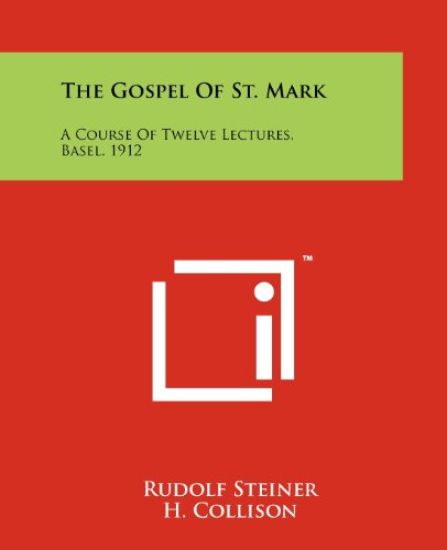
The Gospel of St. Mark: A Course of Twelve Lectures, Basel, 1912

The Gospel of St. Mark: A Course of Twelve Lectures, Basel, 1912

Rudolf Steiner; H. Collison

Literary Licensing, LLC
2011
sidottu
The Gospel of St. Mark: A Course of Twelve Lectures, Basel, 1912 is a book written by Rudolf Steiner. This book is a compilation of twelve lectures delivered by Steiner in Basel in 1912. The lectures focus on the Gospel of St. Mark and provide an in-depth analysis of its content, structure, and meaning. Steiner uses his extensive knowledge of esotericism, philosophy, and spiritual science to shed light on the deeper spiritual significance of the Gospel of St. Mark. The book is divided into twelve chapters, each corresponding to one of the lectures. Steiner's writing style is clear and concise, making it accessible to readers of all backgrounds. This book is an excellent resource for anyone interested in the Gospel of St. Mark and its spiritual significance.For Members Of The Anthroposophical Society Only. Series 24 And 30.This scarce antiquarian book is a facsimile reprint of the old original and may contain some imperfections such as library marks and notations. Because we believe this work is culturally important, we have made it available as part of our commitment for protecting, preserving, and promoting the world's literature in affordable, high quality, modern editions, that are true to their original work.