Kirjojen hintavertailu. Mukana 11 244 527 kirjaa ja 12 kauppaa.

Kirjahaku

Etsi kirjoja tekijän nimen, kirjan nimen tai ISBN:n perusteella.

1000 tulosta hakusanalla Steven G. Krantz

Complex Variables

Complex Variables

Steven G. Krantz

CRC Press
2019
sidottu
The idea of complex numbers dates back at least 300 years—to Gauss and Euler, among others. Today complex analysis is a central part of modern analytical thinking. It is used in engineering, physics, mathematics, astrophysics, and many other fields. It provides powerful tools for doing mathematical analysis, and often yields pleasing and unanticipated answers.This book makes the subject of complex analysis accessible to a broad audience. The complex numbers are a somewhat mysterious number system that seems to come out of the blue. It is important for students to see that this is really a very concrete set of objects that has very concrete and meaningful applications. Features:This new edition is a substantial rewrite, focusing on the accessibility, applied, and visual aspect of complex analysis This book has an exceptionally large number of examples and a large number of figures. The topic is presented as a natural outgrowth of the calculus. It is not a new language, or a new way of thinking. Incisive applications appear throughout the book. Partial differential equations are used as a unifying theme.
Partial Differential Equations and Complex Analysis
Ever since the groundbreaking work of J.J. Kohn in the early 1960s, there has been a significant interaction between the theory of partial differential equations and the function theory of several complex variables. Partial Differential Equations and Complex Analysis explores the background and plumbs the depths of this symbiosis. The book is an excellent introduction to a variety of topics and presents many of the basic elements of linear partial differential equations in the context of how they are applied to the study of complex analysis. The author treats the Dirichlet and Neumann problems for elliptic equations and the related Schauder regularity theory, and examines how those results apply to the boundary regularity of biholomorphic mappings. He studies the ?-Neumann problem, then considers applications to the complex function theory of several variables and to the Bergman projection.
The Proof is in the Pudding

The Proof is in the Pudding

Steven G. Krantz

Springer-Verlag New York Inc.
2011
sidottu
Krantz takes the reader on a journey around the globe and through centuries of history , exploring the many transformations that mathematical proof has undergone from its inception at the time of Euclid and Pythagoras to its versatile, present-day use . The author elaborates on the beauty, challenges and metamorphisms of thought that have accompanied the search for truth through proof. The first two chapters examine the early beginnings of concept of proof and the creation of its elegant structure and language, touching on some of the logic and philosophy behind these developments. The history then unfolds as the author explains the changing face of proofs. The more well-known proofs , the mathematicians behind them, and the world that surrounded them are all highlighted . Each story has its own unique past; there was often a philosophical, sociological, technological or competitive edge that restricted or promoted progress. But the author's commentary and insights create a seamless thread throughout the many vignettes. Though there are many truths to be discovered in this book, by the end it is clear that there is no formalized approach or standard method of discovery to date. This is shown in noting some of the more prominent discussions currently underway, such as Gorenstein's effort to classify finance groups, Thomas Hale's resolution of the Kepler sphere-packing problem, and other modern tales. Most of the proofs are discussed in detail with figures and some equations accompanying them, allowing both the professional mathematician and those less familiar with mathematics to derive the same joy from reading this book.
Handbook of Complex Variables

Handbook of Complex Variables

Steven G. Krantz

Birkhauser Boston Inc
1999
sidottu
This book is written to be a convenient reference for the working scientist, student, or engineer who needs to know and use basic concepts in complex analysis. It is not a book of mathematical theory. It is instead a book of mathematical practice. All the basic ideas of complex analysis, as well as many typical applica­ tions, are treated. Since we are not developing theory and proofs, we have not been obliged to conform to a strict logical ordering of topics. Instead, topics have been organized for ease of reference, so that cognate topics appear in one place. Required background for reading the text is minimal: a good ground­ ing in (real variable) calculus will suffice. However, the reader who gets maximum utility from the book will be that reader who has had a course in complex analysis at some time in his life. This book is a handy com­ pendium of all basic facts about complex variable theory. But it is not a textbook, and a person would be hard put to endeavor to learn the subject by reading this book.
Handbook of Logic and Proof Techniques for Computer Science
Logic is, and should be, the core subject area of modern mathemat­ ics. The blueprint for twentieth century mathematical thought, thanks to Hilbert and Bourbaki, is the axiomatic development of the subject. As a result, logic plays a central conceptual role. At the same time, mathematical logic has grown into one of the most recondite areas of mathematics. Most of modern logic is inaccessible to all but the special­ ist. Yet there is a need for many mathematical scientists-not just those engaged in mathematical research-to become conversant with the key ideas of logic. The Handbook of Mathematical Logic, edited by Jon Bar­ wise, is in point of fact a handbook written by logicians for other mathe­ maticians. It was, at the time of its writing, encyclopedic, authoritative, and up-to-the-moment. But it was, and remains, a comprehensive and authoritative book for the cognoscenti. The encyclopedic Handbook of Logic in Computer Science by Abramsky, Gabbay, and Maibaum is a wonderful resource for the professional. But it is overwhelming for the casual user. There is need for a book that introduces important logic terminology and concepts to the working mathematical scientist who has only a passing acquaintance with logic. Thus the present work has a different target audience. The intent of this handbook is to present the elements of modern logic, including many current topics, to the reader having only basic mathe­ matical literacy.
A Handbook of Real Variables

A Handbook of Real Variables

Steven G. Krantz

Birkhauser Boston Inc
2003
sidottu
The subject of real analysis dates to the mid-nineteenth century - the days of Riemann and Cauchy and Weierstrass. Real analysis grew up as a way to make the calculus rigorous. Today the two subjects are intertwined in most people's minds. Yet calculus is only the first step of a long journey, and real analysis is one of the first great triumphs along that road. In real analysis we learn the rigorous theories of sequences and series, and the profound new insights that these tools make possible. We learn of the completeness of the real number system, and how this property makes the real numbers the natural set of limit points for the rational numbers. We learn of compact sets and uniform convergence. The great classical examples, such as the Weierstrass nowhere-differentiable function and the Cantor set, are part of the bedrock of the subject. Of course complete and rigorous treatments of the derivative and the integral are essential parts of this process. The Weierstrass approximation theorem, the Riemann integral, the Cauchy property for sequences, and many other deep ideas round out the picture of a powerful set of tools.
Geometric Function Theory

Geometric Function Theory

Steven G. Krantz

Birkhauser Boston Inc
2005
sidottu
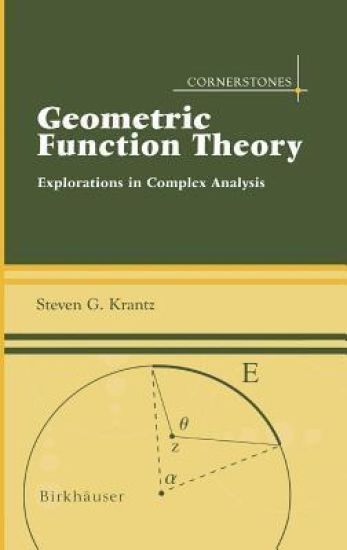
Complex variables is a precise, elegant, and captivating subject. Presented from the point of view of modern work in the field, this new book addresses advanced topics in complex analysis that verge on current areas of research. The author adroitly weaves these varied topics to reveal a number of delightful interactions. Perhaps more importantly, the topics are presented with an understanding and explanation of their interrelations with other important parts of mathematics: harmonic analysis, differential geometry, partial differential equations, potential theory, abstract algebra, and invariant theory. Although the book examines complex analysis from many different points of view, it uses geometric analysis as its unifying theme. This methodically designed book contains a rich collection of exercises, examples, and illustrations within each individual chapter, concluding with an extensive bibliography of monographs, research papers, and a thorough index. Seeking to capture the imagination of advanced undergraduate and graduate students with a basic background in complex analysis –and also to spark the interest of seasoned workers in the field – the book imparts a solid education both in complex analysis and in how modern mathematics works.
Explorations in Harmonic Analysis

Explorations in Harmonic Analysis

Steven G. Krantz

Birkhauser Boston Inc
2009
sidottu
Harmonic analysis is a venerable part of modern mathematics. Its roots began, perhaps, with late eighteenth-century discussions of the wave equation. Using the method of separation of variables, it was realized that the equation could be solved with a data function of the form?(x)= sin jx for j? Z.Itwasnaturaltoask, using the philosophy of superposition, whether the equation could then be solved with data on the interval [0,?] consisting of a nite linear combinationof the sin jx. With an af rmative answer to that question, one is led to ask about in?nite linear combinations. This was an interesting venue in which physical reasoning interacted with mathematical reasoning. Physical intuition certainly suggests that any continuous function? can be a data function for the wave equation. So one is led to ask whether any continuous? can be expressed as an (in nite) superposition of sine functions. Thus was born the fundamental question of Fourier series. No less an eminence gris than Leonhard Euler argued against the proposition.
Techniques of Problem Solving

Techniques of Problem Solving

Steven G. Krantz

Amer Mathematical Society
1996
pokkari
The purpose of this book is to teach the basic principles of problem solving, including both mathematical and non-mathematical problems. This book will help students to: translate verbal discussions into analytical data; learn problem-solving methods for attacking collections of analytical questions or data; build a personal arsenal of internalized problem-solving techniques and solutions; and, become 'armed problem solvers', ready to do battle with a variety of puzzles in different areas of life. Taking a direct and practical approach to the subject matter, Krantz's book stands apart from others like it in that it incorporates exercises throughout the text. After many solved problems are given, a 'Challenge Problem' is presented. Additional problems are included for readers to tackle at the end of each chapter. There are more than 350 problems in all. This book won the CHOICE Outstanding Academic Book Award for 1997. A Solutions Manual to most end-of-chapter exercises is available.
Function Theory of Several Complex Variables

Function Theory of Several Complex Variables

Steven G. Krantz

American Mathematical Society
2001
sidottu
This work departs from earlier treatments of the subject by emphasizing integral formulas, the geometric theory of pseudoconvexity, estimates, partial differential equations, approximation theory, the boundary behavior of holomorphic functions, inner functions, invariant metrics, and mapping theory. While due homage is paid to the more traditional algebraic theory (sheaves, Cousin problems, etc.), the student with a background in real and complex variable theory, harmonic analysis, and differential equations will be most comfortable with this treatment.
A Mathematician's Survival Guide

A Mathematician's Survival Guide

Steven G. Krantz

American Mathematical Society
2003
nidottu
With graduate school, young mathematicians take the first step toward a career in mathematics. During this period, they make important decisions that will affect the rest of their careers. Here now is a detailed guide to help students navigate those years and the years that follow. In his inimitable and forthright style, Steven Krantz addresses the major issues of graduate school, including deciding where to go, passing the qualifying exams, finding an advisor, writing a thesis, and getting that first job. As with his earlier guide, How to Teach Mathematics, Krantz avoids generalities, giving clear advice on how to handle real situations. In addition, he includes a description of the basic elements of a mathematical education, as well as three appendices on the structure of a typical department and university and the standard academic ranks. Steven G. Krantz is an experienced mathematician and an award-winning author. He has worked in many different types of mathematics departments, supervised both masters and doctoral students, and is currently the Chair of the Mathematics Department at Washington University in St. Louis.Other AMS titles by Steven Krantz are A Primer of Mathematical Writing and Techniques of Problem Solving.
Mathematical Publishing

Mathematical Publishing

Steven G. Krantz

Amer Mathematical Society
2006
pokkari
Mathematicians are expected to publish their work: in journals, conference proceedings, and books. It is vital to advancing their careers. Later, some are asked to become editors. However, most mathematicians are trained to do mathematics, not to publish it. But here, finally, for graduate students and researchers interested in publishing their work, Steven G. Krantz, the respected author of several 'how-to' guides in mathematics, shares his experience as an author, editor, editorial board member, and independent publisher.This new volume is an informative, comprehensive guidebook to publishing mathematics. Krantz describes both the general setting of mathematical publishing and the specifics about all the various publishing situations mathematicians may encounter. As with his other books, Krantz's style is engaging and frank. He gives advice on how to get your book published, how to get organized as an editor, what to do when things go wrong, and much more.He describes the people, the language (including a glossary), and the process of publishing both books and journals. Steven G. Krantz is an accomplished mathematician and an award-winning author.He has published more than 130 research articles and 45 books. He has worked as an editor of several book series, research journals, and for the Notices of the AMS. He is also the founder of the "Journal of Geometric Analysis". Other titles available from the AMS by Steven G. Krantz are "How to Teach Mathematics", "A Primer of Mathematical Writing", "A Mathematician's Survival Guide", and "Techniques of Problem Solving".
Survival of a Mathematician

Survival of a Mathematician

Steven G. Krantz

AMERICAN MATHEMATICAL SOCIETY
2009
pokkari
Offers guidance to the professional mathematician in how to develop and survive in the profession. This book offers information on how to begin a research program, how to apply for a grant, how to get tenure, how to teach, and how to get along with one's colleagues.
Partial Differential Equations and Complex Analysis
Ever since the groundbreaking work of J.J. Kohn in the early 1960s, there has been a significant interaction between the theory of partial differential equations and the function theory of several complex variables. Partial Differential Equations and Complex Analysis explores the background and plumbs the depths of this symbiosis. The book is an excellent introduction to a variety of topics and presents many of the basic elements of linear partial differential equations in the context of how they are applied to the study of complex analysis. The author treats the Dirichlet and Neumann problems for elliptic equations and the related Schauder regularity theory, and examines how those results apply to the boundary regularity of biholomorphic mappings. He studies the ?-Neumann problem, then considers applications to the complex function theory of several variables and to the Bergman projection.
A Panorama of Harmonic Analysis

A Panorama of Harmonic Analysis

Steven G. Krantz

Mathematical Association of America
1999
sidottu
Tracing a path from the earliest beginnings of Fourier series through to the latest research A Panorama of Harmonic Analysis discusses Fourier series of one and several variables, the Fourier transform, spherical harmonics, fractional integrals, and singular integrals on Euclidean space. The climax is a consideration of ideas from the point of view of spaces of homogeneous type, which culminates in a discussion of wavelets. This book is intended for graduate students and advanced undergraduates, and mathematicians of whatever background who want a clear and concise overview of the subject of commutative harmonic analysis.
Complex Analysis

Complex Analysis

Steven G. Krantz

Mathematical Association of America
2003
sidottu
In this second edition of a Carus Monograph Classic, Steven G. Krantz, a leading worker in complex analysis and a winner of the Chauvenet Prize for outstanding mathematical exposition, develops material on classical non-Euclidean geometry. He shows how it can be developed in a natural way from the invariant geometry of the complex disk. He also introduces the Bergmann kernel and metric and provides profound applications, some of which have never appeared in print before. In general, the new edition represents a considerable polishing and re-thinking of the original successful volume. A minimum of geometric formalism is used to gain a maximum of geometric and analytic insight. The climax of the book is an introduction to several complex variables from the geometric viewpoint. Poincare's theorem, that the ball and bidisc are biholomorphically inequivalent, is discussed and proved.
A Guide to Complex Variables

A Guide to Complex Variables

Steven G. Krantz

Mathematical Association of America
2008
sidottu
This quick and easy-to-use guide provides a solid grounding in the fundamental area of complex variables. Copious figures and examples are used to illustrate the principal ideas, and the exposition is lively and inviting. In addition to important ideas from the Cauchy theory, the author also includes the Riemann mapping theorem, harmonic functions, the argument principle, general conformal mapping, and dozens of other central topics. An undergraduate taking a first look at the subject, or a graduate student preparing for their qualifying exams, will find this book to be both a valuable resource and a useful companion to more exhaustive texts in the field. For mathematicians and non-mathematicians alike.
A Guide to Real Variables

A Guide to Real Variables

Steven G. Krantz

Mathematical Association of America
2009
sidottu
A Guide to Real Variables is an aid and conceptual support for students taking an undergraduate course on real analysis. It focuses on concepts, results, examples and illustrative figures, rather than the details of proofs, in order to remain a concise guide which students can dip into. The core topics of a first real analysis course are covered, including sequences, series, modes of convergence, the derivative, the integral and metric spaces. The next book in this series, Folland's A Guide to Advanced Real Analysis is designed to naturally follow on from this book, and introduce students to graduate level real analysis. Together these books provide a concise guide to the subject at all levels, ideal for student preparation for exams.
A Guide to Topology

A Guide to Topology

Steven G. Krantz

Mathematical Association of America
2009
sidottu
A Guide to Topology is an introduction to basic topology for graduate or advanced undergraduate students. It covers point-set topology, Moore-Smith convergence and function spaces. It treats continuity, compactness, the separation axioms, connectedness, completeness, the relative topology, the quotient topology, the product topology, and all the other fundamental ideas of the subject. The book is filled with examples and illustrations. Students studying for exams will find this book to be a concise, focused and informative resource. Professional mathematicians who need a quick review of the subject, or need a place to look up a key fact, will find this book to be a useful resource too.