Kirjojen hintavertailu. Mukana 11 244 527 kirjaa ja 12 kauppaa.

Kirjahaku

Etsi kirjoja tekijän nimen, kirjan nimen tai ISBN:n perusteella.

1000 tulosta hakusanalla Steven Heller

Edward Gorey His Book Cover Art & Design

Edward Gorey His Book Cover Art & Design

Steven Heller

Pomegranate Communications Inc,US
2015
sidottu
The master creator of finely crosshatched illustrations and sinisterly amusing tales, Edward Gorey (American, 1925 2000) got his start in publishing by designing book covers for such New York houses as Doubleday, Grosset & Dunlap, Vintage Books, and later Random House. Today, his prodigious output of hundreds of dust jackets and paperback covers evidences his distinctive flair for design and his extraordinary ability to portray the essence of the books that came his way. Edward Gorey: His Book Cover Art & Design features a broad selection of his work, created from 1953 to 2000. In his essay, Steven Heller offers an insightful overview of Gorey's book cover art and design. He writes, "Successful cover design requires the expertise of an artist, typographer, poster designer, and logo maker. Many book design specialists were incapable of designing a cover or jacket with the same Gorey aplomb, even if they tried."
Specimens of Chromatic Wood Type, Borders, &c.

Specimens of Chromatic Wood Type, Borders, &c.

Steven Heller

Rizzoli International Publications
2017
sidottu
Specimens of Chromatic Wood Type, Borders, and C. is a vintage volume with an established cult like status within the bibliophile, typographic, and design worlds. Originally published as a catalogue for William H. Page s Connecticut wood type foundry considered one of the best in the world this 1874 type specimen book features elaborate display typefaces meant to announce tent revivals and circuses. In addition to the beautifully intricate typefaces and playful designs, the original author designed the pages in such a random sequence that the text reads as humorous and strange experimental poetry. Accidental or not, this beautiful book will delight readers with the humour and the beauty of each print. This edition reproduces all 102 pages of the original book. A charming gift or perfect addition to any serious art-book library, this volume will be loved by typographers, designers, artists, poets, DIYers, and anyone with a wicked sense of style.
Design School Reader: A Course Companion for Students of Graphic Design
An Essential Collection of Essays and Musings on Graphic Design from One of the Field's Leading Educators In this wide-ranging compilation, art director, writer, and lecturer Steven Heller shares his passion for graphic design with readers, whom he invites to consider that design can be discerned in all things natural and manmade. Developed as content for a class devoted to reading, this collection is not overtly about conventional design, but about a variety of topics viewed through the lens of design. Offered as a primer for undergraduate and graduate students, Design School Reader presents more than forty essays on subjects such as: The role of design in politicsVisual culture and the social impact of designKey moments in the history of typographyTechnological innovationsThe power of branding and logosEthical considerations and dilemmasImportant figures in the design world Divided into five parts--Design Language; Design Dialects; Politics, Ideology, Design; Business and Commerce; and Inspiration and Discoveries--each section features a collection of essays culled from Heller's extensive publications from the past several decades. At the end of every essay, readers will find discussion points to prompt further lines of inquiry. As Heller notes, "The key is to read, discuss, and debate." Students, aficionados, and anyone with a healthy curiosity will thoroughly enjoy this illuminating and thought-provoking assemblage of perspectives on the practice.
The Swastika and Symbols of Hate

The Swastika and Symbols of Hate

Steven Heller

Allworth Press,U.S.
2019
sidottu
“Force[s] even the most sophisticated to rethink and rework their ideas of how images work in the world.” —School Library Journal This is a classic story, masterfully told, in a new, revised and expanded edition about how one graphic symbol can endure and influence life—for good and evil—for generations and never, even today, be redeemed. A nuanced examination of the most powerful symbol ever created, The Swastika and Symbols of Hate explores the rise and fall of the symbol, its mysteries, co-option, and misunderstandings. Readers will be fascinated by the twists and turns of the swastika’s fortunes, from its pre-Nazi spiritual-religious and benign commercial uses, to the Nazi appropriation and criminalization of the form, to its contemporary applications as both a racist, hate-filled logo and ignorantly hip identity. Once the mark of good fortune, during the twentieth century it was hijacked and perverted, twisted into the graphic embodiment of intolerance. If you want to know what the logo for hate looks like, go no further. The Nazi swastika is a visual obscenity and provokes deep emotions on all sides. The Nazis weaponized this design, first as a party emblem, then as a sign of national pride and, ultimately, as the trademark of Adolf Hitler’s unremitting malevolence in the name of national superiority. A skilled propagandist, Hitler and his accomplices understood how to stoke fear through mass media and through emblems, banners, and uniforms. Many contemporary hate marks are rooted in Nazi iconography both as serious homage and sarcastic digital bots and trolls. Given the increasing tolerance for supremacist intolerance tacitly and overtly shown by politicians the world over, this revised (and reconfigured) edition includes additional material on old and new hate logos as it examines graphic design’s role in far-right extremist ideology today.
For the Love of Design

For the Love of Design

Steven Heller

Skyhorse Publishing
2023
pokkari
Prolific author and co-chair of the MFA Design School of Visual Arts Steven Heller shares his love of design with the world through essays, interviews, and profiles.Design is a living. But to live passion is essential. For the Love of Design is an anthology of Steven Heller's essays that are underscored by the essence that makes designers do what they do, Whether it is to make the environ a better place or communicate important messages or simply enliven the quotidian world, design is everywhere and everything. It is a life force made and appreciated with love. The focus of the anthology is graphic design and typography but these disciplines impact so many other forms of design that it is impossible to ignore them. Through essays, interviews and profiles, Heller captures the essence of what makes artists into designers and what makes design and its makers tick.From the design director of the New York Times discussing how during the pandemic he created the most effective front pages to a collage artist talking about why cutting and pasting scraps of material into dynamic compositions, each story and narrative brings to light ambitions and aspirations they are couched in love for the thinking, making, and doing of design.For the Love of Design is here to show that graphic and other design activities are not just ways of making a living, but living a life.
Growing Up Underground

Growing Up Underground

Steven Heller

PRINCETON ARCHITECTURAL PRESS
2022
nidottu
Award-winning designer and writer Steven Heller comes of age at the center of New York’s youth culture in the mid-1960s to the mid-1970s. Steven Heller has written a memoir. This is no chronological trek through the hills and valleys of his comparatively “normal” life, but instead, a coming of age tale whereby with luck and circumstance, he found himself in certain curious places at critical times during the early to late 1960s and later throughout the 80s in New York City. This story is both entertaining and enlightening and follows Heller between the ages of 16 and 23 as he solidified his work as art director, graphic designer, cartoonist and writer, through stints at the New York Review of Books, Sex, Screw, and The New York Free Press, until becoming the youngest art director (and occasional illustrator) for The New York Times OpEd page at age 23.
Monsters & Magical Sticks

Monsters & Magical Sticks

Steven Heller

ORIGINAL FALCON PRESS
2009
nidottu
If you want to know how hypnosis really works (and, no, it has nothing to do with waving of hands or other similar nonsense), you will want to read this book. If you want to know the "magic" behind Ericksonian techniques and Neuro-Linguistic Programming, you have to read this book. From one of the true masters of hypnotherapy, this is one book that can really change your life
All-American Ads of the 90s

All-American Ads of the 90s

Steven Heller

Taschen GmbH
2018
sidottu
From the Los Angeles riots to the Columbine High School massacre, Americans witnessed events and purchased items that reflected the best and worst of the decade. Bill Clinton’s presidency was in jeopardy, the digital age had erupted, and Silicon Valley was affecting everyone on the planet. Meanwhile nudity and sex ruled the pages of magazines, selling everything from haute couture to fragrances and microwave ovens. Nirvana entertained Generation X while the “Greatest Generation” considered purchasing a Probe and something called a Hummer. Super Soakers and the game consoles Game Boy and PlayStation were the new toys, as Super Mario World, Gran Turismo, and Sonic the Hedgehog were warping the minds of young people everywhere. Luxury brands were in demand: shoppers coveted a Gucci bag, a Louis Vuitton tote, a Hermes scarf, or a Prada frock. TWA and Continental Airlines still flew the airways and Volkswagen reimagined the Beetle. It was a decade that seemed safely benign, but was jammed with events and consumption on a grand scale, setting the stage for the 21st century. Featuring six chapters that cover a range of advertising, from food and fashion to entertainment and cars, a Desert Storm’s worth of advertising highlights makes All-American Ads of the ’90s a must-have compendium for every Beanie Babies–collecting, Simpsons-watching, pog-hoarding, and Harry Potter–loving citizen of 1990s consumerism.
Toys. 100 Years of All-American Toy Ads
Up until the 20th century, children’s play was not a subject that demanded much attention. While objects that entertained children have been present from ancient history, it was only with industrial mass production—and a developing urban middle class—that toys appeared more frequently. As playthings began to display a robust economic performance, an industry rose to provide this new market with the objects of their desire. European manufacturers dominated the toy market, with Germany, in particular, supplying the American market with the bulk of both singular and mass-produced products. World War I ended its dominance, and by the 1920s, bolstered by American ingenuity and an ever-growing consumer culture supported by the media empires of newspapers, radio, and television, American toys became ubiquitous in the consumer market. Ranging from the simple to the complex, children were inundated with a commodity to be wished for and sold to by the millions. From frilly dolls to science sets, children were marketed to with gusto, first through magazines and comic books and later through television. Toys fell along familiar gender lines all while being developed with the unspoken subtext of stimulating developing minds and being vehicles of problem solving with educational value. If the first part of the 20th century represented the rise of toys in America, the postwar period signaled a market unleashed by the baby boom. That one event gained traction for the toy industry and propelled it to its current state. Unforeseen was the next chapter in the industry—the advancement of the technical revolution—which would create another dimension of toy products that would captivate both children and adults as one century blended into the next.In the world of toy production, the multimillion dollar industry took the advertising of its product seriously, and toy manufacturers inundated customers with their latest product via trade journals. In New York City, the hub of the toy industry for most of the 20th century, annual trade shows introduced a deluge of new playthings to the buying public. Frisbees, board games, baseball mitts, Hula-Hoops, air rifles, video games, dolls, and miniature trains were all served up to generations of children, cementing forever the memories of playtime. Filled with a Santa’s sack full of surprises, Toys. 100 Years of All-American Toy Ads takes us down the aisles of America’s toy stores delivering the favorites and forgotten memories of toys that were hugged and hoarded, saved and disposed of, and now finally brought back in their pristine glory. Once again it’s Christmas, your birthday, and a reward for a job well-done.
All-American Ads of the 2000s

All-American Ads of the 2000s

Steven Heller

TASCHEN GMBH
2025
sidottu
Post-9/11, America’s sense of invincibility was shaken. The dotcom bubble had burst, there was war with Iraq, and eco-angst was becoming mainstream, as evidenced by impressive sales of the Toyota Prius.For escapism, self-expression, and even romantic connection, America turned to tech. Geeks were the new superheroes, and the iPod and iPhone reigned supreme, both commercially and creatively. Social media began its unstoppable rise, with MySpace and Facebook pushing brands to get more interactive with consumers. Prestige dramas—The Sopranos, Mad Men, and Breaking Bad—populated the small screen, while Netflix swapped mailing DVDs for streaming content, the reality TV star was born, and Paris Hilton decreed, “That’s hot!”.Amazon and eBay threatened the cultural centrality of the shopping mall, and every famous name from Michael Jordan to Madonna could be found on scotch, sneakers, and scents. Health and wellness fueled the growth of brands like Whole Foods and Lululemon, and consumers increasingly valued experiences, ethics, and personalization.Featuring 10 chapters covering the full range of advertising, from food and fashion to entertainment, business, travel, and automobiles—with special mentions for the worst as well as the best—All-American Ads of the 2000s captures a time when ads still had the power to sell products and dreams in the millions, but mirrored a nation in the midst of profound transition.
Menu Design in Europe

Menu Design in Europe

Steven Heller

TASCHEN GMBH
2022
sidottu
Menu Design in Europe is a mouthwatering feast for the eyes, featuring hundreds of European menus from the early 19th century to the end of the millennium. At once a history of continental cuisine and a sprawling survey of graphic styles, Menu Design in Europe satisfies the craving for foodies and design enthusiasts alike. The dominance of French cuisine provided the template for the culinary delights that spread throughout (and beyond) the continent. As restaurants and dining experiences increased in the 19th century, the need for a more formal presentation of available items resulted in a range of printed menus that could be both extravagant and simple. The 1891 menu from Paris’s Le Grand Vefour, with its intricate die-cut design, evokes a bustling Belle Epoque bistro, while the 1932 menu from London’s Royal Palace Hotel transports you to the bar at a spirited, Jazz Age nightspot. On the opposite side of the design spectrum, the menu for the mid-century Lasserre restaurant expresses a surrealistic simplicity. A range of stylistic decades is represented, from masterpieces of Art Nouveau and Art Deco to the graphic appropriations of the German Democratic Republic. Also showcased are the Michelin awarded restaurants of the celebrity chef–era and rarities such as a German military menu from World War II. More than just bills of fare, these menus often represent a memorable dining experience, at times being presented with as much care and attention to detail as the meal itself. So, although one cannot sit in La Tour D’Argent in 1952 and sample its famous duck dish Le Caneton Tour d’Argent, we can surely imagine what it was like when looking at the waterfowl-themed illustration displaying the night’s offerings. Featuring an essay by graphic design historian Steven Heller and captions by ephemerist and antiquarian book dealer Marc Selvaggio, Menu Design In Europe features menus from leading collectors and institutions, providing a sumptuous visual banquet and historical document of two centuries of culinary traditions.
All-American Ads of the 60s

All-American Ads of the 60s

Steven Heller

TASCHEN GMBH
2022
sidottu
With the consumerist euphoria of the fifties still going strong and the race to the moon at its height, the mood of advertising in the sixties was cheerful, optimistic, and at times, revolutionary. The decade’s ads touted perceived progress—such as tang and instant omelets - "just add water"—while striving to reinforce good old American values. Stars like Sean Connery, Woody Allen, Salvador Dalí, and Sammy Davis Jr. endorsed everything from bourbon to handmade suits in an attempt by Madison Avenue to urge Americans to open their wallets and participate in one giant consumer binge. Social change at the end of the era brought psychedelic swirls and liberated women and minorities to a newly conscious public. Keep an eye out for some of the more surprising and controversial ads—such as Tupperware billing its storage container as a "wifesaver." From forgotten cars, to cigarettes to food and much more, this colorful collection of print ads explores the wide, wonderful world of 60s Americana.
All-American Ads of the 70s

All-American Ads of the 70s

Steven Heller

TASCHEN GMBH
2022
sidottu
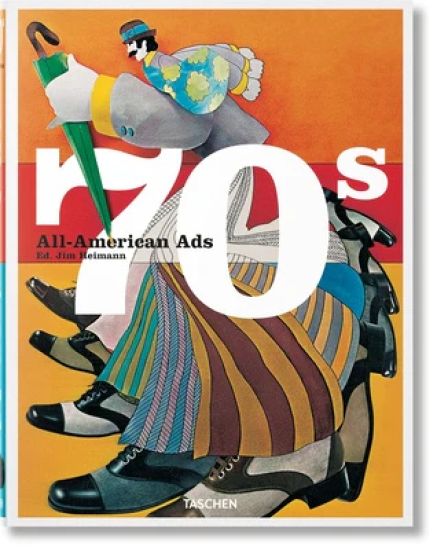
Both eclipsed and influenced by television, American print ads of the 1970s departed from the bold, graphic forms and subtle messages that were typical of their sixties counterparts. More literal, more in-your-face, 70s ads sought to capture the attention of a public accustomed to blaring, to-the-point TV commercials. All was not lost, though; as ads are a sign of the times, racial and ecological awareness crept into everything from cigarette to car advertisements, reminding Americans that everyday products were hip to the modern age. In an attempt to discover how best to communicate with a mass audience, marketing specialists studied focus groups with furious determination, thus producing such dumbed-down gems as "sisters are different from brothers," the slogan used for an African-American hair product. By the end of the decade, however, print ads had begun to recoup, gaining in originality and creativity as they focused on target audiences through carefully chosen placement in smaller publications. A fascinating study of mass culture dissemination in a post-hippie, television-obsessed nation, this weighty volume delivers an exhaustive and nostalgic overview of 70s advertising.
All-American Ads of the 80s

All-American Ads of the 80s

Steven Heller

TASCHEN GMBH
2022
sidottu
With the cold war ebbing, crime and inflation at record levels, and movie star-turned-President Ronald Reagan launching a Star Wars of his own, the 1980s did not seem likely to become one of the most outrageous, flamboyant, and prosperous decades of the 20th century. The "greed is good" mantra on Wall Street spawned the power-dressing, exercise-obsessed "Me Generation" of Yuppies. The art world enjoyed the influx of capital; computers and video games ruled in the office and at home; and the Rubik's cube craze swept the nation. Leg warmers were big, shoulder pads were bigger and hair was biggest of all. Whether your heart warms nostalgically at the memory of E.T. and marathon Trivial Pursuit sessions; if you think Ghostbusters and break dancing are totally awesome, this book's for you. To all those who still hear the echoes of "I want my MTV": All-American Ads of the 80s will leave you ready to reach out and touch someone. So just do it!
Mid-Century Ads. 40th Ed.

Mid-Century Ads. 40th Ed.

Steven Heller

TASCHEN GMBH
2023
sidottu
Gleaned from thousands of images, this book offers the best of American print advertising in the age of the “Big Idea.” From the height of American consumerism, bold and colorful campaigns paint a fascinating portrait of the 1950s and ’60s, as concerns about the Cold War gave way to the carefree booze-and-cigarettes capitalism of the Mad Men era.Digitally remastered for optimum reproduction quality, the ads burst with crisp fonts and colors, as well as a sexy sense of possibility, beguiling their audience to buy everything from guns to girdles, cars to toothpaste, air travel to home appliances. At turns startling, amusing and inspiring, this panorama of midcentury marketing is at once an evocative period piece and a showcase of design innovation and advertising wit.
POP

POP

Steven Heller

Allworth Press,U.S.
2010
pokkari
?Pop culture is often maligned as fleeting, but history shows that sometimes what is pop in one culture has time-honored resonance in later ones. This book is an attempt to show that pop culture, especially as seen through the lenses of design, illustration, satiric and political art (and other things), is integral to a broader understanding of who we are and where we are going.”?Steven Heller, from the Introduction. How do popular culture and graphic design influence one another? What are the goals of design? Are they to sell? To package? To entertain? The answers to these questions are complicated and are intimately tied to the effect design has on the overall culture. POP is the first book to analyze the role of graphic design in the broader culture, as well as the impact of design on other art and entertainment forms, from album covers to baseball stadiums. Author Steven Heller addresses such subjects as: --pop icons --viral and guerilla advertising --political satire --the history of Interview, Monocle, Mad, and other magazines --illusionism and three-dimensional design --art for art’s sake --design vs. decoration --the return of hand lettering --art for the masses. POP spans over 150 years during which popular culture has influenced mass perception and behavior. Illustrated by more than fifty images, POP is sure to inspire both aspiring and experienced designers. Allworth Press, an imprint of Skyhorse Publishing, publishes a broad range of books on the visual and performing arts, with emphasis on the business of art. Our titles cover subjects such as graphic design, theater, branding, fine art, photography, interior design, writing, acting, film, how to start careers, business and legal forms, business practices, and more. While we don't aspire to publish a New York Times bestseller or a national bestseller, we are deeply committed to quality books that help creative professionals succeed and thrive. We often publish in areas overlooked by other publishers and welcome the author whose expertise can help our audience of readers.
Stencil Type

Stencil Type

Steven Heller; Louise Fili

Thames Hudson Ltd
2017
nidottu
Stencils are ubiquitous in the fields of industry, military, traffic and transportation, as well as in the home, often applied as ornamental patterns on cabinets, walls and floors. And because they are an affordable means of mass communication, stencils are even employed by populist, rebellious and street-art movements. This follow-up to the cult typography volumes Scripts and Shadow Type, perennial favourites among designers looking for fresh and unexpected ideas, presents hundreds of examples from the 19th through the 20th centuries, artfully selected by Steven Heller and Louise Fili, preceded by a historical introduction and arranged by country of origin.