Kirjojen hintavertailu. Mukana 11 244 527 kirjaa ja 12 kauppaa.

Kirjahaku

Etsi kirjoja tekijän nimen, kirjan nimen tai ISBN:n perusteella.

1000 tulosta hakusanalla Steven J. Osterlind

The Error of Truth

The Error of Truth

Steven J. Osterlind

Oxford University Press
2019
sidottu
Quantitative thinking is our inclination to view natural and everyday phenomena through a lens of measurable events, with forecasts, odds, predictions, and likelihood playing a dominant part. The Error of Truth recounts the astonishing and unexpected tale of how quantitative thinking came to be, and its rise to primacy in the nineteenth and early twentieth centuries. Additionally, it considers how seeing the world through a quantitative lens has shaped our perception of the world we live in, and explores the lives of the individuals behind its early establishment. This worldview was unlike anything humankind had before, and it came about because of a momentous human achievement: we had learned how to measure uncertainty. Probability as a science was conceptualised. As a result of probability theory, we now had correlations, reliable predictions, regressions, the bellshaped curve for studying social phenomena, and the psychometrics of educational testing. Significantly, these developments happened during a relatively short period in world history— roughly, the 130-year period from 1790 to 1920, from about the close of the Napoleonic era, through the Enlightenment and the Industrial Revolutions, to the end of World War I. At which time, transportation had advanced rapidly, due to the invention of the steam engine, and literacy rates had increased exponentially. This brief period in time was ready for fresh intellectual activity, and it gave a kind of impetus for the probability inventions. Quantification is now everywhere in our daily lives, such as in the ubiquitous microchip in smartphones, cars, and appliances; in the Bayesian logic of artificial intelligence, as well as applications in business, engineering, medicine, economics, and elsewhere. Probability is the foundation of quantitative thinking. The Error of Truth tells its story— when, why, and how it happened.
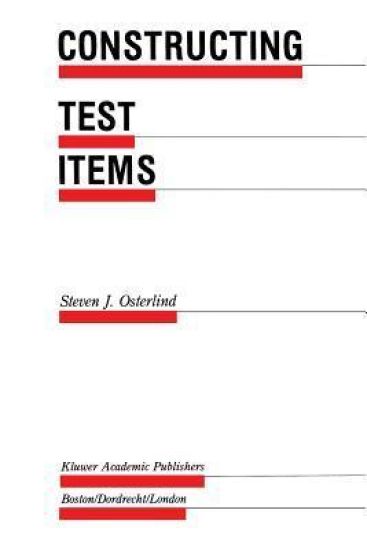
Constructing Test Items

Constructing Test Items

Steven J. Osterlind

Springer
1997
sidottu
Constructing test items for standardized tests of achievement, ability, and aptitude is a task of enormous importance. The interpretability of a test's scores flows directly from the quality of its items and exercises. Concomitant with score interpretability is the notion that including only carefully crafted items on a test is the primary method by which the skilled test developer reduces unwanted error variance, or errors of measurement, and thereby increases a test score's reliability. The aim of this entire book is to increase the test constructor's awareness of this source of measurement error, and then to describe methods for identifying and minimizing it during item construction and later review. Persons involved in assessment are keenly aware of the increased attention given to alternative formats for test items in recent years. Yet, in many writers' zeal to be `curriculum-relevant' or `authentic' or `realistic', the items are often developed seemingly without conscious thought to the interpretations that may be garnered from them. This book argues that the format for such alternative items and exercises also requires rigor in their construction and even offers some solutions, as one chapter is devoted to these alternative formats. This book addresses major issues in constructing test items by focusing on four ideas. First, it describes the characteristics and functions of test items. A second feature of this book is the presentation of editorial guidelines for writing test items in all of the commonly used item formats, including constructed-response formats and performance tests. A third aspect of this book is the presentation of methods for determining the quality of test items. Finally, this book presents a compendium of important issues about test items, including procedures for ordering items in a test, ethical and legal concerns over using copyrighted test items, item scoring schemes, computer-generateditems and more.
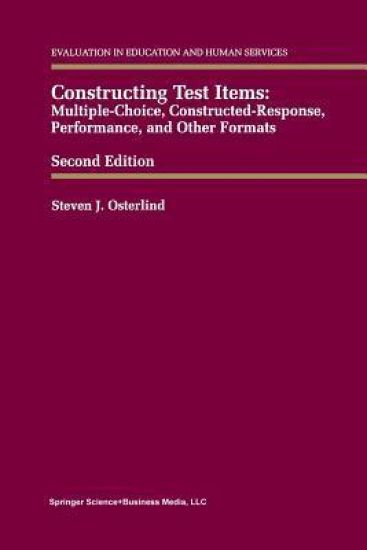
Constructing Test Items

Constructing Test Items

Steven J. Osterlind

Springer
2013
nidottu
Constructing test items for standardized tests of achievement, ability, and aptitude is a task of enormous importance. The interpretability of a test's scores flows directly from the quality of its items and exercises. Concomitant with score interpretability is the notion that including only carefully crafted items on a test is the primary method by which the skilled test developer reduces unwanted error variance, or errors of measurement, and thereby increases a test score's reliability. The aim of this entire book is to increase the test constructor's awareness of this source of measurement error, and then to describe methods for identifying and minimizing it during item construction and later review. Persons involved in assessment are keenly aware of the increased attention given to alternative formats for test items in recent years. Yet, in many writers' zeal to be `curriculum-relevant' or `authentic' or `realistic', the items are often developed seemingly without conscious thought to the interpretations that may be garnered from them. This book argues that the format for such alternative items and exercises also requires rigor in their construction and even offers some solutions, as one chapter is devoted to these alternative formats. This book addresses major issues in constructing test items by focusing on four ideas. First, it describes the characteristics and functions of test items. A second feature of this book is the presentation of editorial guidelines for writing test items in all of the commonly used item formats, including constructed-response formats and performance tests. A third aspect of this book is the presentation of methods for determining the quality of test items. Finally, this book presents a compendium of important issues about test items, including procedures for ordering items in a test, ethical and legal concerns over using copyrighted test items, item scoring schemes, computer-generateditems and more.
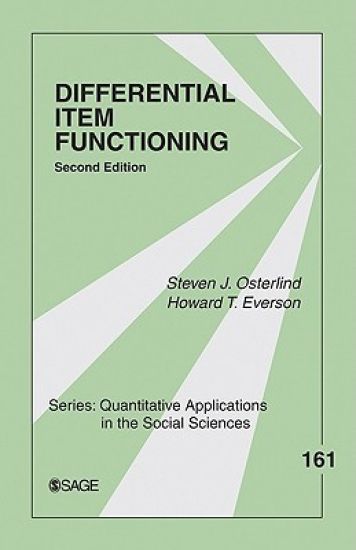
Differential Item Functioning

Differential Item Functioning

Steven J. Osterlind; Howard T. Everson

SAGE Publications Inc
2009
nidottu
This new edition presents an up-to-date description of differential item functioning. It describes varying procedures for addressing DIF in practical testing contexts. The authors present useful examples and studies of DIF that readers may employ as a guide in their own work. They also cover major statistical packages that can be employed in DIF analysis (e.g., SPSS, SAS, M+, Minitab, and Systat).This text is ideal for the measurement professional or advanced student who deals with educational or psychological assessment.
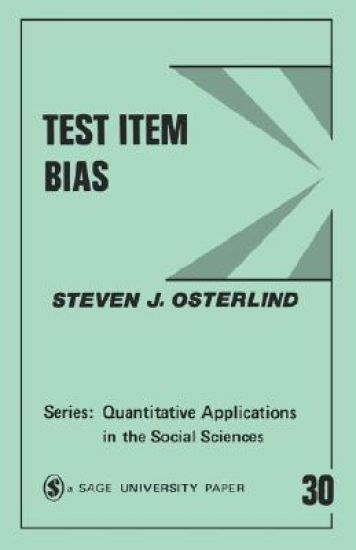
Test Item Bias

Test Item Bias

Osterlind Steven J.

SAGE PUBLICATIONS INC
1983
nidottu
A unique, practical manual for identifying and analyzing item bias in standardized tests. Osterlind discusses five strategies for detecting bias: analysis of variance, transformed item difficulties, chi square, item characteristic curve, and distractor response. He covers specific hypotheses under test for each technique, as well as the capabilities and limitations of each strategy.
Steven J. Taylor: Blue Man Living in a Red World
A tribute to the influence of one of the "intellectual forbearers" of Disability Studies in Education (DSE), this collection of six essays honors the scholar and activist Steven J. Taylor. The Centennial Professor of Disability Studies, and director of the Center on Human Policy at the Syracuse University School of Education was recognized internationally for his enduring commitment to disability policy, advocacy, and the meaningful inclusion of people with disabilities throughout society. His research, teaching, and scholarship shaped our understanding of disability through a sociological lens honed over decades of enquiry that trace back from his early work on deinstitutionalization and to the present disability trends and controversies. Taylor made clear how we socially construct humanness, belonging, community, and care in much the same way we construct deviance and stigma. Steven J. Taylor: Blue man Living in a Red World provides insight into the theoretical grounding that has fueled DSE research and scholarship for decades. You will also find opportunities for personal reflection about how one might find Taylor's work intrinsic to current efforts to challenge the persistent segregation and mistreatment of people labeled with intellectual or developmental disabilities. As the third volume in this series that is devoted to unraveling and better understanding the evolution of thought among those recognized as the early voices and critical leaders who laid the foundation for disability studies in education, the contributors to this text reexamine the impact of Taylor's scholarship on their own thinking, teaching, academic and civic activities. These essays will help you discover that Taylor continues his mentorship of those who ascribe to DSE tenets and more importantly, encourages each of us to use our positions to influence the next generation of disability activists and scholars. Contributors are: Julie Allan, Jennifer Randhare Ashton, Elisabeth De Schauwer, Cheryl M. Jorgensen, Nancy Rice, Janet Story Sauer, Ashley Taylor, Geert Van Hove and Linda Ware.
Steven J. Taylor
A tribute to the influence of one of the “intellectual forbearers” of Disability Studies in Education (DSE), this collection of six essays honors the scholar and activist Steven J. Taylor. The Centennial Professor of Disability Studies, and director of the Center on Human Policy at the Syracuse University School of Education was recognized internationally for his enduring commitment to disability policy, advocacy, and the meaningful inclusion of people with disabilities throughout society. His research, teaching, and scholarship shaped our understanding of disability through a sociological lens honed over decades of enquiry that trace back from his early work on deinstitutionalization and to the present disability trends and controversies. Taylor made clear how we socially construct humanness, belonging, community, and care in much the same way we construct deviance and stigma. Steven J. Taylor: Blue man Living in a Red World provides insight into the theoretical grounding that has fueled DSE research and scholarship for decades. You will also find opportunities for personal reflection about how one might find Taylor’s work intrinsic to current efforts to challenge the persistent segregation and mistreatment of people labeled with intellectual or developmental disabilities. As the third volume in this series that is devoted to unraveling and better understanding the evolution of thought among those recognized as the early voices and critical leaders who laid the foundation for disability studies in education, the contributors to this text reexamine the impact of Taylor’s scholarship on their own thinking, teaching, academic and civic activities. These essays will help you discover that Taylor continues his mentorship of those who ascribe to DSE tenets and more importantly, encourages each of us to use our positions to influence the next generation of disability activists and scholars. Contributors are: Julie Allan, Jennifer Randhare Ashton, Elisabeth De Schauwer, Cheryl M. Jorgensen, Nancy Rice, Janet Story Sauer, Ashley Taylor, Geert Van Hove and Linda Ware.
Data Assimilation for the Geosciences

Data Assimilation for the Geosciences

Steven J. Fletcher

Elsevier Science Publishing Co Inc
2017
nidottu
Data Assimilation for the Geosciences: From Theory to Application brings together all of the mathematical,statistical, and probability background knowledge needed to formulate data assimilation systems in one place. It includes practical exercises for understanding theoretical formulation and presents some aspects of coding the theory with a toy problem. The book also demonstrates how data assimilation systems are implemented in larger scale fluid dynamical problems related to the atmosphere, oceans, as well as the land surface and other geophysical situations. It offers a comprehensive presentation of the subject, from basic principles to advanced methods, such as Particle Filters and Markov-Chain Monte-Carlo methods. Additionally, Data Assimilation for the Geosciences: From Theory to Application covers the applications of data assimilation techniques in various disciplines of the geosciences, making the book useful to students, teachers, and research scientists.
Word by Word Picture Dictionary English/Spanish Edition

Word by Word Picture Dictionary English/Spanish Edition

Steven J. Molinsky; Bliss Bill

PEARSON EDUCATION (US)
2007
nidottu
Program Highlights More than 4,000 vocabulary words are presented through vibrant illustrations and easy-to-use lessons. Extensive coverage of important lifeskill competencies meets standards-based curriculum objectives. A careful research-based sequence of lessons integrates development of grammar and vocabulary skills. Expanded discussion questions encourage students to share their backgrounds, experiences, and opinions. New WordSongs Music CD included with dictionary extends learning outside the classroom through motivating musical practice. New bilingual editions for speakers of Arabic, Brazilian Portuguese, Chinese, Haitian Kreyol, Japanese, Korean, Polish, Russian, Spanish, and Vietnamese Teacher’s Guide and Lesson Planner with CD-ROM saves countless hours of planning, with instructional support materials in two convenient formats – as reproducible masters and on a CD-ROM.
Side by Side Plus 1 Book & eText with CD

Side by Side Plus 1 Book & eText with CD

Steven J. Molinsky; Bill Bliss

Pearson Education (US)
2018
nidottu
Student Book and eText with Digital Audio CD Skill-integrated units focusing on all communication skills Variety of grammar, vocabulary, listening, pronunciation, reading, writing, and communication activities Personalisation activities that get students to share information about their backgrounds, interests, and opinions Standards-based life skills lessons aligned with key curriculum frameworks and assessment systems New Reading and Writing Workshop sections for career and academic readiness: Language arts academic discourse activities Informational readings Writing process lessons Picture dictionary lessons for introducing unit vocabulary Check-up tests and skills checks in all units Gazette magazine sections with high-interest material for use in class and at home Standard CD tracks for Gazette activities and mp3 audio files for major lesson features, including model conversations, readings, and Gazette activities (downloadable to a computer or audio player) eText Use this digital tool to complement the program’s dynamic conversational approach. The eText supports students’ independent practice for self-paced learning. Pages of the Student Book, with the complete audio program in embedded links, provide conversation, listening, pronunciation, reading, and Gazette practice Notes and Bookmark tools enable students to add, receive and share notes, and bookmark pages to revisit them later FunZone activities, games, videos, music, and animations reinforce each unit’s objectives: Vocabulary flashcards Skill building activities for vocabulary, grammar, reading, and life skills GrammarToons animations with activities GrammarRaps, GrammarSongs, and video segments with activities (Levels 1 and 2 only)
Side by Side Plus 4 Book & eText with CD

Side by Side Plus 4 Book & eText with CD

Steven J. Molinsky; Bill Bliss

Pearson Education (US)
2016
nidottu
The standards-based Side by Side Plus series prepares students for their roles in the community, school, and at work. The updated Side by Side Plus develops students' career and academic readiness skills and promotes students' independent practice using the eText. Highlights Standards-based lessons develop competencies aligned with CCRS, CASAS, BEST Plus, and other curriculum frameworks and assessment systems. eText connects point-of-use audio to Student Book pages for lively and effective language learning. eText FunZone includes standards-based activities, eFlashcards for vocabulary practice, engaging videos, and games that reinforce each unit's objectives. Teamwork, critical thinking, and community activities promote cooperative learning, problem-solving, and civics connections. New expanded reading comprehension activities and writing lessons develop students' basic academic and career readiness skills. Expanded Workbooks with Digital Audio CDs include new Gazette activities, standards-based life skills activities, standardized test practice, and content relating to the College and Career Readiness Standards. Use the eText to: "Flip" the lesson plan by moving some of the core conversation practice outside of class. Work on a whiteboard in class. Work through the lesson and activities together in class, in the lab, or assigned with the audio as homework for out-of-class practice on computers and tablets.
English for Workplace, Civics and Academic Readiness: Vocabulary Dictionary Workbook
English for Workplace, Civics, and Academic Readiness is a combined picture dictionary and workbook that develops students' vocabulary to meet the new integrated English literacy and civics curriculum goals of the Workforce Innovation and Opportunity Act (WIOA). It contains all multilevel workplace, civics, and academic content in the Word by Word vocabulary development program, including communicative picture dictionary lessons, skill-building exercises, new standards-based activities, and a complete audio program. This easy-to-use text for beginning through low-intermediate learners can serve as a supplement to any English series, as a stand-alone course, or as a work-text for independent study at home, in a lab setting, or in distance learning. Features Vibrant illustrations and an active conversational approach make vocabulary learning come alive. Standards-based activities develop essential skills for success at work, in civic life, and in continuing education, including research tasks, surveys, charts and graphs, reading comprehension, and writing. Multilevel activities meet the needs of beginning and high-beginning/intermediate learners. Critical thinking and personalization questions promote problem-solving and sharing. Community tasks connect the classroom to civic life. Teamwork activities develop students' language abilities for working cooperatively in school and work settings. A comprehensive audio program and answer key allow students to use the text independently at their own pace.
Assessing Negative Response Bias in Competency to Stand Trial Evaluations
Evaluations of a defendant's competence to stand trial (CST) are probably the most frequently performed forensic evaluations, with estimates in the United States ranging from 60,000 to 70,000 annually. In order for CST evaluations to be considered thorough and accurate, examiners must assess for possible lack of cooperation, feigning, or malingering - the intentional production or gross exaggeration of false or grossly exaggerated physical or psychiatric symptoms, motivated by external incentives. Yet, there are accounts that CST examiners often do not assess for negative response bias, and even if they do nevertheless fail to identify a considerable number of examinees that do feign. Assessing Negative Response Bias in Competency to Stand Trial Evaluations provides readers with a comprehensive guide to assessing whether a defendant has feigned mental impairment during a competency to stand trial evaluation, or simply did not put forth his/her best effort. This book reviews the literature on assessing feigning and negative response bias, with particular focus on issues, tests, and data relevant to CST evaluations, and examines proposed criteria and statistical methods of determining and classifying assessment results. It introduces readers to aspects of the vibrant neuropsychological response style literature, an area many forensic psychologists appear to have overlooked. Additionally, it offers recommendations for research and policy regarding the parameters of CST assessment.
The Porta Stabia Neighborhood at Pompeii Volume I

The Porta Stabia Neighborhood at Pompeii Volume I

Steven J. R. Ellis; Allison L. C. Emmerson; Kevin D. Dicus

Oxford University Press
2023
sidottu
This is the first of four volumes that present the results from the University of Cincinnati's archaeological excavations of the Porta Stabia neighborhood at Pompeii. These excavations targeted two town blocks on either side of the via Stabiana (insulae VIII.7 and I.1), which comprised modest houses, shops, workshops, food and drink outlets, and hospitality buildings. The present volume describes and documents the phased, structural development of this neighborhood over several centuries. The earliest discernible activity here dates to the 6th century BCE, with the insulae taking their definitive shape only in the 2nd century BCE. It is from this time that production activities dominate the neighborhood, only to be wholly replaced by retail-oriented street-fronts from the early 1st century CE. Underpinning this narrative of urban development is a focus on the social and structural making of the Porta Stabia neighborhood, along with an interest in both the micro- (urban site formation processes) and macro-contextualization of the site (setting the results within a larger historic and urban framework).
Imperial Cults and the Apocalypse of John

Imperial Cults and the Apocalypse of John

Steven J. Friesen

Oxford University Press Inc
2001
sidottu
After more than a century of debate about the significance of imperial cults for the interpretation of Revelation, this is the first study to examine both the archaeological evidence and the Biblical text in depth. Friesen argues that a detailed analysis of imperial cults as they were practised in the first century CE in the region where John was active allows us to understand John's criticism of his society's dominant values. He demonstrates the importance of imperial cults for society at the time when Revelation was written, and shows the ways in which John refuted imperial cosmology.
Imperial Cults and the Apocalypse of John

Imperial Cults and the Apocalypse of John

Steven J. Friesen

Oxford University Press Inc
2005
nidottu
After more than a century of debate about the significance of imperial cults for the interpretation of Revelation, this is the first study to examine both the archaeological evidence and the Biblical text in depth. Friesen argues that a detailed analysis of imperial cults as they were practiced in the first century CE in the region where John was active allows us to understand John's criticism of his society's dominant values. He demonstrates the importance of imperial cults for society at the time when Revelation was written, and shows the ways in which John refuted imperial cosmology through his use of vision, myth, and eschatological expectation.