Kirjojen hintavertailu. Mukana 11 242 695 kirjaa ja 12 kauppaa.

Kirjahaku

Etsi kirjoja tekijän nimen, kirjan nimen tai ISBN:n perusteella.

1000 tulosta hakusanalla Steven K. Thompson

Sampling

Sampling

Steven K. Thompson

John Wiley Sons Inc
2012
sidottu
Praise for the Second Edition "This book has never had a competitor. It is the only book that takes a broad approach to sampling . . . any good personal statistics library should include a copy of this book." —Technometrics "Well-written . . . an excellent book on an important subject. Highly recommended." —Choice "An ideal reference for scientific researchers and other professionals who use sampling." —Zentralblatt Math Features new developments in the field combined with all aspects of obtaining, interpreting, and using sample data Sampling provides an up-to-date treatment of both classical and modern sampling design and estimation methods, along with sampling methods for rare, clustered, and hard-to-detect populations. This Third Edition retains the general organization of the two previous editions, but incorporates extensive new material—sections, exercises, and examples—throughout. Inside, readers will find all-new approaches to explain the various techniques in the book; new figures to assist in better visualizing and comprehending underlying concepts such as the different sampling strategies; computing notes for sample selection, calculation of estimates, and simulations; and more. Organized into six sections, the book covers basic sampling, from simple random to unequal probability sampling; the use of auxiliary data with ratio and regression estimation; sufficient data, model, and design in practical sampling; useful designs such as stratified, cluster and systematic, multistage, double and network sampling; detectability methods for elusive populations; spatial sampling; and adaptive sampling designs. Featuring a broad range of topics, Sampling, Third Edition serves as a valuable reference on useful sampling and estimation methods for researchers in various fields of study, including biostatistics, ecology, and the health sciences. The book is also ideal for courses on statistical sampling at the upper-undergraduate and graduate levels.
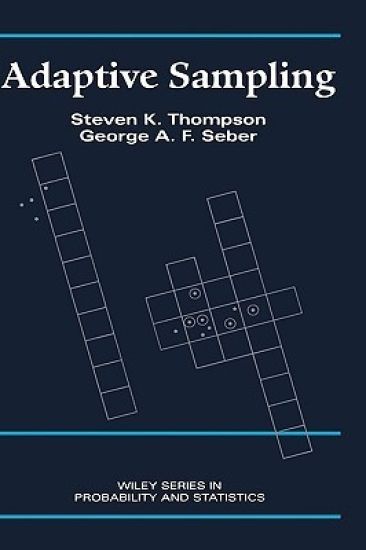
Adaptive Sampling

Adaptive Sampling

Steven K. Thompson; George A. F. Seber

John Wiley Sons Inc
1996
sidottu
Offering a viable solution to the long-standing problem of estimating the abundance of rare, clustered populations, adaptive sampling designs are rapidly gaining prominence in the natural and social sciences as well as in other fields with inherently difficult sampling situations. In marked contrast to conventional sampling designs, in which the entire sample of units to be observed is fixed prior to the survey, adaptive sampling strategies allow for increased sampling intensity depending upon observations made during the survey. For example, in a survey to assess the abundance of a rare animal species, neighboring sites may be added to the sample whenever the species is encountered during the survey. In an epidemiological survey of a contagious or genetically linked disease, sampling intensity may be increased whenever prevalence of the disease is encountered. Written by two acknowledged experts in this emerging field, this book offers researchers their first comprehensive introduction to adaptive sampling. An ideal reference for statisticians conducting research in survey designs and spatial statistics as well as researchers working in the environmental, ecological, public health, and biomedical sciences. Adaptive Sampling: *Provides a comprehensive, fully integrated introduction to adaptive sampling theory and practice *Describes recent research findings *Introduces readers to a wide range of adaptive sampling strategies and techniques *Includes numerous real-world examples from environmental pollution studies, surveys of rare animal and plant species, studies of contagious diseases, marketing surveys, mineral and fossil-fuel assessments, and more
Marketcraft

Marketcraft

Steven K. Vogel

Oxford University Press Inc
2020
nidottu
Modern-day markets do not arise spontaneously or evolve naturally. Rather they are crafted by individuals, firms, and most of all, by governments. Like statecraft, "marketcraft" represents a core function of government, and it requires considerable artistry to govern markets effectively. In Marketcraft, Steven K. Vogel builds his argument upon the recognition that all markets are crafted and then systematically explores the implications for analysis and policy. Vogel marshals a wide range of policy examples to support this concept, focusing in particular on the U.S. and Japan. He examines how the U.S., the "freest" market economy, is actually among the most heavily regulated advanced economies, while Japan's effort to liberalize its economy in the 1990s counterintuitively expanded the government's role in practice. In our era--and despite what anti-government ideologues contend--government officials, regardless of party affiliation, should be trained in marketcraft just as much as in statecraft.
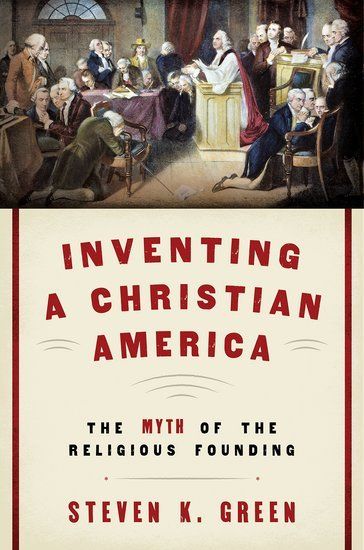
Inventing a Christian America

Inventing a Christian America

Steven K. Green

Oxford University Press Inc
2015
sidottu
One of the most enduring themes in United States history is that of its religious founding. This narrative is pervasive in school textbooks, political lore, and the popular consciousness. It is central to the way in which many Americans perceive the historical legacy of their nation. It is also largely a myth--one that this book sets out to unravel. Steven K. Green explores the historical record that supports the popular belief about the nation's religious origins. His aim is not to take part in the irresolvable debate over whether the Founders were devout Christians or atheistic deists, or whether the people of the founding generation believed chiefly in divine providence and the role of religion in public life or in separation of church and state. Rather, he seeks to explain how the ideas of America's religious founding and its status as a Christian nation became a leading narrative about the nation's collective identity. Moreover, Green takes seriously the notion that America's religious founding is a myth not merely in the colloquial sense, but also in a deeper sense, as a shared story that shapes the way we define ourselves and gives meaning to our history.
Inventing a Christian America

Inventing a Christian America

Steven K. Green

Oxford University Press Inc
2017
nidottu
Among the most enduring themes in American history is the idea that the United States was founded as a Christian nation. A pervasive narrative in everything from school textbooks to political commentary, it is central to the way in which many Americans perceive the historical legacy of their nation. Yet, as Steven K. Green shows in this illuminating new book, it is little more than a myth. In Inventing a Christian America, Green, a leading historian of religion and politics, explores the historical record that is purported to support the popular belief in America's religious founding and status as a Christian nation. He demonstrates that, like all myths, these claims are based on historical "facts" that have been colored by the interpretive narratives that have been imposed upon them. In tracing the evolution of these claims and the evidence levied in support of them from the founding of the New England colonies, through the American Revolution, and to the present day, he investigates how they became leading narratives in the country's collective identity. Three critical moments in American history shaped and continue to drive the myth of a Christian America: the Puritan founding of New England, the American Revolution and the forging of a new nation, and the early years of the nineteenth century, when a second generation of Americans sought to redefine and reconcile the memory of the founding to match their religious and patriotic aspirations. Seeking to shed light not only on the veracity of these ideas but on the reasons they endure, Green ultimately shows that the notion of America's religious founding is a myth not merely in the colloquial sense, but also in a deeper sense, as a shared story that gives deeper meaning to our collective national identity. Offering a fresh look at one of the most common and contested claims in American history, Inventing a Christian America is an enlightening read for anyone interested in the story of-and the debate over-America's founding.
Marketcraft

Marketcraft

Steven K. Vogel

Oxford University Press Inc
2018
sidottu
Modern-day markets do not arise spontaneously or evolve naturally. Rather they are crafted by individuals, firms, and most of all, by governments. Thus "marketcraft" represents a core function of government comparable to statecraft and requires considerable artistry to govern markets effectively. Just as real-world statecraft can be masterful or muddled, so it is with marketcraft. In Marketcraft, Steven Vogel builds his argument upon the recognition that all markets are crafted then systematically explores the implications for analysis and policy. In modern societies, there is no such thing as a free market. Markets are institutions, and contemporary markets are all heavily regulated. The "free market revolution" that began in the 1980s did not see a deregulation of markets, but rather a re-regulation. Vogel looks at a wide range of policy issues to support this concept, focusing in particular on the US and Japan. He examines how the US, the "freest" market economy, is actually among the most heavily regulated advanced economies, while Japan's effort to liberalize its economy counterintuitively expanded the government's role in practice. Marketcraft demonstrates that market institutions need government to function, and in increasingly complex economies, governance itself must feature equally complex policy tools if it is to meet the task. In our era-and despite what anti-government ideologues contend-governmental officials, regardless of party affiliation, should be trained in marketcraft just as much as in statecraft.
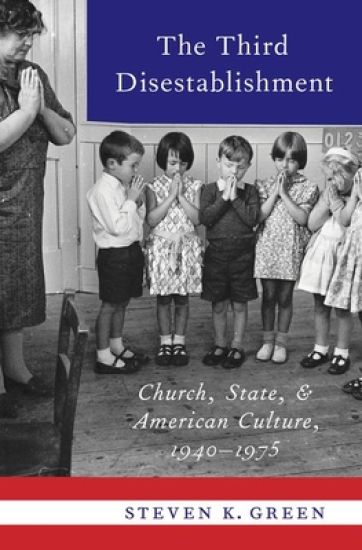
The Third Disestablishment

The Third Disestablishment

Steven K. Green

Oxford University Press Inc
2019
sidottu
In 1947, the Supreme Court embraced the concept of church-state separation as shorthand for the meaning of the Establishment Clause of the First Amendment. The concept became embedded in Court's jurisprudence and remains so today. Yet separation of church and state is not just a legal construct; it is embedded in the culture. Church-state separation was a popular cultural ideal, chiefly for Protestants and secularists, long before the Supreme Court adopted it as a constitutional principle. While the Court's church-state decisions have impacted public attitudes--particularly those controversial holdings regarding prayer and Bible reading in public schools--the idea of church-state separation has remained relatively popular; recent studies indicate that approximately two-thirds of Americans support the concept, even though they disagree over how to apply it. In the follow up to his 2010 book The Second Disestablishment, Steven K. Green sets out to examine the development of modern separationism from a legal and cultural perspective. The Third Disestablishment examines the dominant religious-cultural conflicts of the 1930s-1950s between Protestants and Catholics, but it also shows how other trends and controversies during mid-century impacted both judicial and popular attitudes toward church-state separation: the Jehovah's Witnesses' cases of the late-30s and early-40s, Cold War anti-communism, the religious revival and the rise of civil religion, the advent of ecumenism, and the presidential campaign of 1960. The book then examines how events of the 1960s--the school prayer decisions, the reforms of Vatican II, and the enactment of comprehensive federal education legislation providing assistance to religious schools--produced a rupture in the Protestant consensus over church-state separation, causing both evangelicals and religious progressives to rethink their commitment to that principle. Green concludes by examining a series of church-state cases in the late-60s and early-70s where the justices applied notions of church-state separation at the same time they were reevaluating that concept.
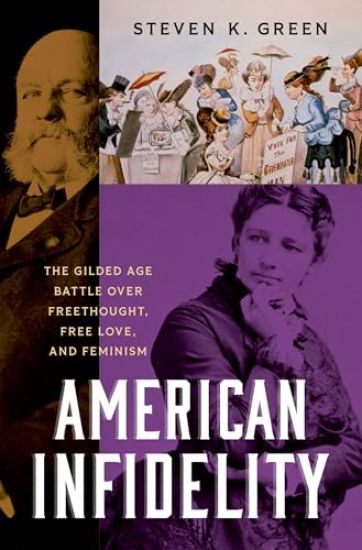
American Infidelity

American Infidelity

Steven K. Green

OXFORD UNIVERSITY PRESS INC
2026
sidottu
American Infidelity is a timely, provocative exploration of a forgotten chapter in American history--one that still echoes in our most urgent cultural debates. In the final decades of the 19th century, America stood at a cultural crossroads. Evangelical Protestantism reigned supreme, shaping laws, morals, and public life. But beneath the surface, a bold countercurrent surged--freethinkers, feminists, and sexual radicals who dared to imagine a freer, more equal society. In American Infidelity, historian Steven K. Green tells the riveting story of this ideological showdown. At its center were two powerful forces: a rising movement of skeptics and reformers who challenged religious orthodoxy and social convention, and the reactionary crusaders--led by the infamous Anthony Comstock--who fought to silence them. These "infidels," as Comstock branded them, weren't just questioning God--they were demanding access to birth control, advocating for divorce reform, and championing women's autonomy over their minds and bodies. Figures like Elizabeth Cady Stanton pushed feminism beyond the vote, calling for sexual and economic liberation. Freethought leaders rejected the idea that America was a Christian nation, insisting instead on reason, inquiry, and personal freedom. But their vision of a more open society collided head-on with a moral panic that sought to preserve traditional values at all costs. Green's gripping narrative reveals how this battle over belief, sex, and power shaped the cultural DNA of the United States. Drawing on vivid historical sources, he shows how the freethought and feminist movements were ultimately suppressed--but not extinguished. Their legacy lives on in today's ongoing struggles over reproductive rights, censorship, and the role of religion in public life.
The Bible, the School, and the Constitution

The Bible, the School, and the Constitution

Steven K. Green

Oxford University Press Inc
2012
sidottu
Few constitutional issues have been as contentious in modern times as those concerning school prayer and the public funding of religious schools. But as Steven K. Green surprisingly reveals in The Bible, the School, and the Constitution, the apogee of this debate was probably reached about one hundred and forty years ago, in the years between 1863 and 1876. As Green shows, the controversy over Bible reading in public schools captured national attention to an unprecedented degree, providing Americans with the opportunity to engage in a grand--and sometimes not so grand--public debate over the meaning of separation of church and state. Rarely in the nation's history have people from such various walks of life--Protestants and Catholics, skeptics and theocrats, nativists and immigrants, educators and politicians--been able to participate in a national discussion over the meaning of a constitutional principle. The debates of this period, Green shows, laid the foundation for constitutional arguments that still rage today.
Staley

Staley

Steven K. Ashby; C. J. Hawking

University of Illinois Press
2009
nidottu
This on-the-ground labor history chronicles the bitterly contested labor conflict in the mid 1990s at the A. E. Staley corn processing plant in Decatur, Illinois, where workers waged one of the most hard-fought struggles in recent labor history. When the company launched a full-scale assault on its workers, Allied Industrial Workers Local 837 responded by educating and mobilizing its members, organizing strong support from the religious and African American communities, building a nationwide solidarity movement, and engaging in nonviolent civil disobedience at the plant gates. Through scores of interviews and videotapes of every union meeting, the authors bring the workers' voices to the fore and reveal their innovative tactics that inform and strengthen today's labor movement.
Bone and Joint Infections, An Issue of Infectious Disease Clinics of North America
Dr. Schmitt has put together a comprehensive issue devoted to bone and joint infections. Top experts have created state-of-the-art clinical reviews devoted to the following topics: Native septic arthritis; Reactive arthritis; Prevention of infection in orthopedic prosthetic surgery; Infections of the spine; Radiologic approach to musculoskeletal infections; Infections associated with open fractures; Fungal musculoskeletal infections; Mycobacterial musculoskeletal infections; Diagnosis of prosthetic joint infections-cultures, biomarkers, and criteria; Management of Prosthetic Joint Infections; Osteomyelitis In adults; and Osteomyelitis in children. Readers will come away with clinical information that can be immediately applied to caring for patients recovering from orthopedic surgeries.
The Richest Man Who Ever Lived

The Richest Man Who Ever Lived

Steven K. Scott

Broadway Books (A Division of Bantam Doubleday Del
2006
sidottu
A multimillionaire draws on the wisdom and insights of King Solomon found in the Old Testament Book of Proverbs to demonstrate how to lead a life marked by financial success and personal fulfillment, discussing the importance of diligence, how to resolve conflicts, and the five key qualities of a valued and admired individual. 25,000 first printing.
Roman Edessa

Roman Edessa

Steven K. Ross

Routledge
2000
sidottu
Roman Edessa offers a comprehensive and erudite analysis of the ancient city of Edessa (modern day Urfa, Turkey), which constituted a remarkable amalgam of the East and the West. Among the areas explored are:* the cultural life and antecedents of Edessa* Edessene religion* the extent of the Hellenization at Edessa before the advent of Christianity* the myth of an exchange of letters between a King Abgar and Jesus.
Roman Edessa

Roman Edessa

Steven K. Ross

Routledge
2011
nidottu
Roman Edessa offers a comprehensive and erudite analysis of the ancient city of Edessa (modern day Urfa, Turkey), which constituted a remarkable amalgam of the East and the West. Among the areas explored are:the cultural life and antecedents of EdessaEdessene religionthe extent of the Hellenization at Edessa before the advent of Christianitythe myth of an exchange of letters between a King Abgar and Jesus.
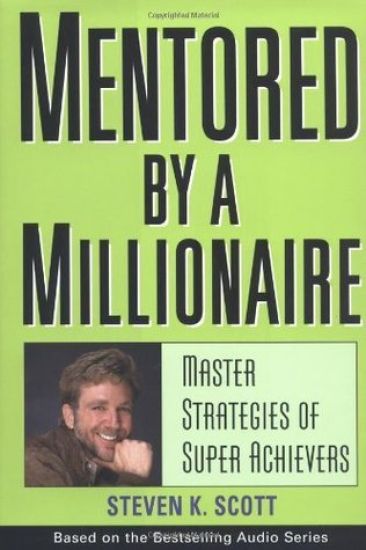
Mentored by a Millionaire

Mentored by a Millionaire

Steven K. Scott

John Wiley Sons Inc
2004
sidottu
You’ve been taught by teachers, now you can be MENTORED by a MILLIONAIRE! When it comes to succeeding, there’s an infinite difference between being taught theories in school, and being mentored in specific skills and strategies by someone who has made tens of millions of dollars himself. Steve Scott was a corporate failure until he was mentored by a millionaire. Using the strategies he learned from his mentor, Steve became a multimillionaire entrepreneur who along with his partners built more than a dozen companies from scratch, achieving billions of dollars in sales. Now, step-by-step, he mentors readers in each of the master strategies that have enabled him and countless others to achieve their impossible dreams. "The secret of Steve Scott’s wonderful book can be found in the title. These strategies work because you’re being mentored by someone from the front lines. This book will be forever around, helping, teaching–mentoring." –Larry King, CNN, Larry King Live "The splendidly organized wisdom in this book is made more attractive by the specific examples Scott uses. It is instantly clear to the reader that these techniques are within the reach of anyone, and this good news makes it a revelation." –Hugh Downs, ABC News, 20/20 (ret.) "I don’t remember whether Horatio Alger was ever cornered to write a book on how to succeed, but at least we have this fun and instructive book by young Mr. Scott. It deserves to be read widely, and my hope for it is that everyone who reads it will become a millionaire." –William F. Buckley Jr., Founder, National Review "UNBELIEVABLE! This book should be required reading for every man and woman in America. In this book, Steve Scott not only proves you and your family can achieve your ‘impossible dreams,’ he takes you by the hand and gives you the knowledge, confidence, and the power to achieve every one!" –Chuck Norris "Steve Scott has captured a very simple but powerful formula for translating one’s dreams into reality. The reason this book has so much credibility for me is that I have seen him implement these principles in his personal life to tremendous success–professionally, with his family, and in all aspects of his life. This is a must-read book." –Hyrum W. Smith, Vice Chairman of the Board, The Franklin-Covey Company "Steve Scott’s phenomenal track record for success in so many different endeavors shows that his principles are universally effective. In this book, he gives you a clear and concise road map to achieving more success than you would even think possible. If you follow it, you’re sure to get there." –Dick Clark, Dick Clark Productions
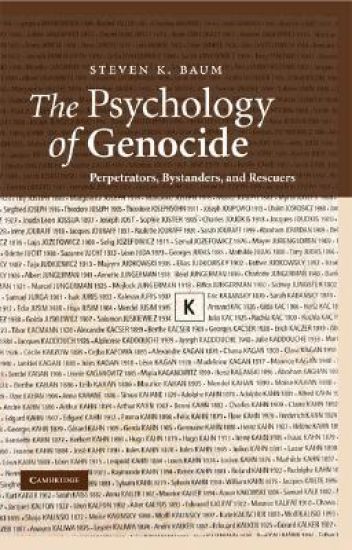
The Psychology of Genocide

The Psychology of Genocide

Steven K. Baum

Cambridge University Press
2008
pokkari
Genocide has tragically claimed the lives of over 262 million victims in the last century. Jews, Armenians, Cambodians, Darfurians, Kosovons, Rwandans, the list seems endless. Clinical psychologist Steven K. Baum sets out to examine the psychological patterns to these atrocities. Building on trait theory as well as social psychology he reanalyzes key conformity studies (including the famous experiments of Ash, Millgram and Zimbardo) to bring forth an understanding of identity and emotional development during genocide. Baum presents a model that demonstrates how people's actions during genocide actually mirror their behaviour in everyday life: there are those who destruct (perpetrators), those who help (rescuers) and those who remain uninvolved, positioning themselves between the two extremes (bystanders). Combining eyewitness accounts with Baum's own analysis, this book reveals the common mental and emotional traits among perpetrators, bystanders and rescuers and how a war between personal and social identity accounts for these divisions.
The Psychology of Genocide

The Psychology of Genocide

Steven K. Baum

Cambridge University Press
2008
sidottu
Genocide has tragically claimed the lives of over 262 million victims in the last century. Jews, Armenians, Cambodians, Darfurians, Kosovons, Rwandans, the list seems endless. Clinical psychologist Steven K. Baum sets out to examine the psychological patterns to these atrocities. Building on trait theory as well as social psychology he reanalyzes key conformity studies (including the famous experiments of Ash, Millgram and Zimbardo) to bring forth an understanding of identity and emotional development during genocide. Baum presents a model that demonstrates how people's actions during genocide actually mirror their behaviour in everyday life: there are those who destruct (perpetrators), those who help (rescuers) and those who remain uninvolved, positioning themselves between the two extremes (bystanders). Combining eyewitness accounts with Baum's own analysis, this book reveals the common mental and emotional traits among perpetrators, bystanders and rescuers and how a war between personal and social identity accounts for these divisions.