
Kirjahaku
Etsi kirjoja tekijän nimen, kirjan nimen tai ISBN:n perusteella.
1000 tulosta hakusanalla Steven Richard Bechtler

Roland Allen (1868-1947) is remembered as one of the foremost missionaries of the last century. Throughout his life, Allen travelled the world, following his vocation and building his missionary methods centred on a theology of indigenisation. From his early days as a Chaplain in China (during which Allen was forced to flee to the British Legation in Beijing), through to his continued mission to India, Canada and South Africa, he developed as man, missionary and theologian. The first of two volumes, Roland Allen: A Missionary Life is an intellectual biography which explores the people and ideas that influenced Allen while tracing the ways in which his missionary ecclesiology evolved during his life. Through extensive examination of unpublished archival papers, including lesser known letters and sermons, Steven Richard Rutt has uncovered the growth of a forthright, morally indefatigable churchman, who was also a loving family man with close and long-running friendships. Rutt unpacks Allen's Church-centred missionary ecclesiology and 'missiology of indigenisation', which were based on Allen's knowledge, gained from experience. Roland Allen: A Missionary Life and Roland Allen: A Theology of Mission explore the thought of a Christian whose writings provided farsighted clarity on global Christian missionary work that is still relevant today.
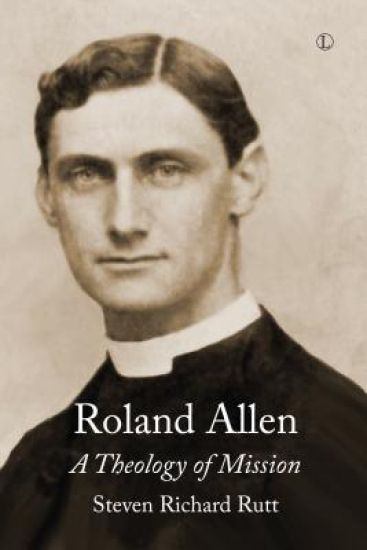
In Roland Allen: A Theology of Mission, a companion work with Roland Allen: A Missionary Life, Steven Richard Rutt completes a portrait of Roland Allen (1868-1947) in this intellectual biography. Extensive archival evidence discloses how apostolic principles formed the basis for Allen's missionary theology. Although it is well-known that Allen's hermeneutical ideas were born of Pauline principles, Steven Richard Rutt expounds the ways in which Allen's missionary experiences had profoundly impacted Allen's theological beliefs. Allen wrote about his findings in letters, sermons, articles and books, some of which were never published. Allen's writings tenaciously challenged the methodology of colonial missionary societies and exposed the causes hindering Church expansion: failures occurred in missions due to the imposition of Western missionary paternalism and institutional devolution. Allen advocated the empowerment of indigenous churches to apply the principles of self-government and self-support. He asserted the importance of the Pauline concept of 'Spirit and order', which encompasses both the doctrine of the Holy Spirit as well as that of the Church. Allen's diagnosis of the missionary situation and the proposed ways to restore apostolic order presented contemporary controversy but since his death, we have seen the importance of Allen's ideas in Mission studies grow steadily. With an expert evaluation of Allen's theological insight, Roland Allen: A Theology of Mission also offers a superb contribution to the discipline of historical theology and historical missiology as Rutt delves into a contextual assay into the missionary landscape of the nineteenth and the twentieth centuries.


Before the film, César Chavez, Chavez's life was depicted in photographs by his confidant, Jon Lewis. In the winter of 1966, twenty-eight-year-old ex-marine Jon Lewis visited Delano, California, the center of the California grape strike. He thought he might stay awhile, then resume studying photography at San Francisco State University. He stayed for two years, becoming the United Farm Workers Union's semiofficial photographer and a close confidant of farmworker leader César Chávez.Surviving on a picket's wage of five dollars a week, Lewis photographed twenty-four hours a day and created an insider's view of the historic and sometimes violent confrontations, mass marches, fasts, picket lines, and boycotts that forced the table-grape industry to sign the first contracts with a farm workers union. Though some of his images were published contemporaneously, most remained unseen. Historian and photographer Richard Steven Street rescues Lewis from obscurity, allowing us for the first time to see a pivotal moment in civil rights history through the lens of a passionate photographer.A masterpiece of social documentary, this work is at once the biography of a photographer, an exposé of poverty and injustice, and a celebration of the human spirit.

Written by one of America's preeminent labor historians, this book is the definitive account of one of the most spectacular, captivating, complex and strangely neglected stories in Western history—the emergence of migratory farmworkers and the development of California agriculture. Street has systematically worked his way through a mountain of archival materials—more than 500 manuscript collections, scattered in 22 states, including Spain and Mexico—to follow the farmworker story from its beginnings on Spanish missions into the second decade of the twentieth century. The result is a comprehensive tour de force. Scene by scene, the epic narrative clarifies and breathes new life into a controversial and instructive saga long surrounded by myth, conjecture, and scholarly neglect. With its panoramic view spanning 144 years and moving from the US-Mexico border to Oregon, Beasts of the Field reveals diverse patterns of life and labor in the fields that varied among different crops, regions, time periods, and racial and ethic groups. Enormous in scope, packed with surprising twists and turns, and devastating in impact, this compelling, revelatory work of American social history will inform generations to come of the history of California and the nation.
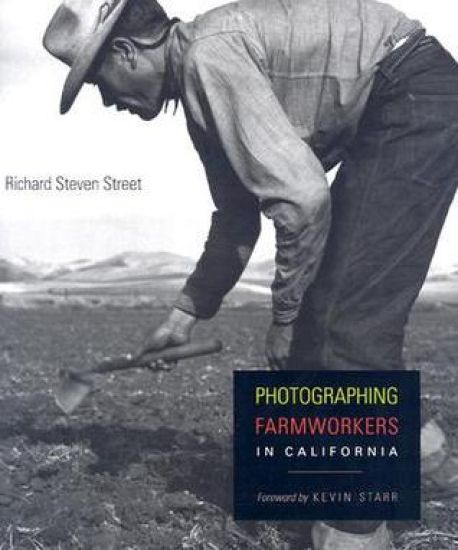
Photographing Farmworkers in California
Richard Steven Street
Stanford University Press
2004
sidottu
The work of nearly every photographer of consequence since the nineteenth century is captured in this collection of photographs of California farmworkers, raising moral questions about the exploitation and colonization of an entire class of people.
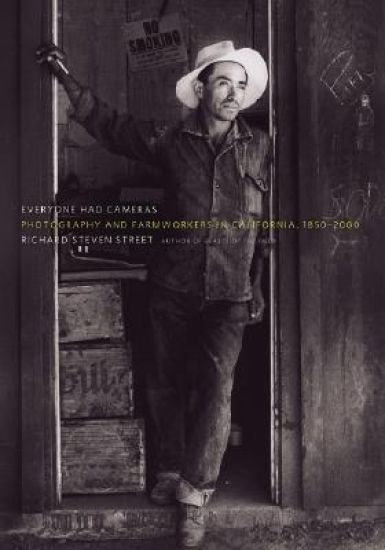
The relationship between California farmworkers and the photographers who have documented their livesAmerican photographers have been fascinated by the lives of California farmworkers since the time of the daguerreotype. From the earliest Gold Rush–era images and the documentary photographs taken during the Great Depression to digital images today, photographers and farmworkers in California have had a complicated and continuously changing bond. In Everyone Had Cameras, Richard Steven Street provides a comprehensive history of the significant presence of California farmworkers in the visual culture of America.Street’s account spans 150 years and sheds a new perspective on some of America’s photographic masters, such as Carleton E. Watkins, Ansel Adams, and Dorothea Lange, and brings to light heretofore unknown and unheralded work by perceptive amateurs, socially committed journeymen, digital documentarians, commercial propagandists, and left-wing critics. Through their artistry, these figures powerfully revealed-and at times obscured-the human cost of industrial agriculture and cheap food. Photographers are deeply embedded in the farmworker story, Street shows, and it cannot be understood without paying attention to their ever-evolving vision. Indeed, cameras are so prevalent on picket lines and at strikes and demonstrations that it is normal to see not only photojournalists but also police, protesters, and growers awaiting a decisive-or incriminating-moment to capture. Deftly weaving the remarkable diversity of field photography into this story of labor activism, Everyone Had Cameras establishes a new history of California photography while chronicling the impact that this visual medium-called by some the common currency of modern dialogue-has had on a vast, dispossessed class of American workers.
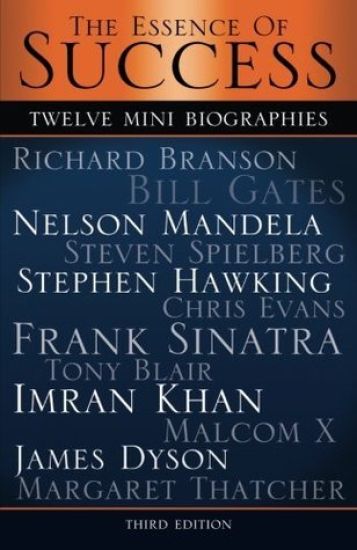
The Essence of Success: 12 Mini Biographies: Richard Branson Bill Gates Nelson Mandela Steven Spielberg Stephen Hawking Chris Evans Frank Sina
Mark Crow
Createspace Independent Publishing Platform
2014
nidottu

The Essence of Success: 12 Mini Biographies: Richard Branson Bill Gates Nelson Mandela Steven Spielberg Stephen Hawking Chris Evans Frank Sina
Mark Crow; Damien Carr; Nicholas Cheek
Createspace Independent Publishing Platform
2015
nidottu

Updated edition published to celebrate the 60th anniversary of Spielberg's first feature film and featuring a foreword from the master filmmaker himself.From the irresistible fantasy of E.T. to the gritty realism of Saving Private Ryan, the films of Steven Spielberg have captured the imagination of the world. Renowned critic Richard Schickel now gives us the definitive illustrated monograph on this Oscar-winning Hollywood icon, whose long and glittering career few directors have equaled.Spielberg is one of the most influential and inspirational minds in cinema, and Schickel provides perceptive analysis of 60 years' worth of work, with illuminating film-by-film commentary on such masterpieces as the underwater thriller, Jaws; the high-speed adventures of Indiana Jones; the harrowing Schindler's List; sci-fi classic Close Encounters of the Third Kind; to his most recent releases, the Oscar-winning Bridge of Spies and West Side Story.

Steven Berkoff was asked to direct Shakespeare's Richard II in New York early 1994. It was a project he found fascinating: performing an Elizabethan play within the scrapers of Manhattan and the still rotting slums of the Lower East Side, between the steaming breath oozing out from the cracked pipes and the brutality of modern New York speak. New York became the backdrop and the energy centre which charged him each day and fed his inspiration. This book offers a wonderful insight into the many characters, challenges and places that were integral to the project and details how gradually the production took form. Served by a first-rate company that worked incredibly hard, the achievement was a critically acclaimed production and the fulfilment of a personal goal to direct the Bard. NEW YORK POST This morning I have joy to report - so let the trumpets sound and the canons roar! Last night at the Anspacher Auditorium of the Joseph Papp Public Theater, there opened a production of The Tragedy of Richard II which can hold its own with the world's best in Shakespearean stagings.NEW YORK SUNDAY TIMES The Tragedy of Richard II now being given an exceptionally stylish production by Steven Berkoff. Mr Berkoff's production, which, among many virtues, is so well and clearly spoken and so clean of dramatic line that it's accessible from start to finish...THE PHILADELPHIA INQUIRER NEW YORK - They'll be talking about this Richard II for years.
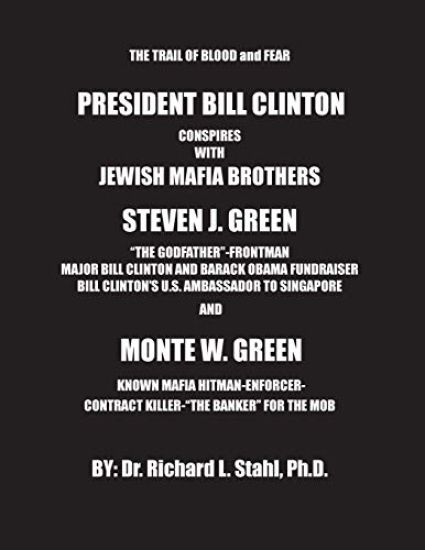
President Bill Clinton Conspires With Jewish Mafia Brothers Steven J. Green...
Richard L. Stahl Ph. D.
Createspace Independent Publishing Platform
2015
nidottu

Canal Zone Richard Prince YES RASTA: Selected Court Documents from Cariou v. Prince et al
Richard Prince; Hollis Gonerka Bart; Steven M. Hayes
Greg.Org
2011
nidottu

Billionaire Habits: The Success Principles, Lessons, and Morning Routines of Elon Musk, Bill Gates, Oprah Winfrey, Richard Branson, Ray Da
Steven Hunter
Independently Published
2019
nidottu
Reveal the Secrets of the TOP 1% to Achieve Massive Wealth & Outstanding Success Billionaires do not become billionaires overnight. They are able to maintain such a massive wealth by combining several things - habits, wisdom, and an out-of-the-box creativity to confront any situation in their lives. In this book, you will learn exactly how to develop billionaire habits, acquire a billionaire wisdom, and expand your creativity to achieve anything you want in life.If you have always wanted to know HOW and WHY billionaires and other successful people are who they are today, and if you really want to corroborate the rumors behind their success, this book will show you exactly what they have done, and how even YOU can become a BILLIONAIRE.In this spectacular book, you will find: The success principles of billionairesInnovative ideas that will lead you to success.How to develop a powerful daily routine.History, facts and things you did not know about the most impressive billionaires in the world.And much, much more Scroll up, click on "Buy Now with 1-Click", and Expose the Billionaires Secrets

The Most Dangerous Man in America: Timothy Leary, Richard Nixon, and the Hunt for the Fugitive King of LSD
Bill Minutaglio; Steven L. Davis
Twelve
2019
nidottu
From Bill Minutaglio and Steven L. Davis, authors of the PEN Center USA award-winning Dallas 1963, comes a madcap narrative about Timothy Leary's daring prison escape and run from the law. On the moonlit evening of September 12, 1970, an ex-Harvard professor with a genius I.Q. studies a twelve-foot high fence topped with barbed wire. A few months earlier, Dr. Timothy Leary, the High Priest of LSD, had been running a gleeful campaign for California governor against Ronald Reagan. Now, Leary is six months into a ten-year prison sentence for the crime of possessing two marijuana cigarettes. Aided by the radical Weather Underground, Leary's escape from prison is the counterculture's union of "dope and dynamite," aimed at sparking a revolution and overthrowing the government. Inside the Oval Office, President Richard Nixon drinks his way through sleepless nights as he expands the war in Vietnam and plots to unleash the United States government against his ever-expanding list of domestic enemies. Antiwar demonstrators are massing by the tens of thousands; homemade bombs are exploding everywhere; Black Panther leaders are threatening to burn down the White House; and all the while Nixon obsesses over tracking down Timothy Leary, whom he has branded "the most dangerous man in America." Based on freshly uncovered primary sources and new firsthand interviews, The Most Dangerous Man in America is an American thriller that takes readers along for the gonzo ride of a lifetime. Spanning twenty-eight months, President Nixon's careening, global manhunt for Dr. Timothy Leary winds its way among homegrown radicals, European aristocrats, a Black Panther outpost in Algeria, an international arms dealer, hash-smuggling hippies from the Brotherhood of Eternal Love, and secret agents on four continents, culminating in one of the trippiest journeys through the American counterculture.
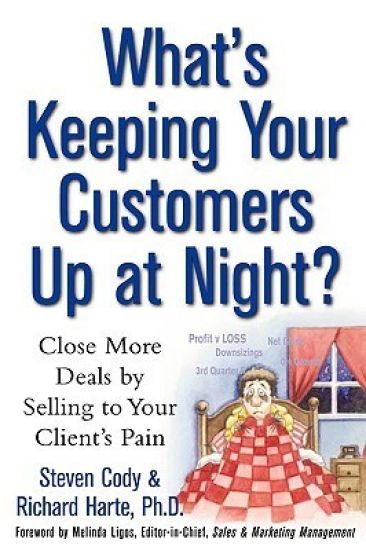
What's Keeping Your Customers Up at Night?
Steven Cody; Richard Harte
McGraw-Hill Inc.,US
2003
pokkari
A groundbreaking approach to selling to your customer's "pain" PR guru Steve Cody and sales consultant Richard Harte team up to bring readers a revolutionary methodology for discovering what customers really need and using that knowledge to build stronger, more profitable relationships with them. The evolutionary next step in the "trusted adviser" approach to selling that has taken the sales world by storm, the system successfully combines public relations strategies with consultative sales techniques in a strategic framework. Among other important lessons, salespeople learn to uncover a client's deepest concerns - "what keeps them up at night" - and to position their products or services in light of those concerns, using message points and other traditional PR tactics to help them successfully sell to the customer's "pain."

Crime and the American Dream
Steven Messner; Richard Rosenfeld
Wadsworth Publishing Co Inc
2012
nidottu
How has America's over-emphasis on the pursuit of materialistic gain contributed to the it's high rate of violent crime? CRIME AND THE AMERICAN DREAM, 5th Edition is an easy-to-understand book that attempts to answer that question using seminal criminological theory.

Crime and the American Dream, International Edition
Steven Messner; Richard Rosenfeld
Wadsworth Publishing Co Inc
2012
nidottu
How has America's over-emphasis on the pursuit of materialistic gain contributed to the it's high rate of violent crime? CRIME AND THE AMERICAN DREAM, 5E, International Edition is an easy-to-understand book that attempts to answer that question using seminal criminological theory.