

Kirjahaku
Etsi kirjoja tekijän nimen, kirjan nimen tai ISBN:n perusteella.
1000 tulosta hakusanalla Stewart C. Lewis

Why pursue a university education? Some people answer in terms of the purpose of getting a good job. Others respond in terms of the aim of earning more money. Still others answer in terms of the goal of promoting social justice. Drawing on C. S. Lewis’s belief that the purpose of life is the experience of perfect happiness, Stewart Goetz explains Lewis’s simple but overlooked view that a person should pursue a university education for the pleasure that comes from higher-level intellectual activity. Goetz not only sharpens our understanding of Lewis’s life and work in higher education, but also leads us to question why we attend, study, teach, or research at a university.
Why pursue a university education? Some people answer in terms of the purpose of getting a good job. Others respond in terms of the aim of earning more money. Still others answer in terms of the goal of promoting social justice. Drawing on C. S. Lewis’s belief that the purpose of life is the experience of perfect happiness, Stewart Goetz explains Lewis’s simple but overlooked view that a person should pursue a university education for the pleasure that comes from higher-level intellectual activity. Goetz not only sharpens our understanding of Lewis’s life and work in higher education, but also leads us to question why we attend, study, teach, or research at a university.
C. S. Lewis on the Soul, God, and Christianity
Stewart Goetz
Cambridge University Press
2025
pokkari
C. S. Lewis was an adamant atheist when he entered Oxford University as a student in 1917. By 1931, he was an Oxford don and a Christian. Lewis was someone who did not think highly of climates of opinion, and in his book The Problem of Pain he warned against uncritically going along with them: 'I take a very low view of 'climates of opinion'. In his own subject every man knows that all discoveries are made and all errors corrected by those who ignore the 'climate of opinion'.' A climate of opinion exists today that either intentionally or unintentionally disenchants or debunks C. S. Lewis. In this Element, the author explains Lewis' belief in the existence of the soul and how it related to his conviction that happiness consists of experiences of pleasure and is the purpose of life, God exists, and Christianity is true.
C. S. Lewis on the Soul, God, and Christianity
Stewart Goetz
Cambridge University Press
2025
sidottu
C. S. Lewis was an adamant atheist when he entered Oxford University as a student in 1917. By 1931, he was an Oxford don and a Christian. Lewis was someone who did not think highly of climates of opinion, and in his book The Problem of Pain he warned against uncritically going along with them: 'I take a very low view of 'climates of opinion'. In his own subject every man knows that all discoveries are made and all errors corrected by those who ignore the 'climate of opinion'.' A climate of opinion exists today that either intentionally or unintentionally disenchants or debunks C. S. Lewis. In this Element, the author explains Lewis' belief in the existence of the soul and how it related to his conviction that happiness consists of experiences of pleasure and is the purpose of life, God exists, and Christianity is true.
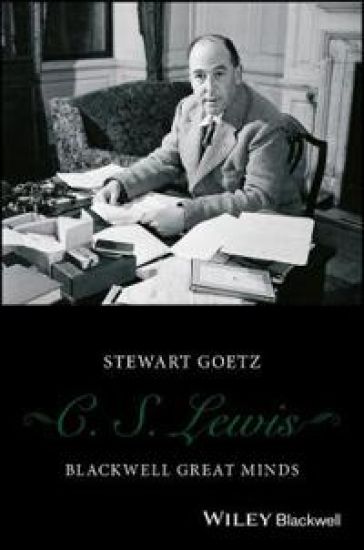
The definitive exploration of C.S. Lewis’s philosophical thought, and its connection with his theological and literary work Arguably one of the most influential writers of the twentieth century, C.S. Lewis is widely hailed as a literary giant, his seven-volume Chronicles of Narnia having sold over 65 million copies in print worldwide. A prolific author and scholar whose intellectual contributions transcend the realm of children’s fantasy literature, Lewis is commonly read and studied as a significant theological figure in his own right. What is often overlooked is that Lewis first loved and was academically trained in philosophy. In this newest addition to the Blackwell Great Minds series, well-known philosopher and Lewis authority Stewart Goetz discusses Lewis’s philosophical thought and illustrates how it informs his theological and literary work. Drawing from Lewis’s published writing and private correspondence, including unpublished materials, C.S. Lewis is the first book to develop a cohesive and holistic understanding of Lewis as a philosopher. In this groundbreaking project, Goetz explores how Lewis’s views on topics of lasting interest such as happiness, morality, the soul, human freedom, reason, and imagination shape his understanding of myth and his use of it in his own stories, establishing new connections between Lewis’s philosophical convictions and his wider body of published work. Written in a scholarly yet accessible style, this short, engaging book makes a significant contribution to Lewis scholarship while remaining suitable for readers who have only read his stories, offering new insight into the intellectual life of this figure of enduring popular interest.
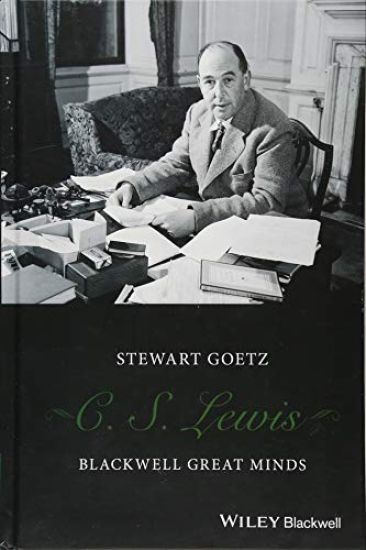
The definitive exploration of C.S. Lewis’s philosophical thought, and its connection with his theological and literary work Arguably one of the most influential writers of the twentieth century, C.S. Lewis is widely hailed as a literary giant, his seven-volume Chronicles of Narnia having sold over 65 million copies in print worldwide. A prolific author and scholar whose intellectual contributions transcend the realm of children’s fantasy literature, Lewis is commonly read and studied as a significant theological figure in his own right. What is often overlooked is that Lewis first loved and was academically trained in philosophy. In this newest addition to the Blackwell Great Minds series, well-known philosopher and Lewis authority Stewart Goetz discusses Lewis’s philosophical thought and illustrates how it informs his theological and literary work. Drawing from Lewis’s published writing and private correspondence, including unpublished materials, C.S. Lewis is the first book to develop a cohesive and holistic understanding of Lewis as a philosopher. In this groundbreaking project, Goetz explores how Lewis’s views on topics of lasting interest such as happiness, morality, the soul, human freedom, reason, and imagination shape his understanding of myth and his use of it in his own stories, establishing new connections between Lewis’s philosophical convictions and his wider body of published work. Written in a scholarly yet accessible style, this short, engaging book makes a significant contribution to Lewis scholarship while remaining suitable for readers who have only read his stories, offering new insight into the intellectual life of this figure of enduring popular interest.
Although it has been almost seventy years since Time declared C.S. Lewis one of the world's most influential spokespersons for Christianity and fifty years since Lewis's death, his influence remains just as great if not greater today. While much has been written on Lewis and his work, virtually nothing has been written from a philosophical perspective on his views of happiness, pleasure, pain, and the soul and body. As a result, no one so far has recognized that his views on these matters are deeply interesting and controversial, and—perhaps more jarring—no one has yet adequately explained why Lewis never became a Roman Catholic. Stewart Goetz's careful investigation of Lewis's philosophical thought reveals oft-overlooked implications and demonstrates that it was, at its root, at odds with that of Thomas Aquinas and, thereby, the Roman Catholic Church.
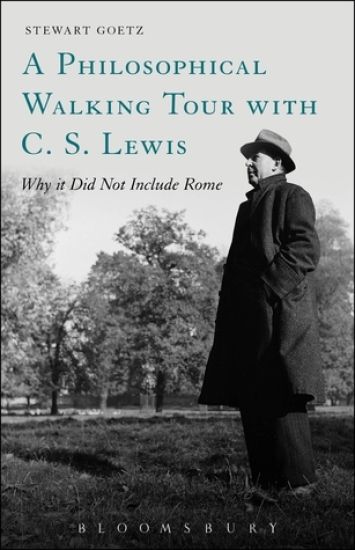
Although it has been almost seventy years since Time declared C.S. Lewis one of the world's most influential spokespersons for Christianity and fifty years since Lewis's death, his influence remains just as great if not greater today. While much has been written on Lewis and his work, virtually nothing has been written from a philosophical perspective on his views of happiness, pleasure, pain, and the soul and body. As a result, no one so far has recognized that his views on these matters are deeply interesting and controversial, and—perhaps more jarring—no one has yet adequately explained why Lewis never became a Roman Catholic. Stewart Goetz's careful investigation of Lewis's philosophical thought reveals oft-overlooked implications and demonstrates that it was, at its root, at odds with that of Thomas Aquinas and, thereby, the Roman Catholic Church.
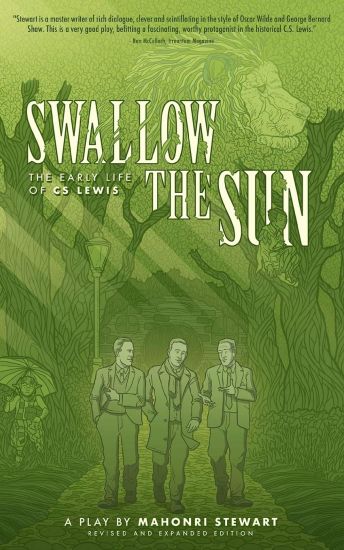
Swallow the Sun: The Early Life of C.S. Lewis
Mahonri Stewart
Createspace Independent Publishing Platform
2018
nidottu
C.S. "Jack" Lewis: accomplished author, famed creator of fantasy worlds, and the 20th Century's most eloquent defender of Christianity. Little do most people know that he was once an entrenched atheist. This play by Kennedy Center award-winning playwright Mahonri Stewart recounts the powerful spiritual journey of the "most reluctant convert in all of England," as he grapples with bold figures of faith like J.R.R. Tolkien and a god who hunts his soul relentlessly. Yet the worth of that soul is manifest in a struggle that will create a legendary legacy. The volume also includes Stewart's speech about C.S. Lewis: "It is the Myth That Gives Life."

Magnetic Resonance Imaging: Physical and Biological Principles, 4th Edition offers comprehensive, well-illustrated coverage on this specialized subject at a level that does not require an extensive background in math and physics. It covers the fundamentals and principles of conventional MRI along with the latest fast imaging techniques and their applications. Beginning with an overview of the fundamentals of electricity and magnetism (Part 1), Parts 2 and 3 present an in-depth explanation of how MRI works. The latest imaging methods are presented in Parts 4 and 5, and the final section (Part 6) covers personnel and patient safety and administration issues. This book is perfect for student radiographers and practicing technologists preparing to take the MRI advanced certification exam offered by the American Registry of Radiologic Technologists (ARRT). "I would recommend it to anyone starting their MRI training and anyone trying to teach MRI to others." Reviewed by RAD Magazine, June 2015 Challenge questions at the end of each chapter help you assess your comprehension. Chapter outlines and objectives assist you in following the hierarchy of material in the text. Penguin boxes highlight key points in the book to help you retain the most important information and concepts in the text. NEW! Two MRI practice exams that mirror the test items in each ARRT category have been added to the end of the text to help you replicate the ARRT exam experience. NEW! Chapter on Partially Parallel Magnetic Resonance Imaging increases the comprehensiveness of the text. NEW! Updated key terms have been added to each chapter with an updated glossary defining each term.

Radiologic Science for Technologists - Text and Elsevier Adaptive Learning Package
Stewart C. Bushong
MOSBY
2014
sidottu
Corresponding chapter-by-chapter to Radiologic Science for Technologists, 10th Edition, Elsevier Adaptive Learning combines the power of brain science with sophisticated, patented Cerego algorithms to help you learn faster and remember longer. It's fun; it's engaging; and it's constantly tracking your performance and adapting to deliver content precisely when it's needed to ensure core information is transformed into lasting knowledge. An individual study schedule reduces cognitive workload and helps you become a more effective learner by automatically guiding the learning and review process. The mobile app offers a seamless learning experience between your smartphone and the web with your memory profile maintained and managed in the cloud. UNIQUE Your memory strength is profiled at the course, chapter, and item level to identify personal learning and forgetting patterns. UNIQUE Material is re-presented just before you would naturally forget it to counteract memory decay. A personalized learning pathway is established based on your learning profile, memory map, and time required to demonstrate information mastery. The comprehensive student dashboard allows you to view your personal learning progress.
Otolaryngology, An Issue of Medical Clinics of North America
Stewart C. Matthew
Elsevier - Health Sciences Division
2018
sidottu
This issue of Medical Clinics, Guest Edited by C. Matthew Stewart, MD, is devoted to Otolaryngology. Articles in this issue include: Hearing Loss; Sinuses and Common Rhinologic Conditions; Dizziness and the Otolaryngology - Head and Neck Surgery POV; Head and Neck Masses; Hoarseness; Aging Face; Pediatric Transitions; Chronic Ear Disease; Tinnitus; Otolaryngology - Head and Neck Surgery System Diseases; Urgent Infections; Speech Language Pathologist Rehabilitation; and Facial Nerve Paralysis.

Bushong's Radiologic Science for Technologists
Stewart C. Bushong; Elizabeth Shields
Elsevier - Health Sciences Division
2025
sidottu
**Selected for 2025 Doody’s Core Titles® in Radiologic Technology** Develop the skills you need to produce diagnostic-quality medical images! Bushong’s Radiologic Science for Technologists, 13th Edition, provides a solid foundation in the concepts of medical imaging and digital radiography. Featuring hundreds of radiographs and illustrations, this comprehensive text helps you learn how to make informed decisions regarding technical factors, image quality, and radiation safety for both patients and providers. With updates reflecting the latest ARRT® guidelines, including shielding practices and streamlined physics and math sections focused on key concepts, this edition equips you with the knowledge needed to succeed on the certification exam and excel in clinical settings. NEW! Chapters on artificial intelligence and quantum computing help you stay abreast of key technological changes. NEW! Streamlined physics and math sections focus on the content you need to know to prepare for the ARRT exam, while also providing the background you need to perform well in the clinical environment UPDATED! Content reflects the latest ARRT guidelines, including the latest released shielding guidelines Broad coverage of radiologic science topics includes radiologic physics, imaging, radiobiology, and radiation protection. Special topics include mammography, fluoroscopy, spiral computed tomography, and cardiovascular interventional procedures Strong pedagogy, including objectives, key terms, outlines, chapter introductions, and summaries, helps you organize information and ensure that you understand what is most important in every chapter Quick-reference information, including formulas, conversion tables, abbreviations, and more, provides easy access to frequently used information End-of-chapter questions, such as definition exercises, short answer, and calculations, offer valuable review opportunities Key terms are bolded and defined at first mention in the text and are included in an expanded glossary to ensure you understand key terms as they are used in discussions of important concepts Math formulas are highlighted in special color boxes for quick reference Important concepts boxes are denoted with a penguin icon Evolve companion website provides answers to challenge questions, answers to workbook questions, an image collection, and review questions to reinforce your understanding of key content

Workbook for Bushong's Radiologic Science for Technologists
Stewart C. Bushong
Elsevier - Health Sciences Division
2025
nidottu
Reinforce your understanding of diagnostic imaging and sharpen your radiographic skills! Corresponding to the chapters in Bushong’s Radiologic Science for Technologists, 13th Edition, this workbook helps you review key concepts and gain the technical knowledge needed to become an informed and confident radiographer. More than 100 worksheets include engaging exercises that enable you to assess your comprehension and apply your knowledge to imaging practice. NEW! Streamlined physics and math sections focus on the content you need to know to prepare for the ARRT exam, while also providing the background you need to perform well in the clinical environment NEW! Chapters on artificial intelligence and quantum computing help you stay abreast of key technological changes. UPDATED! Content reflects the latest ARRT® guidelines, including the most recent shielding guidelines Comprehensive coverage of textbook content provides important review and application materials for all key topics More than 100 worksheets - each covering a specific topic and numbered according to textbook chapter - feature descriptive titles that make it easy to review textbook topics Penguins offer concise summaries of textbook information that is relevant to the exercise questions, making it easier than ever for you to review major textbook concepts
The Twilight of European Colonialism (1961) is a comprehensive appraisal of modern colonialism, as well as providing historical background, of the governments of British, French, Belgian and Portuguese colonies. Political events in colonies and former colonies in all parts of the world are discussed. Charting the political development of each colony, the author analyses at each stage the significance of the major advances toward self-government in addition to critically examining and comparing the policies and performances of the European powers involved.
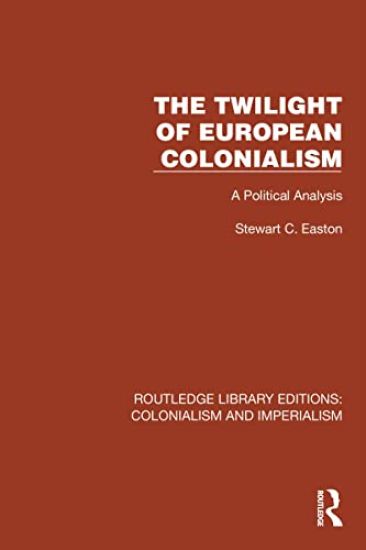
The Twilight of European Colonialism (1961) is a comprehensive appraisal of modern colonialism, as well as providing historical background, of the governments of British, French, Belgian and Portuguese colonies. Political events in colonies and former colonies in all parts of the world are discussed. Charting the political development of each colony, the author analyses at each stage the significance of the major advances toward self-government in addition to critically examining and comparing the policies and performances of the European powers involved.

"The Truth Is Always Stranger Than Fiction"Danny Doogle and his friends stumble upon the real truth behind UFO Alien mysteries from cattle mutilations to a planned attack on Earth and the enslavement of humanity. It's called fiction, but it's not.Beware