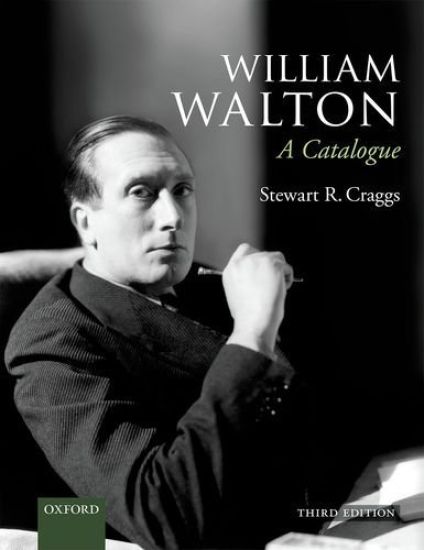
This revised, updated, and expanded edition of the definitive catalogue of works by Sir William Walton (1902-83) follows the completion of the William Walton Edition. A comprehensive source of musical and documentary information relevant to Walton's life and work, the catalogue features full details of composition dates, instrumentation, first performance, publication, the location of autograph manuscripts, critical comment, and significant recordings, as well as previously undiscovered pieces. Appended are a helpful bibliography for further reading and indexes including for works, authors of texts, first lines, and dedicatees.
This final volume in the complete William Walton Edition is a comprehensive listing of the composer's works, compiled by Stewart Craggs, consultant for the Edition. It gives dates and details for composition, first performance and publication of every work, as well as bibliography and recordings.
Sir Arthur Bliss was one of England's most renowned twentieth-century composers. This bio-bibliography provides a brief biography prepared with the assistance of the composer's widow. It then presents a complete list of works and performances, classified by genre and arranged alphabetically by title of composition. Each entry contains a list of premiere performances, with references to commentaries from performance reviews cited in the bibliography. Brief details are also given concerning original manuscripts and their location. The next section contains a discography of commercially and privately produced sound recordings. An annotated bibliography of writings by the composer and about him and his music follows. Annotations are often in the form of quotations from performance reviews. The bibliography concludes with appendices providing alphabetical and chronological listings of Bliss's works and a complete index of names and titles.
Richard Rodney Bennett is one of Britain's most distinguished, versatile, and prolific twentieth century composers. His music ranges across a broad spectrum of styles from opera and ballet through orchestral and chamber music to jazz. This book, the first ever to be published about Bennett, documents his vast and ever increasing output. It consists of a brief biography; a detailed list of works and performances, classified by genre and then arranged alphabetically by title of composition; a list of Bennett's publishers; a discography of commerically and privately produced sound recordings; and an annotated bibliography of writings by and about Bennett, including reviews of performances of his works. Alphabetical and chronological lists of his main compositions and a complete general index conclude the volume.Stewart Craggs' bio-bibliography is a significant contribution to the study of contemporary music. This first book-length study of Richard Rodney Bennett to be published provides unique information about an important twentieth century composer. For those already familiar with Bennett's art, it offers complete discographic and bibliographic information, permitting further study and enjoyment. This book belongs in all music libraries.
John McCabe is a thoroughly documented bio-bibliography of one of Britain's leading composers. John McCabe has an international reputation, both as a composer and a pianist, whose compositions cover most of the established forms. The complete list of his works and performances have never before been presented in such detail. Articles and features by and about the composer contain annotations, often in the form of quotations from the material. National, academic, and public libraries, as well as specialized music libraries and archives, will find this work a valuable research tool.The work begins with a brief biography of John McCabe prepared with the composer's assistance and is followed by a complete list of works and performances classified by genre and arranged alphabetically by title of composition. Performance and publication information is provided for each work, including its first and other selected performances. A list of McCabe's publishers is followed by a discography of commercially produced sound recordings divided into sections on McCabe as a composer and as a performer. A bibliography of writings by and about McCabe includes gramaphone record reviews written by McCabe for the British journal Records and Recordings between 1967 and 1974. An alphabetical and a chronological list of compositions appear in appendices.
Internationally known Welsh composer Alun Hoddinott has played a major role in the promotion of contemporary music in his country through his own prolific compositions--operas; orchestral, chamber, band, and solo instrumental pieces; choral music; songs; and incidental music--and as a professor of music at Cardiff University and artistic director of the Cardiff Festival of Twentieth-Century Music. This bio-bibliography includes a catalog of his works, classified by genre, which documents 278 compositions (plus numerous derived pieces) composed from 1946 to 1991, indicating commissioning, dedication, instrumentation, duration, manuscript information, publication, recordings, and premieres and selected performances. The works catalog is cross-referenced to recordings in a discography section and to related items in an annotated bibliography, which includes a large number of reviews and writings by the composer. An introductory biography, appendices listing the musical compositions alphabetically and chronologically, and a general index complete the volume. Prepared with the full cooperation of Hoddinott, this is the first detailed publication on this important composer.
Taking piano lessons at three years of age and composing by five, William Mathias became one of Britain's leading 20th-century composers. (He was invited to compose the wedding anthem for the marriage of the Prince of Wales to Lady Diana Spencer.) This work provides, for the first time in one volume, up-to-date and comprehensive details of the composer's life's work. It includes a biography, a complete list of works and performances, a discography of sound recordings, and an annotated bibliography, along with useful appendixes and an index. This book will be of interest to musicologists, students, and 20th century music buffs alike. Mathias was a prolific and versatile composer whose works included opera and music for orchestra, chamber groups, solo instruments, organ, brass ensembles, choral, church, and children's groups. His wedding anthem for Prince Charles and Lady Diana was heard by over 750 million people around the world on television—probably the largest audience for any first performance of a new work.
Malcolm Arnold's music encompassed a variety of forms from opera and ballet through orchestral and chamber music to film scores. His most famous film score, for which he won an Oscar award in 1957, is The Bridge on the River Kwai. In 1953 he was commissioned to compose Homage to the Queen, a ballet to celebrate the coronation of Queen Elizabeth II. Arnold was knighted by the Queen in 1993 in honor of his contributions to English music. As with the other volumes in the Greenwood Bio-Bibliographies in Music series, this work includes a brief biography, discography, complete list of works and performances, and an annotated bibliography.Music scholars, musicians, and those with an interest in the music of Malcolm Arnold will appreciate the extensive information gathered in this one volume. Since Malcolm Arnold has retired from composing, this book features the most complete list of his compositions, including some of his newly discovered early works. The works are listed alphabetically within genre. The author also provides a chronological listing of the works through which trends and developments in Arnold's compositions may be traced. Sir Malcolm Arnold's input with the project assures the accuracy and completeness of this bio-bibliography.
Benjamin Britten was arguably the greatest English composer of his time. His music crossed boundaries of genre and form to include opera, ballet, orchestral and chamber music, and film and incidental music. The result of twenty years of research, ^IBenjamin Britten^R provides up-to-date and comprehensive details about Britten's life and music, including works, performances, and recordings--an effort never before undertaken. Certain to be of use to any scholar of British music or 20th century composition, this reference work is an invaluable addition to the literature on this important artist. Following a brief biography of the subject, author Stewart Craggs provides a complete list of works and performances, arranged by genre; a discography, and an annotated bibliography. Rounding out the volume are two lists of compositions, one arranged alphabetically and the other chronologically, and a general index.
This title was first published in 2002. Sir Peter Maxwell Davies is one of Britain's most distinguished composers. This source book documents as much of the material on his music as is available to 2001. As Richard McGregor points out in his foreword to the volume, Stewart Craggs has made valuable advances in sorting out the origins of many unknown works and gleaning details of many private compositions. The book also supplies details of those unknown works which haven't appeared in any previous catalogues, including broadcasts of early works from the BBC Archives. With information given on first performances, manuscript locations and recordings, in addition to details of composition dates, authors/librettists, durations, commissions and dedications amongst much else, this book is a key reference source for all those interested in Peter Maxwell Davies and his music.
First published in 1998, music scored for film has only relatively recently received the critical attention which it merits. Many composers in the twentieth century have written works for films or documentaries, a number feeling that this aspect of their output has been undervalued.This dictionary complements other studies which have appeared in recent years which look at the technical and theoretical issues concerned with film music composition. Arranged alphabetically by composer, the volume comprises over 500 entries covering all nationalities. Each entry includes very brief biographical information on the composer, followed by a list of the films (with dates) for which he or she has composed. Details of recordings are also given. The dictionary’s international coverage ensures that it will become a standard reference work for all those interested in the history of twentieth-century music and the development of film.
First published in 1998, music scored for film has only relatively recently received the critical attention which it merits. Many composers in the twentieth century have written works for films or documentaries, a number feeling that this aspect of their output has been undervalued.This dictionary complements other studies which have appeared in recent years which look at the technical and theoretical issues concerned with film music composition. Arranged alphabetically by composer, the volume comprises over 500 entries covering all nationalities. Each entry includes very brief biographical information on the composer, followed by a list of the films (with dates) for which he or she has composed. Details of recordings are also given. The dictionary’s international coverage ensures that it will become a standard reference work for all those interested in the history of twentieth-century music and the development of film.
This title was first published in 2002. This volume of essays seeks to reflect aspects of the life and work of Arthur Bliss, Master of the Queen's Music. Though each is self-contained, the editor has attempted to keep a theme running throughout. Looking beyond surface impressions is an attitude constantly expressed.
This title was first published in 2002. This volume of essays seeks to reflect aspects of the life and work of Arthur Bliss, Master of the Queen's Music. Though each is self-contained, the editor has attempted to keep a theme running throughout. Looking beyond surface impressions is an attitude constantly expressed.
This title was first published in 2002. Sir Peter Maxwell Davies is one of Britain's most distinguished composers. This source book documents as much of the material on his music as is available to 2001. As Richard McGregor points out in his foreword to the volume, Stewart Craggs has made valuable advances in sorting out the origins of many unknown works and gleaning details of many private compositions. The book also supplies details of those unknown works which haven't appeared in any previous catalogues, including broadcasts of early works from the BBC Archives. With information given on first performances, manuscript locations and recordings, in addition to details of composition dates, authors/librettists, durations, commissions and dedications amongst much else, this book is a key reference source for all those interested in Peter Maxwell Davies and his music.
Alun Hoddinott is the most important living Welsh composer and one of the most distinguished and prolific composers of his generation internationally. His works have been performed in major centres as far afield as Tokyo and Berlin, Melbourne and Leipzig, New York and Venice as well as the major festivals in Wales and England. He is one of the very few composers to have been commissioned to compose a concerto for Mstislav Rostropovitch.Born in Bargoed, Glamorganshire, in August 1929, Alun Hoddinott started to play the violin and compose at an early age. Some of his works were performed and broadcast whilst he was a student at University College, Cardiff and he later studied with the Australian composer and pianist Arthur Benjamin. His first major success was his Clarinet Concerto No.1, given by Gervaise de Peyer and the Halle Orchestra under John Barbirolli at the 1954 Cheltenham Music Festival.This Source Book lists all Hoddinott's compositions from 1946 to 2005, almost 60 years of phenomenal output, and shows he has achieved a mastery of composition which embraces almost every musical medium. With information given on first performances, manuscript locations and recordings, in addition to details of composition dates, authors/librettists, durations, commissions and dedications amongst much else, this book is a key reference for all those interested in Alun Hoddinott and his music.
Alun Hoddinott is the most important living Welsh composer and one of the most distinguished and prolific composers of his generation internationally. His works have been performed in major centres as far afield as Tokyo and Berlin, Melbourne and Leipzig, New York and Venice as well as the major festivals in Wales and England. He is one of the very few composers to have been commissioned to compose a concerto for Mstislav Rostropovitch.Born in Bargoed, Glamorganshire, in August 1929, Alun Hoddinott started to play the violin and compose at an early age. Some of his works were performed and broadcast whilst he was a student at University College, Cardiff and he later studied with the Australian composer and pianist Arthur Benjamin. His first major success was his Clarinet Concerto No.1, given by Gervaise de Peyer and the Halle Orchestra under John Barbirolli at the 1954 Cheltenham Music Festival.This Source Book lists all Hoddinott's compositions from 1946 to 2005, almost 60 years of phenomenal output, and shows he has achieved a mastery of composition which embraces almost every musical medium. With information given on first performances, manuscript locations and recordings, in addition to details of composition dates, authors/librettists, durations, commissions and dedications amongst much else, this book is a key reference for all those interested in Alun Hoddinott and his music.
"A marvelous addition to the literature on both organizations and power. It is well-grounded in the research on these topics and especially the wide-range of relevant theorizing... The book is terrific at bringing together theory, research and the world of organizations." - George Ritzer, Distinguished University Professor, University of Maryland "This book tirelessly illuminates the nooks and crannies of the power literature...taking readers on an audacious tour of power's multiple conceptualizations and expressions." - Hugh Willmott, Diageo Professor of Management Studies, University of Cambridge "Clegg and his associates expose the power dynamics that lie at the heart of all political and organizational arenas, and in so doing, they shed light on the underbelly along with the creative potentialities in organizational life." -Joyce Rothschild, Professor of Sociology, Virginia Polytechnic Institute and State University "Strange but true - most studies of organizational hierarchies downplay the issue of power or uncritically assume more is better, while ignoring its pernicious effects. Stewart Clegg, David Courpasson and Nelson Phillips set the record straight." - Joanne Martin, Merrill Professor of Organizational Behavior and, by courtesy, Sociology Stanford University Graduate School of Business, Stanford In this tour de force, Stewart Clegg, David Courpasson and Nelson Phillips provide a comprehensive account of power and organizations, unlocking power as the central relation of modern organizations and society. The authors present an excellent synthesis of organization, social and political theory to offer an overview of power and organizations that is historically informed, addresses current issues and is comprehensive in scope. Power and Organizations reviews the evolution of theories on power and organization, presenting not only the theorists who identify power as positive, but also dealing with the negativity of power and the real horror of which organizations are capable, which has thus far been underplayed in organization theory. At the core of organizational power projects are organizational elites, whose politics and projects are examined extensively in the book. The book concludes by examining the implications for organizations and their elites of the trends, tendencies, and theories considered in the course of the book. This book is required reading for graduate students and researchers in areas such as organizational, social and political theory.
"A marvelous addition to the literature on both organizations and power. It is well-grounded in the research on these topics and especially the wide-range of relevant theorizing... The book is terrific at bringing together theory, research and the world of organizations." - George Ritzer, Distinguished University Professor, University of Maryland "This book tirelessly illuminates the nooks and crannies of the power literature...taking readers on an audacious tour of power's multiple conceptualizations and expressions." - Hugh Willmott, Diageo Professor of Management Studies, University of Cambridge "Clegg and his associates expose the power dynamics that lie at the heart of all political and organizational arenas, and in so doing, they shed light on the underbelly along with the creative potentialities in organizational life." -Joyce Rothschild, Professor of Sociology, Virginia Polytechnic Institute and State University "Strange but true - most studies of organizational hierarchies downplay the issue of power or uncritically assume more is better, while ignoring its pernicious effects. Stewart Clegg, David Courpasson and Nelson Phillips set the record straight." - Joanne Martin, Merrill Professor of Organizational Behavior and, by courtesy, Sociology Stanford University Graduate School of Business, Stanford In this tour de force, Stewart Clegg, David Courpasson and Nelson Phillips provide a comprehensive account of power and organizations, unlocking power as the central relation of modern organizations and society. The authors present an excellent synthesis of organization, social and political theory to offer an overview of power and organizations that is historically informed, addresses current issues and is comprehensive in scope. Power and Organizations reviews the evolution of theories on power and organization, presenting not only the theorists who identify power as positive, but also dealing with the negativity of power and the real horror of which organizations are capable, which has thus far been underplayed in organization theory. At the core of organizational power projects are organizational elites, whose politics and projects are examined extensively in the book. The book concludes by examining the implications for organizations and their elites of the trends, tendencies, and theories considered in the course of the book. This book is required reading for graduate students and researchers in areas such as organizational, social and political theory.
This wide-ranging analysis both explores current approaches to organization studies and relates the concepts of modernity and postmodernity to the realities of organizational structure and context. In surveying alternative perspectives on organizations in terms of ideal types, systems, contingencies, ecologies, cultures, markets and efficiency, Clegg demonstrates that no single approach is adequate to deal with the real-world variety of organizations that exist. Drawing upon unusual and revealing examples - the production of French bread, Italian fashion and `post-Confucian' Asian enterprises - he argues that their success cannot be reduced to `culture' but must incorporate a fuller understanding of the ways in which organizations are constructed and reproduced. This analysis is carried through in a detailed discussion of the debate over why Japanese organizations are so successful.