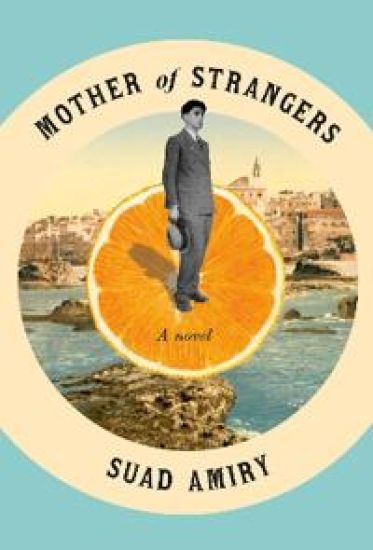
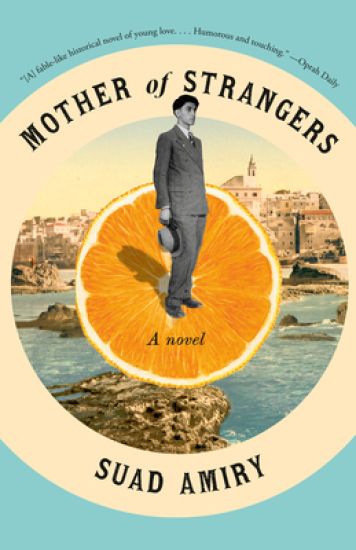
Set in Jaffa in between 1947 and 1951, this fable-like novel--based on a true story--is a heartbreaking tale of young love during the beginning of the destruction of Palestine and displacement of its people. At times darkly humorous and ironic but also profoundly moving, this novel based on a true story, follows the lives of a gifted 15-year-old mechanic, Subhi, and 13-year-old Shams, a peasant girl he hopes to marry one day. At first we see the prosperous life of this cosmopolitan city on the Mediterranean--with its old cinemas, lively cafes and brothels, open air markets, a bustling port and Jaffa's world famous orange groves--through the lives of the families of Subhi and Shams, but particularly through Subhi. As the story evolves, the indiscriminate bombing of Jaffa and the displacements of Palestinian families begin, and we get a fascinating though dark close-up of how those who remained survived. This novel is a cinematic, though devastating, account of one of the most dramatic and least known chapters of Palestinian history. It is a portrait of a city and a people irrevocably changed.
Set in Jaffa in between 1947 and 1951, this "fable-like historical novel of young love ... darkly humorous and touching" (Oprah Daily) is based on a true story during the beginning of the destruction of Palestine and displacement of its people. Based on the true story of two Jaffa teenagers, Mother of Strangers follows the daily lives of Subhi, a fifteen-year-old mechanic, and Shams, the thirteen-year-old student he hopes to marry one day. In this prosperous and cosmopolitan port city, with its bustling markets, cinemas, and caf s on the hills overlooking the Mediterranean Sea, we meet many other unforgettable characters as well, including Khawaja Michael, the elegant and successful owner of orange groves above the harbor; Mr. Hassan, the tailor who makes Subhi's treasured English suit, which he hopes will change his life; and the very mischievous and outrageous Uncle Habeeb, who insists on introducing Subhi to the local bordello. With a thriving orange export business, Jaffa had always been a city welcoming to outsiders--the "Mother of Strangers"--where Muslims, Jews, and Christians lived peacefully together. Once the bombardment of the city begins in April 1948, Suad Amiry gives us the grim but fascinating details of the shock, panic, and destruction that ensues. Jaffa becomes unrecognizable, with neighborhoods flattened, families removed from their homes and separated, and those who remain in constant danger of arrest and incarceration. Most of the population flees eastward to Jordan or by sea to Lebanon in the north or to Egypt and Gaza in the south. Subhi and Shams will never see each other again. Suad Amiry has written a vivid and devastating account of a seminal moment in the history of the Middle East--the beginning of the end of Palestine and a portrait of a city irrevocably changed.
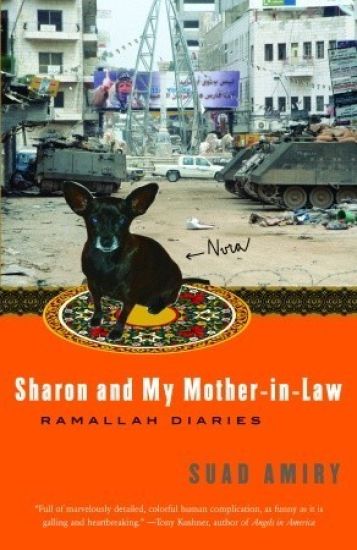
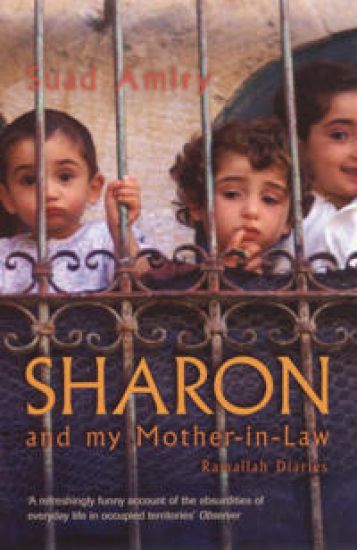
A collection of journal entries, e-mail correspondence, vignettes, and anecdotes offers an irreverent portrait of the miseries of daily life in the West Bank town of Ramallah, dealing with curfews, roadblocks, violence, and a mother-in-law trapped during a forty-two-day curfew. Reprint.
A blackly funny account of everyday life in Ramallah and refreshingly different from most writing on the Palestinian-Israeli conflict, Sharon and My Mother-in-Law describes Suad Amiry's life on the West Bank from the early 1980s to the first decade of the new millennium. Vividly evoking her neighbourhood and her moving family history, Amiry creates a fascinating account of her attempts to live a normal life in an insane situation: from the impossibility of acquiring gas masks during the first Gulf War to her dog acquiring a Jerusalem passport when thousands of Palestinians couldn't. During the Israeli invasion of Ramallah in March 2002, Amiry's feisty ninety-two-year-old mother-in-law came to live with them, and Amiry's diary of this time is at the heart of this wonderful book about the absurdity (and agony) of life in the Occupied Territories.
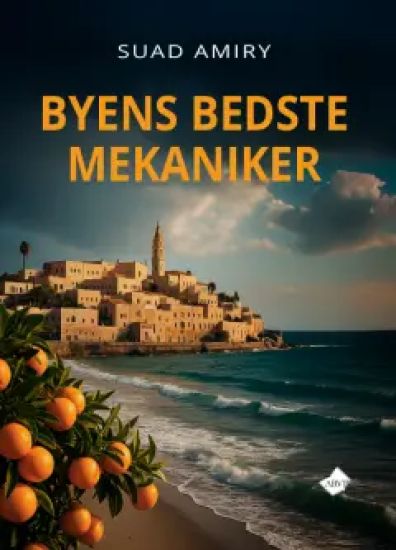
I 1947 er Jaffa Palæstinas vigtigste havneby, hvilket især skyldes eksport af appelsiner. Subhi er trods sin unge alder, snart 16 som han ynder at sige, en dygtig mekaniker, hvilket han beviser ved at reparere vandingsanlægget i en engelskejet appelsinplantage. Han er forelsket i Shams, men kærligheden har trange kår, ikke mindst da englænderne i 1948 opgiver mandatet over Palæstina og trækker sig ud af landet. Jøder fra lande i Europa strømmer til Palæstina, som udråbes til staten Israel. Palæstinensiske familier bliver splittet og fordrives til de omliggende lande. Det gælder også Subhis og Shams’ familier. Romanen er baseret på forfatterens samtaler i 2018 med 87-årige Subhi og 84-årige Shams.
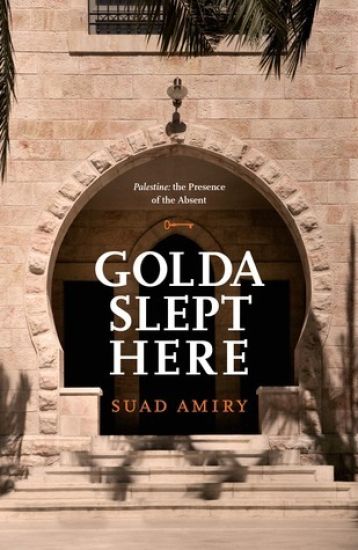
Suad Amiry traces the lives of individual members of Palestinian families and, through them, the histories of both Palestine and the émigré Palestinian community in other countries of the Middle East. Amiry mixes nostalgia with anger while mocking Israeli doublespeak that seeks to wipe out any trace of a Palestinian past in West Jerusalem. She juxtaposes serial bombardments and personal tragedies; evokes the sights and smells of Palestinian architecture and food; and weaves for us the tapestry that is the Palestinian reality, caught between official histories and private memories. Through poetry and prose, monologue and dialogue, we glimpse the lost Palestinian landscape, obscured by the silent battle between remembering and forgetting.
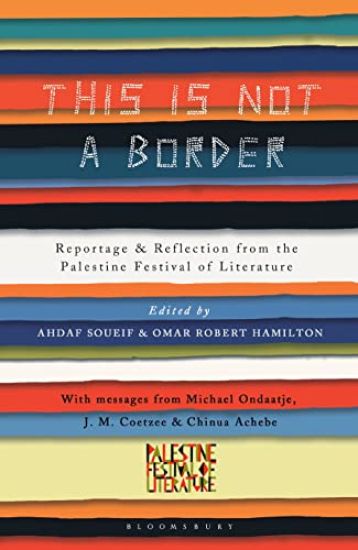
________________'This anthology will help turn your intellectual understanding of oppression into an emotional one' - New Statesman'Thanks for being who you are and for giving us such exposure to wonderful people. Palestine is proud of you' - Suad Amiry________________The Palestine Festival of Literature was established in 2008. Bringing together writers from all corners of the globe, it aims to help Palestinians break the cultural siege imposed by the Israeli military occupation, to strengthen their artistic links with the rest of the world, and to reaffirm, in the words of Edward Said, ‘the power of culture over the culture of power’.Celebrating the tenth anniversary of PalFest, This Is Not a Border is a collection of essays, poems and stories from some of the world’s most distinguished artists, responding to their experiences at this unique festival. Both heartbreaking and hopeful, their gathered work is a testament to the power of literature to promote solidarity and courage in the most desperate of situations.Contributors: Susan Abulhawa, Suad Amiry, Victoria Brittain, Jehan Bseiso, Teju Cole, Molly Crabapple, Selma Dabbagh, Mahmoud Darwish, Najwan Darwish, Geoff Dyer, Yasmin El-Rifae, Adam Foulds, Ru Freeman, Omar Robert Hamilton, Suheir Hammad, Nathalie Handal, Mohammed Hanif, Jeremy Harding, Rachel Holmes, John Horner, Remi Kanazi, Brigid Keenan, Mercedes Kemp, Omar El-Khairy, Nancy Kricorian, Sabrina Mahfouz, Jamal Mahjoub, Henning Mankell, Claire Messud, China Miéville, Pankaj Mishra, Deborah Moggach, Muiz, Maath Musleh, Michael Palin, Ed Pavlic, Atef Abu Saif, Kamila Shamsie, Raja Shehadeh, Gillian Slovo, Ahdaf Soueif, Linda Spalding, Will Sutcliffe, Alice WalkerWith messages from China Achebe, Michael Ondaatje and J. M. Coetzee________________'Every literary act, whether it is a great epic poem or an honest piece of journalism or a simple nonsense tale for children is a blow against the forces of stupidity and ignorance and darkness … The Palestine Festival of Literature exists to do just that – and I salute it for its work. Not only this year but for as long as it is necessary' - Philip Pullman
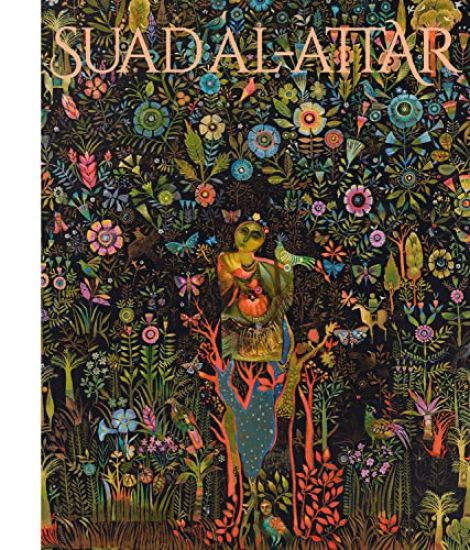
Suad Al-Attar is an extensively illustrated monograph featuring original photography of more than 100 expressive and surrealistic paintings and drawings by one of Iraq’s most renowned artists. Written by the artist’s granddaughter – writer and art historian Nesma Shubber – the book offers unique access to the career of a truly sensational artist and painter. In beautifully written prose, Shubber tells the story of her grandmother’s life and work. Beginning with the artist’s early formative years in Baghdad and her arrival in London in 1976, we discover the origins of Al-Attar’s international career up to the present day in a personal account of an extraordinary woman and artist. For the first time, this book brings together treasured drawings and paintings carefully selected from the artist’s archive to form the most comprehensive published collection of work by Suad Al-Attar as well as a rare document of her remarkable life.
The 21 poems were written in 2021. Some of the poems discuss general topics and others personal topics. The poems cover many different topics such as racism, climate change, the discovery of unmarked graves, the continuation of colonialism in Africa, what I like Canada to be, the pandemic, my favourite drink and many more.
What does religion mean in people's daily lives? In what ways is it a component of ethnic identity? How do religious identities and structures relate to other social identities and structures and to political and economic institutions and behavior? How can Muslim-Christian relations be understood in the context of the emergence of the world capitalist system? These are some of the questions addressed by the authors of this volume. Their collective goal--growing out of a desire to understand the continuing war in Lebanon--is to study the circumstances under which religious differences become politically salient.
This book focuses on tensions between Christians and Muslims in one part of the large area where the two religions meet: the Eastern Mediterranean and the Nile Valley. It addresses the questions: What does religion mean in people's daily lives? In what ways is it a component of ethnic identity?
This book presents a unified collection of concepts, tools, and techniques that constitute the most important technology available today for the design and implementation of information systems. The framework adopted for this integration goal is the one offered by the relational model of data, its applica tions, and implementations in multiuser and distributed environments. The topics presented in the book include conceptual modeling of application environments using the relational model, formal properties of that model, and tools such as relational languages which go with it, techniques for the logical and physical design of relational database systems and their imple mentations. The book attempts to develop an integrated methodology for addressing all these issues on the basis of the relational approach and various research and practical developments related to that approach. This book is the only one available today that presents such an inte gration. The diversity of approaches to data models, to logical and physical database design, to database application programming, and to use and imple mentation of database systems calls for a common framework for all of them. It has become difficult to study modern database technology with out such a unified approach to a diversity of results developed during the vigorous growth of the database area in recent years, let alone to teach a course on the subject.
The major goal of this book is to present the techniques of top-down program design and verification of program correctness hand-in-hand. It thus aims to give readers a new way of looking at algorithms and their design, synthesizing ten years of research in the process. It provides many examples of program and proof development with the aid of a formal and informal treatment of Hoare's method of invariants. Modem widely accepted control structures and data structures are explained in detail, together with their formal definitions, as a basis for their use in the design of correct algorithms. We provide and apply proof rules for a wide range of program structures, including conditionals, loops, procedures and recur sion. We analyze situations in which the restricted use of gotos can be justified, providing a new approach to proof rules for such situations. We study several important techniques of data structuring, including arrays, files, records and linked structures. The secondary goal of this book is to teach the reader how to use the programming language Pascal. This is the first text to teach Pascal pro gramming in a fashion which not only includes advanced algorithms which operate on advanced data structures, but also provides the full axiomatic definition of Pascal due to Wirth and Hoare. Our approach to the language is very different from that of a conventional programming text.
The major topic of this book is the integration of data and programming languages and the associated methodologies. To my knowledge, this is the first book on modern programming languages and programming meth odology devoted entirely to database application environments. At the same time, it is written with the goal of reconciling the relational and object-oriented approaches to database management. One of the reasons that influenced my decision to write this book is my dissatisfaction with the fact that the existing books on programming methodology and the associated concepts, techniques, and programming language notation are largely based on mathematical problems and math ematically oriented algorithms. As such, they give the impression that modern program structures, associated techniques, and methodologies, not to speak of the formal ones, are applicable only to problems of that sort. Although important, such problems are of limited applicability and scale. This does not apply to books in which modem concepts, techniques, methodologies, and programming language notation are applied to systems programming. But, even so, this does not demonstrate that in entirely application-oriented problems-those in which modern computer tech nology is most widely used-modern programming methodology is just as important. This book is meant to be a step toward providing a more convincing support of such a claim and, thus, is based entirely on common, what one might call business-oriented, problems in which database technology has been successfully used.