Kirjojen hintavertailu. Mukana 11 244 527 kirjaa ja 12 kauppaa.

Kirjahaku

Etsi kirjoja tekijän nimen, kirjan nimen tai ISBN:n perusteella.

1000 tulosta hakusanalla Sumit K Majumdar

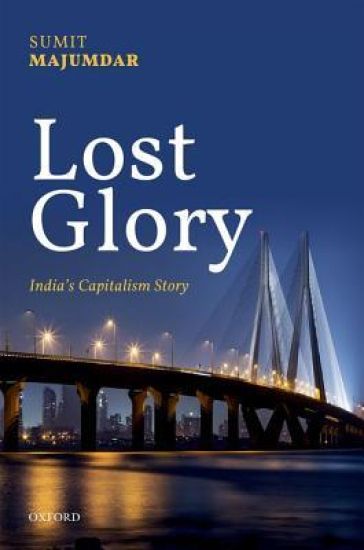
Lost Glory

Lost Glory

Sumit K Majumdar

Oxford University Press
2018
sidottu
Lost Glory: India's Capitalism Story deconstructs India's industrialization story, challenging contemporary ideas about her economy. Based on careful and detailed empirical analyses of India's industrialization, for a period of almost seven decades, the book provides deeply-nuanced depictions of the history of political economy, that have affected India's industrialization over the course of a century. These dimensions of India's economic history have never before been collated and presented. The presentation takes readers on a definitive evidence-based survey of India's industrial landscape. It includes a detailed historical description of the intellectual origins of India's modern industrialization, anchored in a privileged view of economic policy making. Grounded in deep historical and political analyses, that account for the variations, continuities, and changes in institutional contingencies, the facts derived on India's long-term economic performance are used to put the record straight. The findings of the book will transform debate, and set the agenda for thoughtfully assessing what course the Indian economy needs to follow.
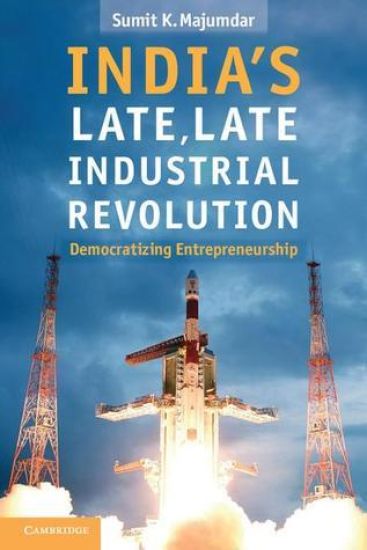
India's Late, Late Industrial Revolution

India's Late, Late Industrial Revolution

Sumit K. Majumdar

Cambridge University Press
2012
sidottu
There is a paradox at the heart of the Indian economy. Indian businessmen and traders are highly industrious and ingenious people, yet for many years Indian industry was sluggish and slow to develop. One of the major factors in this sluggish development was the command and control regime known as the License Raj. This regime has gradually been removed and, after two decades of reform, India is now awakening from its slumber and is experiencing a late, late industrial revolution. This important new book catalogues and explains this revolution through a combination of rigorous analysis and entertaining anecdotes about India's entrepreneurs, Indian firms' strategies and the changing role of government in Indian industry. This analysis shows that there is a strong case for a manufacturing focus so that India can replicate the success stories of Asian countries such as Japan, South Korea and China.
India's Late, Late Industrial Revolution

India's Late, Late Industrial Revolution

Sumit K. Majumdar

Cambridge University Press
2012
pokkari
There is a paradox at the heart of the Indian economy. Indian businessmen and traders are highly industrious and ingenious people, yet for many years Indian industry was sluggish and slow to develop. One of the major factors in this sluggish development was the command and control regime known as the License Raj. This regime has gradually been removed and, after two decades of reform, India is now awakening from its slumber and is experiencing a late, late industrial revolution. This important new book catalogues and explains this revolution through a combination of rigorous analysis and entertaining anecdotes about India's entrepreneurs, Indian firms' strategies and the changing role of government in Indian industry. This analysis shows that there is a strong case for a manufacturing focus so that India can replicate the success stories of Asian countries such as Japan, South Korea and China.
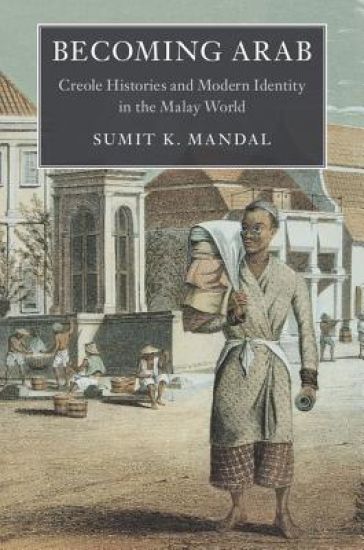
Becoming Arab

Becoming Arab

Sumit K. Mandal

Cambridge University Press
2017
sidottu
Sumit K. Mandal uncovers the hybridity and transregional connections underlying modern Asian identities. By considering Arabs in the Malay world under European rule, Becoming Arab explores how a long history of inter-Asian interaction was altered by nineteenth-century racial categorisation and control. Mandal traces the transformation of Arabs from familiar and multi-faceted creole personages of Malay courts into alienated figures defined by economic and political function. The racialisation constrained but did not eliminate the fluid character of Arabness. Creole Arabs responded to the constraints by initiating transregional links with the Ottoman Empire and establishing modern social organisations, schools, and a press. Contentions emerged between organisations respectively based on Prophetic descent and egalitarianism, advancing empowering but conflicting representations of a modern Arab and Islamic identity. Mandal unsettles finite understandings of race and identity by demonstrating not only the incremental development of a modern identity, but the contested state of its birth.
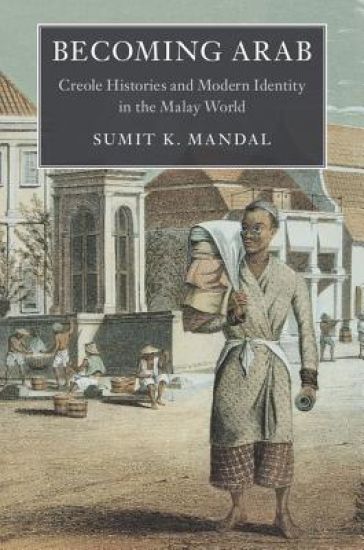
Becoming Arab

Becoming Arab

Sumit K. Mandal

Cambridge University Press
2017
pokkari
Sumit K. Mandal uncovers the hybridity and transregional connections underlying modern Asian identities. By considering Arabs in the Malay world under European rule, Becoming Arab explores how a long history of inter-Asian interaction was altered by nineteenth-century racial categorisation and control. Mandal traces the transformation of Arabs from familiar and multi-faceted creole personages of Malay courts into alienated figures defined by economic and political function. The racialisation constrained but did not eliminate the fluid character of Arabness. Creole Arabs responded to the constraints by initiating transregional links with the Ottoman Empire and establishing modern social organisations, schools, and a press. Contentions emerged between organisations respectively based on Prophetic descent and egalitarianism, advancing empowering but conflicting representations of a modern Arab and Islamic identity. Mandal unsettles finite understandings of race and identity by demonstrating not only the incremental development of a modern identity, but the contested state of its birth.
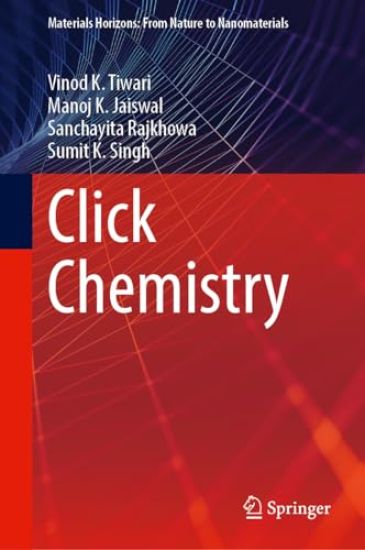
Click Chemistry

Click Chemistry

Vinod K. Tiwari; Manoj K. Jaiswal; Sanchayita Rajkhowa; Sumit K. Singh

SPRINGER VERLAG, SINGAPORE
2024
sidottu
This book comprehensively covers the fundamentals and latest advancements in the area of click chemistry. It discusses notable applications of click chemistry in various emerging areas ranging from chemical biology to catalysis and from medicinal chemistry to material sciences. Various topics covered in this book are catalysis in regioselectivity in click chemistry, organocatalysis in triazole synthesis, Bertozzi’s Bioorthogonal Concept, photo-triggered click chemistry, SuFFEx Click, Thiol-Ene Click, MCR Click, Intramolecular Click Chemistry, synthesis of diverse triazoles and their applications, Click's Post Functionalization, etc. The book is a valuable reference for beginners, researchers and professionals interested in sustainable click concept and its diverse applications in allied fields.
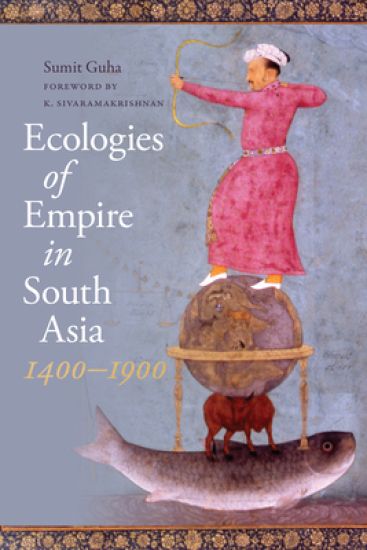
Ecologies of Empire in South Asia, 1400-1900

Ecologies of Empire in South Asia, 1400-1900

Sumit Guha; K. Sivaramakrishnan

UNIVERSITY OF WASHINGTON PRESS
2023
sidottu
Reveals how imperial power and local resistance have shaped landscapesThe perception, valuation, and manipulation of human environments all have their own layered histories. So Sumit Guha argues in this sweeping examination of a pivotal five hundred years when successive empires struggled to harness lands and peoples to their agendas across Asia. Ecologies of Empire in South Asia, 1400–1900 compares the practices of the Mughal and British Empires to demonstrate how their fluctuating capacity for domination was imbricated in the formation of environmental knowledge itself. The establishment of imperial control transforms local knowledge of the world into the aggregated information that reproduces centralized power over it. That is the political ecology that reshapes entire biomes. Animals and plants are translocated; human communities are displaced or destroyed. Some species proliferate; others disappear. But these state projects are overlaid upon the many local and regional geographies made by sacred cosmologies and local sites, pilgrimage routes and river fords, hot springs and fluctuating aquifers, hunting ranges and nesting grounds, notable trees and striking rocks.Guha uncovers these ecological histories by scrutinizing little-used archival sources. His historically based political ecology demonstrates how the biomes of a vast subcontinent were changed by struggles to make and to resist empire.
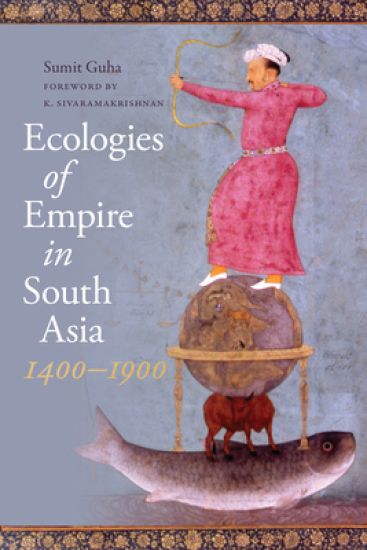
Ecologies of Empire in South Asia, 1400-1900

Ecologies of Empire in South Asia, 1400-1900

Sumit Guha; K. Sivaramakrishnan

UNIVERSITY OF WASHINGTON PRESS
2023
pokkari
Reveals how imperial power and local resistance have shaped landscapesThe perception, valuation, and manipulation of human environments all have their own layered histories. So Sumit Guha argues in this sweeping examination of a pivotal five hundred years when successive empires struggled to harness lands and peoples to their agendas across Asia. Ecologies of Empire in South Asia, 1400–1900 compares the practices of the Mughal and British Empires to demonstrate how their fluctuating capacity for domination was imbricated in the formation of environmental knowledge itself. The establishment of imperial control transforms local knowledge of the world into the aggregated information that reproduces centralized power over it. That is the political ecology that reshapes entire biomes. Animals and plants are translocated; human communities are displaced or destroyed. Some species proliferate; others disappear. But these state projects are overlaid upon the many local and regional geographies made by sacred cosmologies and local sites, pilgrimage routes and river fords, hot springs and fluctuating aquifers, hunting ranges and nesting grounds, notable trees and striking rocks.Guha uncovers these ecological histories by scrutinizing little-used archival sources. His historically based political ecology demonstrates how the biomes of a vast subcontinent were changed by struggles to make and to resist empire.
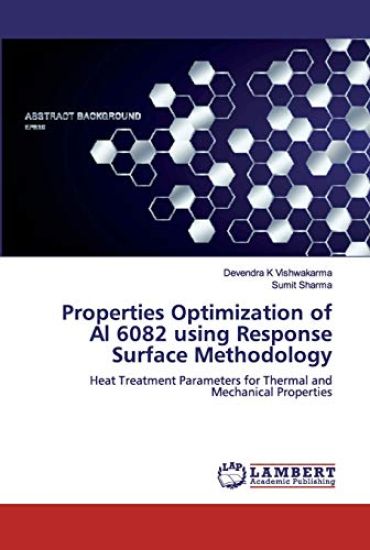
Properties Optimization of Al 6082 using Response Surface Methodology

Properties Optimization of Al 6082 using Response Surface Methodology

Devendra K Vishwakarma; Sumit Sharma

LAP Lambert Academic Publishing
2019
pokkari
Al 6082 is one of the most important alloy present in 6xxx series as a new alloy. This is because of its high strength to weight ratio, good formability, and machinability. In present work, heat treatment on Al 6082 alloy in order to study its effect on thermal and mechanical properties and also optimize it for thermal and mechanical properties using Response Surface Methodology. The process parameters are solutionizing time, aging temperature, and aging time. Solutionization is followed by artificial aging of samples for a period of 90 minutes to 450 minutes. The heating process takes place in Muffle Furnace. The mathematical model for the thermal conductivity, coefficient of thermal expansion and Vickers hardness has been developed. All the mathematical models obtained hold good at 95% confidence level. The optimum parameters will be obtained for thermal & mechanical properties.
Quality of Fish Fillet with Bio-polymer Coating

Quality of Fish Fillet with Bio-polymer Coating

Sumit Kumar Verma; Neeraj Pathak; K Masilan

LAP Lambert Academic Publishing
2019
pokkari
Reef cod is one of the most highly esteemed table fish of India both from the point of view of consumer acceptability and nutritive value. Hence, the present study was undertaken to find the effect of air and vacuum packaging combined with brown seaweed extract on the shelf life and quality of reef cod (Epinephelus diacanthus) fillets in refrigerated condition. This book will useful for fishery professionals, policy makers, scientists and students community in specific.