Kirjahaku
Etsi kirjoja tekijän nimen, kirjan nimen tai ISBN:n perusteella.
1000 tulosta hakusanalla Susanne M Hoffmann


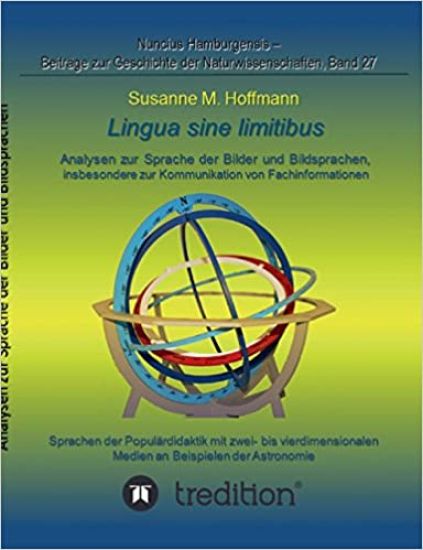
lingua sine limitibus - Analysen zur Sprache der Bilder und Bildsprachen, insbesondere zur Kommunikation von Fachinformationen
Susanne M Hoffmann
Tredition Gmbh
2014
pokkari

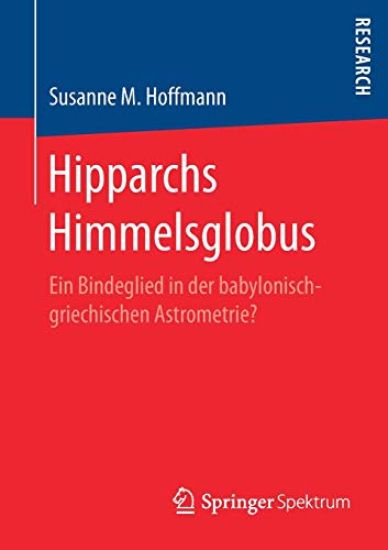
Susanne M. Hoffmann rekonstruiert den nicht überlieferten Himmelsglobus des Hipparch von Nicäa digital und recherchiert die Herkunft seiner Daten und Quellen. Mithilfe der Fehleranalyse im Datensatz untersucht sie Bezüge zu babylonischen und griechischen Messverfahren und eventuell bei Messungen oder durch Kopierprozesse entstandene Fehler. Zwar ist Hipparch laut Aussage von Ptolemaios im Almagest für seine genauen Beobachtungen bekannt, allerdings muss er nicht zwingend alle Daten selbst beobachtet haben. Hierfür könnte er auch Quellen früher babylonischer und griechischer Astronomen genutzt haben. Daher startet die Autorin die Analyse mit MUL.APIN, interpretiert den GU-Text und den shitqulu-Text neu und diskutiert unter anderem die Schriften von Euklid, Eratosthenes, Arat und Hypsikles. Abschließend stellt die Autorin die Texte und Datenwerke in eine chronologische Ordnung und entwirft damit eine neue Geschichte der Astrometrie im -1. Millennium.

Die Arbeit ist der Forschung und Entwicklung in der Fachdidaktik Astronomie gewidmet. Astronomie wird dabei als MINT- bergreifendes Thema aufgefasst. Die Entwicklung und Erprobung von Lehrkonzepten zur Vermessung der Welt wird zuerst mit einer theoretischen Analyse zur Projektmethode berschrieben und m ndet schlie lich in (teilweise erprobten) Vorschl gen zu mehrt gigen au erschulischen Projektma nahmen, bei denen die Teilnehmenden systematisch die Gr e der Erde und des Sonnensystems vermessen sowie die faszinierende relativistische Welt entdecken k nnen.

Die Arbeit ist der Forschung und Entwicklung in der Fachdidaktik Astronomie gewidmet. Astronomie wird dabei als MINT- bergreifendes Thema aufgefasst. Die Entwicklung und Erprobung von Lehrkonzepten zur Vermessung der Welt wird zuerst mit einer theoretischen Analyse zur Projektmethode berschrieben und m ndet schlie lich in (teilweise erprobten) Vorschl gen zu mehrt gigen au erschulischen Projektma nahmen, bei denen die Teilnehmenden systematisch die Gr e der Erde und des Sonnensystems vermessen sowie die faszinierende relativistische Welt entdecken k nnen.

Astronomy in Culture -- Cultures of Astronomy. Astronomie in der Kultur -- Kulturen der Astronomie.
Gudrun Wolfschmidt; Susanne M. Hoffmann
tredition
2022
nidottu
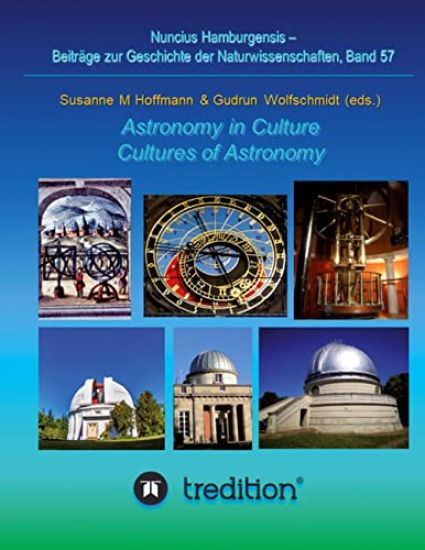
Astronomy in Culture -- Cultures of Astronomy. Astronomie in der Kultur -- Kulturen der Astronomie.
Gudrun Wolfschmidt; Susanne M. Hoffmann
tredition
2022
sidottu
Abortion Under Apartheid examines the politics of abortion in South Africa during the apartheid era (1948-1990), when termination of pregnancy was criminalized. It analyzes the flourishing clandestine abortion industry, the prosecution of medical and "backstreet" abortionists, and the passage in 1975 of the country's first statutory law on abortion. Susanne M. Klausen reveals how ideas about sexuality were fundamental to apartheid culture and shows that the authoritarian National Party government - alarmed by the spread of "permissiveness" in white society - attempted to regulate white women's reproductive sexuality in the interests of maintaining white supremacy. A major focus of the book is the battle over abortion that erupted in the late 1960s and early 1970s, when doctors and feminists, inspired by international developments, called for liberalization of the colonial-era common law that criminalized abortion. The movement for legal reform spurred a variety of political, social, and religious groups to grapple with the meaning of abortion in the context of changing ideas about the traditional family and women's place within it. Abortion Under Apartheid demonstrates that all women, regardless of race, were oppressed under apartheid. Yet, although the National Party was preoccupied with denying young, unmarried white women reproductive control, black girls and women bore the brunt of the lack of access to safe abortion, suffering the effects on a shocking scale. At the heart of the story are the black and white girls and women who-regardless of hostility from partners, elders, religious institutions, nationalist movements, conservative doctors and nurses, or the government-persisted in determining their own destinies. Although a great many were harmed and even died as a result of being denied safe abortions, many more succeeded in thwarting opponents of women's right to control their capacity to bear children. This book conveys both the tragic and triumphant sides of their story.

Before etching Jerusalem William Blake wrote about creating 'the grandest poem that this world contains.' Blake's avowed intention in constructing the work was to move readers from a solely rational way of being (called Ulro) to one that is highly imaginative (called Eden/Eternity), with each word chosen to suit 'the mouth of a true Orator.' Rational interpretation is of limited use when reading this multifaceted epic and its non-linear structure presents a perennial challenge for readers. Susanne Sklar engages with the interpretive challenges of Jerusalem by considering it as a piece of visionary theatre --an imaginative performance in which characters, settings, and imagery are not confined by mundane space and time-- allowing readers to find coherence within its complexities. With his characters, Blake's readers can participate imaginatively in what Blake calls 'the Divine Body, the Saviour's Kingdom,' a way of being in which all things interconnect: spiritually, ecologically, socially, and erotically. Imaginatively engaging with Jerusalem involves close textual reading and analysis. The first part of this book discusses the notion of visionary theatre, and the theological, literary, and historical antecedents of Jerusalem's imagery, characters, and settings. Particular attention is paid to the theological context of Blake's Jesus ('the Divine Body'), and Jerusalem, the heroine of his poem. This prepares the ground for a scene-by-scene commentary of the entire illuminated work. Jerusalem tells the story of Albion's fall, many rescue attempts, escalating violence and oppression, and a surprising apocalypse --in which all living things, awakening, are transfigured in ferocious forgiveness.

Abortion Under Apartheid examines the politics of abortion in South Africa during the apartheid era (1948-1990), when termination of pregnancy was criminalized. It analyzes the flourishing clandestine abortion industry, the prosecution of medical and "backstreet" abortionists, and the passage in 1975 of the country's first statutory law on abortion. Susanne M. Klausen reveals how ideas about sexuality were fundamental to apartheid culture and shows that the authoritarian National Party government -- alarmed by the spread of "permissiveness" in white society -- attempted to regulate white women's reproductive sexuality in the interests of maintaining white supremacy. A major focus of the book is the battle over abortion that erupted in the late 1960s and early 1970s, when doctors and feminists, inspired by international developments, called for liberalization of the colonial-era common law that criminalized abortion. The movement for legal reform spurred a variety of political, social, and religious groups to grapple with the meaning of abortion in the context of changing ideas about the traditional family and women's place within it. Abortion Under Apartheid demonstrates that all women, regardless of race, were oppressed under apartheid. Yet, although the National Party was preoccupied with denying young, unmarried white women reproductive control, black girls and women bore the brunt of the lack of access to safe abortion, suffering the effects on a shocking scale. At the heart of the story are the black and white girls and women who -- regardless of hostility from partners, elders, religious institutions, nationalist movements, conservative doctors and nurses, or the government -- persisted in determining their own destinies. Although a great many were harmed and even died as a result of being denied safe abortion, many more succeeded in thwarting opponents of women's right to control their capacity to bear children. This book conveys both the tragic and triumphant sides of their story.
The relationship between the Russian Federation and the 14 non-Russian successor states is unequal, with Russia the dominant power. This power imbalance is a hold-over from the Soviet era in which the RSFSR was first among equals. Empires, like the Soviet one, are specific types of political systems that differed from modern states. The centralized, multi-ethnic and non-democratic character of empires explains the continued dominance of the Russian Federation. It also explains the absence of alternative economic arrangements and political contacts between the former republics. The Soviet system was structured so as to establish Russian control over non-Russian republics. The political structure was centralized so that all decisions, including investment, production, and distribution decisions were made in Moscow. Economic planning dictated a complex network of production and distribution that rendered the former republics dependent on Russia in a variety of ways.Soviet patterns of government administration and economic management are still evident in all the former republics. Continued dependency on Russia has compromised the state-building efforts of the former republics. Political rhetoric trumpeting new foreign investment, the expansion of diplomatic relations, the signing of trade agreements, and the imminent entrance into international organizations masks the fact that none of these new contacts have been able to replace the old Soviet production and distribution networks. Scholars and students involved with comparative politics and Russian (post-Communist) Studies will find the work of particular value.

The relationship between the Russian Federation and the 14 non-Russian successor states is unequal, with Russia the dominant power. This power imbalance is a hold-over from the Soviet era in which the RSFSR was first among equals. Empires, like the Soviet one, are specific types of political systems that differed from modern states. The centralized, multi-ethnic and non-democratic character of empires explains the continued dominance of the Russian Federation. It also explains the absence of alternative economic arrangements and political contacts between the former republics. The Soviet system was structured so as to establish Russian control over non-Russian republics. The political structure was centralized so that all decisions, including investment, production, and distribution decisions were made in Moscow. Economic planning dictated a complex network of production and distribution that rendered the former republics dependent on Russia in a variety of ways. Soviet patterns of government administration and economic management are still evident in all the former republics. Continued dependency on Russia has compromised the state-building efforts of the former republics. Political rhetoric trumpeting new foreign investment, the expansion of diplomatic relations, the signing of trade agreements, and the imminent entrance into international organizations masks the fact that none of these new contacts have been able to replace the old Soviet production and distribution networks. Scholars and students involved with comparative politics and Russian (post-Communist) Studies will find the work of particular value.

An examination of the importance of oral experience as reflected in literature, Word of Mouth extends psychoanalytic theory as forwarded by Freud, Karl Abraham, Melanie Klein, and Julia Kristeva. The meaning of oral experience is explored with reference to several texts, looking at the oral bond between mother and child in Proust and questions of disordered eating, raised by aggressive orality, found in Conrad's Heart of Darkness . Throughout, the author draws forth the myriad expressions relating the desires and dramas of the mouth, its pervasive pleasures and its dreads.

Life is a battle. There is always something challenging to choose from: finances, sickness, jobs, relationships, family, . . . We must believe we will go for a win in challenges. Something must rise and challenge things around us. Too much of our time is spent living by the rules of a kingdom that we are not a part of. I don't want to live by the rules that are not for my life. We can find out if we are living by the right standards by answering questions like: Does that fit what God says about me? Is that what I believe about my God?God is looking for people who say they are ready to break the rules of the kingdoms of this world; a people who are ready to turn things around and who are not going to live by the world anymore. Israel stood on a hillside and looked at Goliath and saw his size and height and how intimidating and unbeatable he was. David stood on a hillside and looked at the giant and saw how much smaller Goliath was than David's God. A ten-foot giant is no comparison to the God of the Universe How big is your faith ?

Meet Ice and Angel who are nurturing a passionate love in the notorious women's prison called "The Bog". A love that makes them stronger together... and so much more vulnerable when they are apart. The best things in life are often found in the most unexpected places... Angel is a small-town young woman who finds herself trapped in her worst nightmare, a state penitentiary called "The Bog". Sentenced for murder and sent to the infamous prison, Angel becomes a useful inmate to the other prisoners with her unique skills of procuring items for the prisoners. Her life changes when Angel attracts the attention of the legendary prisoner and repeat offender, Morgan Steele, better known as "Ice", who once again returns to the Bog. The minute Angel looks into the woman's icy blue eyes, she is irresistibly attracted to the charismatic woman, sensing a connection she cannot explain nor deny. Charmed by her innocence, Ice takes Angel up on a dare that will forever change their lives as the two start down a road together they've never traveled before - fueling a passion that will rock them to the very core and nurturing a love that will make them stronger together... and so much more vulnerable when they are apart.

To dismiss the work of philosophers and theologians of the past because of their limited perceptions of the whole of humankind is tantamount to tossing the tot out with the tub water. Such is the case when feminist scholars of religion and ethics confront Thomas Aquinas, whose views of women can only be described as misogynistic. Rather than dispense with him, Susanne DeCrane seeks to engage Aquinas and reflect his otherwise compelling thought through the prism of feminist theology, hermeneutics, and ethics. Focusing on one of Aquinas's great intellectual contributions, the fundamental notion of "the common good"-in short, the human will toward peace and justice-DeCrane demonstrates the currency of that notion through a contemporary social issue: women's health care in the United States and, specifically, black women and breast cancer. In her skillful re-engagement with Aquinas, DeCrane shows that certain aspects of religious traditions heretofore understood as oppressive to women and minority groups can actually be parsed, "retrieved," and used to rectify social ills. Aquinas, Feminism, and the Common Good is a bold and intellectually rigorous feminist retrieval of an important text by a Catholic scholar seeking to remain in the tradition, while demanding that the tradition live up to its emphasis on human equity and justice.