Kirjojen hintavertailu. Mukana 11 244 527 kirjaa ja 12 kauppaa.

Kirjahaku

Etsi kirjoja tekijän nimen, kirjan nimen tai ISBN:n perusteella.

1000 tulosta hakusanalla T. S. Eliot

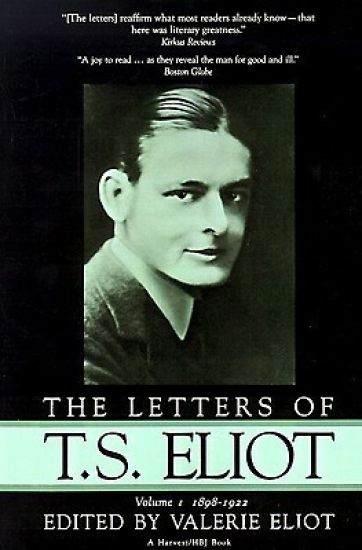
The Letters of T.S. Eliot: Volume 1, 1898-1922
T. S. Eliot, Nobel laureate and a great literary presence of the twentieth century, is renowned for his unique voice as poet, critic, and dramatist. This first volume of his long-awaited correspondence covers the period from his childhood in St. Louis, Missouri, until the end of 1922, by which time he had settled permanently in England, married, and published "The Love Song of J. Alfred Prufrock, " The Sacred Wood, and The Waste Land.Included her are all the significant extant letters Eliot wrote up to age 24 as well as many letters written to him by his family, friends, and contemporaries. There are insights into his struggle to earn a living, care for a wife who was frequently ill, edit a magazine, and become known as a critic and poet. And through the correspondence emerges a memorable view of the social and intellectual milieu before and after World War I.Valerie Eliot has written a detailed introduction, provided annotations and commentary, and selected numerous photographs of Eliot and his world, many of which have never been shown publicly. All these elements combine to create an exceptional portrait of Eliot in the early years of his personal and professional development -- the closest approximation readers will ever have to an autobiography of the poet.
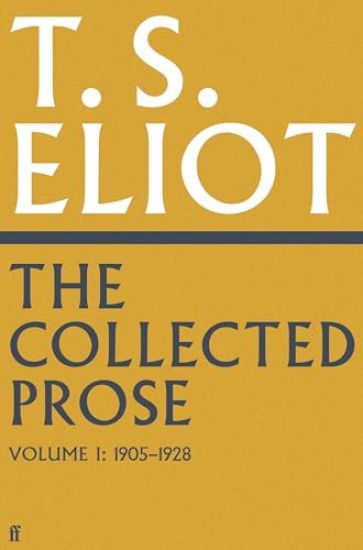
The Collected Prose of T.S. Eliot Volume 1
T. S. Eliot is regarded as the most important poet-critic of modern times, the twentieth century's 'Man of Letters' whose reputation was forged not only on the strength of his verse, but on the enduring influence of his critical writings. The Collected Prose presents those works that Eliot allowed to reach print in the order of their final revision or printing. Publishing across four volumes, the series aims to provide an authoritative and clean-text record of Eliot's approved texts and their revisions, beginning with his formative observations, written while he was at high school, and concluding in his final major opus, To Criticize the Critic, published in the months after his death.This first volume covers the years 1905-1928, a time of dramatic development for Eliot as both a poet and critic that saw the publication of Prufrock and Other Observations, The Waste Land and Journey of the Magi, and a gathering his seminal early essays under the title The Sacred Wood (1920). In his penetrating surveys of poetic form and the literary milieu of the day, he assesses the era's ageing giants, Yeats, Swinburne, Henry James, and hails the arrival of its new generation, Ezra Pound, James Joyce, Wyndham Lewis. The volume also traces Eliot's deepening search for a meaningful response to the trauma of the Great War, and an exploration of religion that led to his confirmation in the Church of England in 1927.
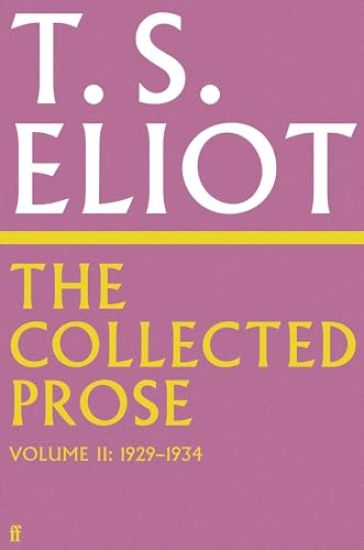
The Collected Prose of T.S. Eliot Volume 2
T. S. Eliot is regarded as the most important poet-critic of modern times, the twentieth century's 'Man of Letters' whose reputation was forged not only on the strength of his verse, but on the enduring influence of his critical writings. The Collected Prose presents those works that Eliot allowed to reach print in the order of their final revision or printing. Publishing across four volumes, the series aims to provide an authoritative and clean-text record of Eliot's approved texts and their revisions, beginning with his formative observations, written while he was at high school, and concluding in his final major opus, To Criticize the Critic, published in the months after his death.This second volume spans 1929-1934, a period in which Eliot's poetry was maturing into the reflective verse of Animula, Ash-Wednesday and Marina. It was also a moment that confirmed his critical reputation with the publication of Selected Essays (1932), reprinting and revising his most important essays on Tradition and the Individual Talent, Hamlet, Marvell and Dante, and culminating in the Harvard lectures that became The Use of Poetry and the Use of Criticism (1933).
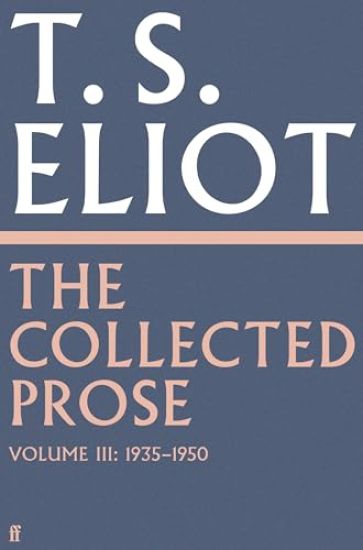
The Collected Prose of T.S. Eliot Volume 3
T. S. Eliot is regarded as the most important poet-critic of modern times, the twentieth century's 'Man of Letters' whose reputation was forged not only on the strength of his verse, but on the enduring influence of his critical writings. The Collected Prose presents those works that Eliot allowed to reach print in the order of their final revision or printing. Publishing across four volumes, the series aims to provide an authoritative and clean-text record of Eliot's approved texts and their revisions, beginning with his formative observations, written while he was at high school, and concluding in his final major opus, To Criticize the Critic, published in the months after his death.This third volume collects Eliot's prose from 1935-1950, when his works The Idea of a Christian Society (1939) and The Music of Poetry (1942) would engage the seminal grounds of his Four Quartets, while his Notes Towards the Definition of Culture (1948) would appear at the moment he was awarded the Nobel Prize in Literature. It was a period of experimentation in form and genre, in which writings for the theatre were taking centre stage and he was composing for the first time for children, Old Possum's Book of Practical Cats.
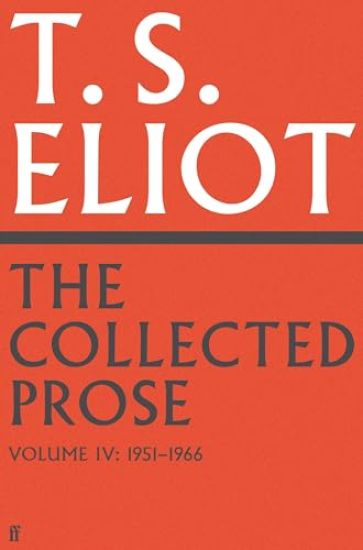
The Collected Prose of T.S. Eliot Volume 4
T. S. Eliot is regarded as the most important poet-critic of modern times, the twentieth century's 'Man of Letters' whose reputation was forged not only on the strength of his verse, but on the enduring influence of his critical writings. The Collected Prose presents those works that Eliot allowed to reach print in the order of their final revision or printing. Publishing across four volumes, the series aims to provide an authoritative and clean-text record of Eliot's approved texts and their revisions, beginning with his formative observations, written while he was at high school, and concluding in his final major opus, To Criticize the Critic, published in the months after his death.This fourth and final volume from 1951-1966, covers a period of concluding productivity in Eliot's writing. Although his poetry was all but complete, his theatrical and critical work flourished through a decade that included such books as Poetry and Drama (1951), The Frontiers of Criticism (1956) and On Poetry and Poets (1957).
The Essential T.S. Eliot

The Essential T.S. Eliot

T. S. Eliot

Ecco Press
2020
sidottu
A selection of the most significant and enduring poems from one of the twentieth century's major writers, chosen and introduced by Vijay SeshadriT.S. Eliot was a towering figure in twentieth century literature, a renowned poet, playwright, and critic whose work--including "The Love Song of J. Alfred Prufrock" (1915), The Waste Land (1922), Four Quartets (1943), and Murder in the Cathedral (1935)--continues to be among the most-read and influential in the canon of American literature. The Essential T.S. Eliot collects Eliot's most lasting and important poetry in one career-spanning volume, now with an introduction from Vijay Seshadri, one of our foremost poets.
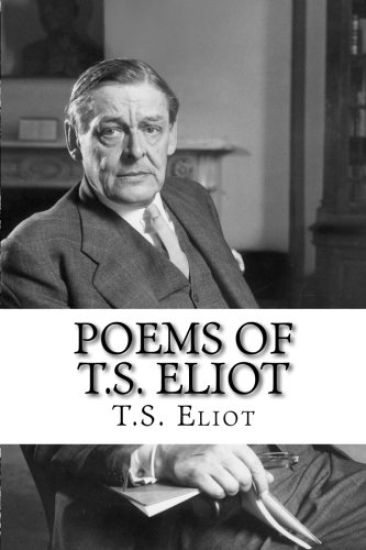
Poems of T.S. Eliot

Poems of T.S. Eliot

T. S. Eliot

Createspace Independent Publishing Platform
2016
nidottu
The poems included are: Gerontion, Burbank with a Baedeker: Bleistein with a Cigar-Sweeney Erect, A Cooking Egg, Le Directeur, M lange adult re de tout, Lune de Miel, The Hippopotamus, Dans le Restaurant, Whispers of Immortality, Mr. Eliot's Sunday Morning Service, Sweeney Among the Nightingales, The Love Song of J. Alfred Prufrock, Portrait of a Lady, Preludes, Rhapsody on a Windy Night, Morning at the Window, The Boston Evening Transcript, Aunt Helen, Cousin Nancy, Mr. Apollinax, Hysteria, Conversation Galante, La Figlia Che Piange
T. S. Eliot Selected Poems

T. S. Eliot Selected Poems

T. S. Eliot

Ecco Press
2025
nidottu
Chosen by Eliot himself, the poems in this volume represent the poet's most important work before Four Quartets. Included here is some of the most celebrated verse in modern literature--"The Love Song of J. Alfred Prufrock," "Gerontion," "The Waste Land," "The Hollow Men," and "Ash Wednesday"--as well as many other fine selections from Eliot's early work.
T. S. Eliot

T. S. Eliot

Craig Raine

Oxford University Press Inc
2007
sidottu
The winner of the Nobel Trize for Literature, the twentieth century's most famous poet and its most influential literary arbiter, T.S. Eliot has long been thought to be an obscure and difficult poet--forbiddingly learned, maddeningly enigmatic. Now, in this brilliant exploration of T.S. Eliot's work, prize-winning poet Craig Raine reveals that, on the contrary, Eliot's poetry (and drama and criticism) can be seen as a unified and coherent body of work. Indeed, despite its manifest originality, its radical experimentation, and its dazzling formal variety, his verse yields meaning just as surely as other more conventional poetry. Raine argues that an implicit controlling theme--the buried life, or the failure of feeling--unfolds in surprisingly varied ways throughout Eliot's work. But alongside Eliot's desire "to live with all intensity" was also a distrust of "violent emotion for its own sake." Raine illuminates this paradoxical Eliot--an exacting anti-romantic realist, skeptical of the emotions, yet incessantly troubled by the fear of emotional failure--through close readings of such poems as "The Love Song of J Alfred Prufrock," "Gerontion," The Hollow Men, Ash Wednesday, and many others. The heart of the book contains extended analyses of Eliot's two master works--The Waste Land and Four Quartets. Raine also examines Eliot's criticism--including his coinage of such key literary terms as the objective correlative, dissociation of sensibility, the auditory imagination--and he concludes with a convincing refutation of charges that Eliot was an anti-Semite. Here then is a volume absolutely indispensable for all admirers of T.S. Eliot and, in fact, for everyone who loves modern literature.
T. S. Eliot

T. S. Eliot

Craig Raine

Oxford University Press Inc
2011
nidottu
The twentieth century's most famous poet and its most influential literary arbiter, T.S. Eliot has long been thought to be an obscure and difficult writer-forbiddingly learned, maddeningly enigmatic. In this compelling exploration, prize-winning poet Craig Raine finds a way to read and make sense of Eliot's full corpus. He illuminates a paradoxical Eliot--an exacting anti-romantic realist, skeptical of the emotions, yet incessantly troubled by the fear of emotional failure--through close readings of his poetry, with extended analyses of Eliot's two master works--The Waste Land and Four Quartets. Raine also examines Eliot's criticism--including his coinage of such key literary terms as the objective correlative, dissociation of sensibility, the auditory imagination, and his biography, crafting a book that provides a concise introduction for beginners and a provocative set of arguments for Eliot admirers.
T. S. Eliot

T. S. Eliot

James E. Miller Jr.

Pennsylvania State University Press
2005
sidottu
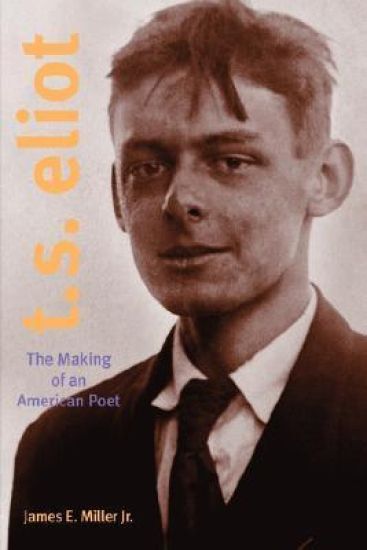
Late in his life T. S. Eliot, when asked if his poetry belonged in the tradition of American literature, replied: “I’d say that my poetry has obviously more in common with my distinguished contemporaries in America than with anything written in my generation in England. That I’m sure of. . . . In its sources, in its emotional springs, it comes from America.” In T. S. Eliot: The Making of an American Poet, James Miller offers the first sustained account of Eliot’s early years, showing that the emotional springs of his poetry did indeed come from America.Miller challenges long-held assumptions about Eliot’s poetry and his life. Eliot himself always maintained that his poems were not based on personal experience, and thus should not be read as personal poems. But Miller convincingly combines a reading of the early work with careful analysis of surviving early correspondence, accounts from Eliot’s friends and acquaintances, and new scholarship that delves into Eliot’s Harvard years. Ultimately, Miller demonstrates that Eliot’s poetry is filled with reflections of his personal experiences: his relationships with family, friends, and wives; his sexuality; his intellectual and social development; his influences.Publication of T. S. Eliot: The Making of an American Poet marks a milestone in Eliot scholarship. At last we have a balanced portrait of the poet and the man, one that takes seriously his American roots. In the process, we gain a fuller appreciation for some of the best-loved poetry of the twentieth century.
T. S. Eliot

T. S. Eliot

James E. Miller Jr.

Pennsylvania State University Press
2008
pokkari
Late in his life T. S. Eliot, when asked if his poetry belonged in the tradition of American literature, replied: “I’d say that my poetry has obviously more in common with my distinguished contemporaries in America than with anything written in my generation in England. That I’m sure of. . . . In its sources, in its emotional springs, it comes from America.” In T. S. Eliot: The Making of an American Poet, James Miller offers the first sustained account of Eliot’s early years, showing that the emotional springs of his poetry did indeed come from America.Miller challenges long-held assumptions about Eliot’s poetry and his life. Eliot himself always maintained that his poems were not based on personal experience, and thus should not be read as personal poems. But Miller convincingly combines a reading of the early work with careful analysis of surviving early correspondence, accounts from Eliot’s friends and acquaintances, and new scholarship that delves into Eliot’s Harvard years. Ultimately, Miller demonstrates that Eliot’s poetry is filled with reflections of his personal experiences: his relationships with family, friends, and wives; his sexuality; his intellectual and social development; his influences.Publication of T. S. Eliot: The Making of an American Poet marks a milestone in Eliot scholarship. At last we have a balanced portrait of the poet and the man, one that takes seriously his American roots. In the process, we gain a fuller appreciation for some of the best-loved poetry of the twentieth century.
The Letters of T. S. Eliot: Volume 2: 1923-1925 Volume 2
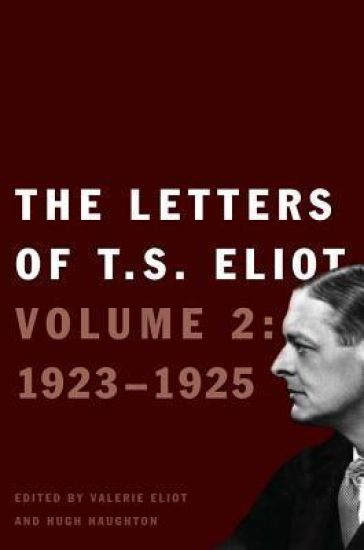
In two highly anticipated volumes, the correspondence of the twentieth century's eminent man of letters, from youth to early manhood Volume One: 1898-1922 presents some 1,400 letters encompassing the years of Eliot's childhood in St. Louis, Missouri, through 1922, by which time the poet had settled in England, married his first wife, and published The Waste Land. Since the first publication of this volume in 1988, many new materials from British and American sources have come to light. More than two hundred of these newly discovered letters are now included, filling crucial gaps in the record and shedding new light on Eliot's activities in London during and after the First World War. Volume Two: 1923-1925 covers the early years of Eliot's editorship of The Criterion, publication of The Hollow Men, and his developing thought about poetry and poetics. The volume offers 1,400 letters, charting Eliot's journey toward conversion to the Anglican faith, as well as his transformation from banker to publisher and his appointment as director of the new publishing house Faber & Gwyer. The prolific and various correspondence of this volume testifies to Eliot's growing influence as cultural commentator and editor.
The Letters of T. S. Eliot: Volume 5: 1930-1931 Volume 5
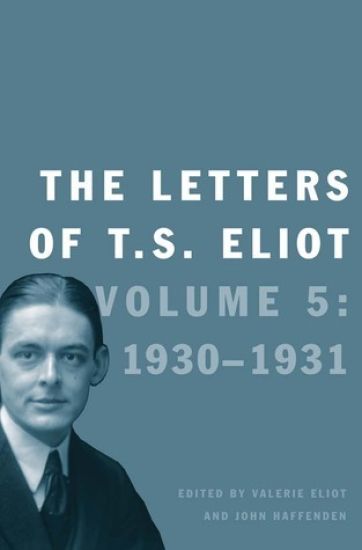
The fifth volume of the correspondence of literary giant T. S. Eliot This fifth volume of the collected letters of poet, playwright, essayist, and literary critic Thomas Stearns Eliot covers the years 1930 through 1931. It was during this period that the acclaimed American-born writer earnestly embraced his newly avowed Anglo-Catholic faith, a decision that earned him the antagonism of friends like Virginia Woolf and Herbert Read. Also evidenced in these correspondences is Eliot's growing estrangement from his wife Vivien, with the writer's newfound dedication to the Anglican Church exacerbating the unhappiness of an already tormented union. Yet despite his personal trials, this period was one of great literary activity for Eliot. In 1930 he composed the poems Ash-Wednesday and Marina, and he published Coriolan and a translation of Saint-John Perse's Anabase the following year. As director at the British publishing house Faber & Faber and editor of The Criterion, he encouraged W. H. Auden, Stephen Spender, Louis MacNeice, and Ralph Hogdson, published James Joyce's Haveth Childers Everywhere, and turned down a book proposal from Eric Blair, better known by his pen name, George Orwell. Through Eliot's correspondences from this time the reader gets a full-bodied view of a great artist at a personal, professional, and spiritual crossroads.
T. S. Eliot

T. S. Eliot

Tony Sharpe

Palgrave Macmillan
1991
nidottu
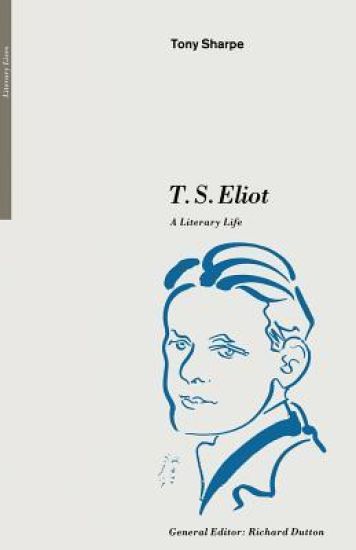
Part of a series which offers accounts of the literary careers of the most widely read British and Irish authors. This volume looks at T.S.Eliot and traces the professional, publishing and social contexts which shaped his writing.
The Poems of T. S. Eliot: Volume I: Collected and Uncollected Poems
The first volume of the first paperback edition of The Poems of T. S. Eliot This two-volume critical edition of T. S. Eliot's poems establishes a new text of the Collected Poems 1909-1962, rectifying accidental omissions and errors that have crept in during the century since Eliot's astonishing debut, "The Love Song of J. Alfred Prufrock." In addition to the masterpieces, The Poems of T. S. Eliot contains the poems of Eliot's youth, which were rediscovered only decades later; poems that circulated privately during his lifetime; and love poems from his final years, written for his wife, Valerie. Calling upon Eliot's critical writings as well as his drafts, letters, and other original materials, Christopher Ricks and Jim McCue have provided a commentary that illuminates the imaginative life of each poem. This first volume respects Eliot's decisions by opening with his Collected Poems 1909-1962 as he arranged and issued it shortly before his death. This is followed by poems uncollected but either written for or suitable for publication, and by a new reading text of the drafts of The Waste Land. The second volume opens with the two books of verse of other kinds that Eliot issued: Old Possum's Book of Practical Cats and Anabasis, his translation of St.-John Perse's Anabase. Each of these sections is accompanied by its own commentary. Finally, pertaining to the entire edition, there is a comprehensive textual history that contains not only variants from all known drafts and the many printings but also extended passages amounting to hundreds of lines of compelling verse.
Poems of T. S. Eliot: Volume II

Poems of T. S. Eliot: Volume II

T. S. Eliot

Farrar, Straus and Giroux
2018
nidottu
The second volume of the first paperback edition of The Poems of T. S. Eliot This two-volume critical edition of T. S. Eliot's poems establishes a new text of the Collected Poems 1909-1962, rectifying accidental omissions and errors that have crept in during the century since Eliot's astonishing debut, "The Love Song of J. Alfred Prufrock." In addition to the masterpieces, The Poems of T. S. Eliot contains the poems of Eliot's youth, which were rediscovered only decades later; poems that circulated privately during his lifetime; and love poems from his final years, written for his wife, Valerie. Calling upon Eliot's critical writings as well as his drafts, letters, and other original materials, Christopher Ricks and Jim McCue have provided a commentary that illuminates the imaginative life of each poem. Following the collected and uncollected poems of the first volume, this second volume opens with the two books of verse of other kinds that Eliot issued: the children's verse of Old Possum's Book of Practical Cats, and Anabasis, his translation of St.-John Perse's Anabase. This volume then gathers the verses that Eliot contributed to the learnedly lighthearted exchanges of Noctes Binanian , and others that he wrote off-the-cuff or for intimate friends. Each of these sections is accompanied by its own commentary. Finally, pertaining to the entire edition, there is a comprehensive textual history that contains not only variants from all known drafts and the many printings but also extended passages amounting to hundreds of lines of compelling verse.
T. S. Eliot

T. S. Eliot

Elisabeth W. Schneider

University of California Press
2021
pokkari
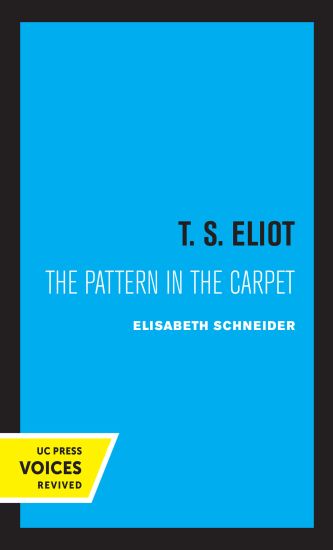
This title is part of UC Press's Voices Revived program, which commemorates University of California Press’s mission to seek out and cultivate the brightest minds and give them voice, reach, and impact. Drawing on a backlist dating to 1893, Voices Revived makes high-quality, peer-reviewed scholarship accessible once again using print-on-demand technology. This title was originally published in 1975.
T. S. Eliot

T. S. Eliot

Elisabeth W. Schneider

University of California Press
2021
sidottu
This title is part of UC Press's Voices Revived program, which commemorates University of California Press’s mission to seek out and cultivate the brightest minds and give them voice, reach, and impact. Drawing on a backlist dating to 1893, Voices Revived makes high-quality, peer-reviewed scholarship accessible once again using print-on-demand technology. This title was originally published in 1975.