Tamra Wilson's prose is all about the extraordinary in everyday life: smelling "ghosts," discovering a family diary from the Gold Rush, spotting real pennies from heaven.These short essays are drawn from her newspaper column "A Fork in the Road" that readers in her corner of North Carolina look for every other Tuesday. Like friendly chats over coffee, they offer insights about room mothers, greeting card glitter and wearing seersucker and white shoes after Labor Day. There are weightier subjects, too, such as leaving home and coping with COVID.Peppered with humor, Tamra's writing captures the essence of what it means to be fully human in our time and place. Her thoughtful work has appeared in the North Carolina Literary Review, storySouth, Evening Street Press, The New Guard and elsewhere.From the ForewordSince 2015, Tamra Wilson has offered readers a unique perspective of life in Catawba County through her column "A Fork in the Road." Through her writing, Tammy captures the essence of what it means to be fully human in our time and place.These 130+ essays offer commentary on such topics as greeting-card glitter, going plaid in a solid gray world and wearing white shoes after Labor Day. But there are weightier subjects too: storms, COVID, slave narratives and war casualties. Interspersed throughout are slices of humor that feel as if you're chatting over the backyard fence. About the AuthorTamra Wilson is an essayist and fiction writer whose work has appeared in North Carolina Literary Review, Our State, storySouth, and dozens of other journals and anthologies across the United States. She is the author of Dining with Robert Redford & Other Stories and co-editor of Idol Talk: Women Writers on the Teenage Infatuations that Changed Their Lives, which was a finalist for the Eric Hoffer Award. She has received two North Carolina Regional Artist Project Grants and has traveled the state as a Road Scholar for the North Carolina Humanities Council.Tamra is a 2021 honoree of the Baker's Dozen Women's Society affiliated with The Corner Table, a nonprofit focused on providing meals to those affected by hunger in Catawba County. A portion of proceeds from this book will benefit that organization. From Going Plaid in a Solid Gray World The recent cold snap reminds me of why we live in North Carolina. Six degrees Fahrenheit sounds extreme, but it could be worse.The other day a Facebook friend posted a photograph from Central Illinois in 1979. It showed a winter scape of a rural highway buried in twelve-foot drifts. A string of stranded semitrailers looks ridiculously small and powerless.I replied, "Thanks for reminding me what prompted Tym and me to move to North Carolina."This same topic came up a few weeks earlier when I noticed that Catawba County Museum of History was seeking artifacts for a display about "local immigrants."I asked museum director Amber Clawson Albert if people from other parts of the United States would qualify as "immigrants."She had never thought of that. Turns out she had never heard of the three horrific winters that sent us South.
Since 2015, Tammy Wilson has offered readers a unique perspective of life in Catawba County through her column "A Fork in the Road." Through her writing, Tammy captures the essence of what it means to be fully human in our time and place.These 135 essays offer commentary on such topics as greeting-card glitter, going plaid in a solid gray world and wearing white shoes after Labor Day. But there are weightier subjects too: storms, COVID, slave narratives and war casualties. Interspersed throughout are slices of humor that feel as if you're chatting over the backyard fence. As executive director of The Corner Table, Inc. I am pleased to partner with Tammy, who is an honoree of this year's Bakers Dozen Women's Society-local women charged with raising vital funds to support our mission of feeding the hungry. Proceeds from the sale of this book will help provide hope for the less fortunate in our community. Opinions expressed in the essays are the author's alone; they do not necessarily reflect the opinions or policies of The Corner Table or its affiliates.The Corner Table provides free meals in a family-friendly restaurant setting through our soup kitchen program, as well as to-go bags each Friday for our guests to cover another meal. We also coordinate the county-wide backpack program for local school children and prepare and distribute frozen meals throughout the county to individuals who are homebound or need additional meals outside of our lunch service. Last year alone, The Corner Table served nearly 32,000 guests and 1,569 school children. That's no small potatoes.I hope that you will savor these collected essays from "A Fork in the Road."Sincere appreciation to all who have helped get this project into the oven and onto the table. Thanks to Gayle Coyne for her encouragement; to Sylvia Bajorek, Janet Ford, and Candace Tippett for editorial excellence; to the Hickory Daily Record, Lincoln Herald and Observer-News-Enterprise for agreeing to see these pieces morph into a book; and to the fine folks at Redhawk Publications for taking this fledgling under their wings.I am forever indebted to my husband Tym, who figured into many of the essays and proofread many of them as early drafts. I miss him more than we could ever imagine.
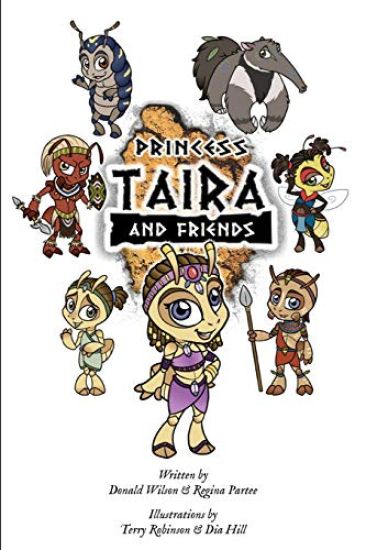
In the beautifully majestic land of Africa lives Princess Taira. She is the heir to the throne of the Uranic Colony, a termite colony deep in Africa. There is only one problem. Taira feels she is not ready to assume her position as queen of the Uranic Colony. She would rather be living out her dream of traveling and exploring the beautiful land where she lives instead of being confined inside the safety of the inner walls of her termite castle. Taira's mother, the reigning queen, is desperately trying to groom Taira for the day that she will become queen. She is constantly met with Taira's resistance and free spirit-something that she knows Taira has inherited from her father, Troytaira, leader of the soldier termites of their colony. Along her journey, Taira encounters Cedric, the centipede; Robbie, a hard-shell roly-poly insect; Ulysses, the ant eater; Sasha, the firefly; and Solomon, a soldier termite. They all join Taira in her search for a new home. Marc Anthony is an ant and the commander of the fierce Siafu Ant Army, who's determined to be the sole ruler over all the insects in Africa. Marc Anthony finally catches up with Taira's group and escorts them all to his vast kingdom as prisoners. Taira has two choices: marry Marc Anthony and be one of his many captured queens or rot in a dungeon along with her friends.Will Taira be able to summon all that her mother has taught her to stand up and be a true queen, even in turmoil? Will her friends escape their fate after being taken captive? Find out in Taira the Termite Queen novel.
Valerie Wilson Wesley's Tamara Hayle mystery series featuring Newark, New Jersey's number one private investigator are loved for their smart, sexy protagonist who "has a way with a wisecrack that is positively lethal" (Washington Post). Now in Dying in the Dark, Hayle is entrenched in a sinister investigation that will demand her best detective work yet.Tamara Hayle's past has come back to haunt her-literally. She's been plagued by terrifying dreams about Celia Jones, an old friend whose walk on the wild side led her to a horrible death. Celia's teenage son, Cecil, begs Tamara to find his mother's killer . . . only to end up dead himself, stabbed through the heart. The search for Celia and her son's killer pulls Tamara deep into her friend's troubled love life, where everyone adored her but somebody held a murderous grudge. There's her bullying thug of an ex-husband; a handsome ex-lover who woos Tamara with charm and lies; and an angry, jealous woman who claims that Celia broke her heart. And those were just the obvious people with axes to grind. Despite her better judgment and the admonitions of the police department, Tamara refuses to back away from the mystery surrounding her old friend's death and the tragedy that met her son. All clues lead to the past Tamara shared with Celia Jones, and Tamara fears that that past will threaten her own son. But she uncovers more than she bargained for-and unearths secrets someone would kill to keep in the shadows.
Betty Friedan once told Simone de Beauvoir that women should have the option of staying at home to raise children, and Beauvoir replied that they shouldn't have, since too many would choose. It is time to say that a certain derivation of the feminist movement has derived in a group that is very authoritarian -with respect to the life that other women must have-"FEMINAZIS: psycho-social portrait of extreme feminism and the risks of the dictatorship of correct political thought," is a revealing book regarding this phenomenon, from a perspective that cannot be found in the hegemonic discourse provided by the mainstream media. To discuss or to accept, it is a very different perspective from the one imposed as obligatory, it is the other bell.The philosophical and ideological currents that sustain the feminazi ideology, its historical roots, the central concepts of its mythology are presented - such as the mythical "Patriarchy", the "gender violence", the "glass roof" - from a deep research in the books that today are the indispensable references.In this book, you will find, even with a plain language, a very consistent historical, sociological, philosophical investigation that can explain very well how correct it is to call them "feminazis".The challenge is a more human way of thinking. Each person is a sum of characteristics, is not their race, is not their height, is not their skin color, is not their gender, is not their form of sexual desire, is not their religious belief. Each person can deviate from the story that these "collectivist, paranoid and authoritarian ideologies" tell. Each person is not a representative of a group. Each person is unique, as is each life story and each destiny,
Betty Friedan una vez le dijo a Simone de Beauvoir que las mujeres deber an tener la opci n de quedarse en casa a criar a los hijos, y Beauvoir respondi que no deber an tenerla, ya que, si no, demasiadas la elegir an. A esta altura es hora de decir que cierta derivaci n del movimiento feminista ha derivado en un grupo que es muy autoritario -con respecto a la vida que deben tener las otras mujeres-, muy violento y que, sobre todas las cosas, se da el fen meno de que todos temen hablar y disgustarlas, todos temen ser acusados de "machistas"."FEMINAZIS: retrato psicosocial del feminismo extremo y los riesgos de la dictadura del pensamiento pol tico correcto", es un libro revelador en cuanto a este fen meno, desde una perspectiva que no se puede encontrar en el relato hegem nico que brindan los grandes medios de comunicaci n. Para discutir o para aceptar, es una mirada muy distinta a la que est impuesta como obligatoria, es la otra campana silenciada.Se presentan las corrientes filos ficas e ideol gicas que sustentan la ideolog a feminazi, sus ra ces hist ricas, los conceptos centrales de su mitolog a -tales como el m tico "Patriarcado", la supuesta "violencia de g nero", la supuesta "cosificaci n"- todo ello, desde una investigaci n muy documentada y con respaldo en los principales libros que hoy conforman las referencias indispensables para acercarse al feminazismo. Adem s, se exploran las bases del importante impacto social de las feminazis, como las reformas en los programas de los Ministerios de Educaci n para injertar el odio de g nero y el prejuicio anti-familia en las nuevas generaciones, las nuevas leyes de "g nero", la creaci n de los nuevos juzgados feminaz s, as como tambi n la consolidaci n de una verdadera dictadura del pensamiento pol tico correcto donde repetir sus dogmas es el paso obligado en la escalera al poder de periodistas, funcionarios judiciales y pol ticos, as como tambi n contradecirlas puede provocar las m s delirantes y sobreactuadas formas de las expulsi n social y del estigma."FEMINAZI" es una palabra recientemente definida por la Real Academia Espa ola. En este libro, encontrar s, a n con un lenguaje llano y comprensible, una muy consistente investigaci n hist rica, sociol gica, filos fica que puede explicar muy bien lo correcto que es llamarlas as y lo descriptiva que es la palabra "feminazi" para describir estos influyentes y temidos grupos de presi n.El desaf o es una manera de pensar m s humana. Cada persona es una suma de caracter sticas, no es su raza, no es su estatura, no es su color de piel, no es su g nero, no es su forma de deseo sexual, no es su creencia religiosa. Cada persona puede apartarse del relato que "cuentan" estas ideolog as colectivistas, paranoides y autoritarias. Cada persona no es un representante de un grupo, sino que cada persona es "Ella Misma".
The 18th century was a wealth of knowledge, exploration and rapidly growing technology and expanding record-keeping made possible by advances in the printing press. In its determination to preserve the century of revolution, Gale initiated a revolution of its own: digitization of epic proportions to preserve these invaluable works in the largest archive of its kind. Now for the first time these high-quality digital copies of original 18th century manuscripts are available in print, making them highly accessible to libraries, undergraduate students, and independent scholars.Western literary study flows out of eighteenth-century works by Alexander Pope, Daniel Defoe, Henry Fielding, Frances Burney, Denis Diderot, Johann Gottfried Herder, Johann Wolfgang von Goethe, and others. Experience the birth of the modern novel, or compare the development of language using dictionaries and grammar discourses. ++++The below data was compiled from various identification fields in the bibliographic record of this title. This data is provided as an additional tool in helping to insure edition identification: ++++British LibraryT022399The date is an error for 1757 (Foxon).London: printed for Charles Marsh: and sold by M. Cooper, 1707 1757]. 28p.; 4