Kirjojen hintavertailu. Mukana 11 244 527 kirjaa ja 12 kauppaa.

Kirjahaku

Etsi kirjoja tekijän nimen, kirjan nimen tai ISBN:n perusteella.

69 tulosta hakusanalla Teun Tieleman

Galen

Galen

Teun Tieleman

Acumen Publishing Ltd
2025
sidottu
Galen offers a much-needed introduction to the philosophical writings of Galen of Pergamum (129–c.215 CE). Written by a leading international expert on Galen, this volume elucidates his significance as a logician and a philosopher, and addresses the key conceptual question raised by this topic: how does Galen’s philosophy relate to his medical work? Galen was the most important medical writer in antiquity and his influence on Western medicine is unparalleled. Yet both Galen and his contemporaries considered him to be a philosopher as much as a doctor. Tieleman convincingly assesses this interrelationship, exploring the ways Galen applied philosophical concepts to medical theory and practice, and conversely considering how his experience as an empirical scientist conditioned his responses to philosophical tradition. Detailing his private and social background, his philosophical and medical education, his career as a medical practitioner and his relationship with the philosophical schools of his day, this volume provides essential context which enables readers to understand Galen’s intellectual profile. Presupposing no previous knowledge of Galen’s work, this volume provides students of classics and philosophy with an up-to-date and accessible overview of his philosophy, as well as an account of recent research on the subject.
Galen

Galen

Teun Tieleman

Acumen Publishing Ltd
2025
nidottu
Galen offers a much-needed introduction to the philosophical writings of Galen of Pergamum (129–c.215 CE). Written by a leading international expert on Galen, this volume elucidates his significance as a logician and a philosopher, and addresses the key conceptual question raised by this topic: how does Galen’s philosophy relate to his medical work? Galen was the most important medical writer in antiquity and his influence on Western medicine is unparalleled. Yet both Galen and his contemporaries considered him to be a philosopher as much as a doctor. Tieleman convincingly assesses this interrelationship, exploring the ways Galen applied philosophical concepts to medical theory and practice, and conversely considering how his experience as an empirical scientist conditioned his responses to philosophical tradition. Detailing his private and social background, his philosophical and medical education, his career as a medical practitioner and his relationship with the philosophical schools of his day, this volume provides essential context which enables readers to understand Galen’s intellectual profile. Presupposing no previous knowledge of Galen’s work, this volume provides students of classics and philosophy with an up-to-date and accessible overview of his philosophy, as well as an account of recent research on the subject.
Discourse and Power

Discourse and Power

Teun A van Dijk

Red Globe Press
2008
sidottu
Teun van Dijk is one of the founders of Critical Discourse Studies and this collection brings together some of his most important writing, framed by new introductory material. He examines the role of discourse in the reproduction of power and domination in society and the ways in which media and political elites control access to public discourse.
Discourse and Power

Discourse and Power

Teun A van Dijk

Red Globe Press
2008
nidottu
Teun van Dijk is one of the founders of Critical Discourse Studies and this collection brings together some of his most important writing, framed by new introductory material. He examines the role of discourse in the reproduction of power and domination in society and the ways in which media and political elites control access to public discourse.
Macrostructures

Macrostructures

Teun A. van Dijk

Routledge
2019
sidottu
Macrostructures are higher-level semantic or conceptual structures that organize the ‘local’ microstructures of discourse, interaction, and their cognitive processing. They are distinguished from other global structures of a more schematic nature, which we call superstructures. Originally published in 1980, the theory of macrostructures outlined in this book is the result of research carried out during the previous 10 years in the domains of literary theory, text grammar, the general theory of discourse, pragmatics, and the cognitive psychology of discourse processing. The presentation of the theory is systematic but informal and at this stage was not intended to be fully formalized.
Macrostructures

Macrostructures

Teun A. van Dijk

Routledge
2021
nidottu
Macrostructures are higher-level semantic or conceptual structures that organize the ‘local’ microstructures of discourse, interaction, and their cognitive processing. They are distinguished from other global structures of a more schematic nature, which we call superstructures. Originally published in 1980, the theory of macrostructures outlined in this book is the result of research carried out during the previous 10 years in the domains of literary theory, text grammar, the general theory of discourse, pragmatics, and the cognitive psychology of discourse processing. The presentation of the theory is systematic but informal and at this stage was not intended to be fully formalized.
Design Thinking

Design Thinking

Teun den Dekker

Routledge
2020
sidottu
This book is not just for reading. Design Thinking is something you need to actually do. Reading about design thinking will increase your knowledge, but by doing it, you will learn what design thinking can mean for you, in your studies and your work. In this book we encourage you to take action: design thinking by doing.Since the end of the last millennium, design thinking has received an increasing amount of attention from the business community, social organizations, universities and colleges.Organizations are confronted with complex problems and issues that are no longer self-containe, clear or easy to define. The creative solution strategy offered by design thinking appears to be increasingly needed to adequately respond to the questions, wishes and needs of customers and society as a whole.This book unravels the thinking and working process of design thinking and offers practical tools for getting started. The author approaches design thinking in four chapters, from different perspectives: as a way of thinking, a way of working, a project approach and a tool box.Design thinking is a way of thinking answers the questions: How do design thinkers approach problems and challenges? Which six fundamental attitudes do they use and what do you need to know in order to use them? Design thinking is a way of working answers questions such as: What phases and milestones does the design process distinguish? What is the difference between the more structured design process and the ‘messy’ cycle of design thinking? Because you learn design thinking by doing, you will practice this in Design thinking is a project approach.Finally, in the last chapter Design thinking is a tool box, the methods and tools that you use in a design project will be discussed.This international edition of Design Thinking is written for students and workers who want to apply design thinking to tackle challenges, problems or complex (social) issues in a different, practical way within their own professional practice.
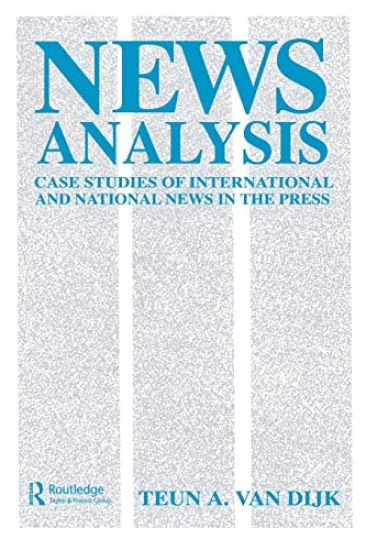
News Analysis

News Analysis

Teun A. van Dijk

Routledge
2011
nidottu
First Published in 1987. This book presents a series of case studies that illustrate the structures of national and international news in the press. It first summarizes our discourse analytical theory of the processes and structures of news reports as it has been developed in the last five years.
Paying Our High Public Officials

Paying Our High Public Officials

Teun J. Dekker

Routledge
2012
sidottu
In almost every liberal democratic society, an issue that is a topic of constant and passionate public discussion is how much that country’s ministers, legislators, senior civil servants, and senior judges should be paid. Nor is this surprising; the issue has considerable voyeuristic appeal, particular democratic significance, and important ramifications for the functioning of the public sector as a whole. However, like most political debates, these discussions tend to be messy, fragmented, and full of unverified assertions and spurious appeals to populist sentiment. It is hardly surprising that those discussions rarely succeed in putting the matter to rest. Paying Our High Public Officials examines the political discourse concerning this question in 17 liberal democracies (Canada, the United States, Mexico, Norway, Finland, the Netherlands, the United Kingdom, Ireland, Germany, Austria, Switzerland, France, Poland, Italy, Hong Kong, Singapore, and New Zealand). Based on many hundreds of parliamentary debates, newspaper articles, speeches, as well as reports by think tanks and high commissions of state, the book identifies seven central arguments that occur in all these societies, translates them into the language of analytical philosophy, and then rigorously evaluates them. This approach contributes to a better understanding of this controversy and may result in better-justified and more legitimate conclusions concerning which policy to adopt.
Populism in Western Europe

Populism in Western Europe

Teun Pauwels

Routledge
2016
nidottu
Despite the increasing academic interest in populism, we still lack understanding of individual factors contributing to populist voting. One of the main reasons for this is that populism is almost always attached to other ideologies which makes it difficult to isolate factors. This book draws on an innovative research design by comparing the reasons to vote for six populist parties which differ remarkably in terms of their host ideology in Belgium, The Netherlands, and Germany. The results show that populist voters are motivated by their dissatisfaction with the functioning of democracy and a desire for more direct democracy. Furthermore it appears that populist parties do not mobilize among one specific social group although deprived groups are generally more susceptible to populist voting. Finally, this study explored why some populist parties persist while others decline. Origins of party formation and how leaders organize their party internally seem the most important factors determining party persistence.This book will be of great interest to students and scholars of populism, European politics and contemporary political theory.
Populism in Western Europe

Populism in Western Europe

Teun Pauwels

Routledge
2014
sidottu
Despite the increasing academic interest in populism, we still lack understanding of individual factors contributing to populist voting. One of the main reasons for this is that populism is almost always attached to other ideologies which makes it difficult to isolate factors. This book draws on an innovative research design by comparing the reasons to vote for six populist parties which differ remarkably in terms of their host ideology in Belgium, The Netherlands, and Germany. The results show that populist voters are motivated by their dissatisfaction with the functioning of democracy and a desire for more direct democracy. Furthermore it appears that populist parties do not mobilize among one specific social group although deprived groups are generally more susceptible to populist voting. Finally, this study explored why some populist parties persist while others decline. Origins of party formation and how leaders organize their party internally seem the most important factors determining party persistence.This book will be of great interest to students and scholars of populism, European politics and contemporary political theory.
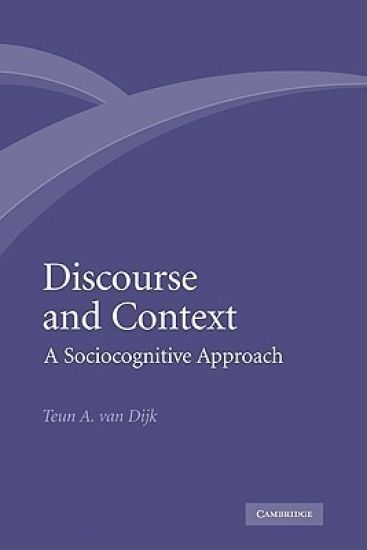
Discourse and Context

Discourse and Context

Teun A. van Dijk

Cambridge University Press
2010
pokkari
How do social situations influence language use, discourse and conversation? This book is a monograph which presents a multidisciplinary theory of context and the way context influences language use and discourse. Unlike in earlier approaches, contexts are not defined as objective social 'variables', such as gender or age. Rather, they are constructs of the participants themselves, that is, 'subjective definitions of the communicative situation' that are made explicit in the sociocognitive notion of context models. These models dynamically control all language use, make sure that discourses are appropriate in the communicative situation and hence are the basis of pragmatics. In this book, context models are studied especially from a (socio) linguistic and cognitive perspective. In another book published by Cambridge University Press, Society and Discourse, Teun A. van Dijk develops the social psychological, sociological and anthropological dimensions of the theory of context.
Society and Discourse

Society and Discourse

Teun A. van Dijk

Cambridge University Press
2009
sidottu
After his earlier book Discourse and Context, also published by Cambridge University Press, Teun A. van Dijk in this study presents the second part of his multidisciplinary theory of context. The main thesis of this theory is that the influence of society on discourse is not direct, as is postulated for instance in sociolinguistics, but cognitively mediated by subjective mental models of the communicative situation: context models. These dynamic models control discourse production and comprehension and define the pragmatic appropriateness of text and talk. Whereas in Discourse and Context the psychological and linguistic aspects of context were analyzed, this book focuses on the social psychological, sociological, anthropological and political aspects of context. Tony Blair's 2003 speech defending his motion to go to war against Saddam Hussein and the following debate in parliament is used as an example illustrating the new theory.
Discourse and Context

Discourse and Context

Teun A. van Dijk

Cambridge University Press
2008
sidottu
How do social situations influence language use, discourse and conversation? This book is a monograph which presents a multidisciplinary theory of context and the way context influences language use and discourse. Unlike in earlier approaches, contexts are not defined as objective social 'variables', such as gender or age. Rather, they are constructs of the participants themselves, that is, 'subjective definitions of the communicative situation' that are made explicit in the sociocognitive notion of context models. These models dynamically control all language use, make sure that discourses are appropriate in the communicative situation and hence are the basis of pragmatics. In this book, context models are studied especially from a (socio) linguistic and cognitive perspective. In another book published by Cambridge University Press, Society and Discourse, Teun A. van Dijk develops the social psychological, sociological and anthropological dimensions of the theory of context.
Human Forever

Human Forever

Teun Toebes

Duckworth Books
2026
nidottu
'Toebes' vision for the future of care is one in which we all pitch in' The Times After his international bestselling book The Housemates made headlines across Europe, Teun Toebes travelled to explore how communities and care systems are handling dementia care across the world, from South Africa to New Zealand, Norway to Japan. This extraordinary book is powerful, revealing and uplifting, and suggests cross-cultural ideas for making the future more hopeful and inclusive for people living with a form of dementia. What we can learn from each other? A book for anyone caring for the older generation or hoping to one day grow old happily themselves.
Ideology

Ideology

Teun A. van Dijk

SAGE Publications Inc
1998
sidottu
The definition of ideology continues to occupy scholars across a wide range of disciplines. In this book, Teun A van Dijk sketches a challenging new multidisciplinary framework for theorizing ideology. He defines ideology as the basis of the social representations of a group, its functions in terms of social relations between groups, and its reproduction as enacted by discourse. Contemporary racist discourse is examined to illustrate these ideological relations between cognition, society and discourse.
Ideology

Ideology

Teun A. van Dijk

SAGE Publications Inc
1998
nidottu
The definition of ideology continues to occupy scholars across a wide range of disciplines. In this book, Teun A van Dijk sketches a challenging new multidisciplinary framework for theorizing ideology. He defines ideology as the basis of the social representations of a group, its functions in terms of social relations between groups, and its reproduction as enacted by discourse. Contemporary racist discourse is examined to illustrate these ideological relations between cognition, society and discourse.
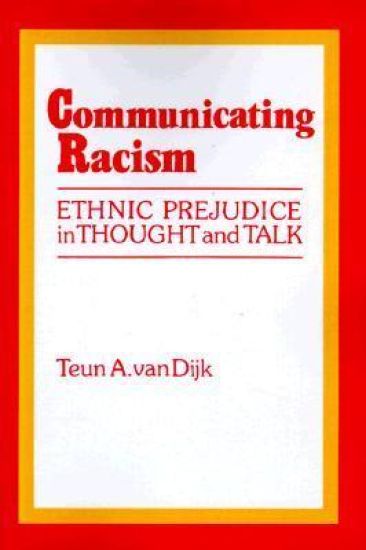
Communicating Racism

Communicating Racism

Teun A. van Dijk

SAGE Publications Inc
1989
nidottu
How do members of "in" groups talk about minority groups? How does everyday talk contribute to the spread, and acceptance, of ethnic prejudice? These are but two among the many fundamental questions raised in this revealing look at ethnic stereotypes and the way in which they are diffused through interpersonal communication and inter group interactions. By analyzing informal discourse about ethnic minorities, and the reproduction of racism within the white majority, Communicating Racism offers us a new understanding of many deeply rooted and poorly understood patterns of prejudice. In a clearly written and methodologically elegant analysis of conversation as an integral and revealing mirror of human behavior, the author teaches us far- reaching lessons about the cognitive, social, and communicative dimensions of racism. Communicating Racism will be essential reading for a wide variety of social science and humanities professionals and their students, including specialists engaged in the study of discourse, cognition, persuasion, and communication. As a result it will be especially useful as background reading for upper division and graduate courses in linguistics, discourse analysis, cognitive and social psychology, micro sociology, anthropology, speech communication, and ethnic studies. "The most analytically comprehensive and revealing treatment of the social organization of ethnic prejudice to date. . . . van Dijk exposes the subtle means by which ethnic prejudice . . . maintains and sustains social inequality and injustice. . . . A remarkable tour de force of scholarship and social concern." --Thomas Kochman, University of Illinois, Chicago "The research in this book disproves the idea that racism and ethnic prejudice come from a particular geographical, sexual, or socioeconomic group. . . . Van Dijk's work is both carefully documented and dedicated to social change. As such it can remind us of and encourage us in our own battles with racism and other prejudices." --Homiletic "The study . . . has considerable methodological value. Advanced students and mature scholars can further develop the ideas presented. Good bibliography." --Choice "Communicating Racism is an ambitious, well-written, and important coordination of varied methodologies and insights of cognitive studies, discourse analysis, and social psychology; it attempts to explicate the social reproduction of prejudice through ordinary language and everyday speech. . . . A significant contribution to the field." --Contemporary Sociology "Communicating Racism will be of interest to scholars in several fields, particularly those who are concerned with the relationship between racist discourse and the perpetuation of racist ideology. . . . van Dijk has accomplished the difficult task of writing for several audiences without biasing the thesis toward general or technical readers. Both scholars and laymen can gain considerable insight. . . . Discourse analysis is presented as a useful tool . . . [the author] has filled an important gap in the field." --American Journal of Sociology "Thorough. . . . Conveys valuable information about shared social cognitions as the bases of prejudice, a group phenomenm. The most striking point made is that the white elite is the group most responsible for the diffusion of racism through the media." --Readings: A Journal of Reviews and Commentary in Mental Health "van Dijk has accomplished the difficult task of writing for several audiences without biasing the thesis toward general or technical readers. Both scholars and laymen can gain considerable insight. . . . Linguists, communication scholars, and others interested in the sociology of racist talk will find this. . . . valuable. . . . Quantitative evidence is provided in support of these observations, and clear patterns emerge out of the arrangements repeatedly raised in support of racial prejudice. . . . van Dijk has provided one of the most comprehensive analyses available racist discourse. Indeed, he has filled an important gap in the field of discourse analysis . . . . Communication Racism is one of the most insightful evaluations of the social and cognitive foundations of racism to date." --American Journal of Sociology "An ambitious . . . attempt to build a theory of prejudiced discourse. . . . Refreshingly, [this book] possesses . . . a scholarly as well as social mission. I recommend [it] as supplemental reading for graduate courses." --Quarterly Journal of Speech "The text [has] a sense of relevance and urgency. The book has the great merit of striking a balance between the necessary detachment of the social scientist and the deep human concern of the author trying to understand how ethnic prejudice is reproduced in society." --Semiotica "An ambitious assault on an extremely delicate problem, the everyday expressions of racism among White people." --Contemporary Psychology "Because of the depth and scope of the research, this book makes a significant and important contribution to research on racism and prejudice. . . . Each chapter includes extensive research data to support van Dijk's theories. . . . Sustains the reader's interest throughout, not only because of the topic relevance, but also because it forces the reader to reflect upon his or her language patterns and how they may be sending rascist messages to others. . . . This book is a 'must read' for educators--from preschool teachers to college professors." --Dimensions "This work is very important to both the areas of discourse analysis and interracial/intercultural communication. . . . This work does much to stimulate thought on undeniably important theoretical, methodological, and social concerns. . . . For those interested in the application of interracial and intercultural communication research to communication skills, van Dijk's work has value. . . . As a theoretical work, Communicating Racism also makes a contribution in identifying components of a framework to be utilized and in pulling together some relevant research related to that framework. . . . There is much in Communicating Racism that is useful and much that is important." --International Journal of Intercultural Relations
Elite Discourse and Racism

Elite Discourse and Racism

Teun A. van Dijk

SAGE Publications Inc
1993
nidottu
This study of 'elite racism,' which can be subtle but is in fact pervasive and sometimes mundane, is an important contribution to the study of racism and a fine example of comparative race and ethnic studies. Intended for undergraduate and graduate students and scholars, it can also be profitably read by anyone interested in understanding the multiple manifestations of racism in U.S. and European societies. --Choice
News Analysis

News Analysis

Teun A. van Dijk

Routledge Member of the Taylor and Francis Group
1987
sidottu
First Published in 1987. This book presents a series of case studies that illustrate the structures of national and international news in the press. It first summarizes our discourse analytical theory of the processes and structures of news reports as it has been developed in the last five years.