Kirjojen hintavertailu. Mukana 11 420 836 kirjaa ja 12 kauppaa.

Kirjahaku

Etsi kirjoja tekijän nimen, kirjan nimen tai ISBN:n perusteella.

1000 tulosta hakusanalla Theda Skocpol

An Analysis of Theda Skocpol's States and Social Revolutions
Many people want to understand what revolutions are and – especially – how they come about, from the academics who study them to the states that wish to prevent (or, in some cases, provoke) them. But it is arguably the US scholar Theda Skocpol who has done most to create a viable model of revolution, and States and Social Revolutions is the work in which she sets out her intellectual stall. Skocpol's magnum opus can be considered a classic product of the critical thinking skill of problem-solving. She assesses several different revolutions – those of France, Russia and China – and asks new, productive questions about their causes and outcomes. The answers, collectively, allow her to move beyond existing theories such as the ‘voluntarist’ school (which suggests that revolutionaries have agency) and the Marxist school (which sees state institutions as nothing more than a front for class interests). Skocpol's model assumes that states are autonomous bureaucratic institutions, which act in their own interests – a fundamental re-imagining based on fresh interpretations of the evidence. Her analysis extends beyond the causes of revolution to their consequences, and her argument that the revolutionary state that survives is the one that successfully implements a far-reaching program of reform helps to explain not only why the three revolutions she studied have proved enduringly influential, but also why hundreds of others, less successful, are barely remembered today.
Boomerang

Boomerang

Theda Skocpol

WW Norton Co
1997
pokkari
In this incisive account, a prize-winning social scientist offers deep insights into the changing terrain of U.S. politics and public policy. Because of far-reaching changes in the Reagan era, Theda Skocpol shows, the Clinton Health Security bill became a perfect foil for antigovernment mobilization. Thus its defeat provides a unique window into the new political landscape.
The Missing Middle

The Missing Middle

Theda Skocpol

WW Norton Co
2001
nidottu
In the opening pages of this powerful examination of American politics, Theda Skocpol reveals a curious pattern: Our politicians argue over programs for the very poor or tax cuts for the very rich, and they worry over the precarious security of our longer-living grandparents and the educational neglect and corresponding bleak future of our children. But, with the spotlight on the youngest, the oldest, the richest, and the poorest, rarely do we find policies concerned with average working men and women of modest means, those the author terms the "missing middle." Skocpol draws us into the history of this disturbing trend and reveals the repercussions of the increasingly simplistic and moralistic stands being taken by our politicians. Taking lessons from the root causes of this shift, she presents a compelling case for family-oriented populism and identifies the bold reforms needed to revitalize American democracy.
Social Revolutions in the Modern World

Social Revolutions in the Modern World

Theda Skocpol

Cambridge University Press
1994
pokkari
In this collection of essays, Theda Skocpol, author of the award-winning book States and Social Revolutions (1979), updates her arguments about social revolutions. How are we to understand recent revolutionary upheavals in countries across the globe? Why have social revolutions happened in some countries, but not in others that seem similar? Skocpol shows how she and other scholars have used ideas about states and societies to identify the particular types of regimes that are susceptible to the growth of revolutionary movements and vulnerable to transfers of state power to revolutionary challengers. Skocpol engages in thoughtful dialogue with critics, and she suggests how culture and ideology can properly be incorporated into historical and comparative studies. She also vigorously defends the value of an institutionalist, comparative and historical approach against recent challenges from Marxists, rational choice theorists, and culturally oriented interpreters of particular revolutions.
Protecting Soldiers and Mothers

Protecting Soldiers and Mothers

Theda Skocpol

The Belknap Press
1995
nidottu
It is a commonplace that the United States lagged behind the countries of Western Europe in developing modern social policies. But, as Theda Skocpol shows in this startlingly new historical analysis, the United States actually pioneered generous social spending for many of its elderly, disabled, and dependent citizens. During the late nineteenth century, competitive party politics in American democracy led to the rapid expansion of benefits for Union Civil War veterans and their families.Some Americans hoped to expand veterans' benefits into pensions for all of the needy elderly and social insurance for workingmen and their families. But such hopes went against the logic of political reform in the Progressive Era. Generous social spending faded along with the Civil War generation.Instead, the nation nearly became a unique maternalist welfare state as the federal government and more than forty states enacted social spending, labor regulations, and health education programs to assist American mothers and children. Remarkably, as Skocpol shows, many of these policies were enacted even before American women were granted the right to vote. Banned from electoral politics, they turned their energies to creating huge, nation-spanning federations of local women's clubs, which collaborated with reform-minded professional women to spur legislative action across the country.Blending original historical research with political analysis, Skocpol shows how governmental institutions, electoral rules, political parties, and earlier public policies combined to determine both the opportunities and the limits within which social policies were devised and changed by reformers and politically active social groups over the course of the late nineteenth and early twentieth centuries.By examining afresh the institutional, cultural, and organizational forces that have shaped U.S. social policies in the past, Protecting Soldiers and Mothers challenges us to think in new ways about what might be possible in the American future.
Social Policy in the United States

Social Policy in the United States

Theda Skocpol

Princeton University Press
1996
pokkari
Health care, welfare, Social Security, employment programs--all are part of ongoing national debates about the future of social policy in the United States. In this wide-ranging collection of essays, Theda Skocpol shows how historical understanding, centered on governmental institutions and political alliances, can illuminate the limits and possibilities of American social policymaking both past and present. Skocpol dispels the myth that Americans are inherently hostile to social spending and suggests why President Clinton's health care agenda was so quickly attacked despite the support of most Americans for his goals.
Diminished Democracy

Diminished Democracy

Theda Skocpol

University of Oklahoma Press
2004
nidottu
Pundits and social observers have voiced alarm each year as fewer Americans involve themselves in voluntary groups that meet regularly. Thousands of nonprofit groups have been launched in recent times, but most are run by professionals who lobby Congress or deliver social services to clients. What will happen to U.S. democracy if participatory groups and social movements wither, while civic involvement becomes one more occupation rather than every citizen's right and duty? In Diminished Democracy, Theda Skocpol shows that this decline in public involvement has not always been the case in this country - and how, by understanding the causes of this change, we might reverse it.
Black Greek-Letter Organizations 2.0

Black Greek-Letter Organizations 2.0

Theda Skocpol

University Press of Mississippi
2011
sidottu
At the turn of the twentieth century, black fraternities and sororities, also known as Black Greek-Letter Organizations (BGLOs), were an integral part of what W.E.B. Du Bois called the ""talented tenth."" This was the top ten percent of the black community that would serve as a cadre of educated, upper-class, motivated individuals who acquired the professional credentials, skills, and capital to assist the race to attain socio-economic parity. Today, however, BGLOs struggle to find their place and direction in a world drastically different from the one that witnessed their genesis.In recent years, there has been a growing body of scholarship on BGLOs. This collection of essays seeks to push those who think about BGLOs to engage in more critically and empirically based analysis. This book also seeks to move BGLO members and those who work with them beyond conclusions based on hunches, conventional wisdom, intuition, and personal experience. In addition to a rich range of scholars, this volume includes a kind of call and response feature between scholars and prominent members of the BGLO community.
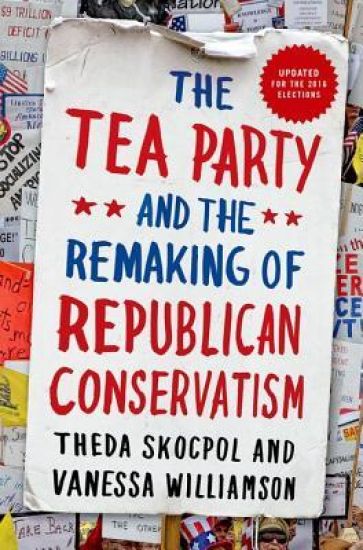
The Tea Party and the Remaking of Republican Conservatism

The Tea Party and the Remaking of Republican Conservatism

Theda Skocpol; Vanessa Williamson

Oxford University Press Inc
2016
nidottu
On February 19, 2009, CNBC commentator Rick Santelli delivered a dramatic rant against Obama administration programs to shore up the plunging housing market. Invoking the Founding Fathers and ridiculing "losers" who could not pay their mortgages, Santelli called for "Tea Party" protests. Over the next two years, conservative activists took to the streets and airways, built hundreds of local Tea Party groups, and weighed in with votes and money to help right-wing Republicans win electoral victories in 2010. In this penetrating new study, Harvard University's Theda Skocpol and Vanessa Williamson go beyond images of protesters in Colonial costumes to provide a nuanced portrait of the Tea Party. What they find is sometimes surprising. Drawing on grassroots interviews and visits to local meetings in several regions, they find that older, middle-class Tea Partiers mostly approve of Social Security, Medicare, and generous benefits for military veterans. Their opposition to "big government" entails reluctance to pay taxes to help people viewed as undeserving "freeloaders" - including immigrants, lower income earners, and the young. At the national level, Tea Party elites and funders leverage grassroots energy to further longstanding goals such as tax cuts for the wealthy, deregulation of business, and privatization of the very same Social Security and Medicare programs on which many grassroots Tea Partiers depend. Elites and grassroots are nevertheless united in hatred of Barack Obama and determination to push the Republican Party sharply to the right. The Tea Party and the Remaking of Republican Conservatism combines fine-grained portraits of local Tea Party members and chapters with an overarching analysis of the movement's rise, impact, and likely fate.
Obama and America’s Political Future

Obama and America’s Political Future

Theda Skocpol; Daniel Carpenter

Harvard University Press
2012
sidottu
Barack Obama’s galvanizing victory in 2008, coming amid the greatest economic crisis since the 1930s, opened the door to major reforms. But the president quickly faced skepticism from supporters and fierce opposition from Republicans, who scored sweeping wins in the 2010 midterm election. Here, noted political scientist Theda Skocpol surveys the political landscape and explores its most consequential questions: What happened to Obama’s “new New Deal”? Why have his achievements enraged opponents more than they have satisfied supporters? How has the Tea Party’s ascendance reshaped American politics?Skocpol’s compelling account rises above conventional wisdom and overwrought rhetoric. The Obama administration’s response to the recession produced bold initiatives—health care reform, changes in college loans, financial regulation—that promise security and opportunity. But these reforms are complex and will take years to implement. Potential beneficiaries do not readily understand them, yet the reforms alarm powerful interests and political enemies, creating the volatile mix of confusion and fear from which Tea Party forces erupted. Skocpol dissects the popular and elite components of the Tea Party reaction that has boosted the Republican Party while pushing it far to the right at a critical juncture for U.S. politics and governance.Skocpol’s analysis is accompanied by contributions from two fellow scholars and a former congressman. At this moment of economic uncertainty and extreme polarization, as voters prepare to render another verdict on Obama’s historic presidency, Skocpol and her respondents help us to understand its triumphs and setbacks and see where we might be headed next.
What a Mighty Power We Can Be

What a Mighty Power We Can Be

Theda Skocpol; Ariane Liazos; Marshall Ganz

Princeton University Press
2008
pokkari
From the nineteenth through the mid-twentieth centuries, millions of American men and women participated in fraternal associations--self-selecting brotherhoods and sisterhoods that provided aid to members, enacted group rituals, and engaged in community service. Even more than whites did, African Americans embraced this type of association; indeed, fraternal lodges rivaled churches as centers of black community life in cities, towns, and rural areas alike. Using an unprecedented variety of secondary and primary sources--including old documents, pictures, and ribbon-badges found in eBay auctions--this book tells the story of the most visible African American fraternal associations. The authors demonstrate how African American fraternal groups played key roles in the struggle for civil rights and racial integration. Between the 1890s and the 1930s, white legislatures passed laws to outlaw the use of important fraternal names and symbols by blacks. But blacks successfully fought back. Employing lawyers who in some cases went on to work for the NAACP, black fraternalists took their cases all the way to the Supreme Court, which eventually ruled in their favor. At the height of the modern Civil Rights movement in the 1950s and 1960s, they marched on Washington and supported the lawsuits through lobbying and demonstrations that finally led to legal equality. This unique book reveals a little-known chapter in the story of civic democracy and racial equality in America.
Health Care Reform and American Politics

Health Care Reform and American Politics

Lawrence Jacobs; Theda Skocpol

Oxford University Press Inc
2016
sidottu
The Patient Protection and Affordable Care Act signed by President Obama in March 2010 is a landmark in U.S. social legislation, and the Supreme Court's recent decision upholding the Act has ensured that it will remain the law of the land. The new law extends health insurance to nearly all Americans, fulfilling a century-long quest and bringing the United States to parity with other industrial nations. Affordable Care aims to control rapidly rising health care costs and promises to make the United States more equal, reversing four decades of rising disparities between the very rich and everyone else. Millions of people of modest means will gain new benefits and protections from insurance company abuses - and the tab will be paid by privileged corporations and the very rich. How did such a bold reform effort pass in a polity wracked by partisan divisions and intense lobbying by special interests? What does Affordable Care mean-and what comes next? In this updated edition of Health Care Reform and American Politics: What Everyone Needs to Know®, Lawrence R. Jacobs and Theda Skocpol-two of the nation's leading experts on politics and health care policy-provide a concise and accessible overview. They explain the political battles of 2009 and 2010, highlighting White House strategies, the deals Democrats cut with interest groups, and the impact of agitation by Tea Partiers and progressives. Jacobs and Skocpol spell out what the new law can do for everyday Americans, what it will cost, and who will pay. In a new section, they also analyze the impact the Supreme Court ruling that upheld the law. Above all, they explain what comes next, as critical yet often behind-the-scenes battles rage over implementing reform nationally and in the fifty states. Affordable Care still faces challenges at the state level despite the Court ruling. But, like Social Security and Medicare, it could also gain strength and popularity as the majority of Americans learn what it can do for them.
Health Care Reform and American Politics

Health Care Reform and American Politics

Lawrence Jacobs; Theda Skocpol

Oxford University Press Inc
2016
nidottu
The Patient Protection and Affordable Care Act signed by President Obama in March 2010 is a landmark in U.S. social legislation, and the Supreme Court's recent decision upholding the Act has ensured that it will remain the law of the land. The new law extends health insurance to nearly all Americans, fulfilling a century-long quest and bringing the United States to parity with other industrial nations. Affordable Care aims to control rapidly rising health care costs and promises to make the United States more equal, reversing four decades of rising disparities between the very rich and everyone else. Millions of people of modest means will gain new benefits and protections from insurance company abuses - and the tab will be paid by privileged corporations and the very rich. How did such a bold reform effort pass in a polity wracked by partisan divisions and intense lobbying by special interests? What does Affordable Care mean-and what comes next? In this updated edition of Health Care Reform and American Politics: What Everyone Needs to Know®, Lawrence R. Jacobs and Theda Skocpol-two of the nation's leading experts on politics and health care policy-provide a concise and accessible overview. They explain the political battles of 2009 and 2010, highlighting White House strategies, the deals Democrats cut with interest groups, and the impact of agitation by Tea Partiers and progressives. Jacobs and Skocpol spell out what the new law can do for everyday Americans, what it will cost, and who will pay. In a new section, they also analyze the impact the Supreme Court ruling that upheld the law. Above all, they explain what comes next, as critical yet often behind-the-scenes battles rage over implementing reform nationally and in the fifty states. Affordable Care still faces challenges at the state level despite the Court ruling. But, like Social Security and Medicare, it could also gain strength and popularity as the majority of Americans learn what it can do for them.
Rust Belt Union Blues

Rust Belt Union Blues

Lainey Newman; Theda Skocpol

Columbia University Press
2023
sidottu
In the heyday of American labor, the influence of local unions extended far beyond the workplace. Unions were embedded in tight-knit communities, touching nearly every aspect of the lives of members—mostly men—and their families and neighbors. They conveyed fundamental worldviews, making blue-collar unionists into loyal Democrats who saw the party as on the side of the working man. Today, unions play a much less significant role in American life. In industrial and formerly industrial Rust Belt towns, Republican-leaning groups and outlooks have burgeoned among the kinds of voters who once would have been part of union communities.Lainey Newman and Theda Skocpol provide timely insight into the relationship between the decline of unions and the shift of working-class voters away from Democrats. Drawing on interviews, union newsletters, and ethnographic analysis, they pinpoint the significance of eroding local community ties and identities. Using western Pennsylvania as a case study, Newman and Skocpol argue that union members’ loyalty to Democratic candidates was as much a product of the group identity that unions fostered as it was a response to the Democratic Party’s economic policies. As the social world around organized labor dissipated, conservative institutions like gun clubs, megachurches, and other Republican-leaning groups took its place.Rust Belt Union Blues sheds new light on why so many union members have dramatically changed their party politics. It makes a compelling case that Democrats are unlikely to rebuild credibility in places like western Pennsylvania unless they find new ways to weave themselves into the daily lives of workers and their families.
Rust Belt Union Blues

Rust Belt Union Blues

Lainey Newman; Theda Skocpol

Columbia University Press
2024
pokkari
In the heyday of American labor, the influence of local unions extended far beyond the workplace. Unions were embedded in tight-knit communities, touching nearly every aspect of the lives of members—mostly men—and their families and neighbors. They conveyed fundamental worldviews, making blue-collar unionists into loyal Democrats who saw the party as on the side of the working man. Today, unions play a much less significant role in American life. In industrial and formerly industrial Rust Belt towns, Republican-leaning groups and outlooks have burgeoned among the kinds of voters who once would have been part of union communities.Lainey Newman and Theda Skocpol provide timely insight into the relationship between the decline of unions and the shift of working-class voters away from Democrats. Drawing on interviews, union newsletters, and ethnographic analysis, they pinpoint the significance of eroding local community ties and identities. Using western Pennsylvania as a case study, Newman and Skocpol argue that union members’ loyalty to Democratic candidates was as much a product of the group identity that unions fostered as it was a response to the Democratic Party’s economic policies. As the social world around organized labor dissipated, conservative institutions like gun clubs, megachurches, and other Republican-leaning groups took its place.Rust Belt Union Blues sheds new light on why so many union members have dramatically changed their party politics. It makes a compelling case that Democrats are unlikely to rebuild credibility in places like western Pennsylvania unless they find new ways to weave themselves into the daily lives of workers and their families.
State and Party in America's New Deal

State and Party in America's New Deal

Kenneth Finegold; Theda Skocpol

University of Wisconsin Press
1995
nidottu
This text examines the activities of the Nevada regulatory agencies and organised crime in their respective efforts to control gambling. The focus is the ""Black Book"", a list of ""notorious and unsavoury"" persons banned for life from all licensed casinos in the state.
Christianity and American Democracy

Christianity and American Democracy

Hugh Heclo; Theda Skocpol

Harvard University Press
2009
nidottu
Christianity, not religion in general, has been important for American democracy. With this bold thesis, Hugh Heclo offers a panoramic view of how Christianity and democracy have shaped each other.Heclo shows that amid deeply felt religious differences, a Protestant colonial society gradually convinced itself of the truly Christian reasons for, as well as the enlightened political advantages of, religious liberty. By the mid-twentieth century, American democracy and Christianity appeared locked in a mutual embrace. But it was a problematic union vulnerable to fundamental challenge in the Sixties. Despite the subsequent rise of the religious right and glib talk of a conservative Republican theocracy, Heclo sees a longer-term, reciprocal estrangement between Christianity and American democracy.Responding to his challenging argument, Mary Jo Bane, Michael Kazin, and Alan Wolfe criticize, qualify, and amend it. Heclo’s rejoinder suggests why both secularists and Christians should worry about a coming rupture between the Christian and democratic faiths. The result is a lively debate about a momentous tension in American public life.
Nature and History in American Political Development

Nature and History in American Political Development

James W. Ceaser; Theda Skocpol

Harvard University Press
2008
nidottu
In this inaugural volume of the Alexis de Tocqueville Lectures, political scientist James Ceaser traces the way certain ideas, including nature, history, and religion—which he calls foundational ideas—have been understood and used by statesmen and public intellectuals over the course of American history, from the Puritans to the current day. Ceaser treats these ideas not as pure concepts of philosophy or theology, but rather as elements of political discourse that provide the ground or ultimate appeal for other political ideas, such as liberty or equality. At times, they have critically influenced the course of American political development, offering various opportunities and constraints for political leaders. Ceaser traces the histories of these ideas and their relation to other ideas, to practices, and to the fortunes of successive partisan regimes. Three critical commentators—historian Jack Rakove and political theorists Nancy Rosenblum and Rogers Smith—challenge Ceaser’s arguments in several ways. They suggest that other ideas may be considered foundational, and they prod him to clarify further how foundational ideas work politically. Ceaser responds with vigor, and the result is a spirited debate about large and enduring questions in American politics.
Social Revolutions in the Modern World

Social Revolutions in the Modern World

Skocpol Theda

Cambridge University Press
1994
sidottu
In this collection of essays, Theda Skocpol, author of the award-winning book States and Social Revolutions (1979), updates her arguments about social revolutions. How are we to understand recent revolutionary upheavals in countries across the globe? Why have social revolutions happened in some countries, but not in others that seem similar? Skocpol shows how she and other scholars have used ideas about states and societies to identify the particular types of regimes that are susceptible to the growth of revolutionary movements and vulnerable to transfers of state power to revolutionary challengers. Skocpol engages in thoughtful dialogue with critics, and she suggests how culture and ideology can properly be incorporated into historical and comparative studies. She also vigorously defends the value of an institutionalist, comparative and historical approach against recent challenges from Marxists, rational choice theorists, and culturally oriented interpreters of particular revolutions.
States and Social Revolutions

States and Social Revolutions

Skocpol Theda

Cambridge University Press
2015
pokkari
State structures, international forces, and class relations: Theda Skocpol shows how all three combine to explain the origins and accomplishments of social-revolutionary transformations. Social revolutions have been rare but undeniably of enormous importance in modern world history. States and Social Revolutions provides a new frame of reference for analyzing the causes, the conflicts, and the outcomes of such revolutions. It develops a rigorous, comparative historical analysis of three major cases: the French Revolution of 1787 through the early 1800s, the Russian Revolution of 1917 through the 1930s, and the Chinese Revolution of 1911 through the 1960s. Believing that existing theories of revolution, both Marxist and non-Marxist, are inadequate to explain the actual historical patterns of revolutions, Skocpol urges us to adopt fresh perspectives. Above all, she maintains that states conceived as administrative and coercive organizations potentially autonomous from class controls and interests must be made central to explanations of revolutions.