

Kirjahaku
Etsi kirjoja tekijän nimen, kirjan nimen tai ISBN:n perusteella.
1000 tulosta hakusanalla Theda Vaughan

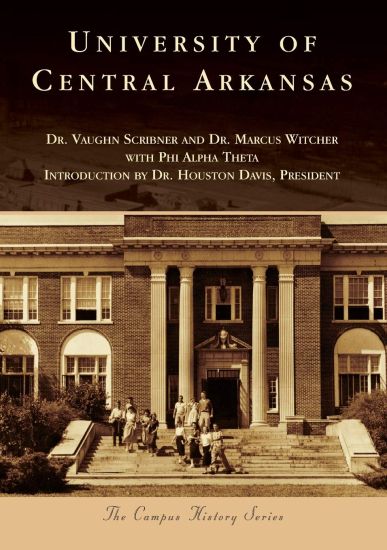
University of Central Arkansas
Marcus Witcher; Vaughn Scribner; Phi Alpha Theta
Arcadia Publishing (SC)
2020
nidottu
The University of Central Arkansas (UCA) began its life as the Arkansas State Normal School in 1907.Originally intended to bolster Arkansas's teaching pool by training professional educators, the school hosted 9 academic departments, 1 building, 107 students, and 7 faculty members.The school renamed itself the Arkansas State Teachers College in 1925 and became the University of Central Arkansas in 1975. UCA now has around 12,000 students, 400 full-time faculty, 150 total degrees and certificates, and more than 120 buildings on over 350 acres.UCA was one of the first schools in the nation to create an honors program, the Norbert O.Schedler Honors College, which still thrives today. The University of Central Arkansas has positioned itself as a beacon of academic progress in Arkansas and continues to grow with Conway's booming population sector.Vaughn Scribner and Marcus Witcher are faculty members in the history department at the University of Central Arkansas. They organized a group of six student members of Phi Alpha Theta--the undergraduate history honors society--to write this volume, which covers UCA's history through five main themes: campus construction, student life, sports, Greek life, and outreach. Dr. Houston Davis has been UCA's president since 2017.

Despite being a mediocre actress with less than classic beauty, Theda Bara was one of Hollywood's leading performers in the early years of cinema. Her success was mostly due to Fox Studio's publicity: they made her a screen vamp and used her to titillate the public. And Theda Bara, ambitious and nearing 30 when she made her first film, enthusiastically played the role. In real life, Theodosia Goodman bore little resemblance to the vampish Theda Bara character. But the studio-created persona, with the invented name, evil personality and fictional history, was a major star. Though her films were often trite, poorly acted, extravagant and crude, the public packed movie houses. But her film career ended once the public tired of the persona. Through contemporary newspaper accounts, film reviews, interviews and other sources, this is a comprehensive account of the life and times of one of Hollywood's first female stars.

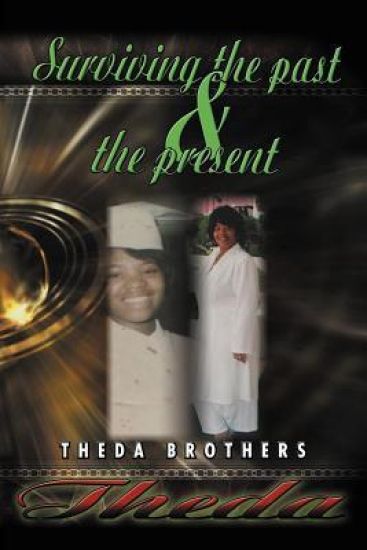

As movie patrons sat in darkened theaters in January 1914, they were mesmerized by an alluring temptress with long sable hair and kohl-rimmed eyes. Theda Bara--"the vamp," as she would come to be known--would soon be one of the highest paid film stars of the 1910s, earning an unheard of $4,000 per week, before retiring from the screen in 1926. In 1946, at age five, the author met Bara--then 61--at her Beverly Hills home and the actress became her mentor. This memoir is the story of their friendship.

Although a major star in the 1910s, Theda Bara--known as "The Vamp"--was largely neglected until the 1990s, when her fame began to resurface. Since then, there have been biographies, documentaries and other works that have brought the silent film actress back into the spotlight, including a painstaking stills reconstruction of her lost epic Cleopatra. This is a complete examination of Bara's more than 40 films, as well as her theater and radio appearances, down to the smallest detail. With the vast majority of Bara's films considered lost, it is a particularly valuable resource for fans and scholars, and includes information about each film's genesis, director, plot, censorship problems, and critical and public reactions. Also included is a biographical overview, with many illuminating anecdotes.




An Analysis of Theda Skocpol's States and Social Revolutions
Riley Quinn
Macat International Limited
2017
nidottu
Many people want to understand what revolutions are and – especially – how they come about, from the academics who study them to the states that wish to prevent (or, in some cases, provoke) them. But it is arguably the US scholar Theda Skocpol who has done most to create a viable model of revolution, and States and Social Revolutions is the work in which she sets out her intellectual stall. Skocpol's magnum opus can be considered a classic product of the critical thinking skill of problem-solving. She assesses several different revolutions – those of France, Russia and China – and asks new, productive questions about their causes and outcomes. The answers, collectively, allow her to move beyond existing theories such as the ‘voluntarist’ school (which suggests that revolutionaries have agency) and the Marxist school (which sees state institutions as nothing more than a front for class interests). Skocpol's model assumes that states are autonomous bureaucratic institutions, which act in their own interests – a fundamental re-imagining based on fresh interpretations of the evidence. Her analysis extends beyond the causes of revolution to their consequences, and her argument that the revolutionary state that survives is the one that successfully implements a far-reaching program of reform helps to explain not only why the three revolutions she studied have proved enduringly influential, but also why hundreds of others, less successful, are barely remembered today.
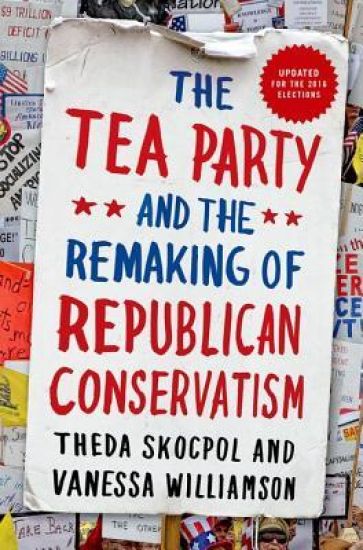
The Tea Party and the Remaking of Republican Conservatism
Theda Skocpol; Vanessa Williamson
Oxford University Press Inc
2016
nidottu
On February 19, 2009, CNBC commentator Rick Santelli delivered a dramatic rant against Obama administration programs to shore up the plunging housing market. Invoking the Founding Fathers and ridiculing "losers" who could not pay their mortgages, Santelli called for "Tea Party" protests. Over the next two years, conservative activists took to the streets and airways, built hundreds of local Tea Party groups, and weighed in with votes and money to help right-wing Republicans win electoral victories in 2010. In this penetrating new study, Harvard University's Theda Skocpol and Vanessa Williamson go beyond images of protesters in Colonial costumes to provide a nuanced portrait of the Tea Party. What they find is sometimes surprising. Drawing on grassroots interviews and visits to local meetings in several regions, they find that older, middle-class Tea Partiers mostly approve of Social Security, Medicare, and generous benefits for military veterans. Their opposition to "big government" entails reluctance to pay taxes to help people viewed as undeserving "freeloaders" - including immigrants, lower income earners, and the young. At the national level, Tea Party elites and funders leverage grassroots energy to further longstanding goals such as tax cuts for the wealthy, deregulation of business, and privatization of the very same Social Security and Medicare programs on which many grassroots Tea Partiers depend. Elites and grassroots are nevertheless united in hatred of Barack Obama and determination to push the Republican Party sharply to the right. The Tea Party and the Remaking of Republican Conservatism combines fine-grained portraits of local Tea Party members and chapters with an overarching analysis of the movement's rise, impact, and likely fate.

When Europeans first arrived in North America, between five and eight million indigenous people were already living there. But how did they come to be here? What were their agricultural, spiritual, and hunting practices? How did their societies evolve and what challenges do they face today? Eminent historians Theda Perdue and Michael Green begin by describing how nomadic bands of hunter-gatherers followed the bison and woolly mammoth over the Bering land mass between Asia and what is now Alaska between 25,000 and 15,000 years ago, settling throughout North America. They describe hunting practices among different tribes, how some made the gradual transition to more settled, agricultural ways of life, the role of kinship and cooperation in Native societies, their varied burial rites and spiritual practices, and many other features of Native American life. Throughout the book, Perdue and Green stress the great diversity of indigenous peoples in America, who spoke more than 400 different languages before the arrival of Europeans and whose ways of life varied according to the environments they settled in and adapted to so successfully. Most importantly, the authors stress how Native Americans have struggled to maintain their sovereignty--first with European powers and then with the United States--in order to retain their lands, govern themselves, support their people, and pursue practices that have made their lives meaningful. Going beyond the stereotypes that so often distort our views of Native Americans, this Very Short Introduction offers an historically accurate, deeply engaging, and often inspiring account of the wide array of Native peoples in America. ABOUT THE SERIES: The Very Short Introductions series from Oxford University Press contains hundreds of titles in almost every subject area. These pocket-sized books are the perfect way to get ahead in a new subject quickly. Our expert authors combine facts, analysis, perspective, new ideas, and enthusiasm to make interesting and challenging topics highly readable.
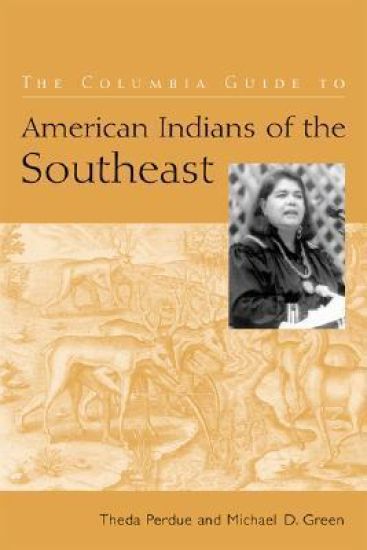
The Columbia Guide to American Indians of the Southeast
Theda Perdue; Michael Green
Columbia University Press
2001
sidottu
Though they speak several different languages and organize themselves into many distinct tribes, the Native American peoples of the Southeast share a complex ancient culture and a tumultuous history. This volume examines and synthesizes their history through each of its integral phases: the complex and elaborate societies that emerged and flourished in the Pre-Columbian period; the triple curse of disease, economic dependency, and political instability brought by the European invasion; the role of Native Americans in the inter-colonial struggles for control of the region; the removal of the "Five Civilized Tribes" to Oklahoma; the challenges and adaptations of the post-removal period; and the creativity and persistence of those who remained in the Southeast.

The Columbia Guide to American Indians of the Southeast
Theda Perdue; Michael Green
Columbia University Press
2005
pokkari
Though they speak several different languages and organize themselves into many distinct tribes, the Native American peoples of the Southeast share a complex ancient culture and a tumultuous history. This volume examines and synthesizes their history through each of its integral phases: the complex and elaborate societies that emerged and flourished in the Pre-Columbian period; the triple curse of disease, economic dependency, and political instability brought by the European invasion; the role of Native Americans in the inter-colonial struggles for control of the region; the removal of the "Five Civilized Tribes" to Oklahoma; the challenges and adaptations of the post-removal period; and the creativity and persistence of those who remained in the Southeast.

The five largest southeastern Indian groups - the Cherokees, Chickasaws, Choctaws, Creeks, and Seminoles - were forced to emigrate west to the Indian territory (now Oklahoma) in the 1830s. Here, from WPA interviews, are those Indians' own stories of the troubled years between the Civil War and Oklahoma statehood - a period of extraordinary turmoil. During this period, Oklahoma Indians functioned autonomously, holding their own elections, enforcing their own laws, and creating their own society from a mixture of old Indian customs and the new ways of the whites. The WPA informants describe the economic realities of the era: a few wealthy Indians, the rest scraping a living out of subsistence farming, hunting, and fishing. They talk about education and religion - Native American and Christian - as well as diversions of the time: horse races, fairs, ball games, cornstalk shooting, and traditional ceremonies such as the Green Corn Dance.

In this incisive account, a prize-winning social scientist offers deep insights into the changing terrain of U.S. politics and public policy. Because of far-reaching changes in the Reagan era, Theda Skocpol shows, the Clinton Health Security bill became a perfect foil for antigovernment mobilization. Thus its defeat provides a unique window into the new political landscape.

In the opening pages of this powerful examination of American politics, Theda Skocpol reveals a curious pattern: Our politicians argue over programs for the very poor or tax cuts for the very rich, and they worry over the precarious security of our longer-living grandparents and the educational neglect and corresponding bleak future of our children. But, with the spotlight on the youngest, the oldest, the richest, and the poorest, rarely do we find policies concerned with average working men and women of modest means, those the author terms the "missing middle." Skocpol draws us into the history of this disturbing trend and reveals the repercussions of the increasingly simplistic and moralistic stands being taken by our politicians. Taking lessons from the root causes of this shift, she presents a compelling case for family-oriented populism and identifies the bold reforms needed to revitalize American democracy.