Kirjojen hintavertailu. Mukana 11 244 527 kirjaa ja 12 kauppaa.

Kirjahaku

Etsi kirjoja tekijän nimen, kirjan nimen tai ISBN:n perusteella.

137 tulosta hakusanalla Theokritos

The Idylls of Theokritos

The Idylls of Theokritos

Theocritus

Purdue University Press
1963
nidottu
These thirty Idylls, written by the Sicilian Theokritos in the third century B.C., present the charms of rustic life in learned, polished verse aimed at a sophisticated audience. A bucolic paradise is seen "through the eyes of city men going to the harvest festival for a holiday, to rest their bodies and minds for awhile in nature's beauty and bounty-not unprovided with well-aged wine." In this handsome volume, which won the Best Poetry Award at the 1963 Indiana Author's Day, Professor Mills translates them into modern English verse that preserves the pastoral quality of the original but emphasizes those qualities of Theokritos that speak most directly to the modern reader.
The Idylls of Theokritos: a Verse Translation

The Idylls of Theokritos: a Verse Translation

Theocritus

Hassell Street Press
2021
sidottu
This work has been selected by scholars as being culturally important and is part of the knowledge base of civilization as we know it.This work is in the public domain in the United States of America, and possibly other nations. Within the United States, you may freely copy and distribute this work, as no entity (individual or corporate) has a copyright on the body of the work.Scholars believe, and we concur, that this work is important enough to be preserved, reproduced, and made generally available to the public. To ensure a quality reading experience, this work has been proofread and republished using a format that seamlessly blends the original graphical elements with text in an easy-to-read typeface.We appreciate your support of the preservation process, and thank you for being an important part of keeping this knowledge alive and relevant.
The Idylls of Theokritos

The Idylls of Theokritos

Literary Licensing, LLC
2012
nidottu
These thirty Idylls, written by the Sicilian Theokritos in the third century B.C., present the charms of rustic life in learned, polished verse aimed at a sophisticated audience. A bucolic paradise is seen "through the eyes of city men going to the harvest festival for a holiday, to rest their bodies and minds for awhile in nature's beauty and bounty-not unprovided with well-aged wine." In this handsome volume, which won the Best Poetry Award at the 1963 Indiana Author's Day, Professor Mills translates them into modern English verse that preserves the pastoral quality of the original but emphasizes those qualities of Theokritos that speak most directly to the modern reader.
Sånger

Sånger

Theokritos

Natur Kultur Allmänlitteratur
2004
sidottu
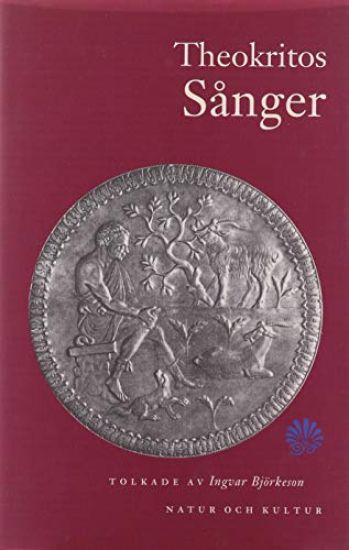
Under den hellenistiska stadsbyggande epoken började många längta tillbaka till landsbygdens skenbara enkelhet och lugn. Theokritos föddes ca 300 f.Kr. på Sicilien och levde som kringresande poet med vänner i grekiska kulturcentra kring hela Medelhavet. Hans berömmelse vilar främst på herdedikterna, där hans friskhet och ursprungliga personlighet kommer till sin fulla rätt. Med kärleken som huvudtema beskriver Theokritos scener ur de sicilianska herdarnas liv med en naturkänsla mer intensiv än hos någon annan grekisk skald. Han skildrade även det rena stadslivet. Med introduktion av Sture Linnér samt grekisk originaltext. Theokritos levde mellan ca 300 och ca 260 f.Kr. Han var en grekisk poet från Syrakusa som verkade i hemstaden samt troligen hos kung Ptolemaios II i Egypten och på Kos. Ingvar Björkeson är en av våra mest hyllade översättare av den klassiska litteraturen. På senare tid har han givit klassiker som Dante, Homeros, Petrarca och Propertius en modern språkdräkt. Våren 2004 utkom De homeriska hymnerna.
Plato’s forms, mathematics and astronomy

Plato’s forms, mathematics and astronomy

Theokritos Kouremenos

De Gruyter
2018
sidottu
Plato’s view that mathematics paves the way for his philosophy of forms is well known. This book attempts to flesh out the relationship between mathematics and philosophy as Plato conceived them by proposing that in his view, although it is philosophy that came up with the concept of beings, which he calls forms, and highlighted their importance, first to natural philosophy and then to ethics, the things that do qualify as beings are inchoately revealed by mathematics as the raw materials that must be further processed by philosophy (mathematicians, to use Plato’s simile in the Euthedemus, do not invent the theorems they prove but discover beings and, like hunters who must hand over what they catch to chefs if it is going to turn into something useful, they must hand over their discoveries to philosophers). Even those forms that do not bear names of mathematical objects, such as the famous forms of beauty and goodness, are in fact forms of mathematical objects. The first chapter is an attempt to defend this thesis. The second argues that for Plato philosophy’s crucial task of investigating the exfoliation of the forms into the sensible world, including the sphere of human private and public life, is already foreshadowed in one of its branches, astronomy.
Plato’s forms, mathematics and astronomy

Plato’s forms, mathematics and astronomy

Theokritos Kouremenos

De Gruyter
2019
isokokoinen pokkari
Plato’s view that mathematics paves the way for his philosophy of forms is well known. This book attempts to flesh out the relationship between mathematics and philosophy as Plato conceived them by proposing that in his view, although it is philosophy that came up with the concept of beings, which he calls forms, and highlighted their importance, first to natural philosophy and then to ethics, the things that do qualify as beings are inchoately revealed by mathematics as the raw materials that must be further processed by philosophy (mathematicians, to use Plato’s simile in the Euthedemus, do not invent the theorems they prove but discover beings and, like hunters who must hand over what they catch to chefs if it is going to turn into something useful, they must hand over their discoveries to philosophers). Even those forms that do not bear names of mathematical objects, such as the famous forms of beauty and goodness, are in fact forms of mathematical objects. The first chapter is an attempt to defend this thesis. The second argues that for Plato philosophy’s crucial task of investigating the exfoliation of the forms into the sensible world, including the sphere of human private and public life, is already foreshadowed in one of its branches, astronomy.