Kirjojen hintavertailu. Mukana 11 244 527 kirjaa ja 12 kauppaa.

Kirjahaku

Etsi kirjoja tekijän nimen, kirjan nimen tai ISBN:n perusteella.

1000 tulosta hakusanalla Thomas Beddoes

Notice of Some Observations Made at the Medical Pneumatic Institution, by Thomas Beddoes, M.D
The 18th century was a wealth of knowledge, exploration and rapidly growing technology and expanding record-keeping made possible by advances in the printing press. In its determination to preserve the century of revolution, Gale initiated a revolution of its own: digitization of epic proportions to preserve these invaluable works in the largest archive of its kind. Now for the first time these high-quality digital copies of original 18th century manuscripts are available in print, making them highly accessible to libraries, undergraduate students, and independent scholars.Medical theory and practice of the 1700s developed rapidly, as is evidenced by the extensive collection, which includes descriptions of diseases, their conditions, and treatments. Books on science and technology, agriculture, military technology, natural philosophy, even cookbooks, are all contained here.++++The below data was compiled from various identification fields in the bibliographic record of this title. This data is provided as an additional tool in helping to insure edition identification: ++++British LibraryT026362With a final page of advertisements. P.29 misnumbered 92. On experiments made with laughing gas.Bristol: printed by Biggs and Cottle, for T.N. Longman and O. Rees, London, 1799. 45, 3]p.; 8
Essay on the Causes, Early Signs, and Prevention of Pulmonary Consumption for the use of Parents and Preceptors. By Thomas Beddoes, M.D
The 18th century was a wealth of knowledge, exploration and rapidly growing technology and expanding record-keeping made possible by advances in the printing press. In its determination to preserve the century of revolution, Gale initiated a revolution of its own: digitization of epic proportions to preserve these invaluable works in the largest archive of its kind. Now for the first time these high-quality digital copies of original 18th century manuscripts are available in print, making them highly accessible to libraries, undergraduate students, and independent scholars.Medical theory and practice of the 1700s developed rapidly, as is evidenced by the extensive collection, which includes descriptions of diseases, their conditions, and treatments. Books on science and technology, agriculture, military technology, natural philosophy, even cookbooks, are all contained here.++++The below data was compiled from various identification fields in the bibliographic record of this title. This data is provided as an additional tool in helping to insure edition identification: ++++British LibraryT020984With a half-title.Bristol: printed by Biggs & Cottle, for T. N. Longman and O. Rees, London, 1799. 8],274p.; 8
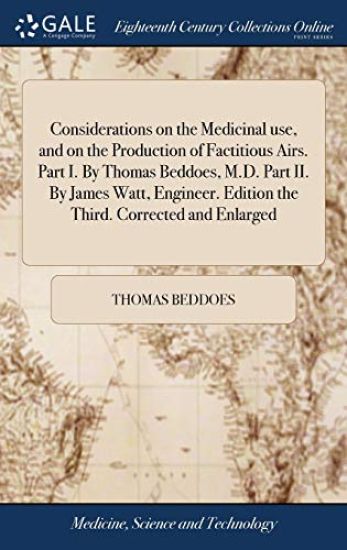
Considerations on the Medicinal Use, and on the Production of Factitious Airs. Part I. by Thomas Beddoes, M.D. Part II. by James Watt, Engineer. Edition the Third. Corrected and Enlarged
The 18th century was a wealth of knowledge, exploration and rapidly growing technology and expanding record-keeping made possible by advances in the printing press. In its determination to preserve the century of revolution, Gale initiated a revolution of its own: digitization of epic proportions to preserve these invaluable works in the largest archive of its kind. Now for the first time these high-quality digital copies of original 18th century manuscripts are available in print, making them highly accessible to libraries, undergraduate students, and independent scholars.Medical theory and practice of the 1700s developed rapidly, as is evidenced by the extensive collection, which includes descriptions of diseases, their conditions, and treatments. Books on science and technology, agriculture, military technology, natural philosophy, even cookbooks, are all contained here.++++The below data was compiled from various identification fields in the bibliographic record of this title. This data is provided as an additional tool in helping to insure edition identification: ++++Countway Library of MedicineN027734Bristol: printed by Bulgin and Rosser, for J. Johnson, London, 1796. 8, 1],10*-23*, 1],9-222,8p., 5 plates; 8
Thomas Beddoes M.D. 1760–1808

Thomas Beddoes M.D. 1760–1808

D.A. Stansfield

Springer
2011
nidottu
We meet in Thomas Beddoes an able chemist, engaged in a field where impor­ tant new discoveries were being made; a good doctor eager to fmd experi­ mentally soun. d ways of healing and to make known the principles of maintaining good health; a vigorous, independent man sharing the hope which the ideas of the French Revolution gave so many 9f his contemporaries. In his life he was a controversial figure and judgement and detached appreciation of his work was often made impossible by anger at his 'revolutionary' political views. It becomes evident that where Beddoes was held in esteem and where he had influence it was not for particular activities but for what he was 'in the round'. With due respect - and with gratitude - to specialist accounts of his achievements as a chemist and of his endeavours to fmd a cure for pulmonary consumption and his efforts to bring about an understanding of the importance of preventive medicine, I have tried in this account to 'see him whole'. Historians of chemistry and of medicine; educationalists; and those concerned with 'women's studies' will each continue to find particular episodes or parts of Beddoes' life of special interest. At the same time I hope this, the first attempt at a biography - for J. E. Stock's 1811 account is truly named "Memoirs" - will add to our understanding of his varied activities.
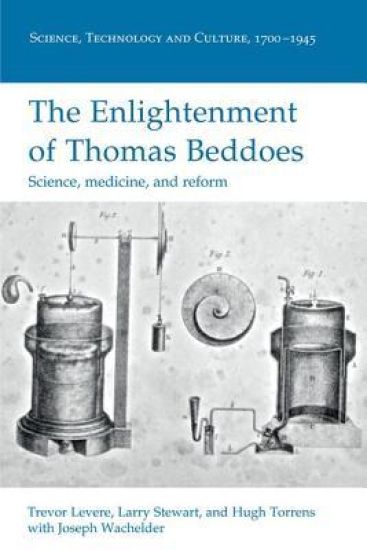
The Enlightenment of Thomas Beddoes

The Enlightenment of Thomas Beddoes

Trevor Levere; Larry Stewart; Hugh Torrens; Joseph Wachelder

Routledge
2018
nidottu
Thomas Beddoes (1760-1808) lived in ‘decidedly interesting times’ in which established orders in politics and science were challenged by revolutionary new ideas. Enthusiastically participating in the heady atmosphere of Enlightenment debate, Beddoes' career suffered from his radical views on politics and science. Denied a professorship at Oxford, he set up a medical practice in Bristol in 1793. Six years later - with support from a range of leading industrialists and scientists including the Wedgwoods, Erasmus Darwin, James Watt, James Keir and others associated with the Lunar Society - he established a Pneumatic Institution for investigating the therapeutic effects of breathing different kinds of ‘air’ on a wide spectrum of diseases.The treatment of the poor, gratis, was an important part of the Pneumatic Institution and Beddoes, who had long concerned himself with their moral and material well-being, published numerous pamphlets and small books about their education, wretched material circumstances, proper nutrition, and the importance of affordable medical facilities. Beddoes’ democratic political concerns reinforced his belief that chemistry and medicine should co-operate to ameliorate the conditions of the poor. But those concerns also polarized the medical profession and the wider community of academic chemists and physicians, many of whom became mistrustful of Beddoes’ projects due to his radical politics.Highlighting the breadth of Beddoes’ concerns in politics, chemistry, medicine, geology, and education (including the use of toys and models), this book reveals how his reforming and radical zeal were exemplified in every aspect of his public and professional life, and made for a remarkably coherent program of change. He was frequently a contrarian, but not without cause, as becomes apparent once he is viewed in the round, as part of the response to the politics and social pressures of the late Enlightenment.
The Enlightenment of Thomas Beddoes

The Enlightenment of Thomas Beddoes

Trevor Levere; Larry Stewart; Hugh Torrens; Joseph Wachelder

Routledge
2016
sidottu
Thomas Beddoes (1760-1808) lived in ‘decidedly interesting times’ in which established orders in politics and science were challenged by revolutionary new ideas. Enthusiastically participating in the heady atmosphere of Enlightenment debate, Beddoes' career suffered from his radical views on politics and science. Denied a professorship at Oxford, he set up a medical practice in Bristol in 1793. Six years later - with support from a range of leading industrialists and scientists including the Wedgwoods, Erasmus Darwin, James Watt, James Keir and others associated with the Lunar Society - he established a Pneumatic Institution for investigating the therapeutic effects of breathing different kinds of ‘air’ on a wide spectrum of diseases.The treatment of the poor, gratis, was an important part of the Pneumatic Institution and Beddoes, who had long concerned himself with their moral and material well-being, published numerous pamphlets and small books about their education, wretched material circumstances, proper nutrition, and the importance of affordable medical facilities. Beddoes’ democratic political concerns reinforced his belief that chemistry and medicine should co-operate to ameliorate the conditions of the poor. But those concerns also polarized the medical profession and the wider community of academic chemists and physicians, many of whom became mistrustful of Beddoes’ projects due to his radical politics.Highlighting the breadth of Beddoes’ concerns in politics, chemistry, medicine, geology, and education (including the use of toys and models), this book reveals how his reforming and radical zeal were exemplified in every aspect of his public and professional life, and made for a remarkably coherent program of change. He was frequently a contrarian, but not without cause, as becomes apparent once he is viewed in the round, as part of the response to the politics and social pressures of the late Enlightenment.
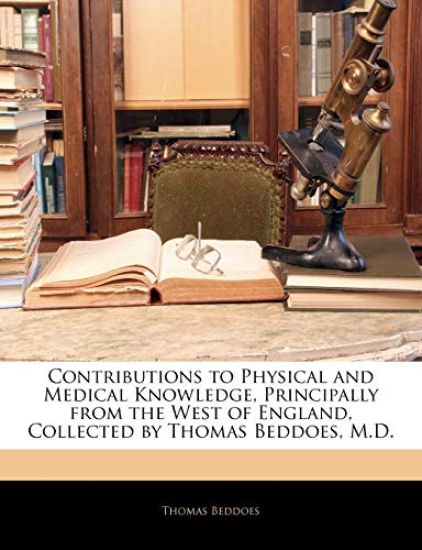
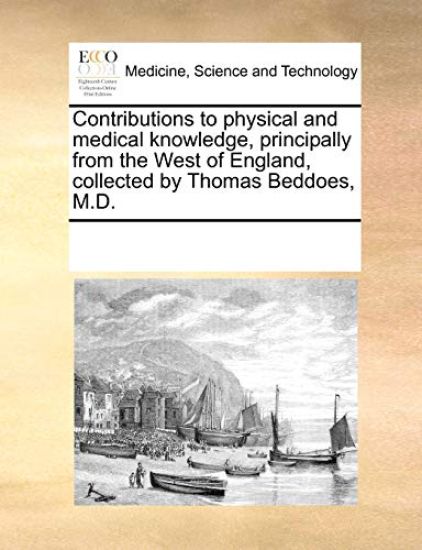
Contributions to Physical and Medical Knowledge, Principally from the West of England, Collected by Thomas Beddoes, M.D
The 18th century was a wealth of knowledge, exploration and rapidly growing technology and expanding record-keeping made possible by advances in the printing press. In its determination to preserve the century of revolution, Gale initiated a revolution of its own: digitization of epic proportions to preserve these invaluable works in the largest archive of its kind. Now for the first time these high-quality digital copies of original 18th century manuscripts are available in print, making them highly accessible to libraries, undergraduate students, and independent scholars.Medical theory and practice of the 1700s developed rapidly, as is evidenced by the extensive collection, which includes descriptions of diseases, their conditions, and treatments. Books on science and technology, agriculture, military technology, natural philosophy, even cookbooks, are all contained here.++++The below data was compiled from various identification fields in the bibliographic record of this title. This data is provided as an additional tool in helping to insure edition identification: ++++British LibraryT144357Between pp. 210] and 211 is a table signed O2. With two final leaves, one of advertisement, one of errata. The text is continuous.Bristol: printed by Biggs & Cottle, for T. N. Longman and O. Rees, London, 1799. 25, 1],428,429 dagger]-434 dagger],429-539, 5]p., table; 8
The Elements of Medicine of John Brown, M.D. Translated From the Latin, With Comments and Illustrations, by the Author. A new Edition, Revised and Corrected. With a Biographical Preface by Thomas Beddoes, ... In two Volumes. ... of 2; Volume 1
The 18th century was a wealth of knowledge, exploration and rapidly growing technology and expanding record-keeping made possible by advances in the printing press. In its determination to preserve the century of revolution, Gale initiated a revolution of its own: digitization of epic proportions to preserve these invaluable works in the largest archive of its kind. Now for the first time these high-quality digital copies of original 18th century manuscripts are available in print, making them highly accessible to libraries, undergraduate students, and independent scholars.Medical theory and practice of the 1700s developed rapidly, as is evidenced by the extensive collection, which includes descriptions of diseases, their conditions, and treatments. Books on science and technology, agriculture, military technology, natural philosophy, even cookbooks, are all contained here.++++The below data was compiled from various identification fields in the bibliographic record of this title. This data is provided as an additional tool in helping to insure edition identification: ++++British LibraryT121092London: printed for J. Johnson, 1795. 2v., plate: port.; 8
Letters from Dr. Withering, of Birmingham, Dr. Ewart, of Bath, Dr. Thornton, of London, and Dr. Biggs, ... Together with Some Other Papers, Supplementary to Two Publications on Asthma, Consumption, Fever, and Other Diseases, by Thomas Beddoes, M.D
The 18th century was a wealth of knowledge, exploration and rapidly growing technology and expanding record-keeping made possible by advances in the printing press. In its determination to preserve the century of revolution, Gale initiated a revolution of its own: digitization of epic proportions to preserve these invaluable works in the largest archive of its kind. Now for the first time these high-quality digital copies of original 18th century manuscripts are available in print, making them highly accessible to libraries, undergraduate students, and independent scholars.Medical theory and practice of the 1700s developed rapidly, as is evidenced by the extensive collection, which includes descriptions of diseases, their conditions, and treatments. Books on science and technology, agriculture, military technology, natural philosophy, even cookbooks, are all contained here.++++The below data was compiled from various identification fields in the bibliographic record of this title. This data is provided as an additional tool in helping to insure edition identification: ++++British LibraryT038486Bristol: printed by Bulgin and Rosser: sold by J. Johnson; and H. Murray, London; also by Bulgin and Sheppard, J. Norton, J. Cottle, W. Browne, and T. Mills, Bristol, 1794]. 2],5, 1],48p.; 8