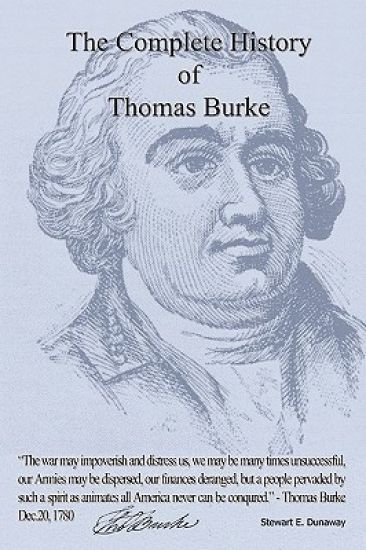
Thomas Burke, a poet, a medical doctor, a lawyer, North Carolina's third governor, has a most interesting life. This book provides complete details on his life with many of his letters being quoted, as opposed to paraphrased opinions about him; you can read it for yourself. Further, his letter to Gen. George Washington shows his deep thinking and great common sense. His activities in the Continental Congress are amazing, and his views of civil rights were way ahead of his time.
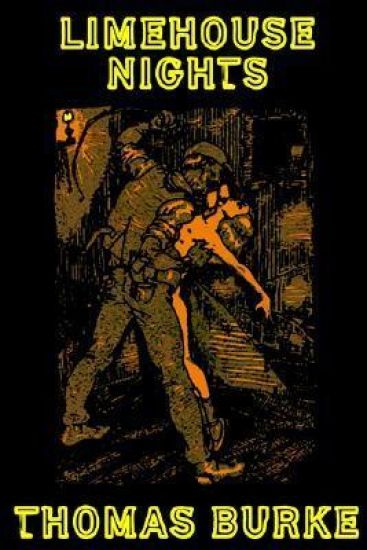
Thomas Burke (29 November 1886 - 22 September 1945) was a British author. He was born in Eltham, London (back then still part of Kent). His first successful publication was Limehouse Nights (1916), a collection of stories centred on life in the poverty-stricken Limehouse district of London. Many of Burke's books feature the Chinese character Quong Lee as narrator. "The Lamplit Hour", an incidental poem from Limehouse Nights, was set to music in the United States by Arthur Penn in 1919. That same year, American film director D. W. Griffith used another tale from the collection, "The Chink and the Child" as the basis of his screenplay for the movie Broken Blossoms. Griffith based his film Dream Street (1921) on Burke's "Gina of Chinatown" and "Song of the Lamp". Life: Thomas Burke was born Sydney Thomas Burke on 29 November 1886 in Clapham, a southern suburb of London that by the turn of the century had fallen out of favour with the middle-classes.Burke's father died when he was barely a few months old and he was eventually sent to live with his uncle in Poplar. At the age of ten he was removed to a home for middle class boys who were " r]espectably descended but without adequate means to their support." When Burke turned sixteen he started working as an office boy, a job that he deeply detested. In 1901, he published his first professional written work entitled "The Bellamy Diamonds" in the magazine Spare Moments.He also edited some anthologies of children's poetry that were published in 1910-1913. In 1915, Burke published Nights in Town: A London Autobiography, which featured his descriptions of working-class London nightlife including the essay, 'A Chinese Night, Limehouse' However, it was not until the publication of Limehouse Nights in 1916 that he obtained any substantial acclaim as an author. This collection of melodramatic short stories, set in a lower-class environment populated by Chinese immigrants, was published in three British periodicals, The English Review, Colour and The New Witness, and received marked attention from literary reviewers. Limehouse Nights helped to earn Burke a reputation as "the laureate of London's Chinatown".Burke's writing also influenced contemporary popular forms of entertainment, such as the nascent film industry. Indeed, D. W. Griffith used the short story "The Chink and the Child" from Limehouse Nights as the basis for his popular silent film Broken Blossoms (1919). Burke continued to develop his descriptions of London life throughout his later literary works. He gradually expanded his range with novels such as The Sun in Splendor, which was published in 1926. He also continued to publish essays on the London environment, including pieces such as "The Real East End" and "London in My Times". Burke died in the Homeopathic Hospital in Queens Square, Bloomsbury on 22 September 1945. His short story "The Hands of Ottermole" was later voted the best mystery of all time by critics in 1949........................
Thomas Burke (29 November 1886 - 22 September 1945) was a British author. He was born in Eltham, London (back then still part of Kent). His first successful publication was Limehouse Nights (1916), a collection of stories centred on life in the poverty-stricken Limehouse district of London. Many of Burke's books feature the Chinese character Quong Lee as narrator. "The Lamplit Hour", an incidental poem from Limehouse Nights, was set to music in the United States by Arthur Penn in 1919. That same year, American film director D. W. Griffith used another tale from the collection, "The Chink and the Child" as the basis of his screenplay for the movie Broken Blossoms. Griffith based his film Dream Street (1921) on Burke's "Gina of Chinatown" and "Song of the Lamp". Life: Thomas Burke was born Sydney Thomas Burke on 29 November 1886 in Clapham, a southern suburb of London that by the turn of the century had fallen out of favour with the middle-classes.Burke's father died when he was barely a few months old and he was eventually sent to live with his uncle in Poplar. At the age of ten he was removed to a home for middle class boys who were " r]espectably descended but without adequate means to their support." When Burke turned sixteen he started working as an office boy, a job that he deeply detested. In 1901, he published his first professional written work entitled "The Bellamy Diamonds" in the magazine Spare Moments.He also edited some anthologies of children's poetry that were published in 1910-1913. In 1915, Burke published Nights in Town: A London Autobiography, which featured his descriptions of working-class London nightlife including the essay, 'A Chinese Night, Limehouse' However, it was not until the publication of Limehouse Nights in 1916 that he obtained any substantial acclaim as an author. This collection of melodramatic short stories, set in a lower-class environment populated by Chinese immigrants, was published in three British periodicals, The English Review, Colour and The New Witness, and received marked attention from literary reviewers. Limehouse Nights helped to earn Burke a reputation as "the laureate of London's Chinatown".Burke's writing also influenced contemporary popular forms of entertainment, such as the nascent film industry. Indeed, D. W. Griffith used the short story "The Chink and the Child" from Limehouse Nights as the basis for his popular silent film Broken Blossoms (1919). Burke continued to develop his descriptions of London life throughout his later literary works. He gradually expanded his range with novels such as The Sun in Splendor, which was published in 1926. He also continued to publish essays on the London environment, including pieces such as "The Real East End" and "London in My Times". Burke died in the Homeopathic Hospital in Queens Square, Bloomsbury on 22 September 1945. His short story "The Hands of Ottermole" was later voted the best mystery of all time by critics in 1949.
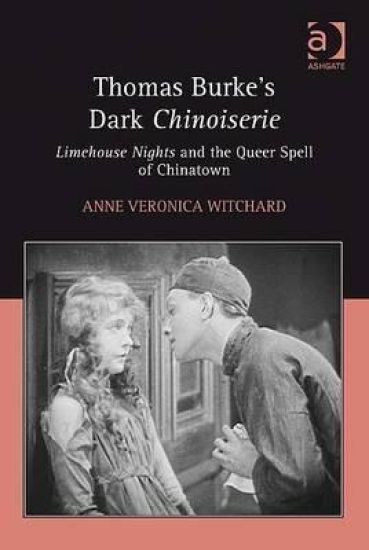
Focusing on Thomas Burke's bestselling collection of short stories, Limehouse Nights (1916), this book contextualises the burgeoning cult of Chinatown in turn-of-the-century London. London's 'Chinese Quarter' owed its notoriety to the Yellow Perilism that circulated in Britain at the fin-de-siècle, a demonology of race and vice masked by outward concerns about degenerative metropolitan blight and imperial decline. Anne Witchard's interdisciplinary approach enables her to displace the boundaries that have marked Chinese studies, literary studies, critiques of Orientalism and empire, gender studies, and diasporic research, as she reassesses this critical moment in London's history. In doing so, she brings attention to Burke's hold on popular and critical audiences on both sides of the Atlantic. A much-admired and successful author in his time, Burke in his Chinatown stories destabilizes social orthodoxies in highly complex and contradictory ways. For example, his writing was formative in establishing the 'queer spell' that the very mention of Limehouse would exert on the public imagination, and circulating libraries responded to Burke's portrayal of a hybrid East End where young Cockney girls eat Chow Mein with chopsticks in the local cafés and blithely gamble their housekeeping money at Fan Tan by banning Limehouse Nights. Witchard's book forces us to rethink Burke's influence and shows that China and chinoiserie served as mirrors that reveal the cultural disquietudes of western art and culture.
Hearing on the nominations of Ann Dunkin to be Assistant Administrator, EPA Office of Environmental Information; Thomas Burke to be Assistant Administrator, EPA Office of Research and Development; and Jane Nishida to be Assistant Administrator, EPA Office of International and Tribal Affairs: hearing before the Committee on Environment and Public Works, United States Senate, One Hundred Four