

Kirjahaku
Etsi kirjoja tekijän nimen, kirjan nimen tai ISBN:n perusteella.
1000 tulosta hakusanalla Thomas D Clareson
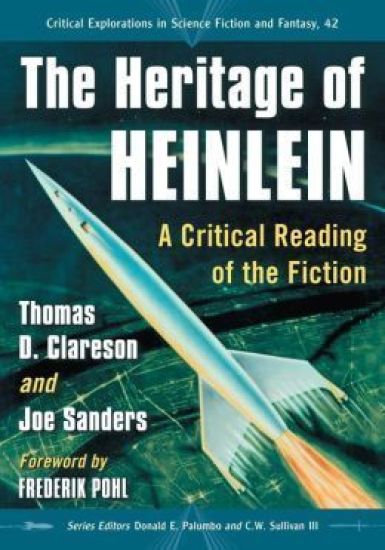
Robert A. Heinlein is generally recognized as the most important American science fiction writer of the 20th century. This is the first detailed critical examination of his entire career. It is not a biography--that is being done in a two-volume work by William Patterson. Instead, this book looks at each piece of fiction (and a few pieces of sf-related nonfiction) that Heinlein wrote, chronologically by date of publication, in order to consider what each contributes to his overall accomplishment. The aim is to be fair, to look clearly at the strengths and weaknesses of the writings that have inspired generations of readers and writers.
![Claremont. Address'd to the Earl of Clare [T. P. Holles. by Sir S. Garth].](/covers/9781241118303.jpg)
Claremont. Address'd to the Earl of Clare [T. P. Holles. by Sir S. Garth].
Thomas Pelham Holles
British Library, Historical Print Editions
2011
pokkari
![Claremont. Address'd to the Earl of Clare [t. P. Holles. by Sir S. Garth].](/covers/9781241179359.jpg)
Claremont. Address'd to the Earl of Clare [t. P. Holles. by Sir S. Garth].
Thomas Newcastle
British Library, Historical Print Editions
2011
pokkari

Le Cri Des Africains Contre Les Europeens, Leurs Oppresseurs Ou Coup D'Oeil (1821)
Thomas Clarkson
KESSINGER PUBLISHING, LLC
2010
pokkari

Le Cri Des Africains Contre Les Européens, Leurs Oppresseurs, Ou Coup d'Oeil Sur Le Commerce
Thomas Clarkson
Hachette Livre - BNF
2014
pokkari
Le cri des africains contre les europeens, leurs oppresseurs, ou Coup d'oeil sur le commerce homicide appele traite des noirs / par Thomas Clarkson, M. A.; traduit de l'anglais par Benjamin La Roche]Date de l'edition originale: 1822Sujet de l'ouvrage: France -- Colonies -- Histoire"Titre original: The Cries of Africa to the inhabitants of Europe"Ce livre est la reproduction fidele d'une oeuvre publiee avant 1920 et fait partie d'une collection de livres reimprimes a la demande editee par Hachette Livre, dans le cadre d'un partenariat avec la Bibliotheque nationale de France, offrant l'opportunite d'acceder a des ouvrages anciens et souvent rares issus des fonds patrimoniaux de la BnF.Les oeuvres faisant partie de cette collection ont ete numerisees par la BnF et sont presentes sur Gallica, sa bibliotheque numerique.En entreprenant de redonner vie a ces ouvrages au travers d'une collection de livres reimprimes a la demande, nous leur donnons la possibilite de rencontrer un public elargi et participons a la transmission de connaissances et de savoirs parfois difficilement accessibles.Nous avons cherche a concilier la reproduction fidele d'un livre ancien a partir de sa version numerisee avec le souci d'un confort de lecture optimal. Nous esperons que les ouvrages de cette nouvelle collection vous apporteront entiere satisfaction.Pour plus d'informations, rendez-vous sur www.hachettebnf.frhttp: //gallica.bnf.fr/ark: /12148/bpt6k54037395

War as a Social Institution: The Historian's Perspective
Jesse D. Clarkson; Thomas C. Cochran
Literary Licensing, LLC
2011
sidottu
War As A Social Institution: The Historian's Perspective is a book written by Jesse D. Clarkson. It is an insightful and informative study of the role of war in human society, from the perspective of a historian. The book explores the impact of war on society, both historically and in contemporary times. It provides a comprehensive analysis of the social, political, and economic factors that have led to the development of war as a social institution. Clarkson delves into the origins of war, tracing its roots back to ancient times, and examines the evolution of warfare through the ages. He explores the various forms of conflict that have arisen throughout history, from tribal warfare to modern-day warfare, and the impact that these conflicts have had on human societies. The book also explores the role of war in shaping political and economic systems, and the impact of war on individual lives and communities.Throughout the book, Clarkson presents a balanced and nuanced view of war as a social institution, highlighting its positive and negative aspects. He argues that while war has often been a destructive force, it has also played a significant role in shaping human societies and driving progress in areas such as technology and medicine.Overall, War As A Social Institution: The Historian's Perspective is a thought-provoking and engaging study of the role of war in human society. It is a must-read for anyone interested in understanding the complex and multifaceted nature of warfare and its impact on human societies.This scarce antiquarian book is a facsimile reprint of the old original and may contain some imperfections such as library marks and notations. Because we believe this work is culturally important, we have made it available as part of our commitment for protecting, preserving, and promoting the world's literature in affordable, high quality, modern editions, that are true to their original work.

War as a Social Institution: The Historian's Perspective
Jesse D. Clarkson; Thomas C. Cochran
Literary Licensing, LLC
2011
nidottu

Plough Quarterly No. 39 - The Riddle of Nature
William Thomas Okie; Angel Adams Parham; Joy Marie Clarkson; Erik Varden; Lore Ferguson Wilbert; Clare Coffey; Daniel J D Stulac; Greta Gaffin; Rhys Laverty; Casey Kleczek; Norann Voll; David McBride; Caroline Moore; Timothy J Keiderling; Robert W Crawford
PLOUGH PUBLISHING HOUSE
2024
nidottu

Plough Quarterly No. 39 – The Riddle of Nature
William Thomas Okie; Angel Adams Parham; Joy Marie Clarkson; Erik Varden; Lore Ferguson Wilbert; Clare Coffey; Daniel J. D. Stulac; Greta Gaffin; Rhys Laverty; Casey Kleczek; Norann Voll; David McBride; Caroline Moore; Timothy J. Keiderling; Robert W. Crawford
PLOUGH PUBLISHING HOUSE
2024
nidottu
What is our place in nature?Since the Industrial Revolution, humans have has exercised unprecedented dominance over nature, with consequences that are now catching up with us. Many have pointed to Christianity as a culprit. Yet Christianity actually teaches that our relationship to nature should not be one of contempt or disassociation. Rather, according to ancient church tradition, nature is a book to be read, revealing truths about its creator and ours. At a time when many moderns are unsure of what difference, if any, marks us out from other living beings on our planet, and of what our place in the natural world ought to be, what might nature itself tell us about how to live within it? On this theme:Peter Mommsen asks if humans should live by nature’s laws.Colin Boller interviews farmers successfully shifting to regenerative agriculture.Caroline Moore introduces some of Britain’s amazing moths.Daniel Stulac wonders what the Promised Land means in Saskatchewan.Clare Coffey defends dandelions in lawns.Rhys Laverty reports on man’s battle with the sea at the Alderney breakwater.William Thomas Okie explores the old idea that plants reveal their uses.Greta Gaffin looks at our relationship to wolves, and Saint Francis’s.Norann Voll remembers lambing with her father.Tim Maendel finds peace by hunting.Erik Varden asks if the Christian teaching on chastity is unnatural.David McBride translates “The Leper of Abercuawg,” an old Welsh poem.Maureen Swinger watches meteor showers.Plough Quarterly features stories, ideas, and culture for people eager to apply their faith to the challenges we face. Each issue includes in-depth articles, interviews, poetry, book reviews, and art.



The Poems Of Thomas D'Arcy McGee 1870
Thomas D'Arcy McGee; Mrs. J. Sadlier
Kessinger Pub
2007
pokkari

A brilliant writer, outstanding orator, and charismatic politician, Thomas D'Arcy McGee is best known for his prominent role in Irish-Canadian politics, his inspirational speeches in support of Canadian Confederation, and his assassination by an Irish revolutionary who accused him of betraying his earlier Irish nationalist principles. Thomas D'Arcy McGee, the first volume in a two-part biography, explores the development of those principles in Ireland and the United States. David Wilson follows McGee from Wexford, Ireland across the Atlantic to Boston, where at nineteen he became the editor of America's leading Irish newspaper, and traces his subsequent involvement with the Young Ireland movement, his reactions to the Famine, and his role in the Rising of 1848. Wilson goes on to examine McGee's experiences as a political refugee in the United States, where his increasing disillusionment with revolutionary Irish nationalism and his opposition to American nativism propelled him towards conservative Catholicism and sent him on a trajectory that ultimately led to Canada - his experiences are the subject of volume 2, Thomas D'Arcy McGee: The Extreme Moderate, 1857-1868.
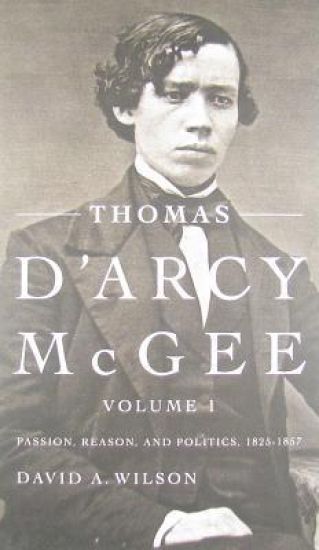
A brilliant writer, outstanding orator, and charismatic politician, Thomas D'Arcy McGee is best known for his prominent role in Irish-Canadian politics, his inspirational speeches in support of Canadian Confederation, and his assassination by an Irish revolutionary who accused him of betraying his earlier Irish nationalist principles. Thomas D'Arcy McGee, the first volume in a two-part biography, explores the development of those principles in Ireland and the United States. David Wilson follows McGee from Wexford, Ireland across the Atlantic to Boston, where at nineteen he became the editor of America's leading Irish newspaper, and traces his subsequent involvement with the Young Ireland movement, his reactions to the Famine, and his role in the Rising of 1848. Wilson goes on to examine McGee's experiences as a political refugee in the United States, where his increasing disillusionment with revolutionary Irish nationalism and his opposition to American nativism propelled him towards conservative Catholicism and sent him on a trajectory that ultimately led to Canada - his experiences are the subject of volume 2, Thomas D'Arcy McGee: The Extreme Moderate, 1857-1868.

After a tumultuous career as a revolutionary in Ireland and an ultra-conservative Catholic in the United States, Thomas D'Arcy McGee moved to Canada in 1857, where he became a force for moderation and the leading Irish Canadian politician in the country. Determined that Canada should avoid the ethno-religious strife that afflicted Ireland, he articulated an inclusive, broad-minded nationalism based on generosity of spirit, a willingness to compromise, and a reasonable balance between order and liberty. To realize his vision, McGee became a strong supporter of the "new northern nationality." A spellbinding orator who emerged as the youngest and most intellectually gifted of the Fathers of Confederation, he fought what he saw as the atavistic and intolerant elements of Canadian life - the Orange Order, with its strident anti-Catholicism; the opponents of separate schools, whom he viewed as enemies of minority rights; and above all the Fenian Brotherhood, with its dreams of revolutionizing Ireland and annexing Canada to the United States. Convinced that compromise with Fenianism was impossible, he set out to destroy the movement through a strategy of confrontation and polarization - channeling his earlier extreme tendencies in the service of moderation and attempting to reduce the influence of Fenianism within his own community. In the process, he alienated many of his former supporters, who came to regard him as a traitor who sacrificed the cause of Irish nationalism on the altar of personal ambition. On 7 April 1868, McGee was assassinated on the doorstep of his Ottawa boarding house. As someone who took an uncompromising stand against militants within his own ethno-religious community, and who attempted to balance core values with minority rights, McGee has become increasingly relevant in today's complex multicultural society.

Recollections of Thomas D. Duncan, a Confederate Soldier
Thomas D Duncan
Anson Street Press
2025
pokkari
Recollections of Thomas D. Duncan, a Confederate Soldier
Thomas D Duncan
Anson Street Press
2025
sidottu
Thomas D'Arcy McGee
Alexander Brady; W Stewart (William Stewart) Wallace
Anson Street Press
2025
pokkari