Kirjojen hintavertailu. Mukana 11 244 527 kirjaa ja 12 kauppaa.

Kirjahaku

Etsi kirjoja tekijän nimen, kirjan nimen tai ISBN:n perusteella.

1000 tulosta hakusanalla Thomas Erl; Eric Monroy

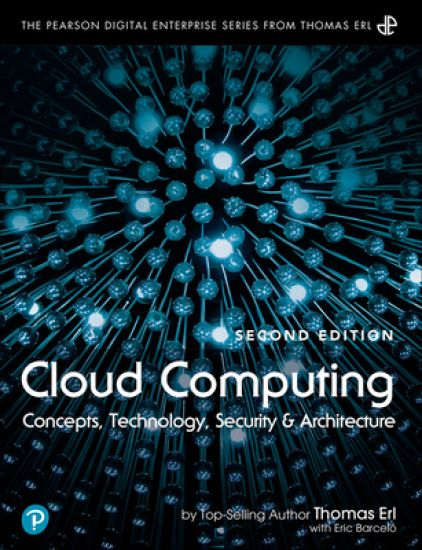
Cloud Computing

Cloud Computing

Thomas Erl; Eric Monroy

PEARSON EDUCATION (US)
2023
nidottu
Cloud Computing: Concepts, Technology, Security & Architecture Cloud computing has become an integral and foundational part of information technology. The majority of digital business activity and technology innovation occurs with the involvement of contemporary cloud environments that provide highly sophisticated automated technology infrastructure and a vast range of technology resources. To successfully build upon, interact with, or create a cloud environment requires an understanding of its common inner mechanics, architectural layers, models, and security controls. It also requires an understanding of the business and economic factors that justify the adoption and real-world use of clouds and cloud-based products and services. In Cloud Computing: Concepts, Technology, Security & Architecture, Thomas Erl, one of the world's top-selling IT authors, teams up with cloud computing expert Eric Barceló Monroy and researchers to break down proven and mature cloud computing technologies and practices into a series of well-defined concepts, technology mechanisms, and technology architectures. Comprehensive coverage of containerization and cybersecurity topics is also included. All chapters are carefully authored from an industry-centric and vendor-neutral point of view. In doing so, the book establishes concrete, academic coverage with a focus on structure, clarity, and well-defined building blocks for mainstream cloud computing and containerization platforms and solutions. With nearly 370 figures, 40 architectural models, and 50 mechanisms, this indispensable guide provides a comprehensive education of contemporary cloud computing, containerization, and cybersecurity that will never leave your side.
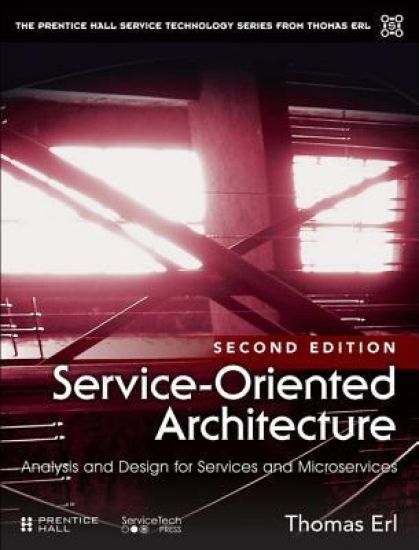
Service-Oriented Architecture
The Top-Selling, De Facto Guide to SOA--Now Updated with New Content and Coverage of Microservices! For more than a decade, Thomas Erl’s best-selling Service-Oriented Architecture: Concepts, Technology, and Design has been the definitive end-to-end tutorial on SOA, service-orientation, and service technologies. Now, Erl has thoroughly updated the industry’s de facto guide to SOA to reflect new practices, technologies, and strategies that have emerged through hard-won experience and creative innovation. This Second Edition officially introduces microservices and micro task abstraction as part of service-oriented architecture and its associated service layers. Updated case study examples and illustrations further explain and position the microservice model alongside and in relation to more traditional types of services. Coverage includes: • Easy-to-understand, plain English explanations of SOA and service-orientation fundamentals (as compiled from series titles) • Microservices, micro task abstraction, and containerization • Service delivery lifecycle and associated phases • Analysis and conceptualization of services and microservices • Service API design with REST services, web services, and microservices • Modern service API and contract versioning techniques for web services and REST services • Up-to-date appendices with service-orientation principles, REST constraints, and SOA patterns (including three new patterns) Service-Oriented Architecture: Analysis and Design for Services and Microservices, Second Edition, will be indispensable to application architects, enterprise architects, software developers, and any IT professionals interested in learning about or responsible for designing or implementing modern-day, service-oriented solutions. Chapter 1: Introduction Chapter 2: Case Study Backgrounds Part I: Fundamentals Chapter 3: Understanding Service-Orientation Chapter 4: Understanding SOA Chapter 5: Understanding Layers with Services and Microservices Part II: Service-Oriented Analysis and Design Chapter 6: Analysis and Modeling with Web Services and Microservices Chapter 7: Analysis and Modeling with REST Services and Microservices Chapter 8: Service API and Contract Design with Web Services Chapter 9: Service API and Contract Design with REST Services and Microservices Chapter 10: Service API and Contract Versioning with Web Services and REST Services Part III: Appendices Appendix A: Service-Orientation Principles Reference Appendix B: REST Constraints Reference Appendix C: SOA Design Patterns Reference Appendix D: The Annotated SOA Manifesto
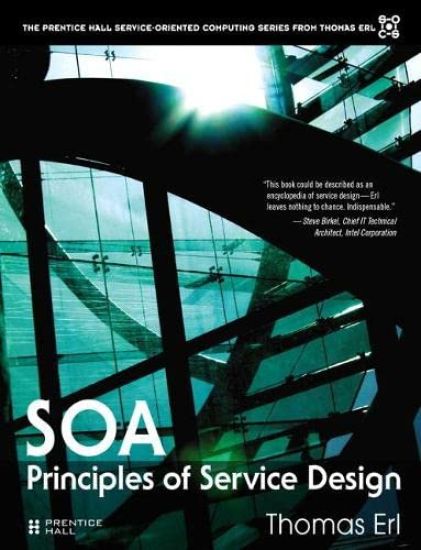
SOA Principles of Service Design (paperback)
“This book could be described as an encyclopedia of service design–Erl leaves nothing to chance. Indispensable.” –Steve Birkel, Chief IT Technical Architect, Intel Corp. “An absolute pleasure to read…the best SOA book I’ve read. A book I would recommend to all of my colleagues; it provides much insight to the topics often overlooked by most books in this genre…the visuals were fantastic.” –Brandon Bohling, SOA Architecture and Strategy, Intel Corporation “This book is a milestone in SOA literature. For the first time we are provided with a practical guide on defining service characteristics and service design principles for SOA from a vendor-agnostic viewpoint. It’s a great reference for SOA discovery, adoptions, and implementation projects.” –Canyang Kevin Liu, Principal Enterprise Architect, SAP Americas, Inc. “I liked this book. It contains extremely important material for those who need to design services.” –Farzin Yashar, IBM SOA Advanced Technologies “This book does a great job laying out benefits, key ideas and design principles behind successfully adopting service-oriented computing. At the same time, the book openly addresses challenges, risks and trade-offs that are in the way of adopting SOA in the real-world today. It moves away from ivory-tower views of service orientation, but still lays out a strong vision for SOA and outlines the changes necessary to realize the full potential.” –Christoph Schittko, Senior Architect, Microsoft “I recommend this book to any SOA practitioner who wishes to empower themselves in making service design real…gives readers the 360º view into service design [and] gives SOA practitioners the depth and understanding needed into the principles of SOA to assist in the design of a mature and successful SOA program.” –Stephen G. Bennett, Americas SOA Practice Lead, BEA Systems “SOA projects are most successful when they are based on a solid technical foundation. Well accepted and established design principles are part of this foundation. This book takes a very structured approach at defining the core design principles for SOA, thus allowing the reader to immediately applying them to a project. Each principle is formally introduced and explained, and examples are given for how to apply it to a real design problem. A ‘must read’ for any architect, designer or developer of service oriented solutions”. –Andre Tost, Senior Technical Staff Member, IBM Software Group “There are few references for SOA that give you the nuts and bolts and this one is at the top of the list. Well written and valuable as a reference book to any SOA practitioner.” –Dr. Mohamad Afshar, Director of Product Management, Oracle Fusion Middleware, Oracle Corporation “A thorough examination of the considerations of service design. Both seasoned SOA practitioners and those endeavoring to realize services can benefit from reading this book.” –Bill Draven, Enterprise Architect, Intel Corporation “There are very few who understand SOA like Thomas Erl does! The principle centric description of service orientation from Thomas canonizes the underpinnings of this important paradigm shift in creating agile and reusable software capabilities. The principles, so eloquently explained, leave little room for any ambiguity attached to the greater purpose of SOA. Most organizations today are creating services in a bottoms-up approach, realizing composition and reuse organically. The time is ripe for a book like this that prepares architects for a principle centric approach to SOA.” –Hanu Kommalapati, Architect, Microsoft Corporation “Outstanding SOA literature uniquely focused on the fundamental services design with thorough and in-depth study on all practical aspects from design principles to methodologies. This book provides a systematic approach for SOA adoption essential for both IT management and professionals.” –Robin Chen, PhD, Google, Inc. “Thomas Erl’s books are always densely filled with information that’s well structured. This book is especially insightful for Enterprise Architects because it provide s great context and practical examples. Part 1 of the book alone is worth getting the book for.” –Markus Zirn, Senior Director, Product Management, Oracle Fusion Middleware, Oracle Corporation “A very clear discussion of the subject matter. Provides a good structure that facilitates understanding and readily highlights key points.” –Kareem Yusuf, Director of SOA Strategy and Planning, IBM Software Group “I am very impressed. Comprehensive. Educative. This book helped me to step back and look at the SOA principles from broader perspective. I’d say this is a must-read book for SOA stakeholders.” –Radovan Janecek, Director R&D, SOA Center, Hewlett-Packard “Very valuable guidance for understanding and applying SOA service design principles with concrete examples. A must read for the practitioner of SOA service design.” –Umit Yalcinalp, PhD, Standards Architect, SAP “This book really does an excellent job of explaining the principles underpinning the value of SOA…Erl goes to great length to explain and give examples of each of the 8 principles that will significantly increase the readers ability to drive an SOA service design that benefits both business and IT.” –Robert Laird, IT Architect, IBM EAI/SOA Advanced Technologies Group “This book strikes a healthy balance between theory and practice. It is a perfect complement to the SOA series by the author.” –Prakash Narayan, Sun Microsystems “If you are going to be designing, developing, or implementing SOA, this is a must have book.” –Jason “AJ” Comfort Sr., Booz Allen Hamilton “An excellent book for anyone who wants to understand service-orientation and the principles involved in designing services…a clear, concise and articulate exploration of the eight design principles involved in analyzing, designing, implementing, and maintaining services…” –Anish Karmarkar, Oracle Corporation “Very well written, succinct, and easy to understand.” –Raj Balasubramanian, IBM Software Group “Acomprehensive exploration of the issues of service design which has the potential to become the definitive work in this area.” –James Pasley, Chief Technology Officer, Cape Clear Software “An excellent addition to any SOA library; it covers a wide range of issues in enough detail to be a valuable asset to anyone considering designing or using SOA based technologies.” –Mark Little, Director of Standards, Red Hat “This book communicates complex concepts in a clear and concise manner. Examples and illustrations are used very effectively.” –Darryl Hogan, Senior Architect, Microsoft “A work of genius…Offers the most comprehensive and thorough explanation on the principles of service design and what it means to be ‘service oriented.’ “Erl’s treatment of the complex world of service oriented architecture is pragmatic, inclusive of real world situations and offers readers ways to communicate these ideas through illustrations and well formulated processes.” –David Michalowicz, MITRE Corporation “This is the book for the large organization trying to rationalize its IT assets and establish an agile platform for the future. By highlighting risk and rewards, Thomas Erl brings clarity to how Service Orientation can be applied to ensure a responsive IT organization. This book finally brings software engineering principles to address the real world development challenges being faced. To effectively serve the business, let alone embrace SOA, everyone involved should be familiar with the concepts investigated here. Thomas Erl thoroughly clarifies the nuances and defines the practice of service design. We expect that this will become a classic text in software engineering, corporate training and colleges.” –Cory Isaacson, President, Rogue Wave Software and Ravi Palepu, SOA Author and Speaker “Thomas Erl does a great job…an easy read.” –Michael H. Sor, Booz Allen Hamilton “…a must read for SOA Architects to develop a firm foundation and understanding of the principles (and trade-offs) that make up a good SOA service. After reading this book, it finally ‘clicked’ as to why a properly designed SOA system is different (and better) than a system based on previous enterprise architectures.” –Fred Ingham, Platinum Solutions Inc. “Lays a tremendous foundation for business and technical workers to come to common terms and expectations…incredibly enlightening to see the details associated with achieving the SOA vision.” –Wayne P. Ariola, Vice President of Strategy, Parasoft “[Erl does] and excellent job of addressing the breadth of [his] audience to present to those new to SOA and weaved in enough detail to assist those who are already actively involved in SOA development.” –R. Perry Smith, Application Program Manager, EDS/OnStar “It is easy to miss the big picture of what SOA means for the design of larger scale systems amidst the details of WS technologies. Erl helps provide a broader perspective, surveying the landscape from a design standpoint.” –Jim Clune, Chief Architect, Parasoft “Lays a firm foundation for the underlying principles of good service design. Cuts through the hype and provides a cogent resource for improving architectural judgment on SOA projects.” –Jim Murphy, Vice President of Product Management, Mindreef, Inc. “The first book to concisely, gradually and comprehensively explain how to apply SOA principles into enterprise-level software design. It is an excellent book.” –Robin G. Qiu, Ph.D., Division of Engineering and Information Science, Pennsylvania State University “I really think that this is a very useful book that a lot of people really need out there in the industry.” –Dr. Arnaud Simon, Principal Software Engineer, Red Hat “…indispensable companion to designing and implementing a service-oriented architecture. It condenses all information necessary to design services and is the most relevant source I know if in the field.” “[This book is] not only helpful, but fundamental to successfully designing an SOA.” –Phillipp Offermann, Research Analyst, University of Berlin “Service-Oriented Architecture is an important topic in IT today. Its vast scope could span an organization’s enterprise. Designing it properly is a major undertaking. This book provides timely, expert and comprehensive discussions on the principles of service design. Thomas has a keen sense in identifying the subtle points of various subjects and explains them in an easy-to-understand way. The book is a valuable resource for IT professionals working in SOA.” –Peter H. Chang, PhD, Associate Professor of Information Systems, Lawrence Technological University The Definitive Guide to Service Engineering The key to succeeding with service-oriented architecture (SOA) is in comprehending the meaning and significance of its most fundamental building block: the service. It is through an understanding of service design that truly “service-oriented” solution logic can be created in support of achieving the strategic goals associated with SOA and service-oriented computing. Bestselling SOA author Thomas Erl guides you through a comprehensive, insightful, and visually rich exploration of the service-orientation design paradigm, revealing exactly how services should and should not be designed for real-world SOA. This book’s in-depth coverage includes Over 240 full-color illustrations. A concise introduction to SOA and service-oriented computing concepts and benefits. A thorough exploration of the service-orientation design paradigm as represented by eight specific design principles. A comparison of service-oriented and object-oriented concepts and principles and a clear definition of what qualifies as “service-oriented” logic. Detailed coverage of four different forms of service-related design granularity. An exhaustive examination of service contracts, with an emphasis on standardization, abstraction, and the utilization of WS-Policy, XML Schema, and WSDL definitions. A comprehensive study of positive and negative service-related coupling types with an emphasis on the requirements to attaining a suitable level of loose coupling. An inside look into how commercial design approaches are incorporated to achieve truly agnostic and reusable service logic. Techniques for maximizing service reliability, scalability, and performance by instilling high levels of autonomy and emphasizing stateless design. Approaches for positioning services as highly discoverable and interpretable enterprise resources. Unprecedented coverage of how to design services for participation in complex compositions. The definition of concrete links between each design principle and the strategic goals and benefits of SOA and service-oriented computing. Numerous cross-references to key design patterns documented separately in SOA: Design Patterns. www.prenhallprofessional.com www.soabooks.com www.soasystems.com Preface xxv Chapter 1: Introduction 1 Chapter 2: Case Study Background 19 Part I: Fundamentals Chapter 3: Service-Oriented Computing and SOA 25 Chapter 4: Service-Orientation 67 Chapter 5: Understanding Design Principles 103 Part II: Design Principles Chapter 6: Service Contracts (Standardization and Design) 125 Chapter 7: Service Coupling (Intra-Service and Consumer Dependencies) 163 Chapter 8: Service Abstraction (Information Hiding and Meta Abstraction Types) 211 Chapter 9: Service Reusability (Commercial and Agnostic Design) 253 Chapter 10: Service Autonomy (Processing Boundaries and Control) 293 Chapter 11: Service Statelessness (State Management Deferral and Stateless Design) 325 Chapter 12: Service Discoverability (Interpretability and Communication) 361 Chapter 13: Service Composability (Composition Member Design and Complex Compositions) 387 Part III: Supplemental Chapter 14: Service-Orientation and Object-Orientation: A Comparison of Principles and Concepts 445 Chapter 15: Supporting Practices 477 Chapter 16: Mapping Service-Orientation Principles to Strategic Goals 497 Appendices Appendix A: Case Study Conclusion 513 Appendix B: Process Descriptions 517 Appendix C: Principles and Patterns Cross-Reference 529 Additional Resources 533 About the Author 535 About the Photos 537 Index 539
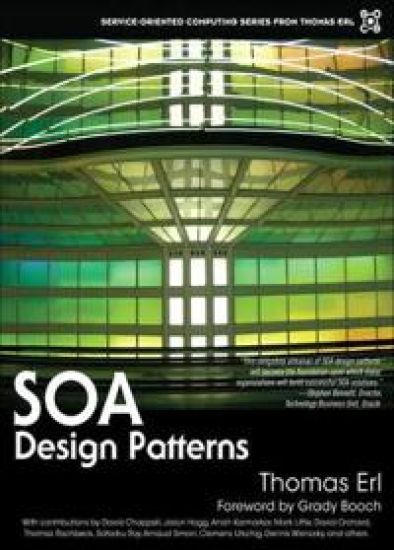
SOA Design Patterns

SOA Design Patterns

Thomas Erl

Pearson
2017
nidottu
“SOA Design Patterns is an important contribution to the literature and practice of building and delivering quality software-intensive systems.” - Grady Booch, IBM Fellow “With the continued explosion of services and the increased rate of adoption of SOA through the market, there is a critical need for comprehensive, actionable guidance that provides the fastest possible time to results. Microsoft is honored to contribute to the SOA Design Patterns book, and to continue working with the community to realize the value of Real World SOA.” - Steven Martin, Senior Director, Developer Platform Product Management, Microsoft “SOA Design Patterns provides the proper guidance with the right level of abstraction to be adapted to each organization’s needs, and Oracle is pleased to have contributed to the patterns contained in this book.” - Dr. Mohamad Afshar, Director of Product Management, Oracle Fusion Middleware, Oracle “Red Hat is pleased to be involved in the SOA Design Patterns book and contribute important SOA design patterns to the community that we and our customers have used within our own SOA platforms. I am sure this will be a great resource for future SOA practitioners.” - Pierre Fricke Director, Product Line Management, JBoss SOA Platform, Red Hat “A wealth of proven, reusable SOA design patterns, clearly explained and illustrated with examples. An invaluable resource for all those involved in the design of service-oriented solutions.” - Phil Thomas, Consulting IT Specialist, IBM Software Group “This obligatory almanac of SOA design patterns will become the foundation on which many organizations will build their successful SOA solutions. It will allow organizations to build their own focused SOA design patterns catalog in an expedited fashion knowing that it contains the wealth and expertise of proven SOA best practices.” - Stephen Bennett, Director, Technology Business Unit, Oracle Corporation “The technical differences between service orientation and object orientation are subtle enough to confuse even the most advanced developers. Thomas Erl’s book provides a great service by clearly articulating SOA design patterns and differentiating them from similar OO design patterns.” - Anne Thomas Manes, VP & Research Director, Burton Group “SOA Design Patterns does an excellent job of laying out and discussing the areas of SOA design that a competent SOA practitioner should understand and employ.” - Robert Laird, SOA Architect, IBM “As always, Thomas delivers again. In a well-structured and easy-to-understand way, this book provides a wonderful collection of patterns each addressing a typical set of SOA design problems with well articulated solutions. The plain language and hundreds of diagrams included in the book help make the complicated subjects of SOA design comprehensible even to those who are new to the SOA design world. It’s a must-have reference book for all SOA practitioners, especially for enterprise architects, solution architects, developers, managers, and business process experts.” - Canyang Kevin Liu, Solution Architecture Manager, SAP “The concept of service oriented architecture has long promised visions of agile organizations being able to swap out interfaces and applications as business needs change. SOA also promises incredible developer and IT productivity, with the idea that key services would be candidates for cross-enterprise sharing or reuse. But many organizations’ efforts to move to SOA have been mired–by organizational issues, by conflicting vendor messages, and by architectures that may amount to little more than Just a Bunch of Web Services. There’s been a lot of confusion in the SOA marketplace about exactly what SOA is, what it’s supposed to accomplish, and how an enterprise goes about in making it work. SOA Design Patterns is a definitive work that offers clarity on the purpose and functioning of service oriented architecture. SOA Design Patterns not only helps the IT practitioner lay the groundwork for a well-functioning SOA effort across the enterprise, but also connects the dots between SOA and the business requirements in a very concrete way. Plus, this book is completely technology agnostic—SOA Design Patterns rightly focuses on infrastructure and architecture, and it doesn’t matter whether you’re using components of one kind or another, or Java, or .NET, or Web services, or REST-style interfaces. While no two SOA implementations are alike, Thomas Erl and his team of contributors have effectively identified the similarities in composition services need to have at a sub-atomic level in order to interact with each other as we hope they will. The book identifies 85 SOA design patterns which have been developed and thoroughly vetted to ensure that a service-oriented architecture does achieve the flexibility and loose coupling promised. The book is also compelling in that it is a living document, if you will, inviting participation in an open process to identify and formulate new patterns to this growing body of knowledge.” - Joe McKendrick, Independent Analyst, Author of ZDNet’s SOA Blog “If you want to truly educate yourself on SOA, read this book.” - Sona Srinivasan, Global Client Services & Operations, CISCO “An impressive decomposition of the process and architectural elements that support serviceoriented analysis, design, and delivery. Right-sized and terminologically consistent. Overall, the book represents a patient separation of concerns in respect of the process and architectural parts that underpin any serious SOA undertaking. Two things stand out. First, the pattern relationship diagrams provide rich views into the systemic relationships that structure a service-oriented architecture: these patterns are not discrete, isolated templates to be applied mechanically to the problem space; rather, they form a network of forces and constraints that guide the practitioner to consider the task at hand in the context of its inter-dependencies. Second, the pattern sequence diagrams and accompanying notes provide a useful framework for planning and executing the many activities that comprise an SOA engagement.” - Ian Robinson, Principal Technology Consultant, ThoughtWorks “Successful implementation of SOA principles requires a shift in focus from software system means, or the way capabilities are developed, to the desired end results, or real-world effects required to satisfy organizational business processes. In SOA Design Patterns, Thomas Erl provides service architects with a broad palette of reusable service patterns that describe service capabilities that can cut across many SOA applications. Service architects taking advantage of these patterns will save a great deal of time describing and assembling services to deliver the real world effects they need to meet their organization’s specific business objectives.” - Chuck Georgo, Public Safety and National Security Architect “In IT, we have increasingly come to see the value of having catalogs of good solution patterns in programming and systems design. With this book, Thomas Erl brings a comprehensive set of patterns to bear on the world of SOA. These patterns enable easily communicated, reusable, and effective solutions, allowing us to more rapidly design and build out the large, complicated and interoperable enterprise SOAs into which our IT environments are evolving.” - Al Gough, Business Systems Solutions CTO, CACI International Inc. “This book provides a comprehensive and pragmatic review of design issues in service-centric design, development, and evolution. The Web site related to this book [SOAPatterns.org] is a wonderful platform and gives the opportunity for the software community to maintain this catalogue….” - Veronica Gacitua Decar, Dublin City University “Erl’s SOA Design Patterns is for the IT decision maker determined to make smart architecture design choices, smart investments, and long term enterprise impact. For those IT professionals committed to service-orientation as a value-added design and implementation option, Patterns offers a credible, repeatable approach to engineering an adaptable business enterprise. This is a must read for all IT architect professionals.” - Larry Gloss, VP and General Manager, Information Manufacturing, LLC “These SOA patterns define, encompass, and comprise a complete repertoire of best practices for developing a world-class IT SOA portfolio for the enterprise and its organizational units through to service and schema analysis and design. After many years as an architect on many SOA projects, I strongly recommend this book be on the shelf of every analyst and technical member of any SOA effort, right next to the SOA standards and guidelines it outlines and elucidates the need for. Our SOA governance standards draw heavily from this work and others from this series.” - Robert John Hathaway III, Enterprise Software Architect, SOA Object Systems “A wise man once told me that wisdom isn’t all about knowledge and intelligence, it is just as much about asking questions. Asking questions is the true mark of wisdom and during the writing of the SOA Design Patterns book Thomas Erl has shown his real qualities. The community effort behind this book is huge meaning that Thomas has had access to the knowledge and experience of a large group of accomplished practitioners. The result speaks for itself. This book is packed with proven solutions to recurring problems, and the documented pros and cons of each solution have been verified by persons with true experience. This book could give SOA initiatives of any scale a real boost.” - Herbjörn Wilhelmsen, Architect and Senior Consultant, Objectware “This book is an absolute milestone in SOA literature. For the first time we are provided with a practical guide on how the principle centric description of service orientation from a vendor-agnostic viewpoint is actually made to work in a language based on patterns. This book makes you talk SOA! There are very few who understand SOA like Thomas Erl does, he actually put’s it all together!” - Brian Lokhorst, Solution Architect, Dutch Tax Office “Service oriented architecture is all about best practices we have learned since IT’s existence. This book takes all those best practices and bundles them into a nice pattern catalogue. [It provides] a really excellent approach as patterns are not just documented but are provided with application scenarios through case studies [which] fills the gap between theory and practice.” - Shakti Sharma, Senior Enterprise Architect, Sysco Corp “An excellent and important book on solving problems in SOA [with a] solid structure. Has the potential of being among the major influential books.” - Peter Chang, Lawrence Technical University “SOA Design Patterns presents a vast amount of knowledge about how to successfully implement SOA within an organization. The information is clear, concise, and most importantly, legitimate.” - Peter B. Woodhull, President and Principal Architect, Modus21 “SOA Design Patterns offers real insights into everyday problems that one will encounter when investing in services oriented architecture. [It] provides a number of problem descriptions and offers strategies for dealing with these problems. SOA design patterns highlights more than just the technical problems and solutions. Common organizational issues that can hinder progress towards achieving SOA migration are explained along with potential approaches for dealing with these real world challenges. Once again Thomas Erl provides in-depth coverage of SOA terminology and helps the reader better understand and appreciate the complexities of migrating to an SOA environment.” - David Michalowicz, Air and Space Operations Center Modernization Team Lead, MITRE Corporation “This is a long overdue, serious, comprehensive, and well-presented catalog of SOA design patterns. This will be required reading and reference for all our SOA engineers and architects. The best of the series so far! [The book] works in two ways: as a primer in SOA design and architecture it can easily be read front-to-back to get an overview of most of the key design issues you will encounter, and as a reference catalog of design techniques that can be referred to again and again…” - Wendell Ocasio, Architecture Consultant, DoD Military Health Systems, Agilex Technologies “Thomas has once again provided the SOA practitioner with a phenomenal collection of knowledge. This is a reference that I will come back to time and time again as I move forward in SOA design efforts. What I liked most about this book is its vendor agnostic approach to SOA design patterns. This approach really presents the reader with an understanding of why or why not to implement a pattern, group patterns, or use compound patterns rather than giving them a marketing spiel on why one implementation of a pattern is better than another (for example, why one ESB is better than another). I think as SOA adoption continues to advance, the ability for architects to understand when and why to apply specific patterns will be a driving factor in the overall success and evolution of SOA. Additionally, I believe that this book provides the consumer with the understanding required to chose which vendor’s SOA products are right for their specific needs.” - Bryan Brew, SOA Consultant, Booz Allen Hamilton “A must have for every SOA practitioner.” - Richard Van Schelven, Principal Engineer, Ericsson “This book is a long-expected successor to the books on object-oriented design patterns and integration patterns. It is a great reference book that clearly and thoroughly describes design patterns for SOA. A great read for architects who are facing the challenge of transforming their enterprise into a service-oriented enterprise.” - Linda Terlouw, Solution Architect, Ordina “The maturation of Service-Orientation has given the industry time to absorb the best practices of service development. Thomas Erl has amassed this collective wisdom in SOA Design Patterns, an absolutely indispensible addition to any Service Oriented bookshelf.” - Kevin P. Davis, Ph.D “The problem with most texts on SOA is one of specificity. Architects responsible for SOA implementation in most organizations have little time for abstract theories on the subject, but are hungry for concrete details that they can relate to the real problems they face in their environment. SOA Design Patterns is critical reading for anyone with service design responsibilities. Not only does the text provide the normal pattern templates, but each pattern is applied in detail against a background case study to provide exceptionally meaningful context to the information. The graphic visualizations of the problems and pattern solutions are excellent supplementary companions to the explanatory text. This book will greatly stretch the knowledge of the reader as much for raising and addressing issues that may have never occurred to the reader as it does in treating those problems that are in more common occurrence. The real beauty of this book is in its plain English prose. Unlike so many technical reference books, one does not find themselves re-reading sections multiple times trying to discern the intent of the author. This is also not a reference that will sit gathering dust on a shelf after one or two perusings. Practitioners will find themselves returning over and over to utilize the knowledge in their projects. This is as close as you’ll come to having a service design expert sitting over your shoulder.” - James Kinneavy, Principal Software Architect, University of California “As the industry converges on SOA patterns, Erl provides an outstanding reference guide to composition and integration–and yet another distinctive contribution to the SOA practice.” - Steve Birkel, Chief IT Technical Architect, Intel Corp. “With SOA Design Patterns, Thomas Erl adds an indispensable SOA reference volume to the technologist’s library. Replete with to-the-point examples, it will be a helpful aid to any IT organization.” - Ed Dodds, Strategist, Systems Architect, Conmergence “Again, Thomas Erl has written an indispensable guide to SOA. Building on his prior successes, his patterns go into even more detail. Therefore, this book is not only helpful to the SOA beginner, but also provides new insight and ideas to professionals.” - Philipp Offermann, Research Scientist, Technische Universität Berlin, Germany “SOA Design Patterns is an extraordinary contribution to SOA best practices! Once again, Thomas has created an indispensable resource for any person or organization interested in or actively engaged in the practice of Service Oriented Architecture. Using case studies based on three very different business models, Thomas guides the reader through the process of selecting appropriate implementation patterns to ensure a flexible, well-performing, and secure SOA ecosystem.” - Victor Brown, Managing Partner and Principal Consultant, Cypress Management Group Corporation In cooperation with experts and practitioners throughout the SOA community, best-selling author Thomas Erl brings together the de facto catalog of design patterns for SOA and service-orientation. More than three years in development and subjected to numerous industry reviews, the 85 patterns in this full-color book provide the most successful and proven design techniques to overcoming the most common and critical problems to achieving modern-day SOA. Through numerous examples, individually documented pattern profiles, and over 400 color illustrations, this book provides in-depth coverage of: • Patterns for the design, implementation, and governance of service inventories–collections of services representing individual service portfolios that can be independently modeled, designed, and evolved. • Patterns specific to service-level architecture which pertain to a wide range of design areas, including contract design, security, legacy encapsulation, reliability, scalability, and a variety of implementation and governance issues. • Service composition patterns that address the many aspects associated with combining services into aggregate distributed solutions, including topics such as runtime messaging and message design, inter-service security controls, and transformation. • Compound patterns (such as Enterprise Service Bus and Orchestration) and recommended pattern application sequences that establish foundational processes. The book begins by establishing SOA types that are referenced throughout the patterns and then form the basis of a final chapter that discusses the architectural impact of service-oriented computing in general. These chapters bookend the pattern catalog to provide a clear link between SOA design patterns, the strategic goals of service-oriented computing, different SOA types, and the service-orientation design paradigm. This book series is further supported by a series of resources sites, including soabooks.com, soaspecs.com, soapatterns.org, soamag.com, and soaposters.com.
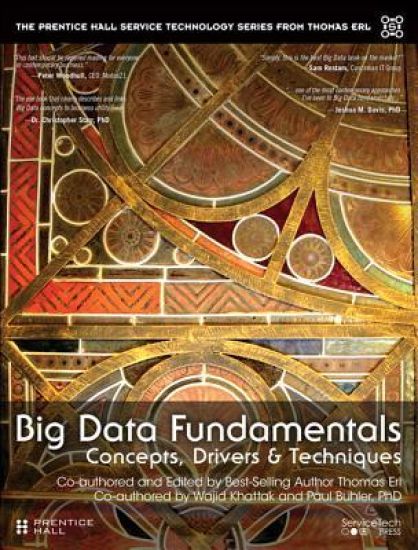
Big Data Fundamentals

Big Data Fundamentals

Thomas Erl; Wajid Khattak; Paul Buhler

Pearson
2016
nidottu
“This text should be required reading for everyone in contemporary business.” --Peter Woodhull, CEO, Modus21 “The one book that clearly describes and links Big Data concepts to business utility.” --Dr. Christopher Starr, PhD “Simply, this is the best Big Data book on the market!” --Sam Rostam, Cascadian IT Group “...one of the most contemporary approaches I’ve seen to Big Data fundamentals...” --Joshua M. Davis, PhD The Definitive Plain-English Guide to Big Data for Business and Technology Professionals Big Data Fundamentals provides a pragmatic, no-nonsense introduction to Big Data. Best-selling IT author Thomas Erl and his team clearly explain key Big Data concepts, theory and terminology, as well as fundamental technologies and techniques. All coverage is supported with case study examples and numerous simple diagrams. The authors begin by explaining how Big Data can propel an organization forward by solving a spectrum of previously intractable business problems. Next, they demystify key analysis techniques and technologies and show how a Big Data solution environment can be built and integrated to offer competitive advantages. Discovering Big Data’s fundamental concepts and what makes it different from previous forms of data analysis and data scienceUnderstanding the business motivations and drivers behind Big Data adoption, from operational improvements through innovationPlanning strategic, business-driven Big Data initiativesAddressing considerations such as data management, governance, and securityRecognizing the 5 “V” characteristics of datasets in Big Data environments: volume, velocity, variety, veracity, and valueClarifying Big Data’s relationships with OLTP, OLAP, ETL, data warehouses, and data martsWorking with Big Data in structured, unstructured, semi-structured, and metadata formatsIncreasing value by integrating Big Data resources with corporate performance monitoringUnderstanding how Big Data leverages distributed and parallel processingUsing NoSQL and other technologies to meet Big Data’s distinct data processing requirementsLeveraging statistical approaches of quantitative and qualitative analysisApplying computational analysis methods, including machine learning
SOA with .NET and Windows Azure

SOA with .NET and Windows Azure

Thomas Erl; David Chou; John deVadoss; Nitin Gandhi; Hanu Kommalapati; Brian Loesgen; Christoph Schittko; Herbjorn Wilhelmsen; M Williams; Scott Golightly; Darryl Hogan; Jeff King; Scott Seely

Pearson
2018
nidottu
The Authoritative Guide to Building Service-Oriented Solutions with Microsoft .NET Technologies and the Windows Azure Cloud Computing Platform In SOA with .NET and Windows Azure, top Microsoft technology experts team up with Thomas Erl to explore service-oriented computing with Microsoft’s latest .NET service technologies and Windows Azure innovations. The authors provide comprehensive documentation of on-premise and cloud-based modern service technology advancements within the Microsoft platform and further show how these technologies have increased the potential for applying and realizing service-orientation practices and goals. Specifically, the book delves into Microsoft enterprise technologies, such as: Windows Communication Foundation (WCF) Windows Azure Windows Workflow Foundation (WF) Windows Azure AppFabric BizTalk Server Windows Presentation Foundation (WPF) ...as well as industry service mediums, including WS-* and REST, and many related service industry standards and technologies. The book steps through common SOA design patterns and service-orientation principles, along with numerous code-level examples that further detail various technology architectures and implementations.
SOA Governance

SOA Governance

Thomas Erl; Stephen Bennett; Benjamin Carlyle; Clive Gee; Robert Laird; Anne Thomas Manes; Anne Manes; Robert Moores; Robert Schneider; Leo Shuster; Andre Tost; Chris Venable; Filippos Santas

Pearson
2017
nidottu
The Definitive Guide to Governing Shared Services and SOA Projects SOA Governance: Governing Shared Services On-Premise and in the Cloud is the result of a multi-year project to collect proven industry practices for establishing IT governance controls specific to the adoption of SOA and service-orientation. Authored by world-renowned experts in the fields of SOA, IT governance, and cloud computing, this comprehensive book provides clear direction as to what does and does not constitute SOA governance and then steps the reader through the most important industry governance practices, as they pertain to individual SOA project lifecycle stages. With a consistent, vendor-neutral focus, and with the help of case study examples, the authors demonstrate how to define and position precepts, organizational roles, processes, standards, and metrics. Readers benefit from thorough and visually depicted cross-references and mapping between roles, processes, precepts, and project stages, enabling them to fully explore dynamics and dependencies and thereby learn how to use these governance controls to create their own custom SOA governance systems. This important title will be valuable to every practitioner concerned with making SOA work, including senior IT managers, project managers, architects, analysts, developers, administrators, QA professionals, security specialists, and cloud computing professionals. Topic Areas Defining SOA governance Establishing an SOA governance office and program Working with proven SOA governance precepts and processes Identifying organizational roles and relating them to SOA governance Associating design-time and runtime SOA project stages with SOA governance controls Governance considerations specific to shared services Roles, precepts, and factors specific to cloud-based services Understanding and categorizing SOA governance products and technologies Applying governance controls as early as the planning stages and measuring their success in subsequent stages Using vitality triggers to govern shared services on an on-going basis SOA governance controls that pertain to business information documents and policies
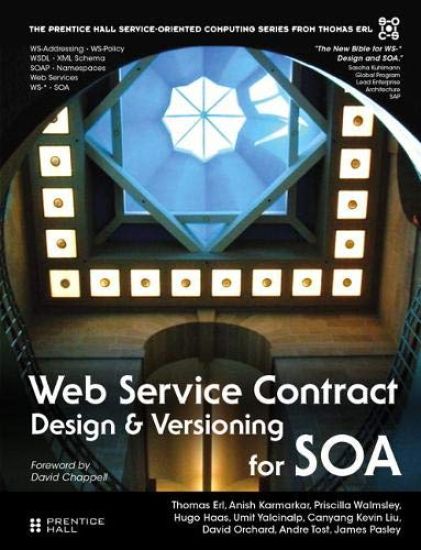
Web Service Contract Design and Versioning for SOA

Web Service Contract Design and Versioning for SOA

Thomas Erl; Anish Karmarkar; Priscilla Walmsley; Hugo Haas; L. Yalcinalp; Kevin Liu; David Orchard; Andre Tost; James Pasley

Pearson
2017
nidottu
The Ultimate Guide for Designing and Governing Web Service Contracts For Web services to succeed as part of SOA, they require balanced, effective technical contracts that enable services to be evolved and repeatedly reused for years to come. Now, a team of industry experts presents the first end-to-end guide to designing and governing Web service contracts. Writing for developers, architects, governance specialists, and other IT professionals, the authors cover the following areas: Understanding Web Service Contract Technologies Initial chapters and ongoing supplementary content help even the most inexperienced professional get up to speed on how all of the different technologies and design considerations relate to the creation of Web service contracts. For example, a visual anatomy of a Web service contract documented from logical and physical perspectives is provided, along with a chapter dedicated to describing namespaces in plain English. The book is further equipped with numerous case study examples and many illustrations. Fundamental and Advanced WSDL Tutorial coverage of WSDL 1.1 and 2.0 and detailed descriptions of their differences is followed by numerous advanced WSDL topics and design techniques, including extreme loose coupling, modularization options, use of extensibility elements, asynchrony, message dispatch, service instance identification, non-SOAP HTTP binding, and WS-BPEL extensions. Also explained is how WSDL definitions are shaped by key SOA design patterns. Fundamental and Advanced XML Schema XML Schema basics are covered within the context of Web services and SOA, after which advanced XML Schema chapters delve into a variety of specialized message design considerations and techniques, including the use of wildcards, reusability of schemas and schema fragments, type inheritance and composition, CRUD-style message design, and combining industry and custom schemas. Fundamental and Advanced WS-Policy Topics, such as Policy Expression Structure, Composite Policies, Operator Composition Rules, and Policy Attachment establish a foundation upon which more advanced topics, such as policy reusability and centralization, nested, parameterized, and ignorable assertions are covered, along with an exploration of creating concurrent policy-enabled contracts and designing custom policy assertions and vocabularies. Fundamental Message Design with SOAPA broad range of message design-related topics are covered, including SOAP message structures, SOAP nodes and roles, SOAP faults, designing custom SOAP headers and working with industry-standard SOAP headers. Advanced Message Design with WS-Addressing The art of message design is taken to a new level with in-depth descriptions of WS-Addressing endpoint references (EPRs) and MAP headers and an exploration of how they are applied via SOA design patterns. Also covered are WSDL binding considerations, related MEP rules, WS-Addressing policy assertions, and detailed coverage of how WS-Addressing relates to SOAP Action values. Advanced Message Design with MTOM, and SwA Developing SOAP messages capable of transporting large documents or binary content is explored with a documentation of the MTOM packaging and serialization framework (including MTOM-related policy assertions), together with the SOAP with Attachments (SwA) standard and the related WS-I Attachments Profile. Versioning Techniques and Strategies Fundamental versioning theory starts off a series of chapters that dive into a variety of versioning techniques based on proven SOA design patterns including backward and forward compatibility, version identification strategies, service termination, policy versioning, validation by projection, concurrency control, partial understanding, and versioning with and without wildcards. Web Service Contracts and SOA The constant focus of this book is on the design and versioning of Web service contracts in support of SOA and service-orientation. Relevant SOA design principles and design patterns are periodically discussed to demonstrate how specific Web service technologies can be applied and further optimized. Furthermore, several of the advanced chapters provide expert techniques for designing Web service contracts while taking SOA governance considerations into account. About the Web Sites www.soabooks.com supplements this book with a variety of resources, including a diagram symbol legend, glossary, supplementary articles, and source code available for download. www.soaspecs.com provides further support by establishing a descriptive portal to XML and Web services specifications referenced in all of Erl’s Service-Oriented Architecture books. Foreword Preface Chapter 1: Introduction Chapter 2: Case Study Background Part I: Fundamental Service Contract Design Chapter 3: SOA Fundamentals and Web Service Contracts Chapter 4: Anatomy of a Web Service Contract Chapter 5: A Plain English Guide to Namespaces Chapter 6: Fundamental XML Schema: Types and Message Structure Basics Chapter 7: Fundamental WSDL Part I: Abstract Description Design Chapter 8: Fundamental WSDL Part II: Concrete Description Design Chapter 9: Fundamental WSDL 2.0: New Features, and Design Options Chapter 10: Fundamental WS-Policy: Expression, Assertion, and Attachment Chapter 11: Fundamental Message Design: SOAP Envelope Structure, and Header Block Processing Part II: Advanced Service Contract Design Chapter 12: Advanced XML Schema Part I: Message Flexibility, and Type Inheritance and Composition Chapter 13: Advanced XML Schema Part II: Reusability, Derived Types, and Relational Design Chapter 14: Advanced WSDL Part I: Modularization, Extensibility, MEPs, and Asynchrony Chapter 15: Advanced WSDL Part II: Message Dispatch, Service Instance Identification, and Non-SOAP HTTP Binding Chapter 16: Advanced WS-Policy Part I: Policy Centralization and Nested, Parameterized, and Ignorable Assertions Chapter 17: Advanced WS-Policy Part II: Custom Policy Assertion Design, Runtime Representation, and Compatibility Chapter 18: Advanced Message Design Part I: WS-Addressing Vocabularies Chapter 19: Advanced Message Design Part II: WS-Addressing Rules and Design Techniques Part III: Service Contract Versioning Chapter 20: Versioning Fundamentals Chapter 21: Versioning WSDL Definitions Chapter 22: Versioning Message Schemas Chapter 23: Advanced Versioning Part IV: Appendices Appendix A: Case Study Conclusion Appendix B: A Comparison of Web Services and REST Services Appendix C: How Technology Standards are Developed Appendix D: Alphabetical Pseudo Schema Reference Appendix E: SOA Design Patterns Related to This Book
Field Guide to Digital Transformation, A

Field Guide to Digital Transformation, A

Thomas Erl; Roger Stoffers

PEARSON EDUCATION (US)
2022
nidottu
Your Complete Guide to Digital Transformation A Field Guide to Digital Transformation is the definitive book on digital transformation. Top-selling IT author Thomas Erl and long-time practitioner Roger Stoffers combine to provide comprehensive, yet easy-to-understand coverage of essential digital transformation concepts, practices, and technologies in the format of a plain-English tutorial written for any IT professionals, students, or decision-makers. With more than 160 diagrams, this guide provides a highly visual exploration of what digital transformation is, how it works, and the techniques and technologies required to successfully build modern-day digital transformation solutions. Learn from the experts and: Discover what digital transformation is, why it emerged and when to apply itIdentify the significant business benefits that successful digital transformations can deliver and how to turn your organization into a “disruptive” forcePrepare for and overcome the common challenges associated with digital transformation initiativesUnderstand the data-driven nature of digital transformation solutions and how they use and continually accumulate data intelligenceUnderstand how digital transformation solutions can utilize AI technology for intelligent automated decision-makingGain insight into customer-centricity and how its practices are applied as part of digital transformationsExplore key digital transformation automation technologies, such as Robotic Process Automation (RPA), Internet of Things (IoT), Blockchain. and Cloud ComputingExplore key digital transformation data science technologies, such as Artificial Intelligence (AI), Machine Learning, and Big Data Analysis and Analytics The book concludes with a uniquely detailed and highly visual real-world business scenario that provides step-by-step insights into how a digital transformation solution works, how it utilizes data intelligence to improve customer relationship building, and how it collects new data intelligence in support of enhancing future business capabilities.
Thomas

Thomas

Rwg

Rwg Publishing
2019
pokkari
College rule (also known as medium ruled paper) is the most common lined paper in use in the United States. It is generally used in middle school through to college and is also popular with adults. This is a good choice for teen or adult notebooks and composition books (known as exercise books outside the US).
Thomas

Thomas

Risto Uro

Continuum International Publishing Group Ltd.
2003
sidottu
Many scholars believe that the Gospel of Thomas, the famous collection of Jesus' sayings found in Nag Hammadi in 1945, makes all the difference for our understanding of the origins of Christianity. The gospel has been studied closely for the new light it throws on pre-canonical traditions and for the different world of wisdom it seems to represent. Without denying the value of such approaches, the present book takes a different approach. It does not look backward to the earlier sources of the gospel nor to the historical Jesus, but seeks to locate Thomas on the map of early Christian literature and history by comparing the gospel to other related writings and traditions. These include the writings ascribed to the mysterious apostle, Judas Thomas, other documents from Nag Hammadi, Paul and Stoic teachers, and the Gospel of Matthew. No single interpretative key for the understanding of the gospel is proposed. Rather, the book opens up several new readings and historical explanations which can usefully be explored. Uro also argues that the conventional methods scholars have been using in their studies are in need of rethinking and refinement. Among many conclusions is the author's belief that Thomas is an early second-century work written by people who, like many other first- and second-century Christians, understood Jesus' message in terms of the Hellenistic belief in the divine origin of the self.
Thomas

Thomas

Egmont UK Ltd
2001
sidottu
Age 18 months+. One of 4 new titles in this super value, bestselling collectable series of board books with plush cover characters. Perfect for the youngest reader, these cuddle, play and read titles represent the ultimate book-plus product.
Thomas

Thomas

EGMONT CHILDRENS BOOKS
2004
nidottu
One of six bumper value, super-sized, fun activity books publishing together. In these Really Big Activity Books you'll find pages and pages of fun, time-filling, colouring, puzzling and dot-to-dotting activities.
Thomas

Thomas

Egmont Books Ltd
2007
muu
Lets you sing along, and read along as Thomas, James, Gordon, Henry, Bertie, Terence and Toby all appear in their own adventures, complete with bump, crash and 'peep! peep!' sound effects! This work allows you to choose your favourite character or collect them all.