Kirjojen hintavertailu. Mukana 12 390 323 kirjaa ja 12 kauppaa.

Kirjahaku

Etsi kirjoja tekijän nimen, kirjan nimen tai ISBN:n perusteella.

1000 tulosta hakusanalla Thomas Hardy; Frederick Marryat

The Pacha of Many Tales (1835).By: Frederick Marryat and By: Thomas Hardy (3 March 1752 - 11 October 1832): In Three Volumes. Vol. II
Thomas Hardy (3 March 1752 - 11 October 1832) was an early Radical, and the founder, first Secretary, and Treasurer of the London Corresponding Society. Hardy was born on 3 March 1752 in Larbert, Stirlingshire, Scotland, the son of a merchant seaman. His father died in 1760 at sea while Thomas was still a boy. He was sent to school by his maternal grandfather and later apprenticed to a shoemaker in Stirlingshire. He later worked in the Carron Iron Works. As a young man, he came to London just before the American Revolutionary War. On 21 May 1781 he married at St-Martin-in-the-Fields church Lydia Priest, the youngest daughter of a carpenter and builder from Chesham, Buckinghamshire. The couple had six children, all of whom died in infancy. Lydia died in childbirth on 27 August 1794, her child (the sixth) being stillborn: the cause may have been the injuries she had sustained when a loyalist "Church and King" mob attacked the Hardy home some weeks earlier.In 1791, Hardy opened his own boot and shoe shop at 9 Piccadilly, London....... Captain Frederick Marryat (10 July 1792 - 9 August 1848) was a British Royal Navy officer, a novelist, and an acquaintance of Charles Dickens. He is noted today as an early pioneer of the sea story, particularly for his semi-autobiographical novel Mr Midshipman Easy (1836), for his children's novel The Children of the New Forest (1847), and for a widely used system of maritime flag signalling, known as Marryat's Code. Early life and naval career: Marryat was born in Great George Street, Westminster, London, the son of Joseph Marryat (1757-1824), a "merchant prince" and member of Parliament, and his American wife Charlotte, n e von Geyer. After trying to run away to sea several times, Marryat was permitted to enter the Royal Navy in 1806 as a midshipman on board HMS Imperieuse, a frigate commanded by Lord Cochrane (who later served as inspiration for Marryat as well as other authors). Marryat's time aboard the Imperieuse included action off the Gironde, the rescue of a fellow midshipman who had fallen overboard, captures of many ships off the Mediterranean coast of Spain, and the capture of the castle of Montgat. The Imperieuse shifted to operations in the Scheldt in 1809, where Marryat contracted malaria; he returned to England on the 74-gun HMS Victorious. After recuperating, Marryat returned to the Mediterranean in the 74-gun HMS Centaur and again saved a shipmate by leaping into the sea after him. He then sailed as a passenger to Bermuda in the 64-gun HMS Atlas, and from there to Halifax, Nova Scotia on the schooner HMS Chubb, where he joined the 32-gun frigate HMS Aeolus on 27 April 1811. A few months later, Marryat again earned distinction by leading the effort to cut away the Aeolus's mainyard to save the ship during a storm and, continuing a pattern, he also saved one of the men from the sea. Shortly thereafter, he moved to the frigate HMS Spartan, participating in the capture of a number of American ships (the War of 1812 having begun). On 26 December 1812, he was promoted to lieutenant, and as such served in the sloop HMS Espiegle and in HMS Newcastle. Marryat led four barges from the latter ship on a punishing raid to Orleans, Massachusetts on December 19, 1814, the last combat in New England during the war. The affair had mixed results. Initially, Marryat cut out an American schooner and three sloops, but managed to escape with just one sloop. The local militia avoided casualties while killing one Royal marine. He was promoted to commander on 13 June 1815, just as peace broke out.............
The Pacha of Many Tales (1835).By: Frederick Marryat and By: Thomas Hardy (3 March 1752 - 11 October 1832): In Three Volumes. Vol. III
Thomas Hardy (3 March 1752 - 11 October 1832) was an early Radical, and the founder, first Secretary, and Treasurer of the London Corresponding Society. Hardy was born on 3 March 1752 in Larbert, Stirlingshire, Scotland, the son of a merchant seaman. His father died in 1760 at sea while Thomas was still a boy. He was sent to school by his maternal grandfather and later apprenticed to a shoemaker in Stirlingshire. He later worked in the Carron Iron Works. As a young man, he came to London just before the American Revolutionary War. On 21 May 1781 he married at St-Martin-in-the-Fields church Lydia Priest, the youngest daughter of a carpenter and builder from Chesham, Buckinghamshire. The couple had six children, all of whom died in infancy. Lydia died in childbirth on 27 August 1794, her child (the sixth) being stillborn: the cause may have been the injuries she had sustained when a loyalist "Church and King" mob attacked the Hardy home some weeks earlier.In 1791, Hardy opened his own boot and shoe shop at 9 Piccadilly, London....... Captain Frederick Marryat (10 July 1792 - 9 August 1848) was a British Royal Navy officer, a novelist, and an acquaintance of Charles Dickens. He is noted today as an early pioneer of the sea story, particularly for his semi-autobiographical novel Mr Midshipman Easy (1836), for his children's novel The Children of the New Forest (1847), and for a widely used system of maritime flag signalling, known as Marryat's Code. Early life and naval career: Marryat was born in Great George Street, Westminster, London, the son of Joseph Marryat (1757-1824), a "merchant prince" and member of Parliament, and his American wife Charlotte, n e von Geyer. After trying to run away to sea several times, Marryat was permitted to enter the Royal Navy in 1806 as a midshipman on board HMS Imperieuse, a frigate commanded by Lord Cochrane (who later served as inspiration for Marryat as well as other authors). Marryat's time aboard the Imperieuse included action off the Gironde, the rescue of a fellow midshipman who had fallen overboard, captures of many ships off the Mediterranean coast of Spain, and the capture of the castle of Montgat. The Imperieuse shifted to operations in the Scheldt in 1809, where Marryat contracted malaria; he returned to England on the 74-gun HMS Victorious. After recuperating, Marryat returned to the Mediterranean in the 74-gun HMS Centaur and again saved a shipmate by leaping into the sea after him. He then sailed as a passenger to Bermuda in the 64-gun HMS Atlas, and from there to Halifax, Nova Scotia on the schooner HMS Chubb, where he joined the 32-gun frigate HMS Aeolus on 27 April 1811. A few months later, Marryat again earned distinction by leading the effort to cut away the Aeolus's mainyard to save the ship during a storm and, continuing a pattern, he also saved one of the men from the sea. Shortly thereafter, he moved to the frigate HMS Spartan, participating in the capture of a number of American ships (the War of 1812 having begun). On 26 December 1812, he was promoted to lieutenant, and as such served in the sloop HMS Espiegle and in HMS Newcastle. Marryat led four barges from the latter ship on a punishing raid to Orleans, Massachusetts on December 19, 1814, the last combat in New England during the war. The affair had mixed results. Initially, Marryat cut out an American schooner and three sloops, but managed to escape with just one sloop. The local militia avoided casualties while killing one Royal marine. He was promoted to commander on 13 June 1815, just as peace broke out...............
The Pacha of Many Tales (1835).By: Frederick Marryat and By: Thomas Hardy (3 March 1752 - 11 October 1832): Complete set Volume I, II and III
Thomas Hardy (3 March 1752 - 11 October 1832) was an early Radical, and the founder, first Secretary, and Treasurer of the London Corresponding Society. Hardy was born on 3 March 1752 in Larbert, Stirlingshire, Scotland, the son of a merchant seaman. His father died in 1760 at sea while Thomas was still a boy. He was sent to school by his maternal grandfather and later apprenticed to a shoemaker in Stirlingshire. He later worked in the Carron Iron Works. As a young man, he came to London just before the American Revolutionary War. On 21 May 1781 he married at St-Martin-in-the-Fields church Lydia Priest, the youngest daughter of a carpenter and builder from Chesham, Buckinghamshire. The couple had six children, all of whom died in infancy. Lydia died in childbirth on 27 August 1794, her child (the sixth) being stillborn: the cause may have been the injuries she had sustained when a loyalist "Church and King" mob attacked the Hardy home some weeks earlier.In 1791, Hardy opened his own boot and shoe shop at 9 Piccadilly, London....... Captain Frederick Marryat (10 July 1792 - 9 August 1848) was a British Royal Navy officer, a novelist, and an acquaintance of Charles Dickens. He is noted today as an early pioneer of the sea story, particularly for his semi-autobiographical novel Mr Midshipman Easy (1836), for his children's novel The Children of the New Forest (1847), and for a widely used system of maritime flag signalling, known as Marryat's Code. Early life and naval career: Marryat was born in Great George Street, Westminster, London, the son of Joseph Marryat (1757-1824), a "merchant prince" and member of Parliament, and his American wife Charlotte, n e von Geyer. After trying to run away to sea several times, Marryat was permitted to enter the Royal Navy in 1806 as a midshipman on board HMS Imperieuse, a frigate commanded by Lord Cochrane (who later served as inspiration for Marryat as well as other authors). Marryat's time aboard the Imperieuse included action off the Gironde, the rescue of a fellow midshipman who had fallen overboard, captures of many ships off the Mediterranean coast of Spain, and the capture of the castle of Montgat. The Imperieuse shifted to operations in the Scheldt in 1809, where Marryat contracted malaria; he returned to England on the 74-gun HMS Victorious. After recuperating, Marryat returned to the Mediterranean in the 74-gun HMS Centaur and again saved a shipmate by leaping into the sea after him. He then sailed as a passenger to Bermuda in the 64-gun HMS Atlas, and from there to Halifax, Nova Scotia on the schooner HMS Chubb, where he joined the 32-gun frigate HMS Aeolus on 27 April 1811. A few months later, Marryat again earned distinction by leading the effort to cut away the Aeolus's mainyard to save the ship during a storm and, continuing a pattern, he also saved one of the men from the sea. Shortly thereafter, he moved to the frigate HMS Spartan, participating in the capture of a number of American ships (the War of 1812 having begun). On 26 December 1812, he was promoted to lieutenant, and as such served in the sloop HMS Espiegle and in HMS Newcastle. Marryat led four barges from the latter ship on a punishing raid to Orleans, Massachusetts on December 19, 1814, the last combat in New England during the war. The affair had mixed results. Initially, Marryat cut out an American schooner and three sloops, but managed to escape with just one sloop. The local militia avoided casualties while killing one Royal marine. He was promoted to commander on 13 June 1815, just as peace broke out...............
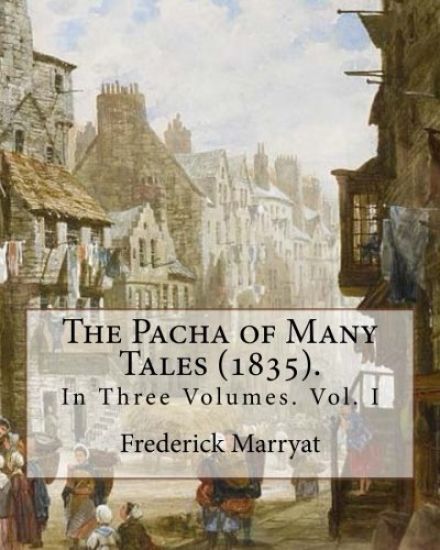
The Pacha of Many Tales (1835).By: Frederick Marryat and By: Thomas Hardy (3 March 1752 - 11 October 1832): In Three Volumes. Vol. I
Thomas Hardy (3 March 1752 - 11 October 1832) was an early Radical, and the founder, first Secretary, and Treasurer of the London Corresponding Society... Captain Frederick Marryat (10 July 1792 - 9 August 1848) was a British Royal Navy officer, a novelist, and an acquaintance of Charles Dickens. He is noted today as an early pioneer of the sea story, particularly for his semi-autobiographical novel Mr Midshipman Easy (1836), for his children's novel The Children of the New Forest (1847), and for a widely used system of maritime flag signalling, known as Marryat's Code. Early life and naval career: Marryat was born in Great George Street, Westminster, London, the son of Joseph Marryat (1757-1824), a "merchant prince" and member of Parliament, and his American wife Charlotte, n e von Geyer. After trying to run away to sea several times, Marryat was permitted to enter the Royal Navy in 1806 as a midshipman on board HMS Imperieuse, a frigate commanded by Lord Cochrane (who later served as inspiration for Marryat as well as other authors). Marryat's time aboard the Imperieuse included action off the Gironde, the rescue of a fellow midshipman who had fallen overboard, captures of many ships off the Mediterranean coast of Spain, and the capture of the castle of Montgat. The Imperieuse shifted to operations in the Scheldt in 1809, where Marryat contracted malaria; he returned to England on the 74-gun HMS Victorious. After recuperating, Marryat returned to the Mediterranean in the 74-gun HMS Centaur and again saved a shipmate by leaping into the sea after him. He then sailed as a passenger to Bermuda in the 64-gun HMS Atlas, and from there to Halifax, Nova Scotia on the schooner HMS Chubb, where he joined the 32-gun frigate HMS Aeolus on 27 April 1811. A few months later, Marryat again earned distinction by leading the effort to cut away the Aeolus's mainyard to save the ship during a storm and, continuing a pattern, he also saved one of the men from the sea. Shortly thereafter, he moved to the frigate HMS Spartan, participating in the capture of a number of American ships (the War of 1812 having begun). On 26 December 1812, he was promoted to lieutenant, and as such served in the sloop HMS Espiegle and in HMS Newcastle. Marryat led four barges from the latter ship on a punishing raid to Orleans, Massachusetts on December 19, 1814, the last combat in New England during the war. The affair had mixed results. Initially, Marryat cut out an American schooner and three sloops, but managed to escape with just one sloop. The local militia avoided casualties while killing one Royal marine. He was promoted to commander on 13 June 1815, just as peace broke out..........
Selected Poems of Thomas Hardy

Selected Poems of Thomas Hardy

Thomas Hardy

Penguin USA
1998
pokkari
Thomas Hardy abandoned the novel form at the turn of the century, probably after public reaction to Jude the Obscure, but continued to write verse displaying a wide variety of metrical styles and stanza forms and a broad scope of tone and attitude. This definitive volume contains selections from his numerous collections published between 1898 and 1928. For more than seventy years, Penguin has been the leading publisher of classic literature in the English-speaking world. With more than 1,700 titles, Penguin Classics represents a global bookshelf of the best works throughout history and across genres and disciplines. Readers trust the series to provide authoritative texts enhanced by introductions and notes by distinguished scholars and contemporary authors, as well as up-to-date translations by award-winning translators.
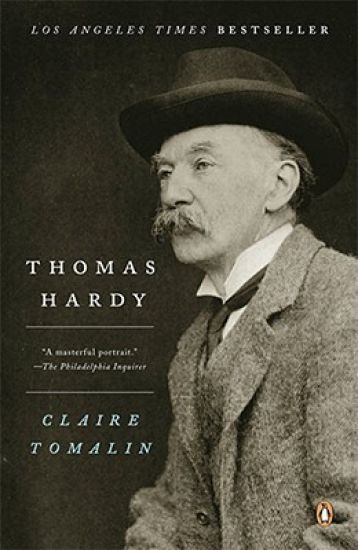
Thomas Hardy

Thomas Hardy

Claire Tomalin

PENGUIN BOOKS
2008
nidottu
"A masterful portrait" (The Philadelphia Inquirer) from a Whitbread Award-winning biographer, and author of A Life of My Own. The novels of Thomas Hardy have a permanent place on every booklover's shelf, yet little is known about the interior life of the man who wrote them. A believer and an unbeliever, a socialist and a snob, an unhappy husband and a desolate widower, Hardy challenged the sexual and religious conventions of his time in his novels and then abandoned fiction to reestablish himself as a great twentieth-century lyric poet. In this acclaimed new biography, Claire Tomalin, one of today's preeminent literary biographers, investigates this beloved writer and reveals a figure as rich and complex as his tremendous legacy.
Thomas Hardy's 'Studies, Specimens &c.' Notebook
Thomas Hardy's Studies, Specimens &c. notebook stands almost alone as a witness to his exertions and aspirations of the 1860s, when he was already in his middle twenties but still working in London as an architectual assistant and only tentatively feeling his way towards as yet dimly glimpsed possibilities of literary expression and employment. Because so little documentation of any kind has survived for this early period of his life and work, the notebook is of extraordinary interest as containing detailed evidence of the untutored deliberateness with which Hardy was seeking to provide himself with a poetic background, educate himself in poetic techniques, and initiate a process from which he could perhaps emerge as a practising, even a publishing, poet. In private hands until very recently, and seen by only a very few scholars, Studies, Specimens &c.' dates from 1865-68, is entirely in Hardy's own hand, and consists of eighty-eight closely written pages of working memoranda, and quotations from other poets - mostly extracts a few words long in which underlining has been used to highlight individual images and word-usages. Although no drafts of actual poems are present, there are numerous instances of Hardy's seeking to generate a poetic, and sometimes erotic, language and imagery out of materials (e.g., an architectual textbook) apparently chosen precisley for their recalcitrance to such treatment. The edition itself seeks to reproduce typographically all essential features of the original document. The introductory material describes the notebook bibliographically, sets it in its biographical context, and discusses some of its more important technical features. Included in the extensive apparatus are textual notes, explications of Hardy's occasional quotations - indicating, in most instances, the editions or actual volumes he certainly or probably used. Explanatory notes are provided for - among other things - some erased but now partly recoved memoranda of Hardy's that appear to have significant biographical implications.
The Collected Letters of Thomas Hardy: Volume 7: 1926-1927
The opening section of this seventh and final volume of the definitive edition of Thomas Hardy's letters covers the period from January 1926 to December 1927: his last letter, to Edmund Gosse, was written on Christmas Day 1927 and he died seventeen days later, on 11 January 1928. Although few of his long-standing personal correspondences were actively kept up during these last two years of his life, Hardy maintained (especially when writing to Sir Frederick Macmillan) a lively and practical interest in all aspects of his work and career; he also responded, usually with a courteous refusal, to the many requests and enquiries that his fame inevitably attracted. The second section is devoted to letters which became available too late for publication in their correct chronological sequence in earlier volumes of the edition; those now added date mostly from the nineteenth century, and include a series of letters to officials of the Duchy of Cornwall about the purchase of land on which Max Gate was built, as well as numerous individual letters of considerable interest and importance. This volume contains more than 350 letters, the great majority of them previously unpublished, which are supplemented, as before, by scrupulous annotation and extensive cross-referencing; by a chronology covering the whole of Hardy's career; and by an index of recipients of the letters included. As the concluding volume, however, it also incorporates an extensive General Index covering the texts and annotations of the entire edition.
The Complete Poetical Works of Thomas Hardy: Volume IV: The Dynasts, Parts First and Second
Volumes IV and V of the Complete Poetical Works of Thomas Hardy, which complete the edition, contain all of his dramatic writing in verse. Hardy was interested in dramatic verse all his adult life; before he wrote his first novel he considered writing plays in blank verse, and during the thirty years of his novel-writing career he entered in his notebooks many schemes for a vast poetic drama of England's wars with Napoleon. But is was not until after he had turned from fiction to poetry, in the 1890s, that he actually began to work on a poetic drama. The Dynasts was written between 1902 and 1907; The Famous Tragedy of the Queen of Cornwall was begun in 1916 and completed in 1923. In addition to the two major dramas this volume includes Hardy's versions of two folk-pieces: the Mummers' Play of 'Saint George' and the rustic operetta O'Jan, O'Jan, O'Jan' (here published for the first time). Textual annotations, together with a full account of the rough draft of Part third of The Dynasts, make it possible for the reader to follow the history of the composition of Hardy's epic drama in unusual detail. Explanatory notes to each of the dramatic works describe its composition and publication, and provide supporting material from Hardy's letters and notebooks. Appendices add further information on the production and performance of these works.
The Complete Poetical Works of Thomas Hardy: Volume V: The Dynasts, Part Third; The Famous Tragedy of the Queen of Cornwall; The Play of 'Saint George'; 'O Jan, O Jan, O Jan'
Volumes IV and V of the Complete Poetical Works of Thomas Hardy, which complete the edition, contain all of his dramatic writing in verse. Hardy was Hardy was interested in dramatic verse all his adult life; before he wrote his first novel he considered writing plays in blank verse, and during the thirty years of his novel-writing career he entered in his notebooks many schemes for a vast poetic drama of England's wars with Napoleon. But it was not until after he had turned from fiction to poetry, in the 1890s, that he actually began to work on a poetic drama. The Dynasts was written between 1902 and 1907; the Famous Tragedy of the Queen of Cornwall was began in 1916 and completed in 1923. In addition to the two major dramas this volume includes Hardy's versions of two folk-pieces: the Mummers'Play of 'Saint George'and the rustic operetta O'Jan. O'Jan, O'Jan'(here published for the first time). Textual annotations, together with a full account of the rough draft of Part Third of The Dynasts, make it possible for the reader to follow the history of the composition of Hardy's epic drama in unusual detail. Explantory notes to each of the dramatic works describe its composition and publication, and provide supporting material from Hardy's letters and notebooks. Appendices add further information on the production and performance of these works.
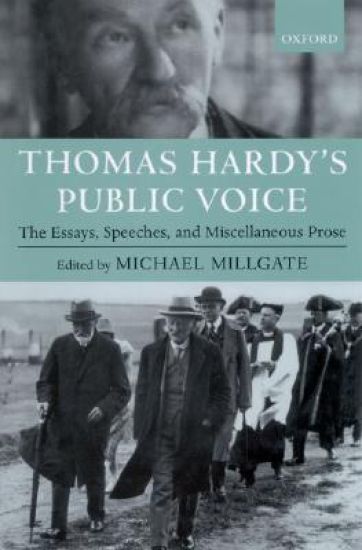
Thomas Hardy's Public Voice

Thomas Hardy's Public Voice

Thomas Hardy

Clarendon Press
2001
sidottu
Thomas Hardy has generally been viewed as an intensely private figure, shy of publicity and even of people, self-isolated in his Dorsetshire home, and much more cautious and conservative in his personal outlook than might be expected of the author of Tess of the D'Ubervilles and Jude the Obscure. What the present volume reveals is that Hardy's public utterances, addressed to a wide range of literary, social, and political issues, were far more numerous and various than has previously been imagined. His essays, speeches, and other acknowledged pieces, both formal and informal, are here fully described, edited, and annotated, together with the letters he wrote to newspapers and the many unsigned items, from obituaries to clandestine contributions to literary gossip-columns, that have now been securely or tentatively identified. Also described, although not necessarily reproduced, are his designs for tombstones and memorials, and some of the more striking instances of his lending his (immensely famous) name to causes and organizations of which he approved and to public letters initiated by others. The edition as a whole is thus a major work of textual scholarship and a rich source of fresh and often surprising information about a little understood aspect of Hardy's life and work.
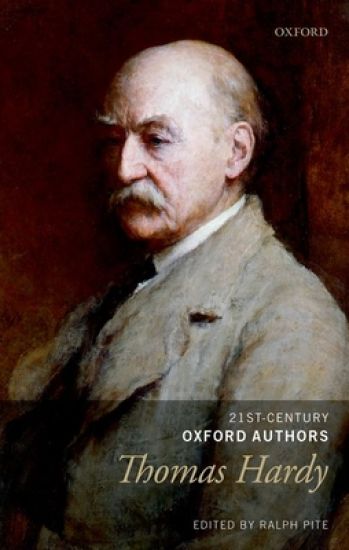
Thomas Hardy

Thomas Hardy

Oxford University Press
2021
sidottu
This volume in the 21st Century Oxford Authors series offers students an authoritative, comprehensive selection of the work of Thomas Hardy--the first for nearly thirty years. The edition presents the poetry in a new way by giving the texts of Hardy's original volumes, as they first appeared, instead of the revised text he later produced for his Collected Poems. It reveals the range and variety of his output--qualities he later tended to disguise. His most famous sequence, the 'Poems of 1912-13' appears in a radically different form. Selections from his epic drama, The Dynasts, are given within the chronological sequence of his poetry, illustrating the power of this neglected work. Notebook and journal entries, where Hardy puts forward his understanding of poetry and the role of the poet, are also included. Uniquely generous in the number of poems it contains, this edition also provides extensive annotation, locating Hardy's work in its cultural context and reading it in the light of the critical reception. The notes direct attention towards Hardy's regional heritage, and they show his response to the issues and debates of his day--to discussions surrounding war, patriotism, the treatment of animals, marriage, and religion, among others. The annotation locates, in addition, how Hardy's work has continued to speak to present-day readers, by addressing present-day concerns--in particular, gender, including the gender(s) of the poetic voice, the global and (or versus) the local, and, thirdly, humanity's place within the natural world. The edition also includes an Introduction to the life and works of Hardy, and a Chronology.