Kirjojen hintavertailu. Mukana 11 342 296 kirjaa ja 12 kauppaa.

Kirjahaku

Etsi kirjoja tekijän nimen, kirjan nimen tai ISBN:n perusteella.

1000 tulosta hakusanalla Thomas J. Buckholtz

Create Crucial Insight: Use Direct Outcomes checklists. Think well. Do great.

Create Crucial Insight: Use Direct Outcomes checklists. Think well. Do great.

Thomas J. Buckholtz

Createspace Independent Publishing Platform
2011
nidottu
Insight matters. People use insight to be aware, to plan, to achieve, and to appreciate achievements. Needs for crucial insight range from personal to global.Now, you can use Direct Outcomes checklists to create crucial insight - easily and quickly - throughout your work. People use Direct Outcomes to frame issues, solve problems, and create opportunities.Address pivotal questions such as the following. "What services do our customers need?" "What do we need to do?" "How well do we need to do it?" "Who best should do it?" "What impact will it have?" "What should we say?" "What else should we consider?" Gain crucial, situation-specific insight.Dr. Thomas J. Buckholtz wrote this book so that you can use Direct Outcomes, think well, create crucial insight, use the insight, do great, and thrive.
Physics Beyond Spin One: Small Things and Vast Effects

Physics Beyond Spin One: Small Things and Vast Effects

Thomas J. Buckholtz

Createspace Independent Publishing Platform
2014
nidottu
Math models may resolve about 10 particle-physics and astrophysics problems. The models use harmonic-oscillator math. The models correlate with Standard Model basic particles. The models seem to correlate with the following. A family of zero-mass bosons includes photons, gravitons, and spin-3 and spin-4 particles. Effects of the family govern the rate of expansion of the universe. Dark matter and dark energy consist of up to two kinds of stuff. One kind features peers of baryonic matter. The other kind includes fermions with spins 3/2 and 7/2. C, P, and T violations exceed amounts correlating with models limited to spins that do not exceed 1. Reactions led to matter/antimatter imbalance. Gravitons and some spin-1 bosons correlate with neutrino oscillations. Some ratios correlating with particle masses feature integers. Basic fermions have 3 generations. Possibly-infinite zero-point vacuum energy need not be a concern. Thomas J. Buckholtz invites you to read, enjoy, learn, and extend work Physics Beyond Spin One discusses.
Physics Math Reset: Small Things and Vast Effects

Physics Math Reset: Small Things and Vast Effects

Thomas J. Buckholtz

Createspace Independent Publishing Platform
2014
nidottu
For decades, people layered quantum mechanics on top of math for classical physics. Math models fail to correlate with numerous elementary-particle and astrophysics phenomena. We reset the basis for some mathematical physics. We start from quantum phenomena and from math for quantum harmonic oscillators. We solve or point to how to solve more than 10 well-known problems. What elementary particles remain to be discovered? What symmetries encompass Standard Model symmetries? How can models unify gravity and electromagnetism? What masses do neutrinos and leptoquarks have? What might dark matter and dark energy be? Why does the Standard Model underestimate symmetry violations? Why do fermions have 3 generations? Why is there much more matter than antimatter? What interactions lead to neutrino oscillations? Why does the universe's rate of expansion change? Why is the universe flat? Models in this book address all these topics. Thomas J. Buckholtz invites you to read, enjoy, learn, and extend work Physics Math Reset discusses.
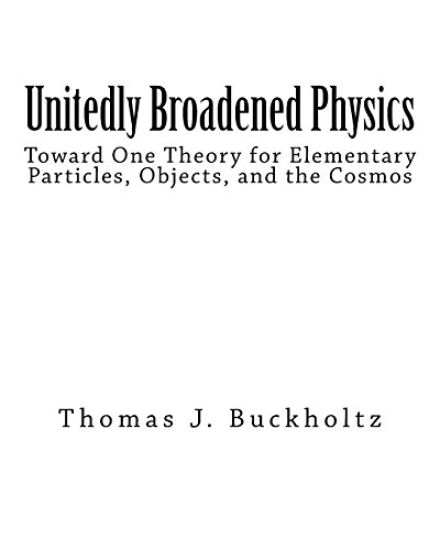
About Much Physics: United Models and Specific Predictions

About Much Physics: United Models and Specific Predictions

Thomas J. Buckholtz

Createspace Independent Publishing Platform
2018
nidottu
We address four physics opportunities. First, suggest new elementary particles and forces. Second, explain phenomena such as dark matter. Third, augment and unite physics theories and models. Fourth, point to opportunities for further research. We use models based on solutions to equations featuring isotropic pairs of isotropic quantum harmonic oscillators. First, we show solutions that match the known elementary particles. We propose that other solutions correlate with elementary particles that people have yet to detect and with dark energy forces leading to three known eras - early acceleration, subsequent deceleration, and current acceleration - pertaining to the rate of expansion of the universe. Second, we extend solutions to encompass known conservation-law symmetries. Extended solutions correlate with known kinematics. We suggest that extended solutions describe dark matter, explain ratios of density of dark matter to density of ordinary matter, correlate with dark energy density, and explain other phenomena. Third, we propose that our work unites, suggests details regarding, extends, suggests complements to, and suggests limits regarding aspects of traditional physics theory. Those aspects include classical physics, special relativity, general relativity, quantum mechanics, the elementary particle Standard Model, the cosmology timeline, and galaxy evolution scenarios. The work provides possible insight regarding foundation of physics topics. Fourth, we suggest opportunities for people. We suggest opportunities for observational, experimental, and theoretical physics research. We suggest quantum field theory that features few interaction vertices, sums of few terms as alternatives to conditionally convergent sums of infinite numbers of terms, and no needs to deal with some infinities. We point to possible opportunities to further develop and apply modeling and math we use.
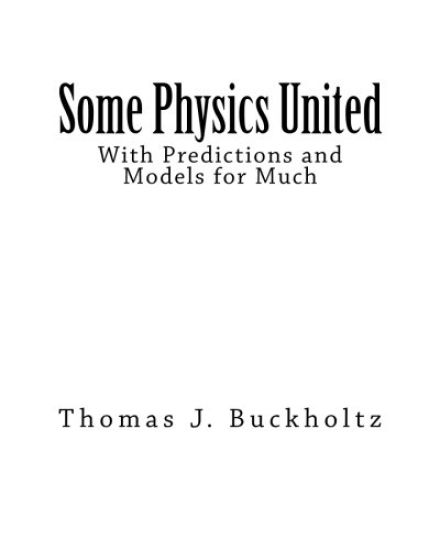
Some Physics United: With Predictions and Models for Much

Some Physics United: With Predictions and Models for Much

Thomas J. Buckholtz

Createspace Independent Publishing Platform
2018
nidottu
We address four physics opportunities. First, predict new elementary particles and forces. Second, explain phenomena such as dark matter. Third, unite physics theories and models. Fourth, point to opportunities for further research. We use models based on solutions to equations featuring isotropic pairs of isotropic quantum harmonic oscillators. First, we show solutions that match the known elementary particles. We propose that other solutions correlate with elementary particles that people have yet to detect and with dark energy forces leading to the three known eras - initial acceleration, subsequent deceleration, and current acceleration - pertaining to the rate of expansion of the universe. Second, we extend solutions to encompass known conservation-law symmetries. We note that extended solutions correlate with known kinematics. We propose that extended solutions describe dark matter, explain ratios of density of dark matter to density of ordinary matter, correlate with dark energy density, and explain other phenomena. Third, we note that the work unites, extends, and limits aspects of traditional physics. Those aspects include classical physics, special relativity, general relativity, quantum mechanics, the elementary particle Standard Model, and the cosmology timeline. The work provides possible insight regarding foundations of physics topics. Fourth, we suggest opportunities for people. We suggest opportunities for observational, experimental, and theoretical physics research. We point to possible opportunities to further develop and apply math we use.
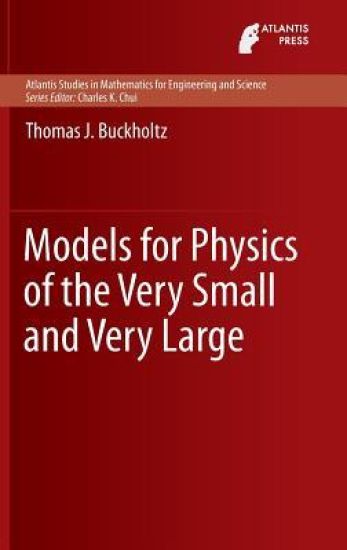
Models for Physics of the Very Small and Very Large

Models for Physics of the Very Small and Very Large

Thomas J. Buckholtz

Atlantis Press (Zeger Karssen)
2016
sidottu
This monograph tackles three challenges. First, show a mathematics-based meta-model that matches known elementary particles. Second, apply models, based on the meta-model, to match other known physics data. Third, predict future physics data. The math features solutions to isotropic pairs of isotropic quantum harmonic oscillators. This monograph matches some solutions to known elementary particles. Matched properties include spin, types of interactions in which the particles partake, and (for elementary bosons) approximate masses. Other solutions point to possible elementary particles. This monograph applies the models and the extended particle list. Results narrow gaps between physics data and theory. Results pertain to elementary particles, astrophysics, and cosmology. For example, this monograph predicts properties for beyond-the-Standard-Model elementary particles, proposes descriptions of dark matter and dark energy, provides new relationships between known physics constants (including masses of some elementary particles), includes theory that dovetails with the ratio of dark matter to ordinary matter, includes math that dovetails with the number of elementary-fermion generations, suggests forces that govern the rate of expansion of the universe, and suggests additions to and details for the cosmology timeline.
Thomas J. Wise

Thomas J. Wise

University of Texas Press
1960
pokkari
Thomas James Wise (1859–1937), though destined to receive in his own lifetime practically every honor the world of letters could bestow, is remembered today as perhaps the greatest malefactor in all of literary history. From 1934 to 1957 various enquiries have implicated him first in the manufacture of more than fifty predated "original" editions of eminent Victorian authors, then in seven additional forgeries, later in countless piracies of other nineteenth-century work, and finally in repeated acts of vandalism upon forty-one seventeenth-century plays. It is fitting that Wise himself appears as a contributor to this volume. Included are his original introduction to the Browning Library, his letters to bookseller J. E. Cornish, his extraordinary letter to Sir Edmund Gosse, and a note to H. Buxton Forman. These Centenary Studies review the course of research over twenty-five years, designate topics requiring further investigation, and assess new evidence of Wise's villainies. One more forgery is identified, the provenance of others reexamined, the forger's method of purveying his wares closely appraised, his association with H. Buxton Forman and Sir Edmund Gosse more precisely defined, and the range of his activities summarized in an annotated handlist. The record includes at least 400 printings directly attributed to Wise, as well as 23 suppressed or abortive issues, and 29 others in which he seems to be somewhat involved. Through these perspectives the culprit appears even more contemptible and, possibly for this very reason, ever more intriguing as a cause célèbre in literary scholarship. The illustration on the cover of this book reproduces, through a magnifying glass, the peculiar question mark appearing in certain forgeries printed for Wise by the firm of Richard Clay & Sons. The mark may also implicate Wise in other irregular printings, including The Death of Balder.
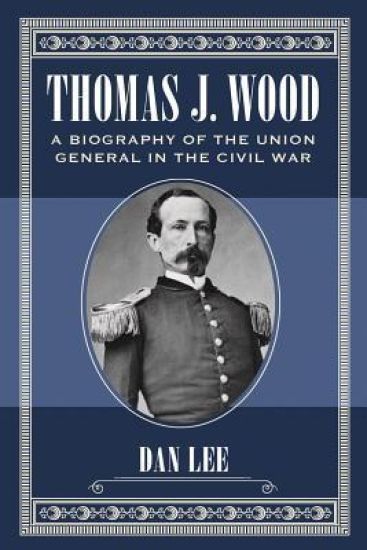
Thomas J. Wood

Thomas J. Wood

Dan Lee

McFarland Co Inc
2012
pokkari
Thomas J. Wood, Kentuckian, graduated fifth in his West Point class in 1846 and joined the staff of General Zachary Taylor. The Mexican War was just beginning and Wood fought in several battles after which he served under General Winfield Scott in Mexico City. In 1861, Wood became a brigadier general of volunteers and began his Civil War service with the Army of the Cumberland, with whom he fought in every campaign and most of its major battles. Wood has never before been the subject of a full length biography but is well known for a notorious lapse of judgment resulting in a Confederate breakthrough at Chickamauga that shattered the Union right flank and threatened the survival of the Army of the Cumberland. It is a moment in the war still argued about. Wood learned from his mistake, became a better general from that time on (notably at Missionary Ridge and Nashville), and redeemed himself in the eyes of his fellow officers and his civilian superiors.
Two Soldiers: The Campaign Diaries of Thomas J. Key, and Robert J. Campbell

Two Soldiers: The Campaign Diaries of Thomas J. Key, and Robert J. Campbell

Thomas J. Key; Robert J. Campbell; Wirt Armistead Cate

Literary Licensing, LLC
2011
sidottu
""Two Soldiers: The Campaign Diaries of Thomas J. Key and Robert J. Campbell"" is a historical book that provides a firsthand account of the American Civil War. The book is a compilation of the personal diaries of two soldiers - Thomas J. Key and Robert J. Campbell - who fought on opposite sides of the war. Key was a Confederate soldier from Virginia, while Campbell was a Union soldier from Ohio.The diaries cover the period from 1861 to 1865 and provide an intimate look at the daily lives of soldiers during the war. The entries detail the harsh conditions of camp life, the brutality of battle, and the toll that the war took on both the soldiers and their families.Through their diaries, Key and Campbell provide unique perspectives on the war and its impact on the nation. Their accounts offer insights into the motivations and experiences of soldiers on both sides of the conflict, and shed light on the complex political and social issues that led to the war.Overall, ""Two Soldiers"" is a fascinating and informative book that provides a valuable window into one of the most significant events in American history.The Campaign Diaries Of Thomas J. Key, December 7, 1863 To May 17, 1865 And Robert J. Campbell January 1, 1864 To July 21, 1864.This scarce antiquarian book is a facsimile reprint of the old original and may contain some imperfections such as library marks and notations. Because we believe this work is culturally important, we have made it available as part of our commitment for protecting, preserving, and promoting the world's literature in affordable, high quality, modern editions, that are true to their original work.