The New York Times bestseller?and the candid voice of an American president In 1974, Newsweek correspondent Thomas M. DeFrank was interviewing Gerald Ford when the Vice President blurted out something astonishingly indiscreet. He then extracted a promise not to publish it. ?Write it when I?m dead, ? Ford said? and thus began a thirty-two-year relationship. During the last fifteen years of their conversations, Ford opened up to DeFrank, speaking in a way few presidents ever have. Here the award-winning journalist reveals these private talks, as Ford discusses his experiences with his fellow presidents, the Warren Commission, and his exchanges with Bill Clinton during the latter's impeachment process. In addition, he shares his thoughts about both Bush administrations, the Iraq war, his beloved wife Betty, and the frustrations of aging. Write It When I?m Gone is not only a historical document but an unprecedented portrait of a president.
Peter Baker; Martha Joynt Kumar; Rita Kirk; David Demarest; Roderick P Hart; Thomas M. DeFrank; Stephen A Smith; Tony Pedersen; Robert W Mong; George C Edwards; Jennifer R. Mercieca; Stacia Deshishku; Jon Meacham
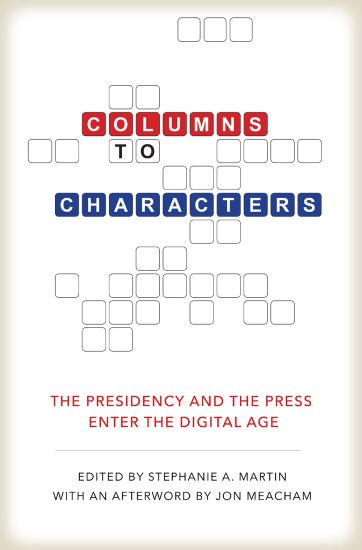
The relationship between the presidency and the press has transformed—seemingly overnight—from one where reports and columns were filed, edited, and deliberated for hours before publication into a brave new world where texts, tweets, and sound bites race from composition to release within a matter of seconds. This change, which has ultimately made political journalism both more open and more difficult, brings about many questions, but perhaps the two most important are these: Are the hard questions still being asked? Are they still being answered?In Columns to Characters, Stephanie A. Martin and top scholars and journalists offer a fresh perspective on how the evolution of technology affects the way presidents interact with the public. From Bill Clinton’s saxophone playing on the Arsenio Hall Show to Barack Obama’s skillful use of YouTube, Twitter, and Reddit as the first “social media president,” political communication appears to reflect the increasing fragmentation of the American public.The accessible essays here explore these implications in a variety of real-world circumstances: the “narcotizing” numbness of information overload and voter apathy; the concerns over privacy, security, and civil liberties; new methods of running political campaigns and mobilizing support for programs; and a future “post-rhetorical presidency” in which the press is all but irrelevant. Each section of the book concludes with a “reality check,” a short reflection by a working journalist (or, in one case, a former White House insider) on the presidential beat.
In the Platonic, Neopythagorean, Middle Platonic and Neoplatonic schools of philosophy, the demiurge is an artisan-like figure responsible for fashioning and maintaining the physical universe. The term was adopted by the Gnostics. Although a fashioner, the demiurge is not necessarily the same as the creator figure in the monotheistic sense, because the demiurge itself and the material from which the demiurge fashions the universe are both considered to be consequences of something else. Depending on the system, they may be considered to be either uncreated and eternal, or considered to be the product of some other entity.
Public Policy And The Dead Hand: The Thomas M. Cooley Lectures, Sixth Series is a book written by Lewis M. Simes. The book is a collection of lectures given by the author on the topic of public policy and the influence of the ""dead hand"" on policymaking. The term ""dead hand"" refers to the influence of past decisions and institutions on current policy decisions. The book is divided into six chapters, each of which explores a different aspect of public policy and the dead hand. The first chapter provides an overview of the concept of the dead hand and its impact on policymaking. The second chapter looks at the role of institutions in shaping public policy and the challenges of reforming these institutions. The third chapter focuses on the role of the judiciary in shaping public policy and the impact of judicial decisions on policymaking. The fourth chapter examines the role of interest groups in shaping public policy and the challenges of balancing their interests with the public interest. The fifth chapter looks at the role of experts in shaping public policy and the challenges of ensuring that their expertise is used effectively. The final chapter provides a summary of the book's main arguments and offers recommendations for policymakers and scholars interested in addressing the challenges posed by the dead hand.Overall, Public Policy And The Dead Hand: The Thomas M. Cooley Lectures, Sixth Series offers a comprehensive and insightful analysis of the challenges facing policymakers in the United States and the impact of past decisions and institutions on current policy decisions. The book is recommended for policymakers, scholars, and anyone interested in the intersection of public policy and institutional reform.Five Lectures Delivered At The University Of Michigan February 7, 8, 9, 14, And 15, 1955.This scarce antiquarian book is a facsimile reprint of the old original and may contain some imperfections such as library marks and notations. Because we believe this work is culturally important, we have made it available as part of our commitment for protecting, preserving, and promoting the world's literature in affordable, high quality, modern editions, that are true to their original work.