

Kirjahaku
Etsi kirjoja tekijän nimen, kirjan nimen tai ISBN:n perusteella.
1000 tulosta hakusanalla Thomas Moyer


Cranston Revisited
Sandra M Moyer; Thomas A Worthington
Arcadia Publishing Library Editions
2014
sidottu

The Plants, Birds And Mammals Of Bucks County, Pennsylvania (1876)
Joseph Thomas; I. S. Moyer
KESSINGER PUBLISHING, LLC
2009
nidottu

The Plants, Birds And Mammals Of Bucks County, Pennsylvania (1876)
Joseph Thomas; I. S. Moyer
KESSINGER PUBLISHING, LLC
2010
sidottu

The Studio Reader – On the Space of Artists
Mary Jane Jacob; Glenn Adamson; Svetlana Alpers; John Badlessari; Alice Bellony–rewold; Mary Bergstein; Walead Beshty; Andrea Bowers; Daniel Buren; Rochelle Feinstein; David J Getsy; Michelle Grabner; Rodney Graham; Amy Granat; Karl Haendel; Rachel Harrison; Caroline A Jones; Suzanne Lacy; Thomas Lawson; Lynn Lester Hershman; Shana Lutker; Annika Marie; Courtney Martin; Carrie Moyer; Bruce Nauman; Michael Peppiatt; David Reed; Lane Relyea; David Robbins; Judith Rodenbeck; Joe Scanlan; Brenda Schmahmann; Carolee Schneemann
University of Chicago Press
2010
nidottu
The image of a tortured genius working in near isolation has long dominated our conceptions of the artist's studio. Examples are abound: think Jackson Pollock dripping resin on a cicada carcass in his shed in the Hamptons. But times have changed; ever since Andy Warhol declared his art space a 'factory', artists have begun to envision themselves as the leaders of production teams, and their sense of what it means to be in the studio has altered just as dramatically as their practices. "The Studio Reader" pulls back the curtain from the art world to reveal the real activities behind artistic production. What does it mean to be in the studio? What is the space of the studio in the artist's practice? How do studios help artists envision their agency and, beyond that, their own lives? This forward-thinking anthology features an all-star array of contributors, ranging from Svetlana Alpers, Bruce Nauman, and Robert Storr to Daniel Buren, Carolee Schneemann, and Buzz Spector, each of whom locates the studio both spatially and conceptually - at the center of an art world that careens across institutions, markets, and disciplines. A companion for anyone engaged with the spectacular sites of art at its making, "The Studio Reader" reconsiders this crucial space as an actual way of being that illuminates our understanding of both artists and the world they inhabit.

Thomas Meyer: Four Poems & One Interview
Ryan Perez
Createspace Independent Publishing Platform
2015
nidottu
The St. Andrews University Press is pleased to announce a special series of digital and print chapbooks to honor the poets and writers who have published in the St. Andrews Review or through the St. Andrews University Press since 1969.

A Hauntological Investigation of the Works of Thomas Meyer
Andy Martrich
Springer Nature Switzerland AG
2026
sidottu

Thomas Starkey (c. 1495–1538) was the most Italianate Englishman of his generation. This book places Starkey into new and more appropriate contexts, both biographical and intellectual, taking him out of others in which he does not belong, from displaced Roundhead to follower of Marsilio of Padua. Beginning with his native Cheshire, it traces his career through Oxford, Padua, Paris, Avignon, Padua again, and finally England, where he spent the last four years of his life trying to fulfil his ambition to serve the commonweal. Most of Starkey’s career revolved around his patron Reginald Pole, scion of the highest nobility, but Starkey (and many other Englishmen) managed to balance loyalty to Pole with allegiance to Henry VIII. Out of favour with the king’s secretary after the middle of 1536, Starkey turned increasingly to religion, continuing to cling to his conciliarist and Italian Evangelical opinions until his death.


The Technical Analysis Course, Fourth Edition: Learn How to Forecast and Time the Market
Thomas Meyers
McGraw-Hill Professional
2011
nidottu
The Classic Introduction to Technical Analysis--Fully Updated and Revised!The most reliable method for forecasting trends and timing market turns, technical analysis is as close to a "scientific" trading approach as you can get—and it is particularly valuable in today's volatile markets. The Technical Analysis Course, Fourth Edition, provides the know-how you need to make this powerful tool part of your overall investing strategy.Through a series of lessons and exams, you'll master the techniques used by the most successful technical analysts in the market today. Updated with hundreds of real market examples, The Technical Analysis Course provides the essential foundation for using time-tested technical analysis techniques to profit from the markets. You'll learn how to:Identify profitable chart patterns, including reversals, consolidation formations, and gapsUtilize key analytical tools, including trendlines and channels, support and resistance, relative strength analysis, and volume and open interestPerform advanced analysis using moving averages, trading bands, Bollinger Bands, oscillators, the Relative Strength Index, stochastics, and moving average convergence-divergencePurchase stocks, bonds, futures, and options when prices are near their bottoms and sell when prices are close to their highsCritical Acclaim for THE TECHNICAL ANALYSIS COURSE"If you are a neophyte in the markets, this may be the book for you. It won't turn you into an overnight market wizard. You will, however, acquire an excellent grasp of market terminology and be a step ahead toward trading success and fortune."--Technical Analysis of Stocks & Commodities
The financial crisis has exposed severe shortcomings in mainstream monetary economics and modern finance. It is surprising that these shortcomings have not led to a wider debate about the need to overhaul these theories. Instead, mainstream economists have closed ranks to defend existing theories and public authorities have expanded their interference in markets.This book investigates the problems associated with mainstream monetary economics and finance, and proposes alternatives based on the Austrian school of economics. This school emanated from the work of the nineteenth-century Austrian economist Carl Menger and was developed further by Eugen von Böhm-Bawerk, Ludwig von Mises, and Friedrich August von Hayek. In monetary economics, the Austrian school regards the creation of money by banks through credit extension as a key source of economic instability. From this follows the need for a comprehensive reform of our present monetary system. In a new monetary order, money could be issued by both public and private institutions, and there would be no need for fractional reserve banking. Instead of creating money, banks would intermediate it.In finance, the Austrian school rejects the notion of rational expectations and measurable risk. Individuals use their subjective knowledge to gather and evaluate information, and they act in a world of radical uncertainty. Hence, markets are not "efficient" nor can portfolios be built on the basis of known probability distributions of asset prices as described in the modern finance literature.This book explores the need for a new theoretical foundation for asset pricing and investment management that will give practitioners more useful orientation.

In recent times, venture capital and private equity funds have become household names, but so far little has been written for the investors in such funds, the so-called limited partners. There is far more to the management of a portfolio of venture capital and private equity funds than usually perceived. Beyond the J Curve describes an innovative toolset for such limited partners to design and manage portfolios tailored to the dynamics of this market place, going far beyond the typical and often-simplistic recipe to 'go for top quartile funds'. Beyond the J Curve provides the answers to key questions, including: Why 'top-quartile' promises should be taken with a huge pinch of salt and what it takes to select superior fund managers?What do limited partners need to consider when designing and managing portfolios?How one can determine the funds' economic value to help addressing the questions of 'fair value' under IAS 39 and 'risk' under Basel II or Solvency II?Why is monitoring important, and how does a limited partner manage his portfolio?How the portfolio's returns can be improved through proper liquidity management and what to consider when over-committing?And, why uncertainty rather than risk is an issue and how a limited partner can address and benefit from the fast changing private equity environment? Beyond the J Curve takes the practitioner's view and offers private equity and venture capital professionals a comprehensive guide making high return targets more realistic and sustainable. This book is a must have for all parties involved in this market, as well as academic and students.
This title is part of UC Press's Voices Revived program, which commemorates University of California Press’s mission to seek out and cultivate the brightest minds and give them voice, reach, and impact. Drawing on a backlist dating to 1893, Voices Revived makes high-quality, peer-reviewed scholarship accessible once again using print-on-demand technology. This title was originally published in 1972.
This title is part of UC Press's Voices Revived program, which commemorates University of California Press’s mission to seek out and cultivate the brightest minds and give them voice, reach, and impact. Drawing on a backlist dating to 1893, Voices Revived makes high-quality, peer-reviewed scholarship accessible once again using print-on-demand technology. This title was originally published in 1972.

Many modern Beowulf translations, while excellent in their own ways, suffer from what Kathleen Biddick might call "melancholy" for an oral and aural way of poetic making. By and large, they tend to preserve certain familiar features of Anglo-Saxon verse as it has been constructed by editors, philologists, and translators: the emphasis on caesura and alliteration, with diction and syntax smoothed out for readability. The problem with, and the paradox of this desired outcome, especially as it concerns Anglo-Saxon poetry, is that we are left with a document that translates an entire organizing principle based on oral transmission (and perhaps composition) into a visual, textual realm of writing and reading. The sense of loss or nostalgia for the old form seems a necessary and ever-present shadow over modern Beowulfs.What happens, however, when a contemporary poet, quite simply, doesn't bother with any such nostalgia? When the entire organizational apparatus of the poem-instead of being uneasily approximated in modern verse form-is itself translated into a modern organizing principle, i.e., the visual text? This is the approach that poet Thomas Meyer takes; as he writes, " I]nstead of the text's orality, perhaps perversely I went for the visual. Deciding to use page layout (recto/ verso) as a unit. Every translation I'd read felt impenetrable to me with its block after block of nearly uniform lines. Among other quirky decisions made in order to open up the text, the project wound up being a kind of typological specimen book for long American poems extant circa 1965. Having variously the 'look' of Pound's Cantos, Williams' Paterson, or Olson or Zukofsky, occasionally late Eliot, even David Jones."A glance anywhere in Meyer's text demonstrates the stunning results. One place he turns it to especially good effect is the fight with Grendel in Fit 11, transforming the famously hyper-condensed syntax of the scene from a discouraging challenge for the translator into a visually pleasing strength: "The eyes of Hygelac's kin watched the wicked raiderexecute his quick attack: without delay, snatching his first chance, a sleeping warrior, he tore him in two, chomped muscle, sucked veins'gushing blood, gulped down his morsel, the dead man, chunk by chunk, hands, feet & all.& thenfootstephandclawfiendreachmanbedquicktrickbeastarmpainclampnewnotknownheartrunfleshofeargetawaygonowrunrunnever before hadsinherd feared anything so."Here the reader is confronted with the words themselves running together, as if in panic, in much the same way that the original passage seems in such a rush to tell the story of the battle that bodies become confused. This is just one example of the adventurous and provocative angle on Beowulf to which Meyer introduces us. His Beowulf-completed in 1972 but never before published-is sure to stretch readers' ideas about what is possible in terms of translating Anglo-Saxon poetry, as well as provide new insights on the poem itself.With a Preface by David Hadbawnik, an Introduction by Daniel C. Remein, and an Interview with Thomas Meyer.

It's the size of one's heart that matters most in this heartfelt Christmas story for young readers Alex the Christmas tree is teased because he is the smallest fir tree in the tree nursery. He can't hold as many ornaments, he can't stand as tall . . . Alex isn't sure any animal family will want him as their Christmas tree. When the families come to choose their fir tree, Alex isn't noticed at first. But then Selma, the smallest rabbit of all, discovers him. The rabbit family takes Alex home, and they all celebrate and sing together-even Alex, the littlest Christmas tree with the biggest holiday spirit Swiss best-selling author Thomas Meyer tells the story with humor and a big dose of Christmas spirit. Philippe Goossen's pictures create a warm mood, and his characters win hearts-big and small.
In this text Meyer argues that the media are transforming traditional party democracy into "media democracy". He argues that the culture of the media should be transformed in ways that would serve democracy, enabling citizens to deepen their understanding of political realities.
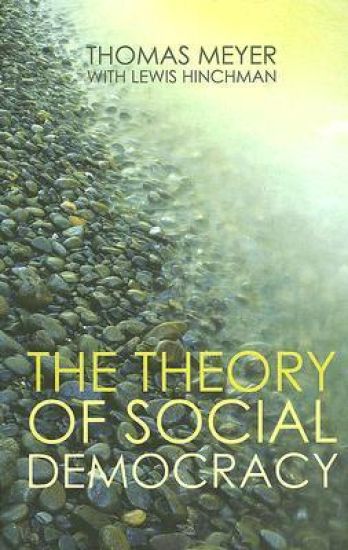
The ascendancy of neo-liberalism in different parts of the world has put social democracy on the defensive. Its adherents lack a clear rationale for their policies. Yet a justification for social democracy is implicit in the United Nations Covenants on Human Rights, ratified by most of the worlds countries. The covenants commit all nations to guarantee that their citizens shall enjoy the traditional formal rights; but they likewise pledge governments to make those rights meaningful in the real world by providing social security and cultural recognition to every person. This new book provides a systematic defence of social democracy for our contemporary global age. The authors argue that the claims to legitimation implicit in democratic theory can be honored only by social democracy; libertarian democracies are defective in failing to protect their citizens adequately against social, economic, and environmental risks that only collective action can obviate. Ultimately, social democracy provides both a fairer and more stable social order. But can social democracy survive in a world characterized by pervasive processes of globalization? This book asserts that globalization need not undermine social democracy if it is harnessed by international associations and leavened by principles of cultural respect, toleration, and enlightenment. The structures of social democracy must, in short, be adapted to the exigencies of globalization, as has already occurred in countries with the most successful social-democratic practices.

The ascendancy of neo-liberalism in different parts of the world has put social democracy on the defensive. Its adherents lack a clear rationale for their policies. Yet a justification for social democracy is implicit in the United Nations Covenants on Human Rights, ratified by most of the worlds countries. The covenants commit all nations to guarantee that their citizens shall enjoy the traditional formal rights; but they likewise pledge governments to make those rights meaningful in the real world by providing social security and cultural recognition to every person. This new book provides a systematic defence of social democracy for our contemporary global age. The authors argue that the claims to legitimation implicit in democratic theory can be honored only by social democracy; libertarian democracies are defective in failing to protect their citizens adequately against social, economic, and environmental risks that only collective action can obviate. Ultimately, social democracy provides both a fairer and more stable social order. But can social democracy survive in a world characterized by pervasive processes of globalization? This book asserts that globalization need not undermine social democracy if it is harnessed by international associations and leavened by principles of cultural respect, toleration, and enlightenment. The structures of social democracy must, in short, be adapted to the exigencies of globalization, as has already occurred in countries with the most successful social-democratic practices.