Kirjahaku
Etsi kirjoja tekijän nimen, kirjan nimen tai ISBN:n perusteella.
1000 tulosta hakusanalla Timothy W Hooker



The Warrior's Guide to the Battle of the Sexes
Timothy W. Hooker
Createspace Independent Publishing Platform
2017
nidottu
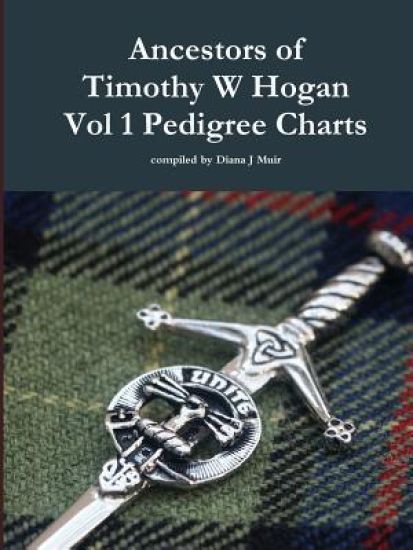
Over 75 generations of ancestors traveled from the wilds of ancient Wales, England, Scotland, Normandy and Germany to the high hillbilly country of Greene Co., Tennessee and Kentucky. Tim's ancestry includes people of several religions; Quaker, Presbyterian, Episcopal, Lutheran and Druid. The people ranged from common folk tilling the soil to Knights, Kings and Queens of Sweden, Scotland, England, Wales and Normandy, many of whom were Freemasons in the early years of the American Nation. One of his ancestors was Robert Burns, the national poet of Scotland. Tim's Warren Freemason ancestors played an integral part in the making of a new nation in Massachusetts and Pennsylvania during the American Revolutionary War. One ancestor died at Bunker Hill and his remaining family was taken care of by Benedict Arnold. Others supported the Revolution, on both sides; Loyalist and Patriot. Enjoy the journey as you identify ancestors that you've always heard about, but had no idea that you were related to.

The ancestors of Timothy Hogan can be traced from Greene County, Tennessee before the Civil War to Haddon Hall in Derbyshire, England where his ancestors were Lords and Ladies of ancient England and Wales. Many lines go back to the ancient leaders of Wales including Rhys aps Griffith and to the Merovingian Kings and Queens of Normandy, France. Timothy's Swedish line, which came to Iowa in the USA, came directly from Sweden where they can be traced back to the sea kings of Uppsala, Sweden in about 500 AD.Continuing back some of his European ancestors, they can be traced to Seleucus Nicator in ancient Syria, the father of Helen of Troy. It is easy to imagine that some of the members of the Hogan Family retained the ambition and traits of their ancient ancestors. Many of his forefathers in Colonial America were Freemasons and instrumental in forming the burgeoning American Nation.Front cover photo - Margarette Falls, Greene Co., TNRear cover photo -Haddon Hall in Derbyshire England

He was, of course, a man better known for burning books than collecting them and yet by the time he died, aged 56, Adolf Hitler owned an estimated 16,000 volumes - the works of historians, philosophers, poets, playwrights and novelists. This title provides a view of Hitler's evolution and offers insights into his emotional and intellectual world.

The world that was revolutionized by industrialization is being remade by the information revolution. But this is mostly a revolution from above, increasingly shaped by a new class of technocrats, experts, and professionals in the service of corporate capitalism. Using Marx as a touchstone, Timothy W. Luke warns that if communities are not to be overwhelmed by new class economic and political agendas, then the practice of democracy must be reconstituted on a more populist basis. However, the galvanizing force for this new, more community-centered populism will not be the proletariat, as Marx predicted, nor contemporary militant patriotic groups. Rather, Luke argues that many groups unified by a concern for ecological justice present the strongest potential opposition to capitalism. Wide-ranging and lucid, Capitalism, Democracy, and Ecology is essential reading in the age of information.

This volume uncovers the roots of electroshock in America, an outgrowth of western patriarchal medicine with primarily female patients. The history of electroshock in the United States in three historic stages is chronicled as it alternated from an enthusiastic reception in 1940, to a period of crisis in the 1960s, to its resurgence after 1980. Early American experiments with electrical medicine are also examined, while the development of electroshock in America is considered through the lens of social, political, and economic factors. The revival of electroshock in recent decades is found to be a product of growing materialism in American psychiatry and the political and economic realities of managed medical care.Kneeland and Warren suggest that the choice of electroshock, made in an era when a number of other medical therapies were available, was connected to American enthusiasm for electricity and technology in the early 20th century. Temporary rejection of electroshock in the 1960s is explained as the outcome of both an internal crisis in psychiatric authority and the external political and social pressure on psychiatry created by the civil rights movement. Scholars and students considering the history of psychology, psychiatry, science, and medicine or the history of technology will find this volume helpful.
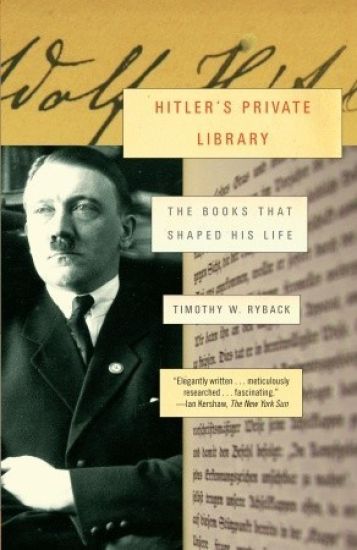
A Washington Post Notable Book With a new chapter on eugenicist Madison Grant's The Passing of the Great Race In this brilliant and original exploration of some of the formative influences in Adolf Hitler's life, Timothy Ryback examines the books that shaped the man and his thinking. Hitler was better known for burning books than collecting them but, as Ryback vividly shows us, books were Hitler's constant companions throughout his life. They accompanied him from his years as a frontline corporal during the First World War to his final days before his suicide in Berlin. With remarkable attention to detail, Ryback examines the surviving volumes from Hitler's private book collection, revealing the ideas and obsessions that occupied Hitler in his most private hours and the consequences they had for our world. A feat of scholarly detective work, and a captivating biographical portrait, Hitler's Private Library is one of the most intimate and chilling works on Hitler yet written.

This collection of essays, four of which are published in English for the first time, represents the life’s work of the historian Tim Mason, one of the most original and perceptive scholars of National Socialism, who pioneered its social and labour history. His provocative articles and essays, written between 1964 and 1990, exhibit a combination of empirical rigour and theoretical astuteness which made them landmarks in the definition and elaboration of major debates in the historiography of National Socialism. These ten essays collect together Mason’s most significant writings, including discussions of the domestic origins of the Second World War, the role of Hitler, and the character of working-class resistance, as well as his pathbreaking study of women under National Socialism, and examples of comparative work on fascism and Nazism. A complete bibliography of his publications is also appended.

This collection of essays, four of which are published in English for the first time, represents the life’s work of the historian Tim Mason, one of the most original and perceptive scholars of National Socialism, who pioneered its social and labour history. His provocative articles and essays, written between 1964 and 1990, exhibit a combination of empirical rigour and theoretical astuteness which made them landmarks in the definition and elaboration of major debates in the historiography of National Socialism. These ten essays collect together Mason’s most significant writings, including discussions of the domestic origins of the Second World War, the role of Hitler, and the character of working-class resistance, as well as his pathbreaking study of women under National Socialism, and examples of comparative work on fascism and Nazism. A complete bibliography of his publications is also appended.


Timothy W. Reardon uncovers thesalvation narrative developed within Luke-Acts and its key themes as they develop within the Lukan presentation of time and space, while being attentive to overcoming a facile compartmentalization of religion and politics. Reardon argues that Luke-Acts offers a complete, holistic, embodied, and theopolitical soteriology, cosmic in scope, that includes both the what and how of salvation. In contrast to recent arguments for some form of vicarious expiation in Luke-Acts, Reardon instead suggests that Luke-Acts’ presentation of salvation — though exhibiting elements of multiple atonement models — noticeably takes a Christus Victor form, using Irenaeus’s Christus Victorparadigm in particular as a point of comparison. Throughout this book, Reardon repeatedly demonstrates that Lukan soteriology is political, examining Jesus’ role as herald of God’s kingdom, the salvific space of heaven and the Church, and the mission of salvation. Reardon concludes that Luke-Acts is a theopolitical salvation unfolding in space, aiming toward the reconciliation of all things.
Timothy W. Reardon uncovers thesalvation narrative developed within Luke-Acts and its key themes as they develop within the Lukan presentation of time and space, while being attentive to overcoming a facile compartmentalization of religion and politics. Reardon argues that Luke-Acts offers a complete, holistic, embodied, and theopolitical soteriology, cosmic in scope, that includes both the what and how of salvation. In contrast to recent arguments for some form of vicarious expiation in Luke-Acts, Reardon instead suggests that Luke-Acts’ presentation of salvation — though exhibiting elements of multiple atonement models — noticeably takes a Christus Victor form, using Irenaeus’s Christus Victorparadigm in particular as a point of comparison. Throughout this book, Reardon repeatedly demonstrates that Lukan soteriology is political, examining Jesus’ role as herald of God’s kingdom, the salvific space of heaven and the Church, and the mission of salvation. Reardon concludes that Luke-Acts is a theopolitical salvation unfolding in space, aiming toward the reconciliation of all things.

Popular translations of the Bible are too generic for anyone to reach a definitive interpretation and often perpetuate old concepts. Tim Seid takes a bold approach to Christian origins and offers fresh translations of the earliest of the New Testament authors.In the first section of Rewriting Paul, Seid explains the foundation for a new understanding of Paul who remains a committed Jew but announces to the gentile peoples the good news that God has overlooked their sins because of the death of Jesus and has included them among the people of God. Paul writes letters of moral exhortation to household assemblies to encourage them to maintain their progress through philosophical practices to reach their greatest potential in a flourishing life.Seid provides an overview of his interpretation of 1 Thessalonians, Galatians, Philippians, Philemon, and Romans based on his translations in appendix one. The paraphrase style of the translations helps the reader to see how to read Paul within this new interpretation.


Generations Lost considers the unusual relationship between popular culture and American youth in a collection of essays touching on differing aspects of this current social crisis. Following a rash of school shootings culminating in the massacre at Columbine High, a heated national debate arose over the potentially toxic effects of contemporary culture and its voice--mass media-- on teens. Evidence suggests youth are in crisis. With absentee parents, failing schools and a lack of role models, adolescents have adopted the values and behaviors of those media-made heroes and myths they are bombarded by. Minus the steadying presence of adults to counteract this deception, they are especially vulnerable to this insidious universe of influences. Bizarre images and bogus representations of reality have distorted their perception. Television, films, video games and cyberspace contribute to their corruption. For youth, reality as adults knew and taught it to children no longer exists. This crucial difference in perception and subsequent behavior accounts for many of the extreme anti-social disorders youth now display.