Kirjahaku
Etsi kirjoja tekijän nimen, kirjan nimen tai ISBN:n perusteella.
47 tulosta hakusanalla Titu Takalo; Helena Hamari
Award-winning Finnish graphic novelist Tiitu Takalo breaks onto the U.S. scene to tell the compelling story of the fight to save a historic working-class neighborhood and a block of flats within it, Annikki, from being replaced by concrete highrises in her hometown of Tampere, Finland. Based on a true story, Me, Mikko, and Annikki masterfully interweaves tales of Annikki's rich history, the author/illustrator's own autobiographical love story with the friend who would become her partner, and their part in the legal battle to save Annikki from demolition and the community effort to restore this unique place. From the formation of the landscape by prehistoric glaciers to the stories of the women laborers who once inhabited Annikki, Takalo explores every fascinating corner of this neighborhood she now calls home. Featuring the author/illustrator's luminous full-color art throughout, this story of a historic neighborhood's preservation is by turns cautionary, thoughtful, and humorous. It will speak to anyone who has been displaced, economically or otherwise, from somewhere they love. The original Finnish text is beautifully translated and edited by Professor Helena Halmari, editor-in-chief of the Journal of Finnish Studies, and associate professor Michael Demson.
Titu Cusi
José Antonio Mazzotti
Harvard University, The David Rockefeller Center for Latin American Studies
2005
nidottu
First written in 1570, this work now published for the first time in modern Spanish with an English translation sheds light on the Inqa (Inca) world. The writing of the Instrucción followed more than a decade of negotiations and skirmishes between Inqa rebels and Spanish officials who were receiving their orders from Spain to find a diplomatic, or alternatively violent, solution to integrate these independently governed territories under Spanish colonial rule.
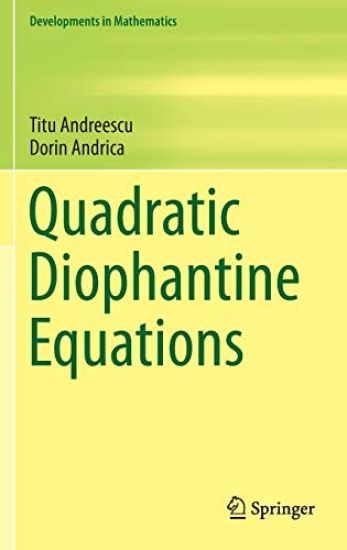
Quadratic Diophantine Equations
Titu Andreescu; Dorin Andrica
Springer-Verlag New York Inc.
2015
sidottu
This monograph treats the classical theory of quadratic Diophantine equations and guides the reader through the last two decades of computational techniques and progress in the area. These new techniques combined with the latest increases in computational power shed new light on important open problems. The authors motivate the study of quadratic Diophantine equations with excellent examples, open problems and applications. Moreover, the exposition aptly demonstrates many applications of results and techniques from the study of Pell-type equations to other problems in number theory.The book is intended for advanced undergraduate and graduate students as well as researchers. It challenges the reader to apply not only specific techniques and strategies, but also to employ methods and tools from other areas of mathematics, such as algebra and analysis.
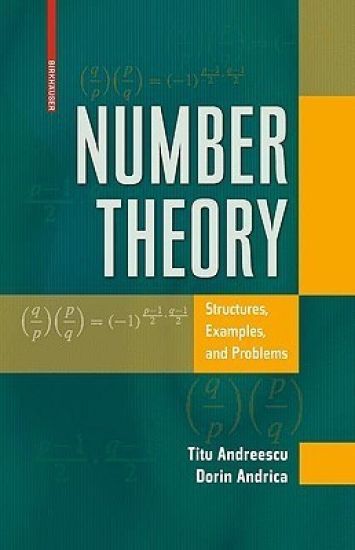
Number theory, an ongoing rich area of mathematical exploration, is noted for its theoretical depth, with connections and applications to other fields from representation theory, to physics, cryptography, and more. While the forefront of number theory is replete with sophisticated and famous open problems, at its foundation are basic, elementary ideas that can stimulate and challenge beginning students. This lively introductory text focuses on a problem-solving approach to the subject. Key features of Number Theory: Structures, Examples, and Problems: * A rigorous exposition starts with the natural numbers and the basics. * Important concepts are presented with an example, which may also emphasize an application. The exposition moves systematically and intuitively to uncover deeper properties. * Topics include divisibility, unique factorization, modular arithmetic and the Chinese Remainder Theorem, Diophantine equations, quadratic residues, binomial coefficients, Fermat and Mersenne primes and other special numbers, and special sequences. Sections on mathematical induction and the pigeonhole principle, as well as a discussion of other number systems are covered. * Unique exercises reinforce and motivate the reader, with selected solutions to some of the problems. * Glossary, bibliography, and comprehensive index round out the text. Written by distinguished research mathematicians and renowned teachers, this text is a clear, accessible introduction to the subject and a source of fascinating problems and puzzles, from advanced high school students to undergraduates, their instructors, and general readers at all levels.
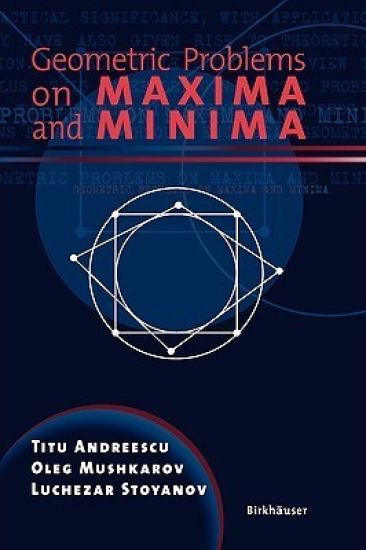
Geometric Problems on Maxima and Minima
Titu Andreescu; Oleg Mushkarov; Luchezar Stoyanov
Birkhauser Boston Inc
2005
nidottu
Questions of maxima and minima have great practical significance, with applications to physics, engineering, and economics; they have also given rise to theoretical advances, notably in calculus and optimization. Indeed, while most texts view the study of extrema within the context of calculus, this carefully constructed problem book takes a uniquely intuitive approach to the subject: it presents hundreds of extreme value problems, examples, and solutions primarily through Euclidean geometry. Written by a team of established mathematicians and professors, this work draws on the authors’ experience in the classroom and as Olympiad coaches. By exposing readers to a wealth of creative problem-solving approaches, the text communicates not only geometry but also algebra, calculus, and topology. Ideal for use at the junior and senior undergraduate level, as well as in enrichment programs and Olympiad training for advanced high school students, this book’s breadth and depth will appeal to a wide audience, from secondary school teachers and pupils to graduate students, professional mathematicians, and puzzle enthusiasts.
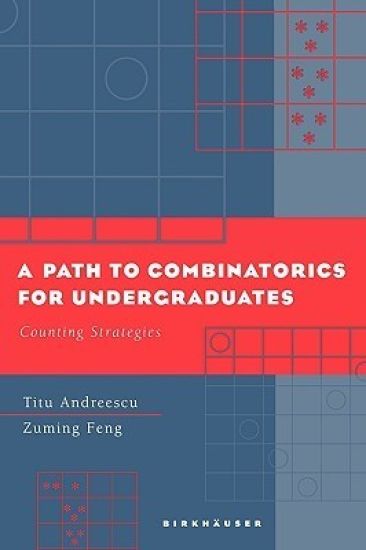
A Path to Combinatorics for Undergraduates
Titu Andreescu; Zuming Feng
Birkhauser Boston Inc
2003
nidottu
The main goal of the two authors is to help undergraduate students understand the concepts and ideas of combinatorics, an important realm of mathematics, and to enable them to ultimately achieve excellence in this field. This goal is accomplished by familiariz ing students with typical examples illustrating central mathematical facts, and by challenging students with a number of carefully selected problems. It is essential that the student works through the exercises in order to build a bridge between ordinary high school permutation and combination exercises and more sophisticated, intricate, and abstract concepts and problems in undergraduate combinatorics. The extensive discussions of the solutions are a key part of the learning process. The concepts are not stacked at the beginning of each section in a blue box, as in many undergraduate textbooks. Instead, the key mathematical ideas are carefully worked into organized, challenging, and instructive examples. The authors are proud of their strength, their collection of beautiful problems, which they have accumulated through years of work preparing students for the International Math ematics Olympiads and other competitions. A good foundation in combinatorics is provided in the first six chapters of this book. While most of the problems in the first six chapters are real counting problems, it is in chapters seven and eight where readers are introduced to essay-type proofs. This is the place to develop significant problem-solving experience, and to learn when and how to use available skills to complete the proofs.
"102 Combinatorial Problems" consists of carefully selected problems that have been used in the training and testing of the USA International Mathematical Olympiad (IMO) team. Key features: * Provides in-depth enrichment in the important areas of combinatorics by reorganizing and enhancing problem-solving tactics and strategies * Topics include: combinatorial arguments and identities, generating functions, graph theory, recursive relations, sums and products, probability, number theory, polynomials, theory of equations, complex numbers in geometry, algorithmic proofs, combinatorial and advanced geometry, functional equations and classical inequalities The book is systematically organized, gradually building combinatorial skills and techniques and broadening the student's view of mathematics. Aside from its practical use in training teachers and students engaged in mathematical competitions, it is a source of enrichment that is bound to stimulate interest in a variety of mathematical areas that are tangential to combinatorics.
103 Trigonometry Problems contains highly-selected problems and solutions used in the training and testing of the USA International Mathematical Olympiad (IMO) team. Though many problems may initially appear impenetrable to the novice, most can be solved using only elementary high school mathematics techniques. Key features: - Problem-solving tactics and strategies, along with practical test-taking techniques, provide in-depth enrichment and preparation for possible participation in various mathematical competitions - Comprehensive introduction (first chapter) to trigonometric functions, their relations and functional properties, and their applications in the Euclidean plane and solid geometry expose advanced students to college level material 103 Trigonometry Problems is a cogent problem-solving resource for advanced high school students, undergraduates, and mathematics teachers engaged in competition training.
Rooted in a pedagogically successful problem-solving approach to linear algebra, this work fills a gap in the literature that is sharply divided between, on the one end, elementary texts with only limited exercises and examples, and, at the other end, books too advanced in prerequisites and too specialized in focus to appeal to a wide audience. Instead, it clearly develops the theoretical foundations of vector spaces, linear equations, matrix algebra, eigenvectors, and orthogonality, while simultaneously emphasizing applications to fields such as biology, economics, computer graphics, electrical engineering, cryptography, and political science.Key features:* Intertwined discussion of linear algebra and geometry* Example-driven exposition; each section starts with a concise overview of important concepts, followed by a selection of fully-solved problems* Over 500 problems are carefully selected for instructive appeal, elegance, and theoretical importance; roughly half include complete solutions* Two or more solutions provided to many of the problems; paired solutions range from step-by-step, elementary methods whose purpose is to strengthen basic comprehension to more sophisticated, powerful proofs to challenge advanced readers* Appendices with review material on complex variablesIdeal as an introduction to linear algebra, the extensive exercises and well-chosen applications also make this text suitable for advanced courses at the junior or senior undergraduate level. It can serve as a colorful supplementary problem book, reference, or self-study manual for professional scientists and mathematicians. Complete with bibliography and index, this work is a natural bridge between pure/ applied mathematics and the natural/social sciences, appropriate for any student or researcher who needs a strong footing in the theory, problem-solving, and model-building that are the subject’s hallmark.
Mathematical Bridges
Titu Andreescu; Cristinel Mortici; Marian Tetiva
Birkhauser Boston Inc
2017
sidottu
Building bridges between classical results and contemporary nonstandard problems, Mathematical Bridges embraces important topics in analysis and algebra from a problem-solving perspective. Blending old and new techniques, tactics and strategies used in solving challenging mathematical problems, readers will discover numerous genuine mathematical gems throughout that will heighten their appreciation of the inherent beauty of mathematics. Most of the problems are original to the authors and are intertwined in a well-motivated exposition driven by representative examples. The book is structured to assist the reader in formulating and proving conjectures, as well as devising solutions to important mathematical problems by making connections between various concepts and ideas from different areas of mathematics.
104 Number Theory Problems
Titu Andreescu; Dorin Andrica; Zuming Feng
Birkhauser Boston Inc
2006
nidottu
This book contains 104 of the best problems used in the training and testing of the U. S. International Mathematical Olympiad (IMO) team. It is not a collection of very dif?cult, and impenetrable questions. Rather, the book gradually builds students’ number-theoretic skills and techniques. The ?rst chapter provides a comprehensive introduction to number theory and its mathematical structures. This chapter can serve as a textbook for a short course in number theory. This work aims to broaden students’ view of mathematics and better prepare them for possible participation in various mathematical competitions. It provides in-depth enrichment in important areas of number theory by reorganizing and enhancing students’ problem-solving tactics and strategies. The book further stimulates s- dents’ interest for the future study of mathematics. In the United States of America, the selection process leading to participation in the International Mathematical Olympiad (IMO) consists of a series ofnational contests called the American Mathematics Contest 10 (AMC 10), the American Mathematics Contest 12 (AMC 12), the American Invitational Mathematics - amination (AIME), and the United States of America Mathematical Olympiad (USAMO). Participation in the AIME and the USAMO is by invitation only, based on performance in the preceding exams of the sequence. The Mathematical Olympiad Summer Program (MOSP) is a four-week intensive training program for approximately ?fty very promising students who have risen to the top in the American Mathematics Competitions.
Why Olympiads? Working mathematiciansoftentell us that results in the ?eld are achievedafter long experience and a deep familiarity with mathematical objects, that progress is made slowly and collectively, and that ?ashes of inspiration are mere punctuation in periods of sustained effort. TheOlympiadenvironment,incontrast,demandsarelativelybriefperiodofintense concentration,asksforquickinsightsonspeci?coccasions,andrequiresaconcentrated but isolated effort. Yet we have foundthat participantsin mathematicsOlympiadshave oftengoneontobecome?rst-classmathematiciansorscientistsandhaveattachedgreat signi?cance to their early Olympiad experiences. For many of these people, the Olympiad problem is an introduction, a glimpse into the world of mathematics not afforded by the usual classroom situation. A good Olympiad problem will capture in miniature the process of creating mathematics. It’s all there: the period of immersion in the situation, the quiet examination of possible approaches, the pursuit of various paths to solution. There is the fruitless dead end, as well as the path that ends abruptly but offers new perspectives, leading eventually to the discoveryof a better route. Perhapsmost obviously,grapplingwith a goodproblem provides practice in dealing with the frustration of working at material that refuses to yield. If the solver is lucky, there will be the moment of insight that heralds the start of a successful solution. Like a well-crafted work of ?ction, a good Olympiad problem tells a story of mathematical creativity that captures a good part of the real experience and leaves the participant wanting still more. And this book gives us more.
An Introduction to Diophantine Equations
Titu Andreescu; Dorin Andrica; Ion Cucurezeanu
Birkhauser Boston Inc
2010
sidottu
This problem-solving book is an introduction to the study of Diophantine equations, a class of equations in which only integer solutions are allowed. The presentation features some classical Diophantine equations, including linear, Pythagorean, and some higher degree equations, as well as exponential Diophantine equations. Many of the selected exercises and problems are original or are presented with original solutions. An Introduction to Diophantine Equations: A Problem-Based Approach is intended for undergraduates, advanced high school students and teachers, mathematical contest participants - including Olympiad and Putnam competitors - as well as readers interested in essential mathematics. The work uniquely presents unconventional and non-routine examples, ideas, and techniques.
This second edition of Mathematical Olympiad Treasures contains a stimulating collection of problems in geometry and trigonometry, algebra, number theory, and combinatorics. It encourages readers to think creatively about techniques and strategies for solving real-world problems, with new sections, revisions, and many more Olympiad-like problems at various levels of difficulty.The problems are clustered by topic into three self-contained chapters. The book begins with elementary facts, followed by carefully selected problems and detailed, step-by-step solutions, which then lead to more complicated, challenging problems and their solutions. Reflecting the vast experience of two professors and Mathematical Olympiad coaches, the text will be invaluable to teachers, students, and puzzle enthusiasts. The advanced reader is challenged to find alternative solutions and extensions of the proposed problems.
It is impossible to imagine modern mathematics without complex numbers. The second edition of Complex Numbers from A to … Z introduces the reader to this fascinating subject that from the time of L. Euler has become one of the most utilized ideas in mathematics.The exposition concentrates on key concepts and then elementary results concerning these numbers. The reader learns how complex numbers can be used to solve algebraic equations and to understand the geometric interpretation of complex numbers and the operations involving them.The theoretical parts of the book are augmented with rich exercises and problems at various levels of difficulty. Many new problems and solutions have been added in this second edition. A special feature of the book is the last chapter a selection of outstanding Olympiad and other important mathematical contest problems solved by employing the methods already presented.The book reflects the unique experience of the authors. Itdistills a vast mathematical literature most of which is unknown to the western public and captures the essence of an abundant problem culture. The target audience includes undergraduate high school students and their teacher's mathematical contestants (such as those training for Olympiads or the W. L. Putnam Mathematical Competition) and their coaches as well as anyone interested in essential mathematics.
An Inca Account of the Conquest of Peru
Titu Cusi Yupanqui
University Press of Colorado
2005
nidottu
Available in English for the first time, An Inca Account of the Conquest of Peru is a firsthand account of the Spanish invasion, narrated in 1570 by Diego de Castro Titu Cusi Yupanqui - the penultimate ruler of the Inca dynasty - to a Spanish missionary and transcribed by a mestizo assistant. The resulting hybrid document offers an Inca perspective on the Spanish conquest of Peru, filtered through the monk and his scribe.Titu Cusi tells of his father's maltreatment at the hands of the conquerors; his father's ensuing military campaigns, withdrawal, and murder; and his own succession as ruler. Although he continued to resist Spanish attempts at "pacification," Titu Cusi entertained Spanish missionaries, converted to Christianity, and then, most importantly, narrated his story of the conquest to enlighten Emperor Phillip II about the behavior of the emperor's subjects in Peru. This vivid narrative illuminates the Incan view of the Spanish invaders and offers an important account of indigenous resistance, accommodation, change, and survival in the face of the European conquest. Informed by literary, historical, and anthropological scholarship, Bauer's introduction points out the hybrid elements of Titu Cusi's account, revealing how it merges native Andean and Spanish rhetorical and cultural practices. Supported in part by the Colorado Endowment for the Humanities.
History of How the Spaniards Arrived in Peru
Titu Cusi Yupanqui
Hackett Publishing Co, Inc
2006
nidottu
Catherine Julien's new translation of Titu Cusi Yupanqui's Relasçion de como los Españoles Entraron en el Peru--an account of the Spanish conquest of Peru by the last indigenous ruler of the Inca empire--features student-oriented annotation, facing-page Spanish, and an Introduction that sets this remarkably rich source in its cultural, historical, and literary contexts.
History of How the Spaniards Arrived in Peru
Titu Cusi Yupanqui
Hackett Publishing Co, Inc
2006
sidottu
Catherine Julien's new translation of Titu Cusi Yupanqui's Relasçion de como los Españoles Entraron en el Peru--an account of the Spanish conquest of Peru by the last indigenous ruler of the Inca empire--features student-oriented annotation, facing-page Spanish, and an Introduction that sets this remarkably rich source in its cultural, historical, and literary contexts.
This book is a continuation of Mathematical Olympiads 1999-2000: Problems and Solutions From Around the World, published by the Mathematical Association of America. It contains solutions to the problems from 27 national and regional contests featured in the earlier book, together with selected problems (without solutions) from national and regional contests given during 2001. In many cases multiple solutions are provided in order to encourage students to compare different problem-solving strategies. The editors have tried to present a wide variety of problems, especially from those countries that have often done well at the IMO. The problems themselves should provide much enjoyment for all those fascinated by solving challenging mathematics questions.
Mastering the Art of War by Sun Tzu: A Questions and Answers Based Approach of Mastering the Art of War by Sun Tzu
Titu Doley
Titu Doley
2017
nidottu
Are you seeking answers to following questions and many more questions like these? If yes, it is time to turn to The Art of War by Sun Tzu for the answers. Why the art of war is of vital importance to the State? In war what should be the great objective? On whom depends, whether a nation shall be in peace or in peril? What is supreme excellence in the art of war? Who provides the opportunity of defeating the enemy? When to use defensive and offensive tactics? When does a victorious strategist seek battle? What is the principle for control of large force and a few men? Which methods to use for joining battle and for securing victory? What are the two methods of attack in battle? How can you be sure of succeeding in your attack? How can you ensure the safety of your defense? What would happen if neither time nor place be known of the coming battle? In war, what to avoid and what to strike? What not to do when you surround a desperate foe? What are the besetting sins of a general, ruinous to the conduct of war? What does peace proposals unaccompanied by a signed covenant indicate? When envoys are sent with compliments in their mouths, what is it sign of? What will happen if soldiers are punished before they have grown attached to you? What are the six calamities an army is exposed to, from faults for which the general is responsible? If fighting is sure to result in victory, then what you must do, even though the ruler forbid it? If fighting will not result in victory, then what you must not do, even at the ruler's bidding? What will happen on seizing something which your opponent holds dear? Why spies are most important element in war? Which class of spies be treated with the utmost liberty?