Kirjojen hintavertailu. Mukana 11 213 693 kirjaa ja 12 kauppaa.

Kirjahaku

Etsi kirjoja tekijän nimen, kirjan nimen tai ISBN:n perusteella.

1000 tulosta hakusanalla Todd A. Finkle

Warren Buffett

Warren Buffett

Todd A. Finkle

Columbia University Press
2023
sidottu
Warren Buffett is perhaps the most accomplished investor of all time. The CEO and chair of Berkshire Hathaway has earned admiration for not only his financial feats but also the philosophy behind them. Todd A. Finkle provides striking new insights into Buffett’s career through the lens of entrepreneurship. This book demonstrates that although Buffett is thought of primarily as an investor, one of the secrets to his success has been running Berkshire as an entrepreneur.Finkle—a Buffett family friend—shares his perspective on Buffett’s early life and business ventures. The book traces the entrepreneurial paths that shaped Buffett’s career, from selling gum door-to-door during childhood to forming Berkshire Hathaway and developing it into a global conglomerate through the imaginative deployment of financial instruments and creative deal making. Finkle considers Buffett’s investment methodology, management strategy, and personal philosophy on building a rewarding life in terms of entrepreneurship. He also zeros in on Buffett’s longtime business partner, Charlie Munger, and his contributions to Berkshire’s success. Finkle draws key lessons from Buffett’s mistakes as well as his successes, using these failures to explore the ways behavioral biases can affect investors and how to overcome them.By viewing Buffett as an entrepreneur, this book offers readers a fresh take on one of the world’s best-known financial titans.
Lessons Learned From Leading Entrepreneurs

Lessons Learned From Leading Entrepreneurs

Todd A Finkle

Finkle Associates, LLC
2011
pokkari
LESSONS LEARNED FROM LEADING ENTREPRENEURS provides the reader with an opportunity to learn from some of the most successful entrepreneurs of our generation. The book provides a benchmark for readers through a step-by-step process based on famous entrepreneurs like Steve Jobs and Apple, Warren Buffett and Berkshire Hathaway, Larry Page and Sergey Brin of Google, and Wayne Huizenga, the only person to found three Fortune 500 companies: Waste Management, Inc., Blockbuster, and AutoNation. All the entrepreneurs read their cases and gave feedback, excluding Jobs. The Buffett case has received world-wide recognition as even Buffett himself acknowledged the value by inviting the author to visit him three times to Omaha. This book provides valuable lessons ranging from Buffett's keys to success (investment methodology and wealth building strategies), creating, growing, and managing a business, integrating successful corporate entrepreneurship, international entrepreneurship, acquiring a franchise, acquiring a small business, strategies to raise capital for your venture, and succession issues within family businesses.
Toward a Behavioral Ecology of Lithic Technology

Toward a Behavioral Ecology of Lithic Technology

Todd A. Surovell

University of Arizona Press
2012
nidottu
Modern humans and their hominid ancestors relied on chipped-stone technology for well over two million years and colonized more than 99 percent of the Earth's habitable landmass in doing so. Yet there currently exist only a handful of informal models derived from ethnographic observation, experiments, engineering, and 'common sense' to explain variability in archaeological lithic assemblages. Because the fundamental processes of making, using, and discarding stone tools are, at root, exercises in problem solving, Todd Surovell asks what conditions favor certain technological solutions. Whether asking if a biface should be made thick or thin or if a flake should be saved or discarded, Surovell seeks answers that extend beyond a case-by-case analysis. One avenue for addressing these questions theoretically is formal mathematical modeling. Here Surovell constructs a series of models designed to link environmental variability to human decision making as it pertains to lithic technology. To test the models, Surovell uses data from the analysis of more than 40,000 artifacts from five Rocky Mountain and Northern Plains Folsom and Goshen complex archaeological sites dating to the Younger Dryas stadial (ca. 12,600-11,500 years BP). The primary result is the production of powerful new analytical tools useful to the interpretation of archaeological assemblages. Surovell's goal is to promote modeling and explore the general issues governing technological decisions. In this light, his models can be applied to any context in which stone tools are made and used.
Stringing Together a Nation

Stringing Together a Nation

Todd A. Diacon

Duke University Press
2004
sidottu
Focusing on one of the most fascinating and debated figures in the history of modern Brazil, Stringing Together a Nation is the first full-length study of the life and career of CÂndido Mariano da Silva Rondon (1865–1958) to be published in English. In the early twentieth century, Rondon, a military engineer, led what became known as the Rondon Commission in a massive undertaking: the building of telegraph lines and roads connecting Brazil’s vast interior with its coast. Todd A. Diacon describes how, in stringing together a nation with telegraph wire, Rondon attempted to create a unified community of “Brazilians” from a population whose loyalties and identities were much more local and regional in scope. He reveals the work of the Rondon Commission as a crucial exemplar of the issues and intricacies involved in the expansion of central state authority in Brazil and in the construction of a particular kind of Brazilian nation.Using an impressive array of archival and documentary sources, Diacon chronicles the Rondon Commission’s arduous construction of telegraph lines across more than eight hundred miles of the Amazon Basin; its exploration, surveying, and mapping of vast areas of northwest Brazil; and its implementation of policies governing relations between the Brazilian state and indigenous groups. He considers the importance of Positivist philosophy to Rondon’s thought, and he highlights the Rondon Commission’s significant public relations work on behalf of nation-building efforts. He reflects on the discussions-both contemporaneous and historiographical-that have made Rondon such a fundamental and controversial figure in Brazilian cultural history.
Stringing Together a Nation

Stringing Together a Nation

Todd A. Diacon

Duke University Press
2004
pokkari
Focusing on one of the most fascinating and debated figures in the history of modern Brazil, Stringing Together a Nation is the first full-length study of the life and career of CÂndido Mariano da Silva Rondon (1865–1958) to be published in English. In the early twentieth century, Rondon, a military engineer, led what became known as the Rondon Commission in a massive undertaking: the building of telegraph lines and roads connecting Brazil’s vast interior with its coast. Todd A. Diacon describes how, in stringing together a nation with telegraph wire, Rondon attempted to create a unified community of “Brazilians” from a population whose loyalties and identities were much more local and regional in scope. He reveals the work of the Rondon Commission as a crucial exemplar of the issues and intricacies involved in the expansion of central state authority in Brazil and in the construction of a particular kind of Brazilian nation.Using an impressive array of archival and documentary sources, Diacon chronicles the Rondon Commission’s arduous construction of telegraph lines across more than eight hundred miles of the Amazon Basin; its exploration, surveying, and mapping of vast areas of northwest Brazil; and its implementation of policies governing relations between the Brazilian state and indigenous groups. He considers the importance of Positivist philosophy to Rondon’s thought, and he highlights the Rondon Commission’s significant public relations work on behalf of nation-building efforts. He reflects on the discussions-both contemporaneous and historiographical-that have made Rondon such a fundamental and controversial figure in Brazilian cultural history.
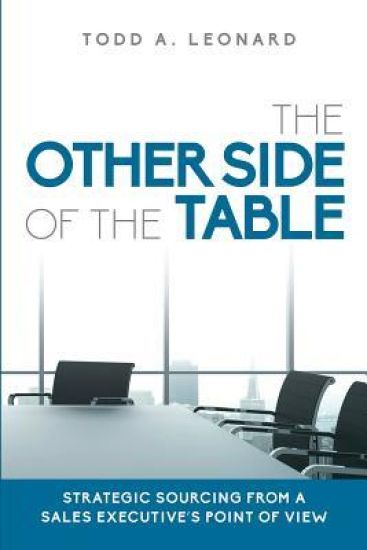
The Other Side of the Table: Strategic Sourcing from a Sales Executive's Point of View
Strategically sourcing a need, particularly a challenging or complex one, can be an intimidating process. Where do you start? When do you use a "strategic sourcing" approach versus "buying?" How do you find the right pool of potential partners and then narrow down to the optimal partner who will solve your need? How do you know when you have the best-fit solution?Todd A. Leonard guides individuals through a methodical process of how to strategically source any need, such that the outcome is good for both organizations. This includes using Requests for Information, Requests for Proposals, understanding the financial business case, and ensuring there is a measurable return on investment. This process also addresses the important elements of negotiating a good contract and leads individuals through the critical components of the implementation, ensuring that you and your company realize long-term benefits.With more than 30 years of experience as a sales executive, Todd addresses the strategic sourcing process from his perspective - called The Other Side of the Table. Supported by real-life examples, you will have the tools to be a better sourcing executive while gaining insight into what goes through the mind of a sales executive.
A Teacher's Right to a Private Life

A Teacher's Right to a Private Life

Todd A. DeMitchell; Richard Fossey

BLOOMSBURY PUBLISHING PLC
2025
nidottu
Do American professional public school teachers have the same rights to a private life as other citizens? This is an astute and incisive analysis of every teacher’s dual life – as responsible exemplars to society’s youth and as their own professional and private selves. Using historical and legal analysis to capture the tension between these two guises, it explores the balance between the weight of expectation from teachers’ communities on one hand and the need for autonomy in professional environments on the other. A Teacher’s Private Life explores some of the core questions that surround this debate: what kind of out-of-school behaviour should constitute dismissal, and what should be protected? To what extent should teachers serve as role models adhering to the values of the community in which they work? How does the special position of trust and responsibility enjoyed by teachers weigh up against their liberty to fashion a life for themselves? Should their private lives be subject to greater scrutiny than those in other professions? This is an enlightening guide for education and legal scholars, local and state level policymakers, community leaders on how the legal framework around these core issues has emerged and evolved over time.
A Teacher's Right to a Private Life

A Teacher's Right to a Private Life

Todd A. DeMitchell; Richard Fossey

BLOOMSBURY PUBLISHING PLC
2025
sidottu
Do American professional public school teachers have the same rights to a private life as other citizens? This is an astute and incisive analysis of every teacher’s dual life – as responsible exemplars to society’s youth and as their own professional and private selves. Using historical and legal analysis to capture the tension between these two guises, it explores the balance between the weight of expectation from teachers’ communities on one hand and the need for autonomy in professional environments on the other. A Teacher's Right to a Private Life explores some of the core questions that surround this debate: what kind of out-of-school behaviour should constitute dismissal, and what should be protected? To what extent should teachers serve as role models adhering to the values of the community in which they work? How does the special position of trust and responsibility enjoyed by teachers weigh up against their liberty to fashion a life for themselves? Should their private lives be subject to greater scrutiny than those in other professions?This is an enlightening guide for education and legal scholars, local and state level policymakers and community leaders on how the legal framework around these core issues has emerged and evolved over time.
Raising a Cautionary Flag

Raising a Cautionary Flag

Todd A. DeMitchell; Richard Fossey; Terri A. DeMitchell

ROWMAN LITTLEFIELD
2022
sidottu
Nearly 50 years ago a California court heard a complaint from a recent high school graduate who alleged that he could not read at a level that would allow him to apply for, let alone hold, a meaningful job. He asserted that the public school district was negligent and that his prospects for a productive life were diminished by their negligence. The court disagreed and educational malpractice was cast outside the schoolhouse gate and an educational malpractice wall was erected. In sum, both federal and state courts have constructed a sturdy wall against the recognition of educational malpractice lawsuits. However, recent advances in research on instruction, statistical analyses that some have argued can identify substandard teaching, may have cracked the wall. Thus, confluence of events may lead to demolishing the educational malpractice wall constructed over the past half century.The authors of Raising a Cautionary Flag: Educational Malpractice and the Professional Teacher, explore the judicial reticence to recognize educational malpractice as a viable tort of negligence. They review the concept of what constitutes a professional, what is malpractice and how is it related to the professional malpractice of physicians and attorneys, and the potential responses to education malpractice. They conclude by raising a cautionary flag about breaching the judicial wall.
Raising a Cautionary Flag

Raising a Cautionary Flag

Todd A. DeMitchell; Richard Fossey; Terri A. DeMitchell

BLOOMSBURY PUBLISHING PLC
2022
nidottu
Nearly 50 years ago a California court heard a complaint from a recent high school graduate who alleged that he could not read at a level that would allow him to apply for, let alone hold, a meaningful job. He asserted that the public school district was negligent and that his prospects for a productive life were diminished by their negligence. The court disagreed and educational malpractice was cast outside the schoolhouse gate and an educational malpractice wall was erected. In sum, both federal and state courts have constructed a sturdy wall against the recognition of educational malpractice lawsuits. However, recent advances in research on instruction, statistical analyses that some have argued can identify substandard teaching, may have cracked the wall. Thus, confluence of events may lead to demolishing the educational malpractice wall constructed over the past half century.The authors of Raising a Cautionary Flag: Educational Malpractice and the Professional Teacher, explore the judicial reticence to recognize educational malpractice as a viable tort of negligence. They review the concept of what constitutes a professional, what is malpractice and how is it related to the professional malpractice of physicians and attorneys, and the potential responses to education malpractice. They conclude by raising a cautionary flag about breaching the judicial wall.
To Protect a Predator

To Protect a Predator

Todd A Vandivert Ret

Independently Published
2020
pokkari
Retired Fish and Wildlife Detective Todd Vandivert's third book, TO PROTECT A PREDATOR, finds Washington State Fish and Wildlife Officer Lisa Bennington, Officer Joe Ramirez, and biologist Sunny Hagen smack in the middle of a battle between a new mine and two endangered species of predators. As the mining company works to open a new mine in the Oroville, Washington area, the mine is threatened by the possible existence of two endangered predators- Canada lynx and gray wolves. If either of the two unpopular endangered species is found in the area, the mine would be shot down before it even opens, meaning the loss of fifty plus jobs for the local residents. In the midst of receiving dozens of death threats, spurred by her work with wolves, the state's biologist goes missing. Joe and Lisa struggle to find their missing colleague, while at the same time working to protect a predator which nobody seems to want saved.
Why Does It Hurt?: The Fascial Distortion Model: A New Paradigm for Pain Relief and Restored Movement
Why Does It Hurt presents a whole new viewpoint on the way our bodies work using FDM, the Fascial Distortion Model. Fascia is the fibrous connective tissue that permeates our bodies and holds everything together. Distorted fascia is often the cause of pain that may not respond to traditional treatments of physical therapy or anti-inflammatory drugs. Thanks to FDM, patients stooped over from chronic back pain now stand straight, and athletes sidelined with sprains quickly return to the game and perform as if nothing happened. Why Does It Hurt explains how, in case after case, FDM dramatically shortens healing time, reduces the need for tests and drugs, and restores movement and well-being to patients who had given up hope.