Kirjojen hintavertailu. Mukana 11 342 296 kirjaa ja 12 kauppaa.

Kirjahaku

Etsi kirjoja tekijän nimen, kirjan nimen tai ISBN:n perusteella.

1000 tulosta hakusanalla Tom Tyler; Steven Blader

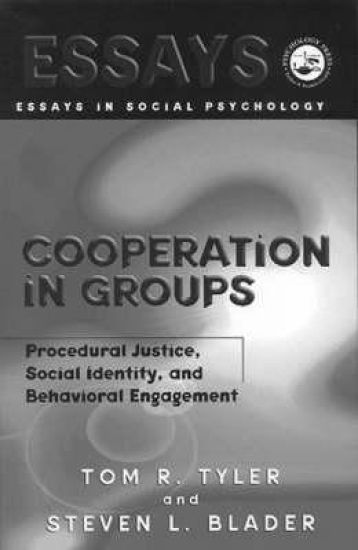
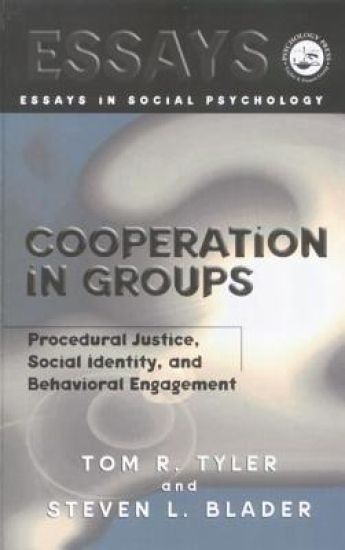
Cooperation in Groups

Cooperation in Groups

Tom Tyler; Steven Blader

Routledge
2018
nidottu
This important new book explores the psychological motives that shape the extent and nature of people's cooperative behavior in the groups, organizations and societies to which they belong. Individuals may choose to expend a great deal of effort on promoting the goals and functioning of the group, they may take a passive role, or they may engage in behaviors targeted towards harming the group and its goals. Such decisions have important implications for the group's functioning and viability, and the goal of this book is to understand the factors that influence these choices.
Cooperation in Groups

Cooperation in Groups

Tom Tyler; Steven Blader

Psychology Press Ltd
2000
sidottu
This important new book explores the psychological motives that shape the extent and nature of people's cooperative behavior in the groups, organizations and societies to which they belong. Individuals may choose to expend a great deal of effort on promoting the goals and functioning of the group, they may take a passive role, or they may engage in behaviors targeted towards harming the group and its goals. Such decisions have important implications for the group's functioning and viability, and the goal of this book is to understand the factors that influence these choices.
Season of Darkness: A Detective Inspector Tom Tyler Mystery
In 1940, England is desperate and fearful. The threat of a German invasion is real, and many German Nationals are interned in camps across the country. One such is on Prees Heath, near the small town of Whitchurch in Shropshire, where Tom Tyler is the sole detective inspector. When a young women is found murdered on a desolate country road, Tyler--who has no shortage of troubles of his own--finds himself drawn into an uneasy alliance with one of the Prees Heath internees, a psychiatrist, who claims to be an expert on the criminal mind.
The Films and Life of Tom Tyler: Cowboy, Monster, Hero
Actor Tom Tyler is perhaps yet another performer from the 1920s-1950s who may only be remembered for his work in westerns and serials, but Tyler was different from many of his peers by looking to expand his acting opportunities and successfully becoming a character actor. His non-western appearances include "Gone with there Wind," "Talk of the Town" (with Cary Grant and Ronald Colman) and "Samson and Delilah," among many others. Director John Ford made his part of his company of actors. Tyler was the son of Eastern European immigrants who originally settled in upper New York State to work in the mines but then moved to Detroit to find employment in the auto plants. Tyler actually hitched his way across the country to Los Angeles to seek a career as an actor and after several years of struggle was chosen to have his own series of westerns in 1926. He literally acted until the incurable disease he had was too much to bear, passing in 19564 at the age of 50. His accomplishments deserve attention and celebration. How many people worked for directors Ford, Ron Ormand, George Stevens, Howard Hawks, as well as Ed Wood? How many other people gained a certain kind of film immortality by playing a murderous mummy ("The Mummy's Hand') and the first superhero in live action film ( "Adventures of Captain Marvel").
CIFERAE

CIFERAE

Tom Tyler

University of Minnesota Press
2012
nidottu
The Greek philosopher Protagoras, in the opening words of his lost book Truth, famously asserted, “Man is the measure of all things.” This contention-that humanity cannot know the world except by means of human aptitudes and abilities-has endured through the centuries in the work of diverse writers. In this bold and creative new investigation into the philosophical and intellectual parameters of the question of the animal, Tom Tyler explores a curious fact: in arguing or assuming that knowledge is characteristically human, thinkers have time and again employed animals as examples, metaphors, and fables. From Heidegger’s lizard and Popper’s bees to Saussure’s ox and Freud’s wolves, Tyler points out, “we find a multitude of brutes and beasts crowding into the texts to which they are supposedly unwelcome.”Inspired by the medieval bestiaries, Tyler’s book features an assortment of “wild animals” (ferae)-both real and imaginary-who appear in the works of philosophy as mere ciferae, or ciphers; each is there deployed as a placeholder, of no importance or worth in their own right. Examining the work of such figures as Bataille, Moore, Nietzsche, Kant, Whorf, Darwin, and Derrida, among others, Tyler identifies four ways in which these animals have been used and abused: as interchangeable ciphers; as instances of generalized animality; as anthropomorphic caricatures; and as repetitive stereotypes. Looking closer, however, he finds that these unruly beasts persistently and mischievously question the humanist assumptions of their would-be employers.Tyler ultimately challenges claims of human distinctiveness and superiority, which are so often represented by the supposedly unique and perfect human hand. Contrary to these claims, he contends that the hand is, in fact, a primitive organ, and one shared by many different creatures, thereby undercutting one of the foundations of anthropocentricism and opening up the possibility of nonhuman, or more-than-human, knowledge.
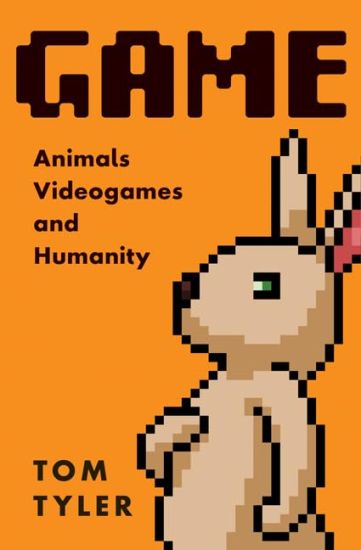
Game

Game

Tom Tyler

UNIVERSITY OF MINNESOTA PRESS
2022
sidottu
A playful reflection on animals and video games, and what each can teach us about the other Video games conjure new worlds for those who play them, human or otherwise: they’ve been played by cats, orangutans, pigs, and penguins, and they let gamers experience life from the perspective of a pet dog, a predator or a prey animal, or even a pathogen. In Game, author Tom Tyler provides the first sustained consideration of video games and animals and demonstrates how thinking about animals and games together can prompt fresh thinking about both.Game comprises thirteen short essays, each of which examines a particular video game, franchise, aspect of gameplay, or production in which animals are featured, allowing us to reflect on conventional understandings of humans, animals, and the relationships between them. Tyler contemplates the significance of animals who insert themselves into video games, as protagonists, opponents, and brute resources, but also as ciphers, subjects, and subversive guides to new ways of thinking. These animals encourage us to reconsider how we understand games, contesting established ideas about winning and losing, difficulty settings, accessibility, playing badly, virtuality, vitality and vulnerability, and much more.Written in a playful style, Game draws from a dizzying array of sources, from children’s television, sitcoms, and regional newspapers to medieval fables, Shakespearean tragedy, and Edwardian comedy; from primatology, entomology, and hunting and fishing manuals to theological tracts and philosophical treatises. By examining video games through the lens of animals and animality, Tyler leads us to a greater humility regarding the nature and status of the human creature, and a greater sensitivity in dealings with other animals.
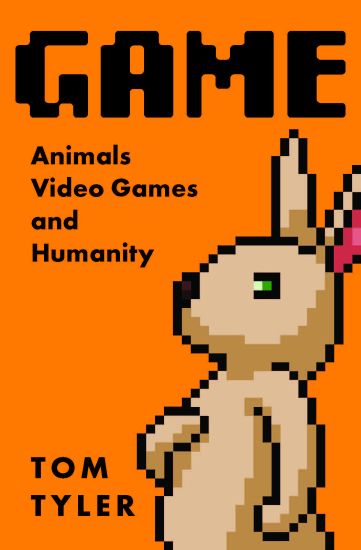
Game

Game

Tom Tyler

UNIVERSITY OF MINNESOTA PRESS
2022
nidottu
A playful reflection on animals and video games, and what each can teach us about the other Video games conjure new worlds for those who play them, human or otherwise: they’ve been played by cats, orangutans, pigs, and penguins, and they let gamers experience life from the perspective of a pet dog, a predator or a prey animal, or even a pathogen. In Game, author Tom Tyler provides the first sustained consideration of video games and animals and demonstrates how thinking about animals and games together can prompt fresh thinking about both.Game comprises thirteen short essays, each of which examines a particular video game, franchise, aspect of gameplay, or production in which animals are featured, allowing us to reflect on conventional understandings of humans, animals, and the relationships between them. Tyler contemplates the significance of animals who insert themselves into video games, as protagonists, opponents, and brute resources, but also as ciphers, subjects, and subversive guides to new ways of thinking. These animals encourage us to reconsider how we understand games, contesting established ideas about winning and losing, difficulty settings, accessibility, playing badly, virtuality, vitality and vulnerability, and much more.Written in a playful style, Game draws from a dizzying array of sources, from children’s television, sitcoms, and regional newspapers to medieval fables, Shakespearean tragedy, and Edwardian comedy; from primatology, entomology, and hunting and fishing manuals to theological tracts and philosophical treatises. By examining video games through the lens of animals and animality, Tyler leads us to a greater humility regarding the nature and status of the human creature, and a greater sensitivity in dealings with other animals.
Social Justice In A Diverse Society

Social Justice In A Diverse Society

Tom Tyler; Robert J Boeckmann; Heather J Smith; Yuen J Huo

Routledge
2019
sidottu
Issues of social justice have been an important part of social psychology since the explosion of psychological research that occurred during and after World War II. At that time, psychologists began to move away from earlier theories that paid little attention to people's subjective understanding of the world. As increasing attention was paid to people's thoughts about their social experiences, it was discovered that people are strongly affected by their assessments of what is just or fair in their dealings with others. This recognition has led to a broad range of studies exploring what people mean by justice and how it influences their thoughts, feelings, and behaviors.
Social Justice In A Diverse Society

Social Justice In A Diverse Society

Tom Tyler; Robert J Boeckmann; Heather J Smith; Yuen J Huo

Routledge
2021
nidottu
Issues of social justice have been an important part of social psychology since the explosion of psychological research that occurred during and after World War II. At that time, psychologists began to move away from earlier theories that paid little attention to people's subjective understanding of the world. As increasing attention was paid to people's thoughts about their social experiences, it was discovered that people are strongly affected by their assessments of what is just or fair in their dealings with others. This recognition has led to a broad range of studies exploring what people mean by justice and how it influences their thoughts, feelings, and behaviors.
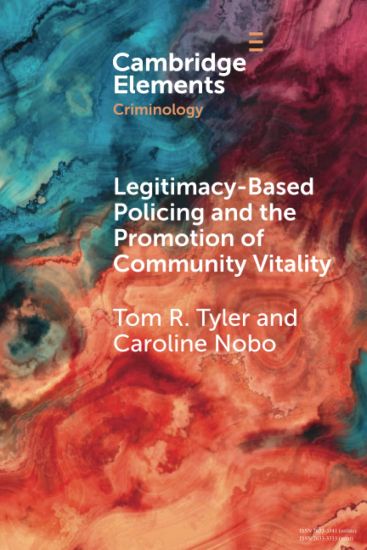
Legitimacy-Based Policing and the Promotion of Community Vitality

Legitimacy-Based Policing and the Promotion of Community Vitality

Tom Tyler; Caroline Nobo

Cambridge University Press
2023
pokkari
This Element presents the history, research, and future potential for an alternative and effective model of policing called 'legitimacy-based policing'. This model is driven by social psychology theory and informed by research findings showing that legitimacy of the police shapes public acceptance of police decisions, willingness to cooperate with the police, and citizen engagement in communities. Police legitimacy is found to be strongly tied to the level of fairness exercised by police authority, i.e. to procedural justice. Taken together these two ideas create an alternative framework for policing that relies upon the policed community's willing acceptance of and cooperation with the law. Studies show that this framework is as effective in lowering crime as the traditional carceral paradigm, an approach that relies on the threat or use of force to motivate compliance. It is also more effective in motivating willing cooperation and in encouraging people to engage in their communities in ways that promote social, economic and political development. We demonstrate that adopting this model benefits police departments and police officers as well as promoting community vitality. This title is also available as Open Access on Cambridge Core.
Tyler Teague and the Einstein Puzzle: Book 2 of the Logic Mysteries

Tyler Teague and the Einstein Puzzle: Book 2 of the Logic Mysteries

Tom Slakey

Createspace Independent Publishing Platform
2017
nidottu
Tyler Teague and the Einstein Puzzle is the second in this series of young adult mysteries about a teenage detective named Tyler Teague. A couple of years have gone by, and Tyler is spending the weekend as a prospective student at St. John's College in Santa Fe, New Mexico. A statue has been stolen from the college, setting up a mystery in which Tyler must solve a logic puzzle, as happened in the previous story (Tyler Teague and the Particulars). Tyler is up against the same villains (The Particulars) as before.These stories are an entirely new type of mystery, the only mysteries that are truly solvable by the reader, because in each the mystery is based on a logic puzzle. Mr. Slakey has invented a new mystery sub-genre. A must-read for any mystery collector. This mystery is gripping and perfectly readable whether or not one wants to tackle the logic puzzle built into it. The differences between this book and the last are that this one is much longer, contains more logic puzzles, and the puzzles are much harder. The central "Einstein Puzzle" on which this mystery is based is said to be so difficult that only two percent of the population can solve it, a nice challenge.This book is a paean to St. John's College and to Santa Fe, New Mexico, both of which the author clearly loves. It is great reading for any fan of mysteries, anyone who enjoys both (right-brain) reading and (left-brain) puzzles, and anyone who wants to hear more about college life. Suppose you are a high school student in the throes of applying to colleges. Wouldn't it be nice to be able to read about what the college visit (prospective weekend) might be like? This book shows that, and it is difficult to find any other book that does.
The Low Road: A John Tyler Thriller (Large Print edition)
Even hundreds of miles from Baltimore . . .Deadly trouble still finds John Tyler.Thanks to his daughter's encouragement, retired soldier John Tyler attends a classic car convention in another state. Lexi tags along for moral and technical support.When Tyler is jailed for a bogus vehicular violation, the weekend gets off to a terrible start.Then, his captors learn who he is . . . and what he's done. After he deals with the men sent to kill him, Tyler tries to figure out what's going on and who wants him dead. He learns some shocking truths about the town where he's imprisoned and its power brokers. They'll do anything to keep their corrupt business going.And Tyler will do anything to stop them and keep his daughter safe. It's a collision course, and despite his captors' best efforts, John Tyler is in the driver's seat. Can he keep Lexi safe and take down a criminal organization before he becomes another body in the town graveyard?The Low Road is the action-packed sixth novel in the John Tyler military thriller series. Each book is a standalone story.
Why Children Follow Rules

Why Children Follow Rules

Tom R. Tyler; Rick Trinkner

Oxford University Press Inc
2018
sidottu
Legal socialization is the process by which children and adolescents acquire their law related values, attitudes, and reasoning capacities. Such values and attitudes, in particular legitimacy, underlie the ability and willingness to consent to laws and defer to legal authorities that make legitimacy based legal systems possible. By age eighteen a person's orientation toward law is largely established, yet legal scholarship has largely ignored this process in favor of studying adults and their relationship to the law. Why Children Follow Rules focuses upon legal socialization outlining what is known about the process across three related, but distinct, contexts: the family, the school, and the juvenile justice system. Throughout, Tom Tyler and Rick Trinkner emphasize the degree to which individuals develop their orientations toward law and legal authority upon values connected to responsibility and obligation as opposed to fear of punishment. They argue that authorities can act in ways that internalize legal values and promote supportive attitudes. In particular, consensual legal authority is linked to three issues: how authorities make decisions, how they treat people, and whether they recognize the boundaries of their authority. When individuals experience authority that is fair, respectful, and aware of the limits of power, they are more likely to consent and follow directives. Despite clear evidence showing the benefits of consensual authority, strong pressures and popular support for the exercise of authority based on dominance and force persist in America's families, schools, and within the juvenile justice system. As the currently low levels of public trust and confidence in the police, the courts, and the law undermine the effectiveness of our legal system, Tom Tyler and Rick Trinkner point to alternative way to foster the popular legitimacy of the law in an era of mistrust.
Why Children Follow Rules

Why Children Follow Rules

Tom R. Tyler; Rick Trinkner

Oxford University Press Inc
2020
nidottu
As with all social institutions, learning about law and how to relate to it is an important part of growing up. In Why Children Follow Rules, Tom R. Tyler and Rick Trinkner focus on legal socialization, the process by which children and adolescents form their orientation toward the law, and outline what is known about the process across three related, but distinct, contexts: family, school, and the juvenile justice system. They emphasize the degree to which individuals develop their orientations toward law upon values of responsibility and obligation, as opposed to fear of punishment. They further argue that when individuals experience authority that is fair, respectful, and aware of the limits of power, they are more likely to consent and voluntarily follow directives. Yet, strong pressures and popular support for the exercise of authority based on dominance and force persist. Given the low levels of public trust and confidence in the police, as well as the legal system in general, Why Children Follow Rules offers an invaluable tool for understanding how people come to understand their relationship with the law.
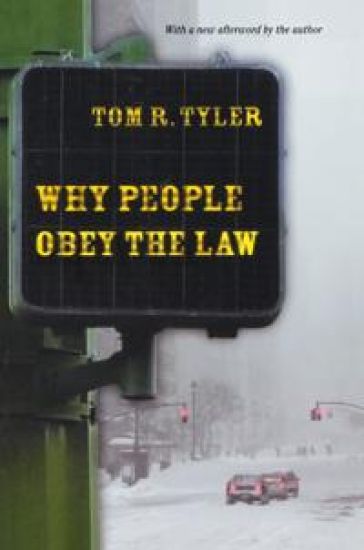
Why People Obey the Law

Why People Obey the Law

Tom R. Tyler

Princeton University Press
2006
pokkari
People obey the law if they believe it's legitimate, not because they fear punishment--this is the startling conclusion of Tom Tyler's classic study. Tyler suggests that lawmakers and law enforcers would do much better to make legal systems worthy of respect than to try to instill fear of punishment. He finds that people obey law primarily because they believe in respecting legitimate authority. In his fascinating new afterword, Tyler brings his book up to date by reporting on new research into the relative importance of legal legitimacy and deterrence, and reflects on changes in his own thinking since his book was first published.
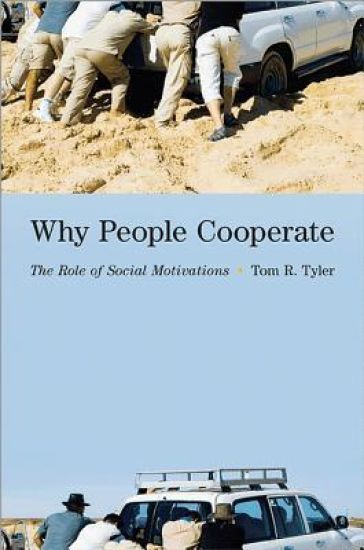
Why People Cooperate

Why People Cooperate

Tom R. Tyler

Princeton University Press
2013
pokkari
Any organization's success depends upon the voluntary cooperation of its members. But what motivates people to cooperate? In Why People Cooperate, Tom Tyler challenges the decades-old notion that individuals within groups are primarily motivated by their self-interest. Instead, he demonstrates that human behaviors are influenced by shared attitudes, values, and identities that reflect social connections rather than material interests. Tyler examines employee cooperation in work organizations, resident cooperation with legal authorities responsible for social order in neighborhoods, and citizen cooperation with governmental authorities in political communities. He demonstrates that the main factors for achieving cooperation are socially driven, rather than instrumentally based on incentives or sanctions. Because of this, social motivations are critical when authorities attempt to secure voluntary cooperation from group members. Tyler also explains that two related aspects of group practices--the use of fair procedures when exercising authority and the belief by group members that authorities are benevolent and sincere--are crucial to the development of the attitudes, values, and identities that underlie cooperation. With widespread implications for the management of organizations, community regulation, and governance, Why People Cooperate illustrates the vital role that voluntary cooperation plays in the long-standing viability of groups.