Kirjojen hintavertailu. Mukana 11 342 296 kirjaa ja 12 kauppaa.

Kirjahaku

Etsi kirjoja tekijän nimen, kirjan nimen tai ISBN:n perusteella.

177 tulosta hakusanalla Toshiharu Taura

Creative Design Engineering

Creative Design Engineering

Toshiharu Taura

Academic Press Inc
2016
nidottu
Creative Design Engineering: Introduction to an Interdisciplinary Approach presents the latest information on a field that has traditionally been primarily concerned with how to make things. However, as technology has advanced, and we have no shortage of things, a new challenge for today’s engineers is what to make. In tackling this, our approaches to engineering design have come under the spotlight. This book presents solutions to this topic in different sections that highlight the basic concerns associated with innovation. First, design is considered a kind of universal human act. Second, it is an interdisciplinary approach that brings together perspectives from fields such as cognitive science and science of knowledge is adopted. Third, the scope of the discussion also includes the process of creating an initial idea for a new product (called the pre-design phase), as well as the use of the product in society (the post-design phase). Design engineers and researchers in engineering design will find this a user-friendly route to understanding the importance of creativity to engineering and how to implement new techniques to improve design outcomes. The book has been translated from the original Japanese book titled Sozo Dezain Kogaku [Creative Design Engineering] (published by the University of Tokyo Press 2014).
Concept Generation for Design Creativity

Concept Generation for Design Creativity

Toshiharu Taura; Yukari Nagai

Springer London Ltd
2012
sidottu
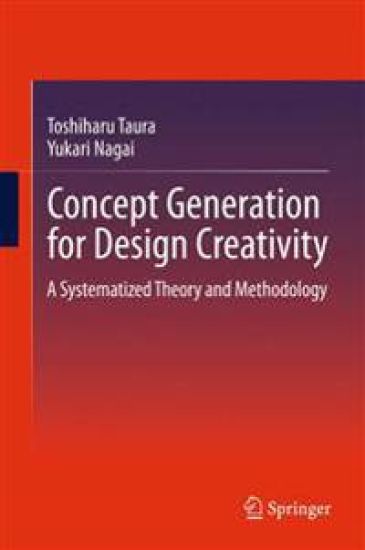
The concept generation process seems like an intuitional thought: difficult to capture and perform, although everyone is capable of it. It is not an analytical process but a synthetic process which has yet to be clarified. Furthermore, new research methods for investigating the concept generation process—a very difficult task since the concept generation process is driven by inner feelings deeply etched in the mind—are necessary to establish its theory and methodology. Concept Generation for Design Creativity – A Systematized Theory and Methodology presents the concept generation process both theoretically and methodologically. Theoretically, the concept generation process is discussed by comparing metaphor, abduction, and General Design Theory from the notions of similarities and dissimilarities. Analogy, blending, and integration by thematic relation have been explained methodologically. So far, these theories and methods have been discussed independently, and the relations among them have not been clarified. Two newly developed research methods to investigate the concept generation process are clearly explained: the explanation-based protocol analysis and constructive simulation. By reading Concept Generation for Design Creativity – A Systematized Theory and Methodology, students, researchers and lecturers in design disciplines (including engineering design, industrial design, software design, CHI, design education, and cognitive science ) can obtain a clear picture of the advanced research findings and the outline of the theories and methods for concept generation. Furthermore, readers are expected to achieve the competence to generate new concepts.
Concept Generation for Design Creativity

Concept Generation for Design Creativity

Toshiharu Taura; Yukari Nagai

Springer London Ltd
2014
nidottu
The concept generation process seems like an intuitional thought: difficult to capture and perform, although everyone is capable of it. It is not an analytical process but a synthetic process which has yet to be clarified. Furthermore, new research methods for investigating the concept generation process—a very difficult task since the concept generation process is driven by inner feelings deeply etched in the mind—are necessary to establish its theory and methodology. Concept Generation for Design Creativity – A Systematized Theory and Methodology presents the concept generation process both theoretically and methodologically. Theoretically, the concept generation process is discussed by comparing metaphor, abduction, and General Design Theory from the notions of similarities and dissimilarities. Analogy, blending, and integration by thematic relation have been explained methodologically. So far, these theories and methods have been discussed independently, and the relations among them have not been clarified. Two newly developed research methods to investigate the concept generation process are clearly explained: the explanation-based protocol analysis and constructive simulation. By reading Concept Generation for Design Creativity – A Systematized Theory and Methodology, students, researchers and lecturers in design disciplines (including engineering design, industrial design, software design, CHI, design education, and cognitive science ) can obtain a clear picture of the advanced research findings and the outline of the theories and methods for concept generation. Furthermore, readers are expected to achieve the competence to generate new concepts.
Milestones in Neurotoxicity and Neuroprotection: A Tribute to Professor Toshiharu Nagatsu
This book summarizes recent advances in understanding the mechanism underlying the selective cell death of dopamine neurons in Parkinson's disease. MPTP, endogenous neurotoxins, L-DOPA, and metal were proved to induce apoptosis and necrosis in neurons. The relationship of these causal factors to the pathogenesis of Parkinson's disease was discussed to give us overviews on the role of neurotoxins in this degenerative disorder. This title further presents the intracellular signal transduction, and the related enzymes and other factors involved in dopaminergic neuronal death. Recent results on intracellular mechanism of neuroprotection are presented, suggesting that neuroprotection as a causal therapy of neurodegenerative disorders may become practical in near future. This book shows new neuroprotective agents, such as propargylamine derivatives and neurotrophins, and the intracellular mechanism to prevent the activation of apoptotic cascade in neurons. The authors of this book are active researchers participating in these subjects and the readers will find the knowledge and techniques for the study on neurotoxicity and neuroprotection, and the strategy for future research on these important subjects in clinical and basic neurology and neurosciences. The book is dedicated to Professor Toshiharu Nagatsu, a pioneer in the search for pathogenic factors in Parkinson's disease. The book is reprinted from the journal 'Neurotoxicology and Teratology', Volume 24/5.
Inspiration and Emulation

Inspiration and Emulation

Toshiharu Nakamura

Peter Lang AG, Internationaler Verlag der Wissenschaften
2019
sidottu
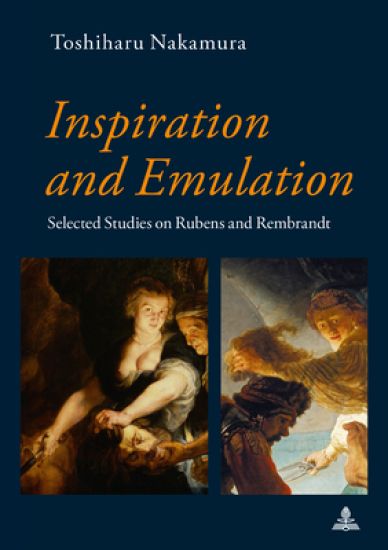
This book discusses an important theme in art history - artistic emulation that emphasizes the exchange between Flemish and Dutch art in the seventeenth century. Since the Middle Ages, copying has been perceived as an important step in artistic training. Originality, on the other hand, has been considered an indispensable hallmark of great works of art since the Renaissance. Therefore, in the seventeenth century, ambitious painters frequently drew inspiration from other artists’ works, attempting to surpass them in various aspects of aesthetic appeal. Drawing on this perspective, this book considers the problems of imitation, emulation, and artistic rivalry in seventeenth-century Netherlandish art. It primarily focuses on Rubens and Rembrandt, but also discusses other masters like van Dyck and Hals. It particularly results in expanding the extant body of knowledge in relation to Rubens’s influence on Rembrandt and Hals. Moreover, it reveals certain new aspects of Rubens and Rembrandt as work-shop masters - collaboration with specialists, use of oil sketches, and teaching methods to pupils for example.
Dynamic Locational Phases of Economic Activity in the Globalized World
This book clarifies the mechanisms of economic globalization in changing industries’ locations and shows how industries’ locations have changed through those mechanisms. First, the book deals with the retailing industry. Introducing the concept of a contact price into the market area analysis, it is shown in Part I that retailers’ market areas and prices are changed in different ways by a reduction of transportation costs. The mechanism of these changes is explained by checking the contact prices at apexes of the retailers’ market areas. Then the book moves to the manufacturing industry and deals with a firm’s production process. Part II of the book shows the manner in which the production volume of factories within an agglomeration is decreased as the number of factories within the agglomeration increases. Subsequently, considering the fact that many production factories depart from agglomerations to other sites to reduce production costs, a method of searching for a factory’s new site is proposed in which a firm can seek out an optimal location of a factory in a short period of time. By referring to a chaotic phenomenon, a firm sets a location prospective area in a large geographical area and selects an optimal location within that area. In the third part of the book the city system is the focus. Part III elucidates the theoretical formation of a city system and analyzes structural changes of a city system due to a reduction of transportation costs. The mechanism of the change is explained by a flexible market area theory which studies a city system by using the market areas established in the free-entry equilibrium. Then, the economic relationships between the cities within a city system are examined from the point of view of the land rent in the cities’ areas. This analysis shows the influences of a change in the largest city on other cities. Finally, the relationships between a city system and regional performance are examined using real data.The examination shows that the city system reveals the regional performance.
Dynamic Locational Phases of Economic Activity in the Globalized World
This book clarifies the mechanisms of economic globalization in changing industries’ locations and shows how industries’ locations have changed through those mechanisms. First, the book deals with the retailing industry. Introducing the concept of a contact price into the market area analysis, it is shown in Part I that retailers’ market areas and prices are changed in different ways by a reduction of transportation costs. The mechanism of these changes is explained by checking the contact prices at apexes of the retailers’ market areas. Then the book moves to the manufacturing industry and deals with a firm’s production process. Part II of the book shows the manner in which the production volume of factories within an agglomeration is decreased as the number of factories within the agglomeration increases. Subsequently, considering the fact that many production factories depart from agglomerations to other sites to reduce production costs, a method of searching for a factory’s new site is proposed in which a firm can seek out an optimal location of a factory in a short period of time. By referring to a chaotic phenomenon, a firm sets a location prospective area in a large geographical area and selects an optimal location within that area. In the third part of the book the city system is the focus. Part III elucidates the theoretical formation of a city system and analyzes structural changes of a city system due to a reduction of transportation costs. The mechanism of the change is explained by a flexible market area theory which studies a city system by using the market areas established in the free-entry equilibrium. Then, the economic relationships between the cities within a city system are examined from the point of view of the land rent in the cities’ areas. This analysis shows the influences of a change in the largest city on other cities. Finally, the relationships between a city system and regional performance are examined using real data.The examination shows that the city system reveals the regional performance.
Role of Industrial Agglomeration in Regional Economic Activity

Role of Industrial Agglomeration in Regional Economic Activity

Toshiharu Ishikawa

SPRINGER VERLAG, SINGAPORE
2025
sidottu
This book analyzes role of industrial agglomeration in regional economy. The analysis shows the functions of the agglomeration in two stages of economic development, before and after the globalization. This analysis is followed by verification of the effectiveness of the agglomeration analysis by using Japanese economic data. First, the book clarifies that the agglomeration contributes to reducing the production costs though the land-based economies. In line with the minimum-cost logic, it is shown that the market competition modes that minimizes the delivery prices to the consumers comes to prevail in the spatial goods market. Secondly, the book explains that firms' production processes are fragmented by connection economies and the land-based economies of the agglomeration. The fragmentation increases the differentiation among workers and between the regions. And then, it increases the opportunity for government to intervene in the industrial locations. In this intervention, industrial parks that provide agglomeration economies become important as a means of the policy. The final part of the book shows that the inspection using the regional economic data in Japan supports the effectiveness of the analysis using the concepts of the connection economies and the land-based agglomeration economies. Lastly, an industrial policy based on the results derived by the analysis is proposed for the regions in the rural area.
Modelling of Concrete Performance

Modelling of Concrete Performance

Rajesh Chaube; Toshiharu Kishi; Koichi Maekawa

CRC Press
2019
nidottu
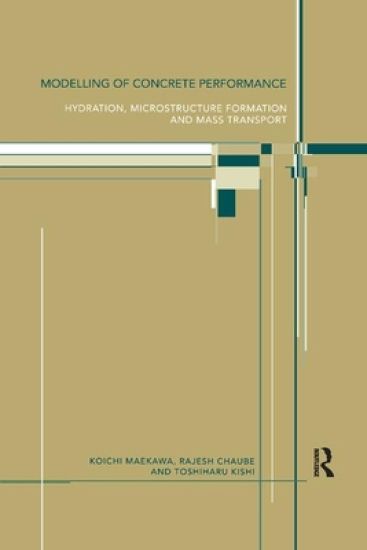
The intial defects induced at early age of concrete hardening: thermal strains, shrinkage, creep and the associated risks of cracking are one of the governing factors for long-term performance of concrete. Proposing a simplified but intergrated scenario of concrete life cycle simulation method, this book examines and explains the vast amount of experimental observations related to hardening concrete using a common set of physical laws. The methods used focus on the three primary processes common to the development of all cementitious materials: hydration, moisture transport and structure formation. The authors describe an intergrated theoretical and computational platform from which to examine and assess the quality and structural durability of concrete at an early age. This represents a new approach to the problem of evaluating durability performance and presents a practical methodology for researchers and practitioners in the field of concrete technology. The proposed scheme may be used in practical computational simulation methods, with the relevant software available on the Internet, and is a valuable guide to those engaged in concrete design.
Modelling of Concrete Performance

Modelling of Concrete Performance

Rajesh Chaube; Toshiharu Kishi; Koichi Maekawa

Spon Press
1999
sidottu
The intial defects induced at early age of concrete hardening: thermal strains, shrinkage, creep and the associated risks of cracking are one of the governing factors for long-term performance of concrete. Proposing a simplified but intergrated scenario of concrete life cycle simulation method, this book examines and explains the vast amount of experimental observations related to hardening concrete using a common set of physical laws. The methods used focus on the three primary processes common to the development of all cementitious materials: hydration, moisture transport and structure formation. The authors describe an intergrated theoretical and computational platform from which to examine and assess the quality and structural durability of concrete at an early age. This represents a new approach to the problem of evaluating durability performance and presents a practical methodology for researchers and practitioners in the field of concrete technology. The proposed scheme may be used in practical computational simulation methods, with the relevant software available on the Internet, and is a valuable guide to those engaged in concrete design.
Generalized Coordination of Multi-robot Systems

Generalized Coordination of Multi-robot Systems

Kazunori Sakurama; Toshiharu Sugie

Now Publishers Inc
2021
nidottu
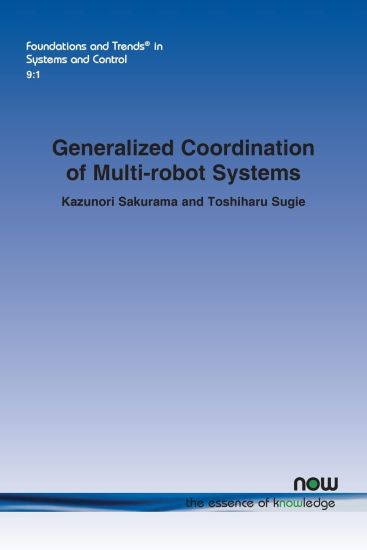
Multi-robot systems have huge potential for practical applications, which include sensor networks, area surveillance, and environment mapping. In many applications, cooperative coordination of the robots plays a central role. However, there are so many tasks and their variants, it is not viable to describe individually all the existing methods. Instead, in this monograph the authors focus on a generalized coordination problem which can cover a wide range of coordination problems and handle them in a unified manner.The reader is first introduced to the mathematics and a set of systematic tools that underpin subsequent discussions on the practical implementations. Each chapter in the second part of the book uses the same structure to address three types of generalized coordination problems, namely, Pairwise Coordination; Generalized Coordination with “Absolute” Measurements and Generalized Coordination with “Relative” Measurements. Finally, the authors present real-world applications of generalized coordination.Throughout, the authors provide examples to clearly illustrate the concepts being discussed. The book provides an accessible overview of the complexities of the topic for students, researchers and practitioners alike.
Multi-Scale Modeling of Structural Concrete

Multi-Scale Modeling of Structural Concrete

Koichi Maekawa; Tetsuya Ishida; Toshiharu Kishi

CRC Press
2019
nidottu
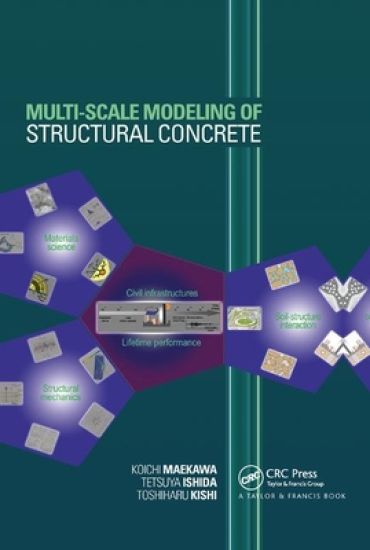
Increases in computer power have now enabled engineers to combine materials science with structural mechanics in the design and the assessment of concrete structures. The techniques developed have become especially useful for the performance assessment of such structures under coupled mechanistic and environmental actions. This allows effective management of infrastructure over a much longer life cycle, thus satisfying the requirements for durability and sustainability.This ground-breaking new book draws on the fields of materials and structural mechanics in an integrated way to address the questions of management and maintenance. It proposes a realistic way of simulating both constituent materials and structural responses under external loading and under ambient conditions. Where the research literature discusses component or element technology related to performance assessment, this book uniquely covers the subject at the level of the whole system including soil foundation, showing engineers how to model changes in concrete structures over time and how to use this for decision making in infrastructure maintenance and asset management.
Multi-Scale Modeling of Structural Concrete

Multi-Scale Modeling of Structural Concrete

Koichi Maekawa; Tetsuya Ishida; Toshiharu Kishi

CRC Press
2008
sidottu
Increases in computer power have now enabled engineers to combine materials science with structural mechanics in the design and the assessment of concrete structures. The techniques developed have become especially useful for the performance assessment of such structures under coupled mechanistic and environmental actions. This allows effective management of infrastructure over a much longer life cycle, thus satisfying the requirements for durability and sustainability.This ground-breaking new book draws on the fields of materials and structural mechanics in an integrated way to address the questions of management and maintenance. It proposes a realistic way of simulating both constituent materials and structural responses under external loading and under ambient conditions. Where the research literature discusses component or element technology related to performance assessment, this book uniquely covers the subject at the level of the whole system including soil foundation, showing engineers how to model changes in concrete structures over time and how to use this for decision making in infrastructure maintenance and asset management.
Strategic Industrial Sourcing

Strategic Industrial Sourcing

Toshihiro Nishiguchi

Oxford University Press Inc
1994
sidottu
Japanese industrial firms have developed a system of subcontracting with suppliers that has played a major role in their world-wide success. This book explores the historical evolution of subcontracting in Japan and analyses it in current practice. It develops a theory of `strategic dualism' that after nearly six decades of evolution is a new mode of contractual relations, based on principles of problem-solving collaborative manufacturing. This new form of contractual relations is supported by a range of institutional arrangements that drive prime contractors and subcontractors towards continuous improvement in product quality and cost reduction. It argues that this system is possible in a range of cultures different from Japan.
Japan and the Study of the History of Economic Thought
This volume marks the first English translation of Toshihiro Tanaka’s research outside Japan, offering a rare opportunity for international scholars to explore the relationship between Western economic thought and Japan.Rigorous in its analysis and broad in scope, the volume is structured in five parts that cut a path through classical economics and the Scottish Enlightenment, through to the lectures of modern and neoclassical economics, before concluding with studies in the influence of American and Australian economics in Japan. Studies incorporate work from philosophers such as Bernard Mandeville, Irving Fisher, Thorstein Veblen and Joseph Dorfman, but also pay due attention to work from the Society for the History of Economic Thought of Japan since 1981. Concerned with the methodology of writing a history of economics, the latter parts of the volume are composed from selected materials, including a previously unpublished letter from David Hume to Adam Smith, book reviews, and a word of remembrance for the late Professor Peter Groenewegen. Japan and the Study of the History of Economic Thought will appeal to students and scholars of philosophy, economics and Japanese studies more broadly.
Social Security Reform in Advanced Countries

Social Security Reform in Advanced Countries

Toshihiro Ihori; Toshiaki Tachibanaki

Routledge
2002
sidottu
Increasingly ageing populations and a slowing rate of growth in the macroeconomy are forcing advanced countries to reconsider their social security programmes. The need for detailed examination of the possible reforms and initiatives has never been greater. This book brings together internationally-renowned scholars to evaluate the effect of recent social security reforms in advanced countries (pension programmes in particular) and to suggest policy reforms for the future. Including detailed studies of countries including Australia, Germany, Japan, Scandinavia, the UK and the USA, this book will be of essential interest to economists and policy-makers working in pension financing reform, and public economics more generally.
Microbial Polyesters

Microbial Polyesters

Yoshiharu Doi

John Wiley Sons Inc
1990
sidottu
This is the first book to present a topical overview of the research and development of microbial polyesters. Comprehensive and amply illustrated, it covers the * biosynthesis * structure * properties * applications of these biodegradable and biocompatible thermoplastics. The book provides the reader with the necessary background to understand the nature and mechanism of biological polymerization. It unites aspects from both the biological and polymer sciences and is a typical modern example of the analysis of biological macromolecules.
Why Are the Japanese Non-Religious?

Why Are the Japanese Non-Religious?

Toshimaro Ama

University Press of America
2004
nidottu
Why Are the Japanese Non-Religious?: Japanese Spirituality: Being Non-Religious in a Religious Culture, translated here for the first time in English, was first published in Japan in 1996. It has also been translated into Korean and German. Author Toshimaro Ama examines the concept of mushukyo, or lack of specific religious beliefs. According to Ama, the Japanese generally lack an understanding of or desire to commit to a particular organized religion, oftentimes fusing Shinto, Christianity, and Buddhism into a hybrid form of spirituality. The book classifies Japanese religion into "revealed," or organized (i.e. Buddhism or Confucianism), and "natural," or folklore based. It explains how folklore and culture have been integrated into the Japanese religious mind, examines governmental influence over the development of Japanese religion, and introduces several attempts to restore authentic spirituality. The book, which has sold more than 100,000 copies, is widely popular among students of Japanese culture and ethnicity as well as lay readers desiring to learn more about Japanese religious identity.