Kirjojen hintavertailu. Mukana 11 627 220 kirjaa ja 12 kauppaa.

Kirjahaku

Etsi kirjoja tekijän nimen, kirjan nimen tai ISBN:n perusteella.

1000 tulosta hakusanalla U. S. Army Command and General Staff Col

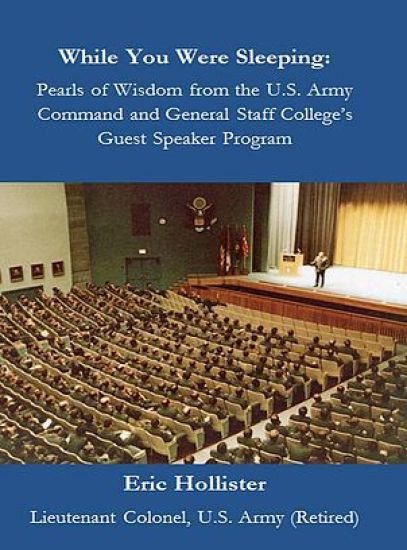
While You Were Sleeping: Pearls of Wisdom from the U.S. Army Command and General Staff College's Guest Speaker Program
The U.S. Army's Command and General Staff College (CGSC) at Fort Leavenworth, Kansas is one of the most important institutions of higher learning for Army officers, and has been for well over 100 years. Here, mid-career officers obtain the knowledge and tools to assume higher levels of responsibility, culminating in senior Army leadership roles. Since its inception, guest speakers have regularly addressed this important body of officers. Fort Leavenworth's Combined Arms Research Library (CARL) Archives has a collection of over 500 guest speaker tapes going back to the late 1940s, including remarks by senior military and civilian leadership. The tapes represent an amazing time capsule of original source material containing the views of these leaders on important events impacting the military. As they are in the restricted archives and recorded on outdated formats (mostly reel, cassette, and VHS tape), they have, for the most part, been untouched since their recording. This curated collection focuses on remarks delivered between 1949 and 2001 by those who held important positions such as Army Chiefs of Staff, Chairmen of the Joint Chiefs, Secretaries of Defense and of the Army, as well as individuals of historical significance, congressmen and even one Commander in Chief (Harry S. Truman). For more information about the book, please see the First City Press website.

Birth of the American Force Projection Army: The Impact or Political, Military, and National Culture and Strategic Position on U.S. Efforts to Incorpo
In the aftermath of World War II, the Supreme Allied Commander, General Dwight D. Eisenhower, so loathed yet respected the Great German General Staff that he called for its complete destruction on at least two separate occasions. Regardless of whether the individual's view of the Great German General Staff, with its Prussian roots, is revulsion or admiration, the fact remains that in the latter 19th and early 20th centuries, no better system existed.While the Prussian General Staff solidified its position in history during the German Wars of Unification, the United States Army, under leaders such as Generals Grant, Sherman, and Sheridan, sought to enhance the level of professionalism and excellence throughout the American Army. To this end, these leaders certainly sought to study and incorporate elements of the Prussian General Staff. Unfortunately, American political, military and national culture and strategic position thwarted their efforts. It was not until the deficiencies of the Spanish-American War highlighted the weaknesses in the American military system that Prussian style reforms became possible. The change in strategic position after the war with Spain combined with the identified need to improve military processes brought about enough of a change to the appropriate aspects of American culture that incorporating elements of the Prussian system became possible.
Deception Integration in the U.S. Army

Deception Integration in the U.S. Army

U. S. Army Command and General Staff Col

Createspace Independent Publishing Platform
2015
nidottu
The Army has begun the process of relearning and integrating deception into doctrine andoperations. The state of doctrine and training both appear to be in need of aggressive review andmodification. History shows that it is a potent combat multiplier that can be decisive in gainingsurprise and initiative. History shows the costs of these operations to be less than one would expect.The risks appear relatively low as well. Benefits, - on the other hand, are uniformly high whencompared to cost and risk. The 1989 Army Deception White Paper attempted to set the azimuth fordeception integration. It failed to provide the required urgency and priority. This thesis uses thepremise of 'What the White Paper should have said" to explore the subject. The paper makesrecommendations based on interviews with senior defense officials, including Generals Starry, Cavazos, and Livsey; Dr. Edward Luttwak, and several experts in the field of deception. Therecommendations address doctrine development, parallel training, and the integration of deceptioninto planning. Training events such as BCTP, the NTC, JRTC, and the ARTEP must includedeception if deception is to become an effective component of Army doctrine and operations.
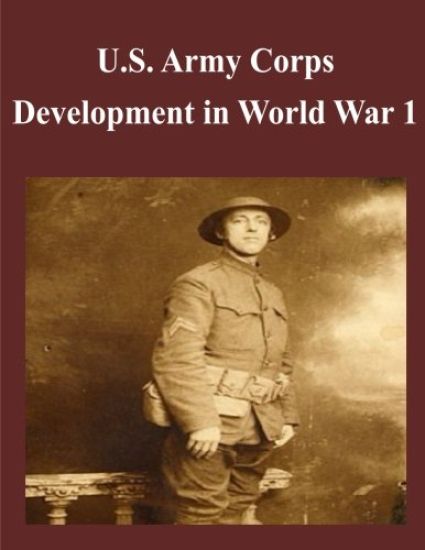
U.S. Army Corps Development in World War 1

U.S. Army Corps Development in World War 1

U. S. Army Command and General Staff Col

Createspace Independent Publishing Platform
2014
nidottu
This book examines the development of the American Army corps structure during World War I. The corps formation developed in World War I by General John J. Pershing was the culmination of 56 years of lessons learned from the Civil War through the beginning of World War I. The success of the American Expeditionary force (AEF) in World War I was, in large part, the result of the development and combat effectiveness of the corps formation. The corps formation allowed commanders flexibility, concentrated firepower, sustainability, and increased command and control.The American corps formation in World War I led the AEF to victory in the Saint Mihiel and Meuse-Argonne campaigns. The American corps formation provided resources and capabilities that helped provide the needed edge to defeat the Central Powers and help end World War I.
Is the U.S. Army Field Artillery Prepared to Support the Next Major Combat Operation

Is the U.S. Army Field Artillery Prepared to Support the Next Major Combat Operation

U. S. Army Command and General Staff Col

Createspace Independent Publishing Platform
2014
nidottu
In 2007, three former brigade combat team commanders authored a white paper and sent it to the Army Chief of Staff entitled The King and I: The Impending Crisis in the Field Artillery's Ability to Provide Fire Support to Maneuver Commanders. The paper details the authors' concerns as maneuver commanders with the ability of the field artillery to support maneuver operations. This book examines Operation COBRA to determine how the corps commanders employed field artillery when conducting offensive operations and identifies key concepts that were used to ensure success.The three areas that were seen as crucial to the success of offensive operations were the ability to mass artillery fires, integrate close air support into the ground maneuver plan, and how logistics supported artillery units. For the future of the field artillery, those three areas must be maintained in order to prevail in the next major combat operation.