Kirjojen hintavertailu. Mukana 11 244 527 kirjaa ja 12 kauppaa.

Kirjahaku

Etsi kirjoja tekijän nimen, kirjan nimen tai ISBN:n perusteella.

17 tulosta hakusanalla Upamanyu Pablo Mukherjee

Crime and Empire

Crime and Empire

Upamanyu Pablo Mukherjee

Oxford University Press
2003
sidottu
The language of crime and punishment is everywhere, especially in the context of building new global orders where old imperial relationships between the west and the rest of the world are being redefined and redesigned. This book is about one of the formative moments of this rhetorical strategy of representing empires. By looking at a variety of British narratives about India being produced from the later half of the eighteenth century onwards, it suggests that the discourse of crime was one of the major representative tools which the British employed to understand, imagine, and rule the vast country. However, to understand the full implication of this strategy for British understanding of both the colonised 'others' and a particular image of 'self', we must study the formation of this discourse not only in the context of the colony, but of its peculiar importance within 'domestic' Britain itself. Nineteenth-Century British society placed a huge amount of importance on issues of crime, punishment, order, and policing. These issues became fundamental to British claims of being a civilised nation. Naturally, they became an important part of British colonial/imperial strategy. But, since in Britain these issues were sites of contest and not consent, of debate and opposition and not unquestioned hegemonic power, they were inherently risky tools to use in building an ideology of empire. As the various readings of the narratives employing 'fictions' of crime offered here shows, an opposition or critique of empire was formed through these fictions even as they were used to build a consensus for empire-building. The slippages and ambiguities associated with imperial narratives then, are not products of some inherent semiotic disorder. Rather, they grew out of a particular history within which the rhetoric employed by these narratives took shape. This book is an attempt to recover the traces of that history within the various imperial fictions of crime.
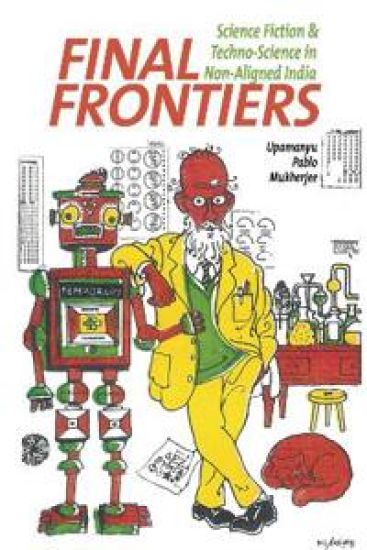
Final Frontiers

Final Frontiers

Upamanyu Pablo Mukherjee

Liverpool University Press
2020
sidottu
Winner of the Science Fiction Research Association Book Award 2021.This is the first book-length study of the relationship between science fiction, the techno-scientific policies of independent India, and the global non-aligned movement that emerged as a response to the Cold War and decolonization. Today, we see the trend of science fiction writers being used by governments as advisors on techno-scientific policies and defence industries. But such relationships between literature, policy and geo-politics have a long and complex history. Glimpses of this history can be seen in the case of the first generation of post-colonial Indian science fiction writers, the policies of scientific and technological development in independent India, and the political strategy of non-alignment advocated by India’s first prime minister, Jawaharlal Nehru, who proposed that Third World nations should maintain an equal distance between Washington and Moscow. Such a perspective reveals the surprisingly long and relatively unknown life of Indian science fiction, as well as the critical role played by the genre in imagining alternative pathways for scientific and geo-political developments to those that dominate our lives now.
Final Frontiers

Final Frontiers

Upamanyu Pablo Mukherjee

LIVERPOOL UNIVERSITY PRESS
2022
nidottu
Winner of the Science Fiction Research Association Book Award 2021.This is the first book-length study of the relationship between science fiction, the techno-scientific policies of independent India, and the global non-aligned movement that emerged as a response to the Cold War and decolonization. Today, we see the trend of science fiction writers being used by governments as advisors on techno-scientific policies and defence industries. But such relationships between literature, policy and geo-politics have a long and complex history. Glimpses of this history can be seen in the case of the first generation of post-colonial Indian science fiction writers, the policies of scientific and technological development in independent India, and the political strategy of non-alignment advocated by India’s first prime minister, Jawaharlal Nehru, who proposed that Third World nations should maintain an equal distance between Washington and Moscow. Such a perspective reveals the surprisingly long and relatively unknown life of Indian science fiction, as well as the critical role played by the genre in imagining alternative pathways for scientific and geo-political developments to those that dominate our lives now.
Combined and Uneven Development

Combined and Uneven Development

Sharae Deckard; Nicholas Lawrence; Neil Lazarus; Graeme Macdonald; Upamanyu Pablo Mukherjee; Benita Parry; Stephen Shapiro

Liverpool University Press
2015
sidottu
The ambition of this book is to resituate the problem of ‘world literature’, considered as a revived category of theoretical enquiry, by pursuing the literary-cultural implications of the theory of combined and uneven development. This theory has a long pedigree in the social sciences, where it continues to stimulate debate. But its implications for cultural analysis have received less attention, even though the theory might be said to draw attention to a central – perhaps the central – arc or trajectory of modern(ist) production in literature and the other arts worldwide. It is in the conjuncture of combined and uneven development, on the one hand, and the recently interrogated and expanded categories of ‘world literature’ and ‘modernism’, on the other, that this book looks for its specific contours. In the two theoretical chapters that frame the book, the authors argue for a single, but radically uneven world-system; a singular modernity, combined and uneven; and a literature that variously registers this combined unevenness in both its form and content to reveal itself as, properly speaking, world-literature. In the four substantive chapters that then follow, the authors explore a selection of modern-era fictions in which the potential of their method of comparativism seems to be most dramatically highlighted. They treat the novel paradigmatically, not exemplarily, as a literary form in which combined and uneven development is manifested with particular salience, due in no small part to its fundamental association with the rise of capitalism and its status in peripheral and semi-peripheral societies as a ‘modernising’ import. The peculiar plasticity and hybridity of the novel form enables it to incorporate not only multiple literary levels, genres and modes, but also other non-literary and archaic cultural forms – so that, for example, realist elements might be mixed with more experimental modes of narration, or older literary devices might be reactivated in juxtaposition with more contemporary frames.
Combined and Uneven Development

Combined and Uneven Development

Sharae Deckard; Nicholas Lawrence; Neil Lazarus; Graeme Macdonald; Upamanyu Pablo Mukherjee; Benita Parry; Stephen Shapiro

Liverpool University Press
2015
nidottu
The ambition of this book is to resituate the problem of ‘world literature’, considered as a revived category of theoretical enquiry, by pursuing the literary-cultural implications of the theory of combined and uneven development. This theory has a long pedigree in the social sciences, where it continues to stimulate debate. But its implications for cultural analysis have received less attention, even though the theory might be said to draw attention to a central – perhaps the central – arc or trajectory of modern(ist) production in literature and the other arts worldwide. It is in the conjuncture of combined and uneven development, on the one hand, and the recently interrogated and expanded categories of ‘world literature’ and ‘modernism’, on the other, that this book looks for its specific contours. In the two theoretical chapters that frame the book, the authors argue for a single, but radically uneven world-system; a singular modernity, combined and uneven; and a literature that variously registers this combined unevenness in both its form and content to reveal itself as, properly speaking, world-literature. In the four substantive chapters that then follow, the authors explore a selection of modern-era fictions in which the potential of their method of comparativism seems to be most dramatically highlighted. They treat the novel paradigmatically, not exemplarily, as a literary form in which combined and uneven development is manifested with particular salience, due in no small part to its fundamental association with the rise of capitalism and its status in peripheral and semi-peripheral societies as a ‘modernising’ import. The peculiar plasticity and hybridity of the novel form enables it to incorporate not only multiple literary levels, genres and modes, but also other non-literary and archaic cultural forms – so that, for example, realist elements might be mixed with more experimental modes of narration, or older literary devices might be reactivated in juxtaposition with more contemporary frames.
Fundamentals of Digital Communication

Fundamentals of Digital Communication

Upamanyu Madhow

Cambridge University Press
2008
sidottu
This is a concise presentation of the concepts underlying the design of digital communication systems, without the detail that can overwhelm students. Many examples, from the basic to the cutting-edge, show how the theory is used in the design of modern systems and the relevance of this theory will motivate students. The theory is supported by practical algorithms so that the student can perform computations and simulations. Leading edge topics in coding and wireless communication make this an ideal text for students taking just one course on the subject. Fundamentals of Digital Communications has coverage of turbo and LDPC codes in sufficient detail and clarity to enable hands-on implementation and performance evaluation, as well as 'just enough' information theory to enable computation of performance benchmarks to compare them against. Other unique features include space-time communication and geometric insights into noncoherent communication and equalization.
English, August: An Indian Story

English, August: An Indian Story

Upamanyu Chatterjee

Faber Faber
2018
nidottu
Agastya Sen, known to friends by the English name August, is a child of the Indian elite. His friends go to Yale and Harvard. August himself has just landed a prize government job, which takes him to Madna - a town with the highest temperatures in India - deep in the sticks. There he finds himself surrounded by incompetents and cranks, time wasters, bureaucrats, and crazies. What to do? Get stoned, shirk work, collapse in the heat, stare at the ceiling. Dealing with the locals turns out to be much easier than living with himself. English, August is a comic masterpiece from contemporary India.
Introduction to Communication Systems

Introduction to Communication Systems

Upamanyu Madhow

Cambridge University Press
2014
sidottu
Showcasing the essential principles behind modern communication systems, this accessible undergraduate textbook provides a solid introduction to the foundations of communication theory. Carefully selected topics introduce students to the most important and fundamental concepts, giving students a focused, in-depth understanding of core material, and preparing them for more advanced study. Abstract concepts are introduced to students 'just in time' and reinforced by nearly 200 end-of-chapter exercises, alongside numerous MATLAB code fragments, software problems and practical lab exercises, firmly linking the underlying theory to real-world problems, and providing additional hands-on experience. Finally, an accessible lecture-style organisation makes it easy for students to navigate to key passages, and quickly identify the most relevant material. Containing material suitable for a one- or two-semester course, and accompanied online by a password-protected solutions manual and supporting instructor resources, this is the perfect introductory textbook for undergraduate students studying electrical and computer engineering.
English, August

English, August

Upamanyu Chatterjee

The New York Review of Books, Inc
2009
nidottu
Agastya Sen, known to friends by the English name August, is a child of the Indian elite. His friends go to Yale and Harvard. August himself has just landed a prize government job. The job takes him to Madna, "the hottest town in India," deep in the sticks. There he finds himself surrounded by incompetents and cranks, time wasters, bureaucrats, and crazies. What to do? Get stoned, shirk work, collapse in the heat, stare at the ceiling. Dealing with the locals turns out to be a lot easier for August than living with himself." English, August "is a comic masterpiece from contemporary India. Like "A Confederacy of Dunces" and "The Catcher in the Rye," it is both an inspired and hilarious satire and a timeless story of self-discovery.
Data Driven Insights from Standard SAP Tables in MS Excel

Data Driven Insights from Standard SAP Tables in MS Excel

Upamanyu Sarmah

Independently Published
2019
nidottu
This ebook will teach you how to master the 15 super-formulae in Microsoft Excel which will make you a data-crunching guru. This book will talk about creating the magical Pivot Table which will be the cornerstone of your reporting projects. And finally, this book will get into the details of creating 3 HIGHLY CRUCIAL reports which every organisation needs, and how you can use your Functional Consulting knowledge to give them this information.
Das Sivabhaktavilasam - Die Taten der Siva-Verehrer
Das Sivabhaktavilasam ist ein Teil des Skanda Puranam und die sp tere Sanskritversion des Periya Puranam, der Legendensammlung der 63 s dindischen Sivaheiligen aus dem 12. Jahrhundert. Die Heiligen zeichnen sich durch ihre kompromisslose Verehrung Sivas und den Dienst f r andere Sivaverehrer aus. Die Geschichten spielen auf dem Hintergrund des reichen s dindischen Tempelkults.