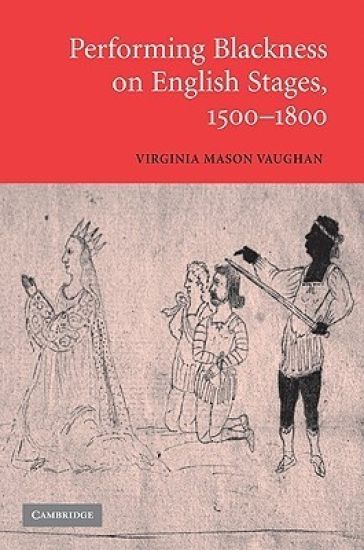
Performing Blackness on English Stages, 1500–1800 examines early modern English actors' impersonations of black Africans. Those blackface performances established dynamic theatrical conventions that were repeated from play to play, plot to plot, congealing over time and contributing to English audiences' construction of racial difference. Vaughan discusses non-canonical plays, grouping of scenes, and characters that highlight the most important conventions - appearance, linguistic tropes, speech patterns, plot situations, the use of asides and soliloquies, and other dramatic techniques - that shaped the ways black characters were 'read' by white English audiences. In plays attended by thousands of English men and women from the sixteenth century to the end of the eighteenth, including Titus Andronicus, Othello and Oroonoko, blackface was a polyphonic signifier that disseminated distorted and contradictory, yet compelling, images of black Africans during the period in which England became increasingly involved in the African slave trade.
Shakespeare’s Othello has exercised a powerful fascination over audiences for centuries with its portrayal of destructive jealousy. This study is a major exercise in the historicisation of Othello in which the author examines contemporary writings and demonstrates how they were embedded in the text of Othello: discourse about conflict between Turk and Venetian treatises on the professionalisation of England’s military forces, representations of Africans and blackamoors, and narratives depicting jealous husbands. The second section traces Othello’s history in England and the United States from the Restoration to the late 1980s, using illustrations where appropriate. Each chapter highlights a specific historical period, actor or production to demonstrate how and why elements from Shakespeare’s text were emphasised or repressed. Othello is revealed as a significant shaper of cultural meaning.
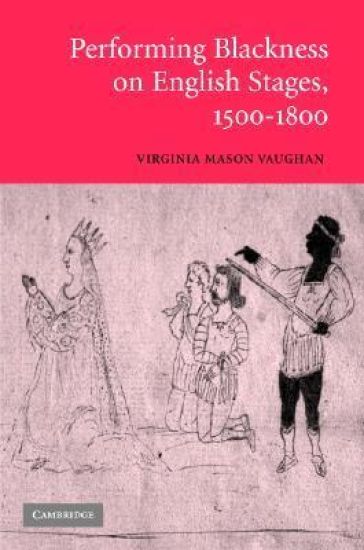
Performing Blackness on English Stages, 1500–1800 examines early modern English actors' impersonations of black Africans. Those blackface performances established dynamic theatrical conventions that were repeated from play to play, plot to plot, congealing over time and contributing to English audiences' construction of racial difference. Vaughan discusses non-canonical plays, grouping of scenes, and characters that highlight the most important conventions - appearance, linguistic tropes, speech patterns, plot situations, the use of asides and soliloquies, and other dramatic techniques - that shaped the ways black characters were 'read' by white English audiences. In plays attended by thousands of English men and women from the sixteenth century to the end of the eighteenth, including Titus Andronicus, Othello and Oroonoko, blackface was a polyphonic signifier that disseminated distorted and contradictory, yet compelling, images of black Africans during the period in which England became increasingly involved in the African slave trade.
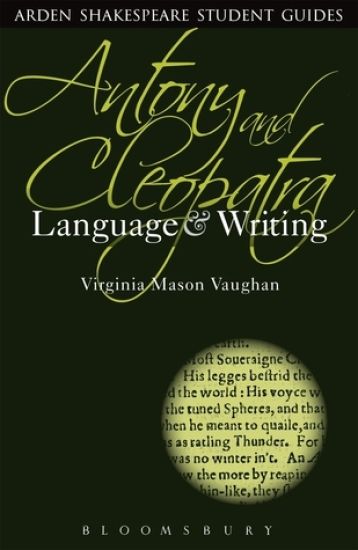
Reading Antony and Cleopatra is particularly challenging because of Shakespeare's masterful embodiment of Rome and Egypt's contrasting worlds in language, structure, and characterization.Instead of seeing the interaction of Roman and Egyptian perspectives in Antony and Cleopatra as a type of double image of reality that changes as one moves from one location to another, students often find themselves compelled to pick sides. The more romantic opt for Cleopatra as the most sympathetic character, while the pragmatists dismiss her lifestyle as self-indulgent. The central challenge in reading this play, in other words, is to resist the compulsion to take sides and, instead, to adopt a 'both-and' point of view rather than an 'either-or' choice. The play's central binary - Rome vs. Egypt - is deeply embedded in its language and structure, yet the play consistently complicates our view of either side. The book encourages students to think outside the binary box, to understand, and to celebrate, Shakespeare's exploitation of the multivalent nature of language.
Reading Antony and Cleopatra is particularly challenging because of Shakespeare's masterful embodiment of Rome and Egypt's contrasting worlds in language, structure, and characterization.Instead of seeing the interaction of Roman and Egyptian perspectives in Antony and Cleopatra as a type of double image of reality that changes as one moves from one location to another, students often find themselves compelled to pick sides. The more romantic opt for Cleopatra as the most sympathetic character, while the pragmatists dismiss her lifestyle as self-indulgent. The central challenge in reading this play, in other words, is to resist the compulsion to take sides and, instead, to adopt a 'both-and' point of view rather than an 'either-or' choice. The play's central binary - Rome vs. Egypt - is deeply embedded in its language and structure, yet the play consistently complicates our view of either side. The book encourages students to think outside the binary box, to understand, and to celebrate, Shakespeare's exploitation of the multivalent nature of language. As well as helping students to analyse the intricacy of Shakespeare's language in Antony and Cleopatra, each chapter's 'Writing matters’ section enables students to develop their own writing strategies in coursework and examinations.
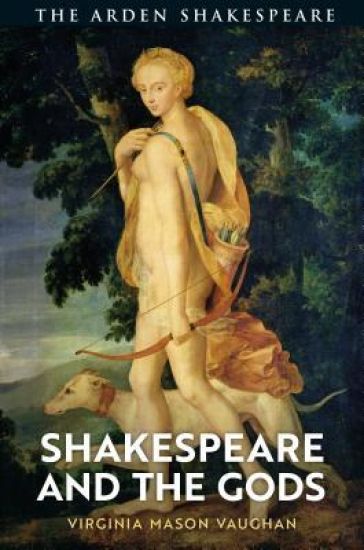
Shakespeare and the Gods examines Shakespeare’s many allusions to six classical gods (Jupiter, Diana, Venus, Mars, Hercules and Ceres) that enhance his readers’ and audiences’ understanding and enjoyment of his work. Vaughan explains their historical context, from their origins in ancient Greece to their appropriation in Rome and their role in medieval and early modern mythography. The book also illuminates Shakespeare’s classical allusions by comparison to the work of contemporaries like Edmund Spenser, Ben Jonson and Thomas Heywood andexplores allusive patterns that repeat throughout Shakespeare’s canon. Each chapter concludes with a more focused reading of one or two plays in which the god appears or serves as an underlying motif. Shakespeare and the Gods highlights throughout the gods’ participation in western constructions of gender as well as classical myth’s role in changing attitudes toward human violence and sexuality.
Now available in paperback, Shakespeare and the Gods examines Shakespeare’s many allusions to six classical gods (Jupiter, Diana, Venus, Mars, Hercules and Ceres) that enhance his readers’ and audiences’ understanding and enjoyment of his work. Vaughan explains their historical context, from their origins in ancient Greece to their appropriation in Rome and their role in medieval and early modern mythography. The book also illuminates Shakespeare’s classical allusions by comparison to the work of contemporaries like Edmund Spenser, Ben Jonson and Thomas Heywood and explores allusive patterns that repeat throughout Shakespeare’s canon. Each chapter concludes with a more focused reading of one or two plays in which the god appears or serves as an underlying motif. Shakespeare and the Gods highlights throughout the gods’ participation in western constructions of gender as well as classical myth’s role in changing attitudes toward human violence and sexuality.
OXFORD SHAKESPEARE TOPICS General Editors: Peter Holland and Stanley Wells Oxford Shakespeare Topics provide students and teachers with short books on important aspects of Shakespeare criticism and scholarship. Each book is written by an authority in its field, and combines accessible style with original discussion of its subject. This book traces Shakespeare's contributions to America's cultural history from the colonial era to the present, with substantial attention to theatre history, publishing history, and criticism. It identifies four broad themes that distinguish Shakespeare in the United States from the dramatist's reception in other countries. During the eighteenth and nineteenth centuries, Americans in search of self-improvement took a utilitarian approach to the plays, mining them for moral insights and everyday wisdom; beginning in the nineteenth century, American entrepreneurs collected, edited, and adapted Shakespeare for their own pleasure and profit; while America's public schools and theatre practitioners sought to make the works widely accessible; and throughout American history, Americans have had fun with Shakespeare in spoofs, parodies, and other appropriations and the collection of Shakespeare kitsch. Shakespeare in America also examines America's evolving awareness of Shakespeare, initially through the importation of his writings in the early eighteenth century, the staging a few decades later of English adaptations of the plays, and in the nineteenth century and beyond, through the promotion of Shakespeare and his works at Lyceums, Chautauquas, Shakespeare Clubs (both scholarly men's associations and more socially-oriented women's clubs), and America's literary 'renaissance' as championed by Emerson, Thoreau, Melville, Whitman, and others. The nineteenth century also witnessed growing attention to Shakespeare in schools, especially in William H McGuffey's Readers, and later in colleges, while simultaneously American familiarity with Shakespeare encouraged burlesques on stage, including the popular 'black' minstrel shows of the 1840s through 1870s. The twentieth century witnessed new organizations for promoting Shakespeare, such as the Shakespeare Association of America, and new venues for amateur and professional performances, such as Shakespeare summer festivals beginning in the 1930s and still going strong; and in new media for enjoying Shakespeare, such as feature films, Broadway musicals, and, toward the end of the twentieth century, radical adaptations of the plays on stage, on film, and in fiction, often aimed at persuading American youth that Shakespeare speaks to them. The story of Shakespeare in America is ever-changing.
OXFORD SHAKESPEARE TOPICS General Editors: Peter Holland and Stanley Wells Oxford Shakespeare Topics provide students and teachers with short books on important aspects of Shakespeare criticism and scholarship. Each book is written by an authority in its field, and combines accessible style with original discussion of its subject. This book traces Shakespeare's contributions to America's cultural history from the colonial era to the present, with substantial attention to theatre history, publishing history, and criticism. It identifies four broad themes that distinguish Shakespeare in the United States from the dramatist's reception in other countries. During the eighteenth and nineteenth centuries, Americans in search of self-improvement took a utilitarian approach to the plays, mining them for moral insights and everyday wisdom; beginning in the nineteenth century, American entrepreneurs collected, edited, and adapted Shakespeare for their own pleasure and profit; while America's public schools and theatre practitioners sought to make the works widely accessible; and throughout American history, Americans have had fun with Shakespeare in spoofs, parodies, and other appropriations and the collection of Shakespeare kitsch. Shakespeare in America also examines America's evolving awareness of Shakespeare, initially through the importation of his writings in the early eighteenth century, the staging a few decades later of English adaptations of the plays, and in the nineteenth century and beyond, through the promotion of Shakespeare and his works at Lyceums, Chautauquas, Shakespeare Clubs (both scholarly men's associations and more socially-oriented women's clubs), and America's literary 'renaissance' as championed by Emerson, Thoreau, Melville, Whitman, and others. The nineteenth century also witnessed growing attention to Shakespeare in schools, especially in William H McGuffey's Readers, and later in colleges, while simultaneously American familiarity with Shakespeare encouraged burlesques on stage, including the popular 'black' minstrel shows of the 1840s through 1870s. The twentieth century witnessed new organizations for promoting Shakespeare, such as the Shakespeare Association of America, and new venues for amateur and professional performances, such as Shakespeare summer festivals beginning in the 1930s and still going strong; and in new media for enjoying Shakespeare, such as feature films, Broadway musicals, and, toward the end of the twentieth century, radical adaptations of the plays on stage, on film, and in fiction, often aimed at persuading American youth that Shakespeare speaks to them. The story of Shakespeare in America is ever-changing.
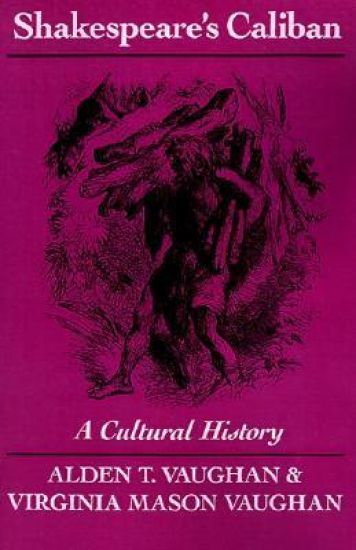
Among Shakespeare’s numerous stage characters, probably none has been so variously interpreted as the ‘savage and deformed slave’ Caliban in The Tempest. For nearly four centuries, widely diverse writers and artists from around the world have found the rebellious monster an intriguing and useful signifier. He has been portrayed in the theatre and in literary criticism as - among other things - a fish, a tortoise, the missing link, an American Indian, and an African slave. He has also appeared extensively and diversely in poems by Browning, Auden, and Brathwaite among others, and in illustrations by Hogarth, Fuseli, Walter Crane, and other major artists. In the twentieth century, he has been widely adopted as a cultural icon, especially in the Caribbean, Latin America, and Africa: first as a symbol of imperialist North Americans, more recently as an emblem of colonised native populations. Shakespeare’s Caliban looks first at the historical, etymological, literary, and folklore contexts in which Shakespeare created Caliban. The authors weigh the plausible intellectual influences of early Jacobean England and reach a tentative conclusion about what Shakespeare may have had in mind. The rest (and far larger part) of the book traces Caliban’s evolution from his first appearance in 1611 to the present, with chapters on the major artistic genres in which Caliban has been interpreted, appropriated, and adapted: criticism, stage, painting, poetry, film, and sociopolitical literature. Shakespeare’s Caliban relates the monster’s changing incarnations to the cultural and intellectual forces that allowed him to reflect major trends - including romanticism, Darwinism, the late nineteenth-century Anglo-American rapproachment, and the Third World liberation movements after World War II.