Kirjojen hintavertailu. Mukana 11 244 527 kirjaa ja 12 kauppaa.

Kirjahaku

Etsi kirjoja tekijän nimen, kirjan nimen tai ISBN:n perusteella.

1000 tulosta hakusanalla Vladimir N. Vapnik

Statistical Learning Theory

Statistical Learning Theory

Vladimir N. Vapnik

John Wiley Sons Inc
1998
sidottu
A comprehensive look at learning and generalization theory. The statistical theory of learning and generalization concerns the problem of choosing desired functions on the basis of empirical data. Highly applicable to a variety of computer science and robotics fields, this book offers lucid coverage of the theory as a whole. Presenting a method for determining the necessary and sufficient conditions for consistency of learning process, the author covers function estimates from small data pools, applying these estimations to real-life problems, and much more.
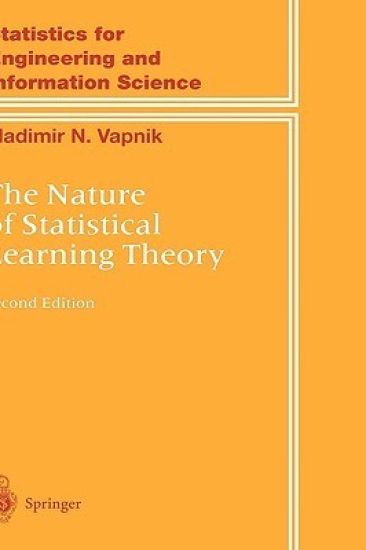
The Nature of Statistical Learning Theory

The Nature of Statistical Learning Theory

Vladimir Vapnik

Springer-Verlag New York Inc.
1999
sidottu
The aim of this book is to discuss the fundamental ideas which lie behind the statistical theory of learning and generalization. It considers learning as a general problem of function estimation based on empirical data. Omitting proofs and technical details, the author concentrates on discussing the main results of learning theory and their connections to fundamental problems in statistics. These include: * the setting of learning problems based on the model of minimizing the risk functional from empirical data * a comprehensive analysis of the empirical risk minimization principle including necessary and sufficient conditions for its consistency * non-asymptotic bounds for the risk achieved using the empirical risk minimization principle * principles for controlling the generalization ability of learning machines using small sample sizes based on these bounds * the Support Vector methods that control the generalization ability when estimating function using small sample size. The second edition of the book contains three new chapters devoted to further development of the learning theory and SVM techniques. These include: * the theory of direct method of learning based on solving multidimensional integral equations for density, conditional probability, and conditional density estimation * a new inductive principle of learning. Written in a readable and concise style, the book is intended for statisticians, mathematicians, physicists, and computer scientists. Vladimir N. Vapnik is Technology Leader AT&T Labs-Research and Professor of London University. He is one of the founders of
The Nature of Statistical Learning Theory

The Nature of Statistical Learning Theory

Vladimir Vapnik

Springer-Verlag New York Inc.
2010
nidottu
The aim of this book is to discuss the fundamental ideas which lie behind the statistical theory of learning and generalization. It considers learning as a general problem of function estimation based on empirical data. Omitting proofs and technical details, the author concentrates on discussing the main results of learning theory and their connections to fundamental problems in statistics. These include: * the setting of learning problems based on the model of minimizing the risk functional from empirical data * a comprehensive analysis of the empirical risk minimization principle including necessary and sufficient conditions for its consistency * non-asymptotic bounds for the risk achieved using the empirical risk minimization principle * principles for controlling the generalization ability of learning machines using small sample sizes based on these bounds * the Support Vector methods that control the generalization ability when estimating function using small sample size. The second edition of the book contains three new chapters devoted to further development of the learning theory and SVM techniques. These include: * the theory of direct method of learning based on solving multidimensional integral equations for density, conditional probability, and conditional density estimation * a new inductive principle of learning. Written in a readable and concise style, the book is intended for statisticians, mathematicians, physicists, and computer scientists. Vladimir N. Vapnik is Technology Leader AT&T Labs-Research and Professor of London University. He is one of the founders of
From Vladimir Lenin to Vladimir Putin

From Vladimir Lenin to Vladimir Putin

Vladimir N. Brovkin

TAYLOR FRANCIS LTD
2023
nidottu
This book integrates Soviet and post-Soviet Russian history into a coherent whole by focusing on the culture, role models, habits and behavior patterns that provide continuity between various political regimes, systems, and rulers from Vladimir Lenin to Vladimir Putin.The unifying theme of all these periods is the central question of identity – how the Russians have defined themselves, their country, and their values. Why did the Bolsheviks try to erase any trace of Old Russia and with what did they try to replace it? Why did Stalin wipe out the kulaks and the old Bolsheviks? What were the political consequences of the Great Patriotic War on the Russians as people? When post-Stalin Russia slowly weakened and gave way to the humanism and Westernization that led to the collapse of the Soviet system, why did the 1990s generate a resurgence of anti-western nationalism? And how to explain the slow and steady break with the West under President Putin?This will be a core textbook for undergraduate and graduate students of Russian and European history, and a valuable text for all those interested in how the Russian past influenced and shaped current politics, and in the international East–West divide in particular.For YouTube discussions of the book, see:https://www.youtube.com/watch?v=lvG1G1cax-k https://www.youtube.com/watch?v=0W3V6nb3h18&t=3s
From Vladimir Lenin to Vladimir Putin

From Vladimir Lenin to Vladimir Putin

Vladimir N. Brovkin

TAYLOR FRANCIS LTD
2023
sidottu
This book integrates Soviet and post-Soviet Russian history into a coherent whole by focusing on the culture, role models, habits and behavior patterns that provide continuity between various political regimes, systems, and rulers from Vladimir Lenin to Vladimir Putin.The unifying theme of all these periods is the central question of identity – how the Russians have defined themselves, their country, and their values. Why did the Bolsheviks try to erase any trace of Old Russia and with what did they try to replace it? Why did Stalin wipe out the kulaks and the old Bolsheviks? What were the political consequences of the Great Patriotic War on the Russians as people? When post-Stalin Russia slowly weakened and gave way to the humanism and Westernization that led to the collapse of the Soviet system, why did the 1990s generate a resurgence of anti-western nationalism? And how to explain the slow and steady break with the West under President Putin?This will be a core textbook for undergraduate and graduate students of Russian and European history, and a valuable text for all those interested in how the Russian past influenced and shaped current politics, and in the international East–West divide in particular.For YouTube discussions of the book, see:https://www.youtube.com/watch?v=lvG1G1cax-k https://www.youtube.com/watch?v=0W3V6nb3h18&t=3s
Magnetobiology

Magnetobiology

Vladimir N. Binhi

Academic Press Inc
2002
sidottu
People are immersed in electromagnetic fields from such sources as power lines, domestic appliances, mobile phones, and even electrical storms. All living beings sense electric fields, but the physical origins of the phenomenon are still unclear. Magnetobiology considers the effects of electromagnetic fields on living organisms. It provides a comprehensive review of relevant experimental data and theoretical concepts, and discusses all major modern hypotheses on the physical nature of magnetobiological effects. It also highlights some problems that have yet to be solved and points out new avenues for research. Why do some people feel unwell during a lightning storm? Why is there a correlation between the level of electromagnetic background and the incidence of cancer? Why do so many medical centers use electromagnetic exposures to treat a wide variety of disorders in humans? The international scientific community is extremely interested in a theory of magnetobiology and the answers to these and other questions, as evidenced by the growing number of research associations in the United States, Europe, and other parts of the world. The World Health Organization (WHO) has named electromagnetic contamination in occupational and residential areas as a stress factor for human beings. This book stands out among recent texts on magnetobiology because it draws on a strong foundation of empirical and theoretical evidence to explain the various effects of magnetic fields on the human body. It contains the first comprehensive collection of experimental data bearing physical information, frequency and amplitude/power spectra, and original research data on how electromagnetic fields interfere with ions and molecules inside the proteins of living organisms.
Combinatorial Methods in Discrete Mathematics

Combinatorial Methods in Discrete Mathematics

Vladimir N. Sachkov

Cambridge University Press
2011
pokkari
Originally published in 1996, this is a presentation of some complex problems of discrete mathematics in a simple and unified form using an original, general combinatorial scheme. The author's aim is not always to present the most general results, but rather to focus attention on ones that illustrate the methods described. A distinctive aspect of the book is the large number of asymptotic formulae derived. Professor Sachkov begins with a discussion of block designs and Latin squares before proceeding to treat transversals, devoting much attention to enumerative problems. The main role in these problems is played by generating functions, which are considered in Chapter 3. The general combinatorial scheme is then introduced and in the last chapter Polya's enumerative theory is discussed. This is an important book, describing many ideas not previously available in English; the author has taken the chance to update the text and references where appropriate.
Probabilistic Methods in Combinatorial Analysis

Probabilistic Methods in Combinatorial Analysis

Vladimir N. Sachkov

Cambridge University Press
1997
sidottu
This work explores the role of probabilistic methods for solving combinatorial problems. These methods not only provide the means of efficiently using such notions as characteristic and generating functions, the moment method and so on but also let us use the powerful technique of limit theorems. The basic objects under investigation are nonnegative matrices, partitions and mappings of finite sets, with special emphasis on permutations and graphs, and equivalence classes specified on sequences of finite length consisting of elements of partially ordered sets; these specify the probabilistic setting of Sachkov’s general combinatorial scheme. The author pays special attention to using probabilistic methods to obtain asymptotic formulae that are difficult to derive using combinatorial methods. This is an important book, describing many ideas not previously available in English; the author has taken the chance to rewrite parts of the text and refresh the references where appropriate.
Combinatorial Methods in Discrete Mathematics

Combinatorial Methods in Discrete Mathematics

Vladimir N. Sachkov

Cambridge University Press
1996
sidottu
This is a presentation of some complex problems of discrete mathematics in a simple and unified form using an original, general combinatorial scheme. The author’s aim is not always to present the most general results, but rather to focus attention on ones that illustrate the methods described. A distinctive aspect of the book is the large number of asymptotic formulae derived. Professor Sachkov begins with a discussion of block designs and Latin squares before proceeding to treat transversals, devoting much attention to enumerative problems. The main role in these problems is played by generating functions, which are considered in Chapter 3. The general combinatorial scheme is then introduced and in the last chapter Polya’s enumerative theory is discussed. This is an important book, describing many ideas not previously available in English; the author has taken the chance to update the text and references where appropriate.
Behind the Front Lines of the Civil War

Behind the Front Lines of the Civil War

Vladimir N. Brovkin

Princeton University Press
2015
pokkari
Countering the powerful myth that the civil war in Russia was largely between the "Whites" and the "Reds," Vladimir Brovkin views the struggle as a multifaceted social and political process. Brovkin focuses not so much on armies and governments as on the interaction of state institutions, political parties, and social movements on both Red and White territories. In the process, he exposes the weaknesses of the various warring factions in a Russia plagued by strikes, mutinies, desertion, and rebellions. The Whites benefited from popular resistance to the Reds, and the Reds, from resistance to the Whites. In Brovkin's view, neither regime enjoyed popular support. Pacification campaigns, mass shooting, deportations, artillery shelling of villages, and terror were the essence of the conflict, and when the Whites were defeated, the war against the Greens, the peasant rebels, went on. Drawing on a remarkable array of previously untapped sources, Brovkin convicts the early Bolsheviks of crimes similar to those later committed by Stalin. What emerges "behind the front lines" is a picture of how diverse forces--Cossacks, Ukrainians, Greens, Mensheviks, and SRs, as well as Whites and Bolsheviks--created the tragic victory of a party that had no majority support. This book has important contemporary implications as the world again asks an old question: Can Russian statehood prevail over local, regional, and national identities? Originally published in 1994. The Princeton Legacy Library uses the latest print-on-demand technology to again make available previously out-of-print books from the distinguished backlist of Princeton University Press. These editions preserve the original texts of these important books while presenting them in durable paperback and hardcover editions. The goal of the Princeton Legacy Library is to vastly increase access to the rich scholarly heritage found in the thousands of books published by Princeton University Press since its founding in 1905.
Behind the Front Lines of the Civil War

Behind the Front Lines of the Civil War

Vladimir N. Brovkin

Princeton University Press
2016
sidottu
Countering the powerful myth that the civil war in Russia was largely between the "Whites" and the "Reds," Vladimir Brovkin views the struggle as a multifaceted social and political process. Brovkin focuses not so much on armies and governments as on the interaction of state institutions, political parties, and social movements on both Red and White territories. In the process, he exposes the weaknesses of the various warring factions in a Russia plagued by strikes, mutinies, desertion, and rebellions. The Whites benefited from popular resistance to the Reds, and the Reds, from resistance to the Whites. In Brovkin's view, neither regime enjoyed popular support. Pacification campaigns, mass shooting, deportations, artillery shelling of villages, and terror were the essence of the conflict, and when the Whites were defeated, the war against the Greens, the peasant rebels, went on. Drawing on a remarkable array of previously untapped sources, Brovkin convicts the early Bolsheviks of crimes similar to those later committed by Stalin. What emerges "behind the front lines" is a picture of how diverse forces--Cossacks, Ukrainians, Greens, Mensheviks, and SRs, as well as Whites and Bolsheviks--created the tragic victory of a party that had no majority support. This book has important contemporary implications as the world again asks an old question: Can Russian statehood prevail over local, regional, and national identities? Originally published in 1994. The Princeton Legacy Library uses the latest print-on-demand technology to again make available previously out-of-print books from the distinguished backlist of Princeton University Press. These editions preserve the original texts of these important books while presenting them in durable paperback and hardcover editions. The goal of the Princeton Legacy Library is to vastly increase access to the rich scholarly heritage found in the thousands of books published by Princeton University Press since its founding in 1905.
Electrets In Engineering

Electrets In Engineering

Vladimir N. Kestelman; Leonid S. Pinchuk; Victor A. Goldade

Springer
2000
sidottu
Recently a new sphere in materials science· has formed which subject is structure and properties of electret materials used in engineering, medicine, biotechnology and other branches. It is characterized by specific methods of experimental investigations based on recording charge transfer, polarization and depolarization of dielectrics and involves original techniques and physico-mathematical aids where notions that exist at the interface of several natural and technical sciences are concentrated. It embraces a vast area of applications mainly in engineering, instrument­ making, electronics, medical technique, biotechnology, and etc., has a specialized technological base for electric polarization of dielectrics composed of uncommon technological methods, equipment and instrumentation. Apparently, future fundamental investigations in the domain of electret materials science are to be developed at the interface of computer of dielectrics. Elaboration of a simulation, physics and physical chemistry model for electric polarization of solid media with uneven charge density distribution, complicated by surface phenomena, outer electromagnetic, heat, chemical and other effects, presents a grave methodological problem. The simulation of structures in which polarization follows diffusion mechanism of chemically active molecules or their fragments, and the development of calculation methods for polarized charge relaxation and regularities of dielectric nonlinear properties, are the most urgent objectives of current research. Success in bioelectret effect studies is anticipated to result in profound widening of natural science knowledge.
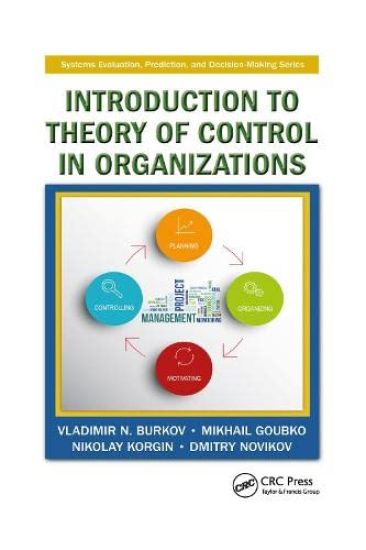
Introduction to Theory of Control in Organizations

Introduction to Theory of Control in Organizations

Vladimir N. Burkov; Mikhail Goubko; Nikolay Korgin; Dmitry Novikov

CRC Press
2019
nidottu
Introduction to Theory of Control in Organizations explains how methodologies from systems analysis and control theory, including game and graph theory, can be applied to improve organizational management. The theory presented extends the traditional approach to management science by introducing the optimization and game-theoretical tools required to account for the special nature of human beings being viewed as control objects.The book introduces a version of mechanism design that has been customized to solve the problems that today’s managers must contend with. All mathematical models and mechanisms studied are motivated by the most common problems encountered by managers in firms and non-profit organizations.Requiring no prior knowledge of game theory or mechanism design, the book includes a systematic introduction to the underlying methodology of modern theory of control in organizations. The authors use formal methods to construct robust and efficient decision-making procedures which support all aspects and stages of management activity over all decision horizons—from operational to strategic management.The mathematical and methodological backgrounds of the organizational mechanisms discussed are not limited to game theory but also include systems analysis, control theory, operations research, and discrete mathematics.The book includes a set of exercises in each chapter—from simple to advanced—that provide the reader with the understanding required to integrate advanced methods of optimization, game theory, and mechanism design into daily managerial practice.
Modern Biogeochemistry

Modern Biogeochemistry

Vladimir N. Bashkin

Springer-Verlag New York Inc.
2006
sidottu
At present, quantitative ecological risk assessment is widely used in different contexts, however very often without an understanding of the natural mechanisms that drive the processes of environmental and human risk. Its application is often accompanied by high uncertainty about risk values. On the other hand, the sustainability of modern technoecosystems is known because of their natural biogeochemical cycling that has been transformed to various extents by anthropogenic studies. Accordingly our understanding of the principal mechanisms that drive the biogeochemical food webs allows us to present a quantitative ecological risk assessment and to propose technological solutions for management of various ERA enterprises. It also enables us to devise a powerful mechanism for ecological insurance, to assign responsibilities and protect rights while managing the control of damage from natural and anthropogenic accidents and catastrophes.
Electrets In Engineering

Electrets In Engineering

Vladimir N. Kestelman; Leonid S. Pinchuk; Victor A. Goldade

Springer-Verlag New York Inc.
2014
nidottu
Recently a new sphere in materials science· has formed which subject is structure and properties of electret materials used in engineering, medicine, biotechnology and other branches. It is characterized by specific methods of experimental investigations based on recording charge transfer, polarization and depolarization of dielectrics and involves original techniques and physico-mathematical aids where notions that exist at the interface of several natural and technical sciences are concentrated. It embraces a vast area of applications mainly in engineering, instrument­ making, electronics, medical technique, biotechnology, and etc., has a specialized technological base for electric polarization of dielectrics composed of uncommon technological methods, equipment and instrumentation. Apparently, future fundamental investigations in the domain of electret materials science are to be developed at the interface of computer of dielectrics. Elaboration of a simulation, physics and physical chemistry model for electric polarization of solid media with uneven charge density distribution, complicated by surface phenomena, outer electromagnetic, heat, chemical and other effects, presents a grave methodological problem. The simulation of structures in which polarization follows diffusion mechanism of chemically active molecules or their fragments, and the development of calculation methods for polarized charge relaxation and regularities of dielectric nonlinear properties, are the most urgent objectives of current research. Success in bioelectret effect studies is anticipated to result in profound widening of natural science knowledge.
Introduction to Theory of Control in Organizations

Introduction to Theory of Control in Organizations

Vladimir N. Burkov; Mikhail Goubko; Nikolay Korgin; Dmitry Novikov

Productivity Press
2015
sidottu
Introduction to Theory of Control in Organizations explains how methodologies from systems analysis and control theory, including game and graph theory, can be applied to improve organizational management. The theory presented extends the traditional approach to management science by introducing the optimization and game-theoretical tools required to account for the special nature of human beings being viewed as control objects.The book introduces a version of mechanism design that has been customized to solve the problems that today’s managers must contend with. All mathematical models and mechanisms studied are motivated by the most common problems encountered by managers in firms and non-profit organizations.Requiring no prior knowledge of game theory or mechanism design, the book includes a systematic introduction to the underlying methodology of modern theory of control in organizations. The authors use formal methods to construct robust and efficient decision-making procedures which support all aspects and stages of management activity over all decision horizons—from operational to strategic management.The mathematical and methodological backgrounds of the organizational mechanisms discussed are not limited to game theory but also include systems analysis, control theory, operations research, and discrete mathematics.The book includes a set of exercises in each chapter—from simple to advanced—that provide the reader with the understanding required to integrate advanced methods of optimization, game theory, and mechanism design into daily managerial practice.
Geoecological Risk Management in Polar Areas

Geoecological Risk Management in Polar Areas

Vladimir N. Bashkin; Rauf V. Galiulin

Springer Nature Switzerland AG
2019
sidottu
This monograph is devoted to full-scale geoecological risk assessment in gas industry impacted polar areas and the relevant risk management options using innovative nature-like biogeochemical technologies. Readers will discover more about geoecological risks during gas production, transportation, storage and refining.Chapters discuss in detail the geodynamic dangers associated with the designing and building of main gas pipelines. The book has interdisciplinary appeal, and specialists and practitioners in environmental sciences, ecology, biogeochemistry and those within the energy sector who are interested in understanding ecosystems affected by anthropogenic impacts in severe climatic conditions will find it particularly engaging. Through this book, readers will learn more about recultivation of contaminated soils as well as health risk assessments of chemical substances associated with the gas industry.