

Kirjahaku
Etsi kirjoja tekijän nimen, kirjan nimen tai ISBN:n perusteella.
1000 tulosta hakusanalla W. Edward Makk

The Americanization of Edward Bok (1921) by: Edward W. Bok
Edward W. BOK
Createspace Independent Publishing Platform
2018
nidottu
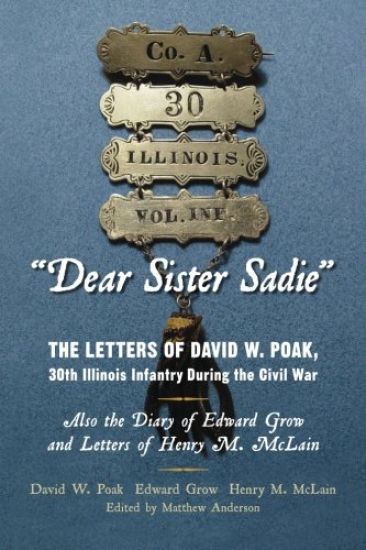
"Dear Sister Sadie" The Letters of David W. Poak, 30th Illinois Infantry During the Civil War: Also the Diary of Edward Grow and Letters of Henry M. M
David W. Poak Edward Gr Henry M. McLain
Createspace Independent Publishing Platform
2014
nidottu
The letters and diaries of three civil war soldiers from the 30th Illinois Infantry during the Civil War. These writings give insight to what a soldier that served with this regiment experienced from the letters they wrote home and the diaries that was written as a personal record of their experience. David W. Poak was well educated and quite literate, Edward Grow and even more so Henry McLain wrote the words as they sounded to them. I tried to keep their spelling and punctuation as close to their written text as possible so the reader can get a better feel for the soldier himself.This is a book for those who are familiar with the Civil War and are looking to expand their knowledge from the soldier's perspective."Sister Sadie" or "Dear Sister" was how David Watson Poak usually addressed his many letters to Sarah J. Poak during his Civil War service with Company A, 30th Illinois Infantry. D. W. Poak was born and raised in Mt. Jackson, Lawrence Co., Pennsylvania, which was a small farming community in the mid-nineteenth century. He and his sister Sadie were the only children born to John Poak and Sarah Duff Poak. Their mother died in 1847. and the father married Emeline McCurley and they had two daughters, Ella and Nancy. His sister Sadie was born in 1841, David was born 1842, Ella in 1854 and Nancy 1859. Sometime around 1858-9 David W. Poak moved to Millersburg, Mercer County, Illinois along with another dozen or so residents of Lawrence County, PA. Mercer County was a thriving area of Illinois at the time, and towns like Aledo, the county seat, Millersburg, Keithsburg, New Boston, Viola and others were growing In Millersburg his occupation was a teacher, and he did this until the call came for volunteers from the state of Illinois to suppress the rebellion. So on August 12, 1861 David W. Poak enlisted into Co. A, 30th Illinois Volunteer Infantry as a Sergeant. The enlistment record says Poak was twenty years old, five foot five and a quarter inches tall, fair complexion, blue eyes, and had sandy colored hair. During the conflict on January 33, 1863 he would rise to the rank of 1st Lieutenant. During the Battle of Atlanta on July 22nd, 1864 he became acting adjutant and received the Seventeenth Corp Silver Medal of Honor for bravery. After the war, David Poak returned to Millersburg, IL, then moved to the newly incorporated town of Pleasanton, Linn County, Kansas. There he became a school director on February 19, 1870 and was elected Pleasanton's first mayor on October 25th, 1870. In 1872 he is listed as cashier for the Fannin County Bank in Bonham, Fannin County, Texas. In the 1876-77 City Directory for Sherman, TX his occupation is listed as vice-president of the Bank of Sherman, Grayson Co., TX. Sometime afterwards he went back to his home in Mt. Jackson, PA. His obituary on page one of the New Castle Courant, dated April 4th, 1879, stated that David W. Poak died "last week" (March 27th, 1879) at his home of consumption and is buried at the Westfield Presbyterian Church Cemetery. As for his sister Sarah J Polk, she married James Hayes October 26th, 1893. She died in 1919 and is also buried at the Westfield Presbyterian Church Cemetery.
The blindman's world and other stories.By. Edward Bellamy and W.D. Howells
W. D. Howells; Edward Bellamy
Createspace Independent Publishing Platform
2016
nidottu
![Remains of W. R. Churton. [Edited by Edward Churton.]](/covers/9781241065355.jpg)
Remains of W. R. Churton. [Edited by Edward Churton.]
William Ralph Churton; Edward Churton
British Library, Historical Print Editions
2011
pokkari

Successward (1895) By Edward w. book (Classics)
Edward W. Book
Createspace Independent Publishing Platform
2016
nidottu

With the untimely death of Edward W. Said in 2003, various academic and public intellectuals worldwide have begun to reassess the writings of this powerful oppositional intellectual. Figures on the neoconservative right have already begun to discredit Said’s work as that of a subversive intent on slandering America’s benign global image and undermining its global authority. On the left, a significant number of oppositional intellectuals are eager to counter this neoconservative vilification, proffering a Said who, in marked opposition to the “anti-humanism” of the great poststructuralist thinkers who were his contemporaries--Jacques Derrida, Jean-Francois Lyotard, Jacques Lacan, Louis Althusser, and Michel Foucault--reaffirms humanism and thus rejects poststructuralist theory.In this provocative assessment of Edward Said’s lifework, William V. Spanos argues that Said’s lifelong anti-imperialist project is actually a fulfillment of the revolutionary possibilities of poststructuralist theory. Spanos examines Said, his legacy, and the various texts he wrote--including Orientalism,Culture and Imperialism, and Humanism and Democratic Criticism--that are now being considered for their lasting political impact.

With the untimely death of Edward W. Said in 2003, various academic and public intellectuals worldwide have begun to reassess the writings of this powerful oppositional intellectual. Figures on the neoconservative right have already begun to discredit Said’s work as that of a subversive intent on slandering America’s benign global image and undermining its global authority. On the left, a significant number of oppositional intellectuals are eager to counter this neoconservative vilification, proffering a Said who, in marked opposition to the “anti-humanism” of the great poststructuralist thinkers who were his contemporaries--Jacques Derrida, Jean-Francois Lyotard, Jacques Lacan, Louis Althusser, and Michel Foucault--reaffirms humanism and thus rejects poststructuralist theory.In this provocative assessment of Edward Said’s lifework, William V. Spanos argues that Said’s lifelong anti-imperialist project is actually a fulfillment of the revolutionary possibilities of poststructuralist theory. Spanos examines Said, his legacy, and the various texts he wrote--including Orientalism,Culture and Imperialism, and Humanism and Democratic Criticism--that are now being considered for their lasting political impact.

The Geocritical Legacies of Edward W. Said
Palgrave Macmillan
2015
sidottu
Edward W. Said is considered one of the most influential literary and postcolonial theorists in the world. Affirming Said's multifaceted and enormous critical impact, this collection features essays that highlight the significance of Said's work for contemporary spatial criticism, comparative literary studies, and the humanities in general.

The Geocritical Legacies of Edward W. Said
Palgrave Macmillan
2015
nidottu
Edward W. Said is considered one of the most influential literary and postcolonial theorists in the world. Affirming Said's multifaceted and enormous critical impact, this collection features essays that highlight the significance of Said's work for contemporary spatial criticism, comparative literary studies, and the humanities in general.

Edward Said has long been considered one of the world's most compelling public intellectuals, taking on a remarkable array of topics with his many publications. But no single book has encompassed the vast scope of his stimulating erudition quite like Power, Politics, and Culture. "A fascinating, oblique entry into the mind of one whose own writings . . . are a brilliant questioning chronicle of contemporary culture and values." --Nadine Gordimer In these twenty-eight interviews, Said addresses everything from Palestine to Pavarotti, from his nomadic upbringing under colonial rule to his politically active and often controversial adulthood, and reflects on Austen, Beckett, Conrad, Naipaul, Mahfouz, and Rushdie, as well as on fellow critics Bloom, Derrida, and Foucault. The passion Said feels for literature, music, history, and politics is powerfully conveyed in this indispensable complement to his prolific life's work.

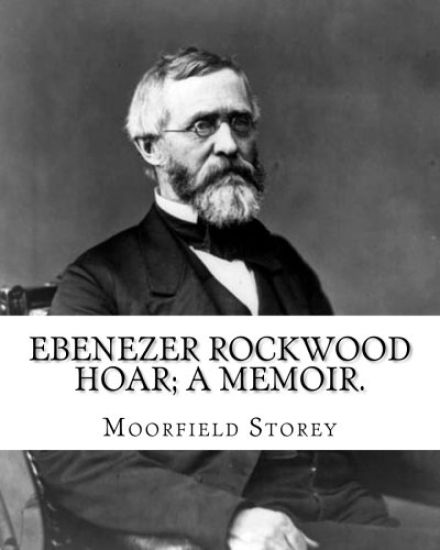
Ebenezer Rockwood Hoar; a memoir. By: Moorfield Storey and By: Edward W. Emerson: Hoar, E. R. (Ebenezer Rockwood), 1816-1895, United States -- Politic
Edward W. Emerson; Moorfield Storey
Createspace Independent Publishing Platform
2016
nidottu

Interviews with Edward W. Said
University Press of Mississippi
2004
nidottu
Edward W. Said has been a controversial and influential figure in and around the U.S. academy for well over three decades. His work has played a foundational role in the development of postcolonial studies, even as his books- such as Orientalism (1978), The World, the Text, and the Critic (1983), and Culture and Imperialism (1993)-have contributed to a radical transformation of literary studies. In Interviews with Edward W. Said, the first collection of interviews with this powerful intellectual, Said reveals the displacements and conflicts in his Palestinian background, and the energies and concerns that have made him a shaper of public discourse. Covering encounters from 1972 to 2000, the book provides, for both the specialist and the general reader, an engaging introduction to Said's wide and disparate oeuvre and his insights that have made a considerable impact on the practices of many disciplines, including literature, anthropology, political science, international studies, peace studies, history, sociology, and music. Since the late 1970s, through his literary writings, Said has established a reputation as a towering and paradoxical figure whose work has evolved theory, but who has, at the same time, challenged the damaging effect of various critical methods and schools on our ability to respond to the ""complex affiliations binding the texts to the world."" In the interviews gathered here, Said's formidable capacity as a public speaker is evidenced as he discusses the evolving issues that surround the still ambiguous political fortunes of his native Palestinians. Not only is Said a major public intellectual on the U.S. scene today, but also he has elaborated in his speeches, writings, and interviews on how one can be a responsible public person and what it means to be one. In almost all his interviews, Said's passion and occasional rage mark the probity and complexity of his positions on a variety of topics. In 1999, he told an interviewer that he was ""still a militant intellectual . . . my tongue is very sharp, and . . . I give and trade blows with people . . . who disagree with me, I mean that's part of the deal . . . ."" While in some interviews Said comes through as feisty and argumentative, in others his wit and urbanity allow for a charming persuasiveness. In a 1995 interview, Said stated: ""I am invariably criticized by younger post-colonialists . . . for being inconsistent and untheoretical, and I find that I like that. Who wants to be consistent?"" Delightful and edifying, this book will serve as a rich resource on Said's thoughtful personality and his often provocative views on both personal identity and historical experience. Amritjit Singh is a professor of English at Rhode Island College and co-editor of Postcolonial Theory and the United States, published by University Press of Mississippi in 2000. Bruce G. Johnson, a doctoral candidate at the University of Rhode Island, teaches courses in writing and African American studies at Rhode Island College.

Edward W. Blyden's Intellectual Transformations
Harry N. K. Odamtten
Michigan State University Press
2019
nidottu
Distinguished by its multidisciplinary dexterity, this book is a masterfully woven reinterpretation of the life, travels, and scholarship of Edward W. Blyden, arguably the most influential Black intellectual of the nineteenth and early twentieth centuries. It traces Blyden’s various moments of intellectual transformation through the multiple lenses of ethnicity, race, religion, and identity in the historical context of Atlantic exchanges, the Back-to-Africa movement, colonialism, and the global Black intellectual movement. In this book Blyden is shown as an African public intellectual who sought to reshape ideas about Africa circulating in the Atlantic world. The author also highlights Blyden’s contributions to different public spheres in Europe, in the Jewish Diaspora, in the Muslim and Christian world of West Africa, and among Blacks in the United States. Additionally, this book places Blyden at the pinnacle of Afropublicanism in order to emphasize his public intellectualism, his rootedness in the African historical experience, and the scholarship he produced about Africa and the African Diaspora. As Blyden is an important contributor to African studies, among other disciplines, this volume makes for critical scholarly reading.

William Beckford's "Vathek" and Edward W. Said's Concept of Orientalism
Anonym
Grin Publishing
2015
pokkari
