How social and economic conditions have precipitated advances in engineering. A Social History of Engineering shows how social and economic conditions in each age have precipitated advances in engineering. There are, in short, economic, political, and philosophical implications in changing technologies. While the book begins with the Stone Age, the Greeks, and the Romans, the bulk of the volume concentrates on the nineteenth and twentieth centuries. A Social History of Engineering reflects Professor Armytage's special subject area interests, namely nineteenth-century industrial society, radical and socialist movements, the history of professional organization, and the study of higher and technical education.
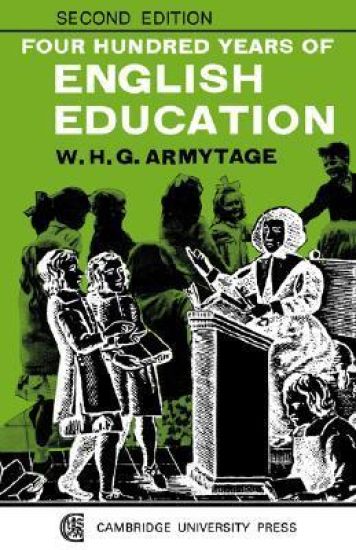
Professor Armytage's well-known book has become established as a very useful guide to the history of education in England. Not only does it provide a thorough and detailed account of the subject itself, but it also explains how education was shaped by the political, religious and economic background of the times. In this edition the final chapter has been extended and revised to take account of developments in education since the book first appeared.
This work has been selected by scholars as being culturally important and is part of the knowledge base of civilization as we know it.This work is in the public domain in the United States of America, and possibly other nations. Within the United States, you may freely copy and distribute this work, as no entity (individual or corporate) has a copyright on the body of the work.Scholars believe, and we concur, that this work is important enough to be preserved, reproduced, and made generally available to the public. To ensure a quality reading experience, this work has been proofread and republished using a format that seamlessly blends the original graphical elements with text in an easy-to-read typeface.We appreciate your support of the preservation process, and thank you for being an important part of keeping this knowledge alive and relevant.
First published in 1968, Yesterday’s Tomorrows elucidates on the favourite occupation of man: forecasting the future. By man’s predictions, he mirrors his own wish-fulfilments, displacements, projections, denials, evasions and withdrawals. These predications can take the form of countries of the imagination, ‘mirror worlds’ like Rabelais’ Ever-Ever lands or the Erewhon of Butler. Alternatively, they may spring from panic, reflecting fear rather than hope, often manifesting themselves, in our technological age, as reports of ‘flying saucers’ or invasions from another planet. In either form, they provide philosophers, scientists, doctors and sociologists with material for evaluating man’s future needs, offering both criticism of our present society, plans for our future, and release from tension and disequilibrium.Professor Armytage shows in this book how such ‘visions’ can, and do, refresh minds for renewed grappling with the present by arming them with ideas for man’s future needs. He indicates that, out of an apparent welter of futuristic fantasies, a constructive debate about tomorrow is emerging, providing us with operational models of what tomorrow could be. This book will hold special interest for students of philosophy and of English literature.
First published in 1968, Yesterday’s Tomorrows elucidates on the favourite occupation of man: forecasting the future. By man’s predictions, he mirrors his own wish-fulfilments, displacements, projections, denials, evasions and withdrawals. These predications can take the form of countries of the imagination, ‘mirror worlds’ like Rabelais’ Ever-Ever lands or the Erewhon of Butler. Alternatively, they may spring from panic, reflecting fear rather than hope, often manifesting themselves, in our technological age, as reports of ‘flying saucers’ or invasions from another planet. In either form, they provide philosophers, scientists, doctors and sociologists with material for evaluating man’s future needs, offering both criticism of our present society, plans for our future, and release from tension and disequilibrium.Professor Armytage shows in this book how such ‘visions’ can, and do, refresh minds for renewed grappling with the present by arming them with ideas for man’s future needs. He indicates that, out of an apparent welter of futuristic fantasies, a constructive debate about tomorrow is emerging, providing us with operational models of what tomorrow could be. This book will hold special interest for students of philosophy and of English literature.
Originally published in 1969. British merchants first penetrated to Moscow in the early 16th century. From that time until today developments in Russia have influenced Britain in innumerable ways - sometimes unexpectedly. In this volume Professor Armytage traces this influence, showing how Tolstoy, Kropotkin and others better known for their activities in fields other than education, have, in fact, had their effect on education in Britain. The lively account of the way in which these ideas have found their way into the British system shows that recent influences have been more direct. In particular the rapid development of higher technological education owes a great deal to the Russian example.
Originally published in 1969. British merchants first penetrated to Moscow in the early 16th century. From that time until today developments in Russia have influenced Britain in innumerable ways - sometimes unexpectedly. In this volume Professor Armytage traces this influence, showing how Tolstoy, Kropotkin and others better known for their activities in fields other than education, have, in fact, had their effect on education in Britain. The lively account of the way in which these ideas have found their way into the British system shows that recent influences have been more direct. In particular the rapid development of higher technological education owes a great deal to the Russian example.
First published in 2006. This book tells a number of plain tales of those who tried to save the English behind their collective backs under the term of Utopian Experiments in England between 1560 and 1960. It looks at the influences of the church to community experiments and groups, the ideas of Robert Owen, William Allen, George Mudie, Abraham Combe and more.
First published in 2006. The ambitious role cast for scientists in public affairs has been matched by an equal coyness on the part of scientists to play it. Yet in spite of themselves, they have been virtually dragged on to the political stage because of their 'collectivities' - groups formed over the last four centuries often more fugitive than institutional - which have helped modify the human environment, thereby enabling men to emancipate themselves from the tyranny of the present and plan for the future. The byproducts of such plans, from the great botanical gardens to the seed beds of physical scientists like the Ecole Polytechnique, have also incubated further ideas about the relation of science and society that are ecumenical in scope.Indeed the positivist overtones of the Polytechnique herald the transition from platocracy to technocracy, for the technical intelligentsia trained its German, Russian and American counterparts have effected a quasi-religious synthesis of physics and politics. In this 'planning' was the central theme. The social history of such planning (with the concomitant views on the social organisation of science) is the subject of the bookPressurising it is the conviction that we can identify a particular thing only by pointing to the various things it successively was before it became that particular thing that it will presently cease to be, and the story, which begins four hundred years ago and ends in 1964.
First published in 2006. This book tells a number of plain tales of those who tried to save the English behind their collective backs under the term of Utopian Experiments in England between 1560 and 1960. It looks at the influences of the church to community experiments and groups, the ideas of Robert Owen, William Allen, George Mudie, Abraham Combe and more.
First published in 2006. The ambitious role cast for scientists in public affairs has been matched by an equal coyness on the part of scientists to play it. Yet in spite of themselves, they have been virtually dragged on to the political stage because of their 'collectivities' - groups formed over the last four centuries often more fugitive than institutional - which have helped modify the human environment, thereby enabling men to emancipate themselves from the tyranny of the present and plan for the future. The byproducts of such plans, from the great botanical gardens to the seed beds of physical scientists like the Ecole Polytechnique, have also incubated further ideas about the relation of science and society that are ecumenical in scope. Indeed the positivist overtones of the Polytechnique herald the transition from platocracy to technocracy, for the technical intelligentsia trained its German, Russian and American counterparts have effected a quasi-religious synthesis of physics and politics. In this 'planning' was the central theme. The social history of such planning (with the concomitant views on the social organisation of science) is the subject of the bookPressurising it is the conviction that we can identify a particular thing only by pointing to the various things it successively was before it became that particular thing that it will presently cease to be, and the story, which begins four hundred years ago and ends in 1964.
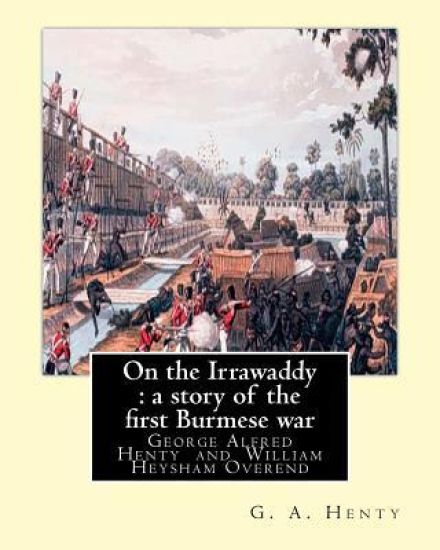
WILLIAM HEYSHAM OVEREND (1851-1898) William Heysham Overend was a painter and illustrator, specialising in naval and other marine subjects. Despite his short career, he was prolific and successful. William Heysham Overend was born on 5 October 1851 in Coatham, near Middlesborough, now in the county of North Yorkshire. He was the third son of James Overend, a flax spinner, and Martha n e Hodgson. When he was 10 years old, he and his family moved south to Hackney, London, where his father took up a position as a railway contractor. They later lived at Buccleuch Terrace, Clapton Common. Overend was educated as a dayboy at Charterhouse, in 1863, and then at Bruce Castle, a progressive school in Tottenham. Determined to become a painter, he studied for three years in the studio of the painter, Davis Cooper. Developing as a marine artist, he exhibited paintings mainly at the Royal Academy of Arts and the Royal Institute of Oil Painters (being elected a member of the latter in 1886). He also contributed to magazines, especially the Illustrated London News (1872-96), and illustrated books, most notably boys' stories, such as those by G A Henty. Having had various addresses through the 1870s, Overend is recorded in 1881 as living with his wife, Sofia, at a boarding house at 64 Guilford Street, Bloomsbury, and keeping a studio close by at 39a Queen Square. In 1882, Overend sailed to New York, in order to fulfil a commission to commemorate Admiral David Porter's naval conquest of New Orleans, during the American Civil War. The resulting painting proved a great success. He would also exhibit at the World's Columbian Exposition, held in Chicago in 1893. Overend died at home at 17 Southampton Street, Fitzroy Square, London, on 18 March 1898. George Alfred Henty (8 December 1832 - 16 November 1902) was a prolific English novelist and war correspondent.He is best known for his historical adventure stories that were popular in the late 19th century. His works include The Dragon & The Raven (1886), For The Temple (1888), Under Drake's Flag (1883) and In Freedom's Cause (1885).Biography--G.A.Henty was born in Trumpington, near Cambridge. He was a sickly child who had to spend long periods in bed. During his frequent illnesses he became an avid reader and developed a wide range of interests which he carried into adulthood. He attended Westminster School, London, and later Gonville and Caius College, Cambridge, where he was a keen sportsman. He left the university early without completing his degree to volunteer for the Army Hospital Commissariat when the Crimean War began. He was sent to the Crimea and while there he witnessed the appalling conditions under which the British soldier had to fight. His letters home were filled with vivid descriptions of what he saw. His father was impressed by his letters and sent them to The Morning Advertiser newspaper which printed them. This initial writing success was a factor in Henty's later decision to accept the offer to become a special correspondent, the early name for journalists now better known as war correspondents.....
With Cochrane the dauntless: a tale of the exploits of Lord Cochrane in South American waters, By: G. A. Henty and W. H. Margetson(illustrator).George Alfred Henty (8 December 1832 - 16 November 1902) was a prolific English novelist and war correspondent.He is best known for his historical adventure stories that were popular in the late 19th century. His works include The Dragon & The Raven (1886), For The Temple (1888), Under Drake's Flag (1883) and In Freedom's Cause (1885).Biography--G.A.Henty was born in Trumpington, near Cambridge. He was a sickly child who had to spend long periods in bed. During his frequent illnesses he became an avid reader and developed a wide range of interests which he carried into adulthood. He attended Westminster School, London, and later Gonville and Caius College, Cambridge, where he was a keen sportsman. He left the university early without completing his degree to volunteer for the Army Hospital Commissariat when the Crimean War began. He was sent to the Crimea and while there he witnessed the appalling conditions under which the British soldier had to fight. His letters home were filled with vivid descriptions of what he saw. His father was impressed by his letters and sent them to The Morning Advertiser newspaper which printed them. This initial writing success was a factor in Henty's later decision to accept the offer to become a special correspondent, the early name for journalists now better known as war correspondents. Shortly before resigning from the army as a captain in 1859 he married Elizabeth Finucane. The couple had four children. Elizabeth died in 1865 after a long illness and shortly after her death Henty began writing articles for the Standard newspaper. In 1866 the newspaper sent him as their special correspondent to report on the Austro-Italian War where he met Giuseppe Garibaldi. He went on to cover the 1868 British punitive expedition to Abyssinia, the Franco-Prussian War, the Ashanti War, the Carlist Rebellion in Spain and the Turco-Serbian War.He also witnessed the opening of the Suez Canal and travelled to Palestine, Russia and India. William Henry Margetson (Londen, 1860 - Wallingford, 2 januari 1940) was een Engels kunstschilder en illustrator, vooral bekend om zijn esthetische portretten van vrouwen.Leven en werk Margetson studeerde aan het Dulwich College, en vervolgens aan de South Kensington Schools en de Royal Academy Schools. In 1885 exposeerde hij ook voor het eerst bij de Royal Academy, en later ook bij de Royal Society of British Artists, het Royal Institute of Oil Painters en de Grosvenor Gallery. In 1909 werd hij lid van het Royal Institute. Margetson schilderde in olie en in waterverf. Hij maakte vooral naam als portrettist van mooie vrouwen, vaak met modern aandoende korte kapsels en hoeden. Ook maakte hij religieuze en allegorische werken. Aanvankelijk werkte bij in een academische, Victoriaans stijl. Later hanteerde hij een meer losse penseelvoering, beinvloed door het post-impressionisme en de prerafa lieten, meer in het bijzonder door Laurens Alma-Tadema. Zijn meest succesvolle werk is het klassiek-decoratieve The Sea Hath its Pearls, waarmee hij in 1897 exposeerde bij de Royal Academy, thans in het bezit van de 'Art Gallery of New South Wales', Australi . Een door Margetson geschilderd portret van Alfred Tennyson hangt in de National Portrait Gallery te Londen. Margetson werkte ook veel als boekillustrator. Hij was gehuwd met kunstenares Helen Hatton, die hij had leren kennen tijdens een gezamenlijke illustratieopdracht. Hij woonde en werkte eerst in Londen en later in Blewbury en Wallingford. Hij overleed in 1940, 79 jaar oud.