Kirjojen hintavertailu. Mukana 11 244 527 kirjaa ja 12 kauppaa.

Kirjahaku

Etsi kirjoja tekijän nimen, kirjan nimen tai ISBN:n perusteella.

1000 tulosta hakusanalla Wade H. Phillips

Quest to Restore God's House - A Theological History of the Church of God (Cleveland, Tennessee): Volume I, 1886-1923, R.G. Spurling to A.J. Tomlinson
In this first volume of a projected three-volume set, Bishop Wade H. Phillips offers the most comprehensive examination to date of the origins, early history, and theological development of the Church of God (Cleveland, TN). Meticulously researched, this work breaks new ground at nearly every turn. Offering the most extensive analysis of the ministry and thought of Richard Spurling, Phillips places Spurling's emerging thought and identity within the context of his theological influences. Along the way he demonstrates Spurling's indispensible role in the creation of the Church of God while identifying never before revealed details about his ministry, including the fact that he helped establish not one but at least four Christian Union congregations. Turning his attention to A.J. Tomlinson, Phillips offers what is clearly the most detailed examination to date of Tomlinson's life and ministry through 1923. Identifying his Quaker origins, Phillips traces and documents Frank Sandford's direct influence upon Tomlinson and the developing Church of God. Drawing on a vast array of resources, including thousands of pages of legal depositions and over one hundred photographs, Phillips carefully unravels the events that led to the disruption of 1923. Offering a sympathetic, though critical, analysis of Tomlinson's role in the rise of the Church of God, Phillips' study brings clarity to a number of ecclesiological dimensions of early Church of God thought. Phillips' work is destined to be the starting point for all future historiographies and theological analyses of the origins and early history of the Church of God.
Death Certificate - Most Sadistic Series on the Market

Death Certificate - Most Sadistic Series on the Market

Wade H Garrett

Independently Published
2019
pokkari
This is the sixth installment in the "A Glimpse into Hell" series. In this story, Seth is up to his usual antics, punishing the predators of society in the most sadistic way possible. The fate of Barry Muller is also at hand. A fate that is unforeseen and shocking. A fate that is worse than death itself. Death Certificate is packed with dark humor, sadistic torture, and nonstop acts of carnage.
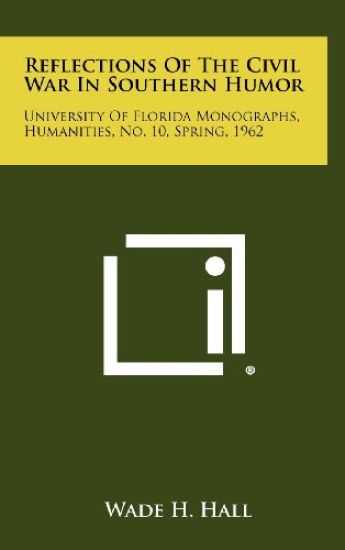
Reflections of the Civil War in Southern Humor: University of Florida Monographs, Humanities, No. 10, Spring, 1962
""Reflections of the Civil War in Southern Humor"" is a scholarly work by Wade H. Hall, published as part of the University of Florida Monographs series in the spring of 1962. The book explores the ways in which Southern humorists used their craft to reflect and comment on the Civil War and its aftermath. Hall examines the work of several well-known Southern humorists, including Mark Twain, William Faulkner, and Eudora Welty, as well as lesser-known writers like George Washington Harris and Johnson Jones Hooper. Through close analysis of their stories, essays, and sketches, Hall shows how these writers used humor to explore themes such as race, class, and the meaning of Southern identity in the wake of the war. The book is a valuable resource for anyone interested in Southern literature, American humor, or the cultural impact of the Civil War.This scarce antiquarian book is a facsimile reprint of the old original and may contain some imperfections such as library marks and notations. Because we believe this work is culturally important, we have made it available as part of our commitment for protecting, preserving, and promoting the world's literature in affordable, high quality, modern editions, that are true to their original work.
Report Cards

Report Cards

Wade H. Morris

Johns Hopkins University Press
2023
sidottu
The definitive history of the report card.Report cards represent more than just an account of academic standing and attendance. The report card also serves as a tool of control and as a microcosm for the shifting power dynamics among teachers, parents, school administrators, and students. In Report Cards: A Cultural History, Wade H. Morris tells the story of American education by examining the history of this unique element of student life. In the nearly two hundred-year evolution of the report card, this relic of academic bookkeeping reflected broader trends in the United States: the republican zealotry and religious fervor of the antebellum period, the failed promises of postwar Reconstruction for the formerly enslaved, the changing gender roles in newly urbanized cities, the overreach of the Progressive child-saving movement in the early twentieth century, and—by the 1930s—the increasing faith in an academic meritocracy. The use of report cards expanded with the growth of school bureaucracies, becoming a tool through which administrators could surveil both student activity and teachers. And by the late twentieth century, even the most radical critics of numerical reporting of children have had to compromise their ideals.Morris traces the evolution of how teachers, students, parents, and administrators have historically responded to report cards. From a western New York classroom teacher in the 1830s and a Georgia student in the 1870s who was born enslaved, to a Colorado student incarcerated in the early 1900s and the son of Russian-Jewish immigrants applying to college in the 1930s, Report Cards describes how generations of people have struggled to maintain dignity within a system that reduces children to numbers on slips of paper.