Kirjahaku
Etsi kirjoja tekijän nimen, kirjan nimen tai ISBN:n perusteella.
1000 tulosta hakusanalla Walter C Kennedy


Walter Charles Mycroft (1890-1959) was the film critic of the Evening Standard from 1922-1927, and also a founding member of London's Film Society. In 1928, he was appointed Head of the Scenario Department—and then Director of Production—at British International Pictures (later Associated British Pictures). In 1941 Mycroft was sacked following the death of the company's Managing Director and the requisition of Elstree studios by the British Government for war purposes. After that his career went into steady decline, although after the Second World War he worked for nearly a decade as Scenario Adviser to Robert Clark, who ran the rebuilt Elstree studios. This long-lost memoir, which Mycroft wrote mainly in the 1940s, offers a detailed account of the vagaries and complex economic vicissitudes of British film production in the 1930s. Mycroft also recalls how he selected film stories for directors Harry Lachman, E. A. Dupont and Alfred Hitchcock, and he reveals, for the first time, the true story behind Hitchcock's departure from British International Pictures. Mycroft also provides incisive portraits of British film industry captains: the charismatic Alexander Korda, C. M. Woolf, the rising J. Arthur Rank, and above all John Maxwell, the shrewd iconoclastic Scots lawyer who built Associated British into the largest and most financially successful film corporation in pre-war Britain. The memoirs conclude with the death of Maxwell and Mycroft's fall from grace at Elstree. The volume is supplemented by four appendixes consisting of Mycroft's earlier writings on the aesthetics and business of film production, along with a filmography of over 200 films on which he worked. This memoir provides both scholars and the general reader with new and fascinating insights into the worlds of British journalism during the first two decades of the twentieth century and of British film production during the 1930s. Walter Mycroft: The Time of My Life will be of interest not only to scholars of British journalism a

Walter C. Woodward: Friend on the Frontier, a Biography
Elizabeth H. Emerson; Errol T. Elliott
Literary Licensing, LLC
2011
nidottu


What's Making Walter C. Laugh? is a whimsical story. Each page will bring giggles to children and adults as they wonder What is Making Walter C. Laugh? Is it a goldfish dancing with a banana on the kitchen table? Is it a snowman eating pizza in the bathtub? Or is it ... Have fun figuring it out!
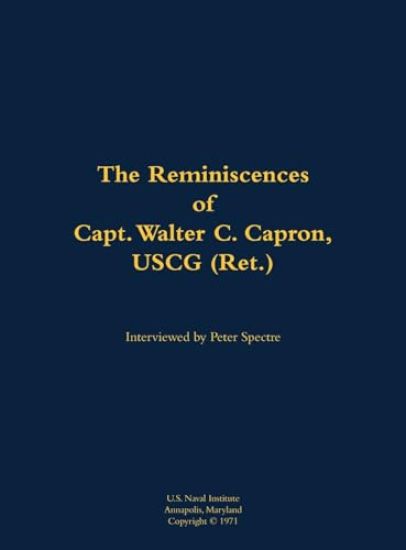
The Reminiscences of Capt. Walter C. Capron, USCG (Ret.)
Naval Institute Press
2017
sidottu
Following commissioning from Coast Guard Academy in 1928, served in the USCGD Conyngham (CG-2), USCGC Seneca (CG-17), and Calypso (WPC-104). In 1941 assigned to staff of Transports Commander, Atlantic Fleet and served aboard the transportsUSS Barnett (APA-5), McCawley (APA-4) Henry Lee (APA-10), Mount Vernon (AP-22), and Leonard Wood (APA-12). After U.S. entered World War II, was assigned to staff of Army Engineer Amphibian Command where he commanded CG detachment and directed Army's first school for instructing troops in beach landing craft operations. Also conducted training in beach landings for Amphibious Force, Atlantic. In 1943 served in Spencer on convoy operations between U.S. and Mediterranean, and Caribbean ports. Further duties at 12th Coast Guard District and Deputy Chief of Staff, USCG Headquarters.
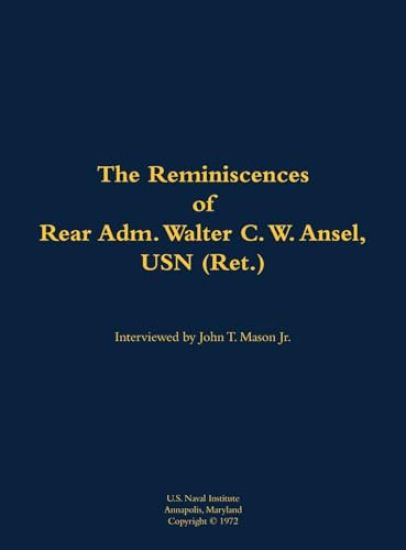
The Reminiscences of Rear Adm. Walter C. W. Ansel, USN (Ret.)
Naval Institute Press
2016
sidottu
A 1918 graduate of the Naval Academy, Admiral Ansel served on convoy escort duty in the closing months of World War I. He had a variety of duties in the interwar years, including study of amphibious warfare, service on board the cruiser USS Milwaukee (CL-5) and at the Naval Academy, and command of the destroyer USS Bulmer (DD-222) and Destroyer Division 14. During a tour in the War Plans Division of OpNav just prior to World War II, Ansel observed the poor state of U.S. Navy war planning. He was first CO of the oiler USS Winooski (AO-38), then had staff duty for the planning of the invasions of North Africa, Sicily, and Southern France. In 1944-45, he commanded the light cruiser USS Philadelphia (CL-41), including support duty in the Mediterranean. After postwar staff duty in the support force off Japan, he was on a SecNav Board and then served 1947-49 as subchief of the U.S. naval mission to Brazil. Rear Admiral Ansel retired in 1949.
Dickens, Reade, and Collins Sensation Novelists
Walter C. Phillips
Columbia University Press
2022
sidottu

Although they came from distinct polities and peoples who spoke different languages, slaves from the African Gold Coast were collectively identified by Europeans as "Coromantee" or "Mina." Why these ethnic labels were embraced and how they were utilized by enslaved Africans to develop new group identities is the subject of Walter C. Rucker's absorbing study. Rucker examines the social and political factors that contributed to the creation of New World ethnic identities and assesses the ways displaced Gold Coast Africans used familiar ideas about power as a means of understanding, defining, and resisting oppression. He explains how performing Coromantee and Mina identity involved a common set of concerns and the creation of the ideological weapons necessary to resist the slavocracy. These weapons included obeah powders, charms, and potions; the evolution of "peasant" consciousness and the ennoblement of common people; increasingly aggressive displays of masculinity; and the empowerment of women as leaders, spiritualists, and warriors, all of which marked sharp breaks or reformulations of patterns in their Gold Coast past.
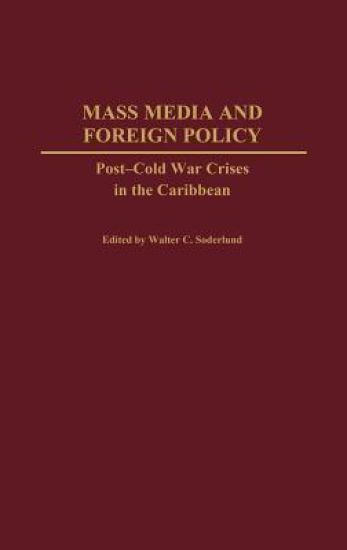
The terrorist attacks on the United States that occurred on September 11 marked the end of an historical era known as the post-Cold War period. During this time, the U.S. government produced no clear media guidelines for dealing with world crises, and media coverage increasingly came to be focused on domestic conflicts rather than international ones. In the absence of a clearly defined threat, no dominant media frame replaced the time-worn Cold War in media reporting. Mass media has been recognized as an important intermediary between the government and the population. In this context, this study examines network coverage of seven post-Cold War crises, ranging from Cuba to Mexico, occurring in the Caribbean Basin between 1990 and 1996 to evaluate the framing of these events by the various media covering them.In providing context for understanding these crises, this examination reviews U.S. policy in each case and discovers a strong correlation between the level of U.S. involvement in the crisis and the amount of media attention generated. By appearing on the news or not, the president along with key Cabinet members were able to define whether an event constituted a crisis for the United States. In instances where the media received little guidance from Washington officials on the implications for the United States, the media did attempt to provide explanations of events, however, coverage tended to be minimal. Case studies include the recording and coding of language used as positive, negative, and neutral/ambiguous.

Old Testament texts that point to the coming of the Messiah are traditionally interpreted either from the viewpoint of their New Testament fulfillment (evangelicalism) or their linguistic and grammatical distinctiveness within the Hebrew Bible (non-conservative). The Messiah in the Old Testament considers another important line of interpretation that has been neglected in building an Old Testament theology. It approaches Israel's concept of the Messiah as a developing theme and shows how a proper grasp of the textual meaning at each stage of Old Testament revelation is necessary for understanding messianic prophecy. Beginning in the Pentateuch and working through the Old Testament to the Minor Prophets, the author delineates texts that are direct messianic prophecies and examines their meaning and development within the flow of God's plan. The reader will gain an understanding of God's process for bringing the Messiah to earth through the nation of Israel, and of his intent to bring the saving knowledge of Christ to the World through them.
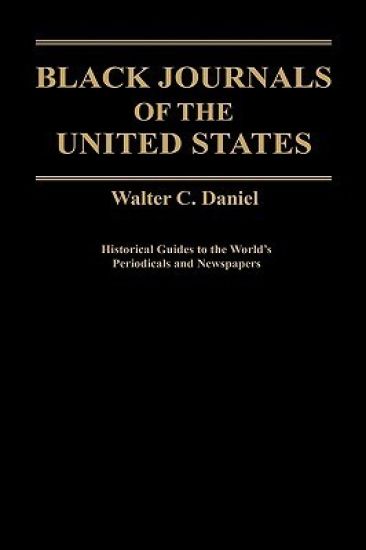
Product information not available.

Two basic processes—industrialization and the emergence of the nation-state—have marked the evolution of many modern societies, particularly in Western Europe. Industrialization broadened the class structure of societies. With the new classes came demands for political power and influence, demands that were vigorously resisted by the ruling monarchies and landowning aristocracies. And with these demands came upheaval and, eventually, new forms of democratic social and political organization. In Portugal’s transition from absolutist monarchy to pluralist democracy can be found an example of these transformative processes at work. Yet the experience of this nation has been largely neglected in discussions of Western European politics. With Portugal: From Monarchy to Pluralist Democracy, Walter C. Opello, Jr., brings the transformation of Portugal into sharp focus and, in doing so, offers interesting insights into the problems of forming a democratic regime. This profile traces Portugal’s transition to democracy within the broader context of its historical development as a nation-state, documenting the effects of absolutism, imperialism, centralization, class and regional cleavages, and late industrialization on the Portuguese people, their polity, economy, and society. Exploring the themes that have shaped the development of Portugal’s democratic structures, Professor Opello also assesses the future viability of these structures in light of the country’s nondemocratic legacies.
Portugal's early developmental experience created a highly centralized administrative state that continues to have a powerful influence on the nature and style of the country's government and politics. Emphasizing this theme, Dr. Opello shows that, contrary to the conclusions of scholars who have analyzed Portugal from Latin American or Third World perspectives, Portuguese political development is more comparable to the pattern of development of West European countries, especially France. He compares Portugal's political experience with that of other West European countries and concludes by speculating about the future of Portugal's fledgling democracy.

Two basic processes—industrialization and the emergence of the nation-state—have marked the evolution of many modern societies, particularly in Western Europe. Industrialization broadened the class structure of societies. With the new classes came demands for political power and influence, demands that were vigorously resisted by the ruling monarchies and landowning aristocracies. And with these demands came upheaval and, eventually, new forms of democratic social and political organization. In Portugal’s transition from absolutist monarchy to pluralist democracy can be found an example of these transformative processes at work. Yet the experience of this nation has been largely neglected in discussions of Western European politics. With Portugal: From Monarchy to Pluralist Democracy, Walter C. Opello, Jr., brings the transformation of Portugal into sharp focus and, in doing so, offers interesting insights into the problems of forming a democratic regime. This profile traces Portugal’s transition to democracy within the broader context of its historical development as a nation-state, documenting the effects of absolutism, imperialism, centralization, class and regional cleavages, and late industrialization on the Portuguese people, their polity, economy, and society. Exploring the themes that have shaped the development of Portugal’s democratic structures, Professor Opello also assesses the future viability of these structures in light of the country’s nondemocratic legacies.
Portugal's early developmental experience created a highly centralized administrative state that continues to have a powerful influence on the nature and style of the country's government and politics. Emphasizing this theme, Dr. Opello shows that, contrary to the conclusions of scholars who have analyzed Portugal from Latin American or Third World perspectives, Portuguese political development is more comparable to the pattern of development of West European countries, especially France. He compares Portugal's political experience with that of other West European countries and concludes by speculating about the future of Portugal's fledgling democracy.